Supreme Court Lets Trump Get Closer to Ending Birthright Citizenship
The Supreme Court has agreed to hear arguments in the attack on the constitutional right.

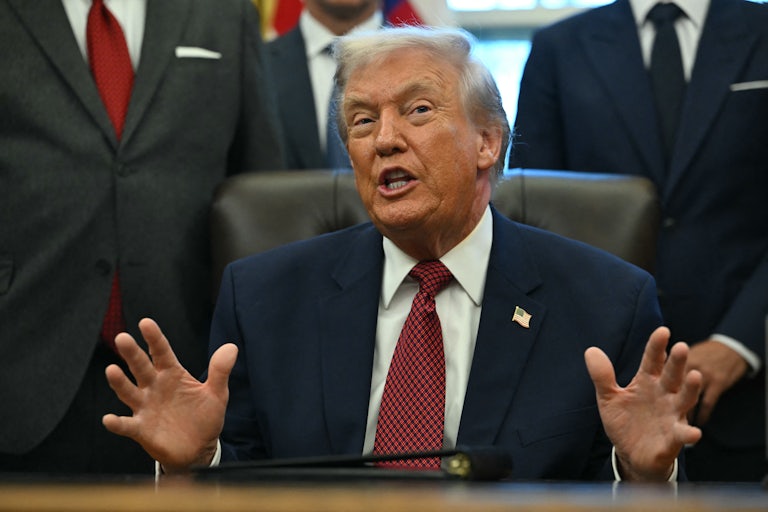
The Supreme Court agreed Friday to hear arguments over the legality of Donald Trump’s plan to end birthright citizenship, the 1868 constitutional detail that entitles any person born on U.S. soil to an American passport.
In doing so, the nation’s highest judiciary has set the stage for a decision, expected by the end of June, that could undermine the Fourteenth Amendment. That amendment guarantees citizenship to everyone born or naturalized on U.S. soil.
Trump attempted to end the constitutionally enshrined right mere hours after he was sworn into office in January by signing an executive order stating that children born to immigrants on temporary visas or who are in the country illegally should not be entitled to birthright status. That order was blocked by multiple judges in multiple court circuits over the last year.
In the case the Supreme Court has agreed to hear, which stems from qualms in New Hampshire, the Trump administration argues that language included in the amendment—specifically, “subject to the jurisdiction of”—requires applicable children to not only be present in the country at the time of the birth but also to confer their allegiance to the United States. Exactly how newborn babies would be expected to do so, however, is not clear.
“Long after the Clause’s adoption, the mistaken view that birth on U.S. territory confers citizenship on anyone subject to the regulatory reach of U.S. law became pervasive, with destructive consequences,” Solicitor General D. John Sauer wrote in legal arguments on behalf of the administration.
Sauer added that the intent of Trump’s executive order is to “restore the Clause’s original meaning.”
It’s not the first time this year that the Supreme Court has heard arguments on the topic.
In May, justices on both ideological sides of the court flamed the Trump administration’s efforts to rewrite birthright citizenship through America’s courts, questioning why the government’s attorneys would even bring the case to the judiciary’s doorstep when “every court has ruled against” the administration on birthright citizenship.
At the time, Justice Brett Kavanaugh pressed Sauer into a corner, forcing the solicitor general to admit that the Trump administration doesn’t even know how it would enforce its birthright citizenship order. Sauer managed to appall another Trump appointee—Justice Amy Coney Barrett—by arguing that Trump has the “right” to disregard legal opinions that he doesn’t personally agree with.