Breaking News
Breaking News
from Washington and beyond

Trump’s DOJ Quietly Changes Crucial Detail in Charges Against Maduro

The Venezuelan president originally was charged with running a drug cartel.

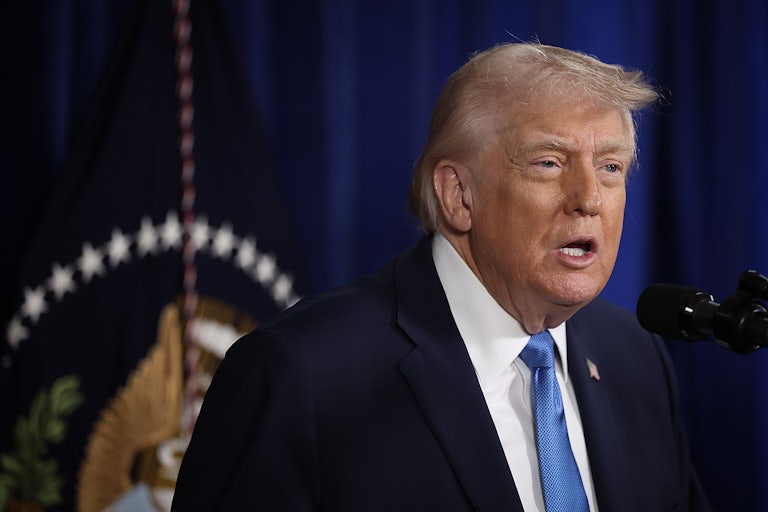
Donald Trump stands at a podium
Tasos Katopodis/Getty Images

President Donald Trump’s Department of Justice quietly removed references to a fictional drug cartel led by Nicolás Maduro from its newest indictment of the kidnapped Venezuelan president.

The New York Times reported Monday that the new indictment of Maduro and others on charges related to drug trafficking omitted a crucial element of the original charges: the criminal organization that Maduro supposedly ran, Cartel de los Soles.

The original indictment filed against Maduro in March 2020 in the Southern District of New York described the Cartel de los Soles as a “drug trafficking organization comprised of high-ranking officials” that operated between 1999 and 2020.

“Under the leadership of Maduro Moros and others, the Cartel de Los Soles sought not only to enrich its members and enhance their power, but also to ‘flood’ the United States with cocaine,” the indictment said.

But apparently, Cartel de los Soles isn’t a real organization at all. It’s a slang term invented by the Venezuelan media to describe corruption, according to the Times. The supposed cartel’s inclusion in the original indictment would be as if someone tried Trump for leading “Trumpworld” as a criminal organization.

The original indictment mentions the cartel 32 times, while the new one only mentions it twice, this time describing Cartel de los Soles as a “patronage system run by those at the top.”

The fabrication of Cartel de los Soles must be a relatively new revelation for the Trump administration. In November, the U.S. State Department designated Cartel de los Soles as a terrorist organization led by Maduro.

The new indictment adds to the original by including additional charges of “narco-terrorism,” conspiracy to import cocaine, and gun charges, as well as charges against Maduro’s wife for allegedly accepting bribes to broker trafficking meetings.
Woman Arrested on Camera for Protesting Trump’s Invasion of Venezuela

In a chilling video, officers handcuff a protest leader and lead her to a van.

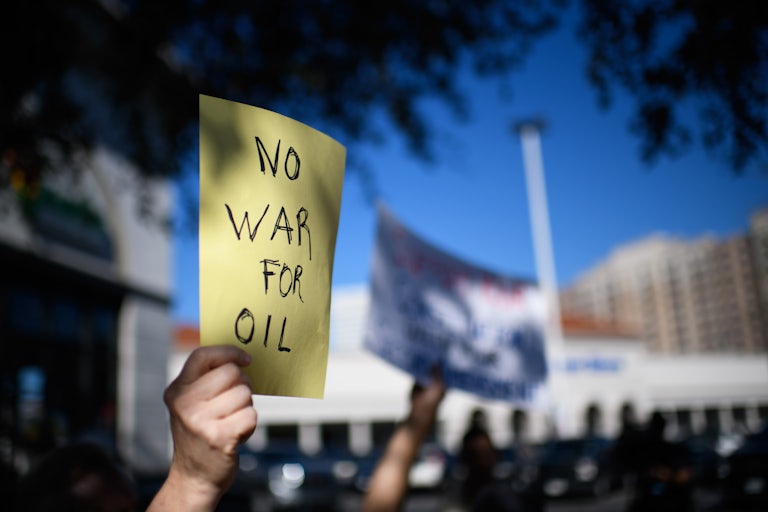
A protester holds up a sign that says, "No war for oil"
Mark Felix/Bloomberg/Getty Images
A protest in Houston

A woman was arrested live on camera in Grand Rapids, Michigan, while talking to a local newscast about protesting the U.S. government’s sudden takeover of Venezuela.

Jessica Plichta helped Grand Rapids Opponents of War organize the turnout Saturday, which inspired dozens of locals to march through snowy city streets. But in a bizarre turn of events, Plichta’s decision to exercise her First Amendment rights ended when local authorities handcuffed her on the sidewalk while she was live on air.

“We have to apply pressure at all points that we can, this is not just a foreign issue,” Plichta said before she was arrested. “It’s our tax dollars that are also being used to commit these war crimes.”

She was reportedly arrested for obstructing a roadway and failure to obey a lawful command from an officer, according to 13 ON YOUR SIDE.

What in the Gestapo is going on in Grand Rapids? Watch this activist get arrested *mid-interview* for speaking out against U.S. action in Venezuela.

[image or embed]

— Brandon Friedman (@brandonfriedman.bsky.social) January 5, 2026 at 11:12 AM

Plichta had visited Venezuela just three weeks before the Trump administration kidnapped the Latin American nation’s leader, Nicolás Maduro. While there, she attended an international summit, the People’s Assembly for Peace and Sovereignty of Our America, during which she said she saw Maduro “in person.”

“People loved him,” Plichta told the ABC News affiliate before her arrest. “Maduro was elected by the people. He is for the people, and the people want to see his return. Free Maduro.”

U.S. forces invaded Venezuela early Saturday, bombing its capital Caracas as nearly 200 American troops infiltrated the city to capture Maduro. Trump failed to notify Congress before the invasion but didn’t forget to tip off his friends at America’s biggest oil companies, which stand to gain the most from the America’s newfound control over Venezuela’s oil supply—the largest in the world.

The invasion followed months of escalating rhetoric between the White House and Venezuela’s leadership, which saw the Trump administration repeatedly pin U.S. fentanyl deaths on Venezuelan drug cartels despite a resounding lack of evidence.

Trump to Cut Off Funding to Minnesota and Four Other Blue States

Donald Trump is taking revenge on blue states that didn’t vote for him.

Donald Trump speaks
Joe Raedle/Getty Images

The Trump administration is cutting off $10 billion in funding for social services like childcare and aid for poor families in five deep blue states. 

The New York Post reported Monday that the Department of Health and Human Services will freeze funding for California, Colorado, Illinois, Minnesota, and New York. The freeze will affect $7.35 billion from the Temporary Assistance for Needy Families, or TANF, program, which gives cash assistance to very poor people. The administration is also blocking $2.4 billion in Child Care Development Funding and  another $869 million from the Social Services Block Grant for all five states, citing benefits going to immigrants. 

An official from the Office of Management and Budget later confirmed the news to Axios, though all states don’t appear to have yet been notified.

The move appears to be a reaction to Minnesota’s Somali day-care scandal, which the right has latched onto.  

Regardless of the justification, this is likely just another instance of Trump going out of his way to spite American citizens, many of whom voted for him, living in states that didn’t. 

Lindsey Graham Salivates Over Trump’s Potential Next Targets

The neocon senator can’t wait for the U.S. to invade more countries.

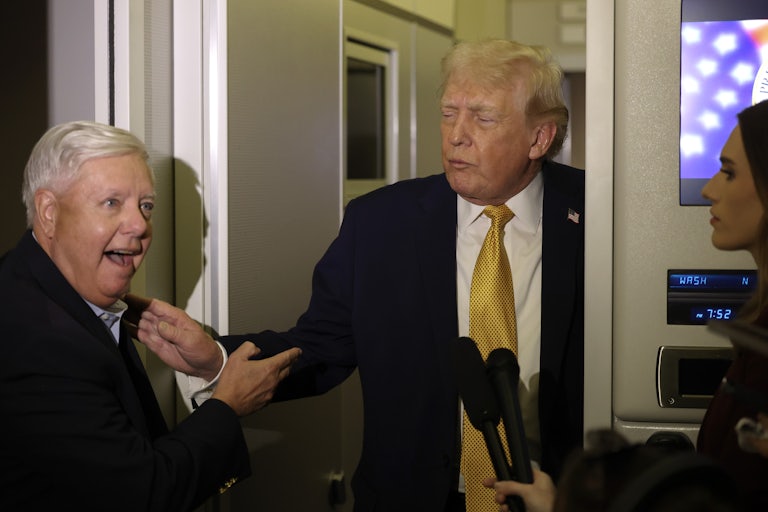
Lindsey Graham and Donald Trump aboard Air Force one
Joe Raedle/Getty Images

President Trump’s recent imperialistic escalations and threats have neocons like Republican Senator Lindsey Graham practically drooling.

After the “America First” president kidnapped Venezuelan President Nicolás Maduro, killing about 80 people in airstrikes in the process, he turned his ire to some of neocon America’s longtime targets: Cuba and Iran.

“One of the things that is happening … Cuba is ready to fall,” Trump said inside Air Force One on Sunday, standing snugly in a corner alongside Graham and Commerce Secretary Howard Lutnick

“Yes!” Graham interjected, his eyes and smile lighting up as he became visibly excited.

Graham also put his own two cents in.

“You just wait for Cuba. Cuba is a Communist dictatorship that’s killed priests and nuns, they preyed on their own people,” Graham said. “Their days are numbered.”

“Having Trump stand on his plane threatening more regime-change operations, including one of the neocons’ decade-long crown jewel in Cuba, while Lindsey Graham stands next to him twitching in glee and ecstasy—is the perfect illustration of MAGA foreign policy,” journalist Glenn Greenwald chimed.

Graham tripled down later Monday on Fox News.

“Donald Trump will have done something that’s eluded America since the fifties: deal with the Communist dictatorship 90 miles off the coast of Florida. I can’t wait till that day comes. To our Cuban friends in Florida … the liberation of your homeland is close.”

“Trump used to mock @GrahamBlog for being a bloodthirsty neocon warmonger (and stupid!),” podcaster Tommy Vietor wrote on X. “Now he’s adopting Graham’s foreign policy.”

Graham also blew smoke at Iran during his Fox News appearance.

“Unlike Obama, President Trump has not turned his back on the people of Iran. So I pray and hope that 2026 will be the year that we make Iran great again,” he said, donning a black hat with that slogan on it.

Trump Wants Stephen Miller to Have a Terrifying New Role in Venezuela

Apparently Secretary of State Marco Rubio is too busy.

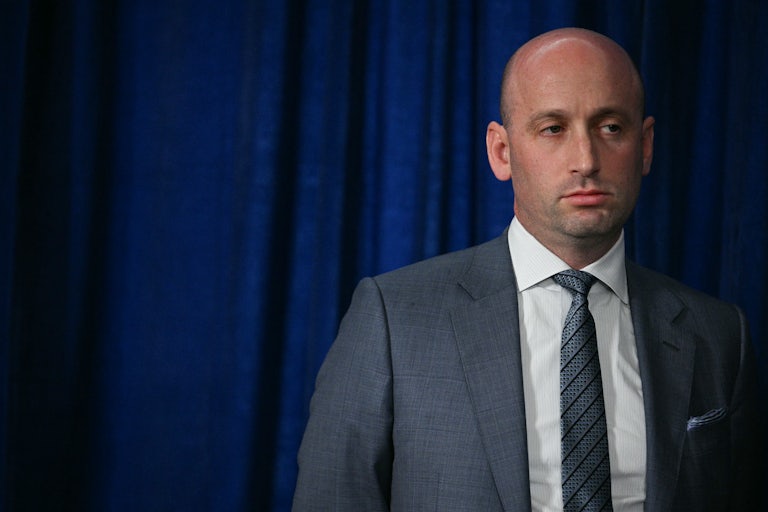
Deputy White House Chief of Staff Stephen Miller stands during a Donald Trump speech
Jim WATSON/AFP/Getty Images

The White House’s succession plan for Venezuela could see Stephen Miller deciding the country’s future.

Donald Trump is reportedly “weighing” whether to tap the notoriously anti-immigrant deputy chief of staff to oversee Venezuela in the coming months, according to at least one insider that spoke with The Washington Post.

Miller played a central role in U.S. efforts to oust Venezuela’s leader Nicolás Maduro. That plan came to a head late Friday, when U.S. military forces successfully captured Maduro, hauling him back to Manhattan on narco-terrorism charges.

Maduro’s Vice President Delcy Rodríguez has since been recognized by Venezuela’s armed forces as its interim leader, taking control as acting president in Maduro’s absence. She swore in on Monday.

In the meantime, Trump has seized the country’s oil reserves—the largest in the world—and told reporters he intends to “run” Venezuela.

That decision, in turn, could hand Miller outsize influence regarding the future of the country. Miller might be tasked with the day-to-day, nitty-gritty responsibilities of supervising the regime change under the office of Secretary of State Marco Rubio.

Rubio, a longtime Venezuela hawk, would be the more obvious choice to oversee the regime change—but his schedule is, unfortunately, already backed up. The Trump administration has tapped Rubio to serve not only as secretary of state but also as its national security adviser since Trump’s last pick—Mike Waltz—accidentally admitted journalists into a classified Signal group chat discussing an imminent bombing in Yemen.

Miller would not come without his own policy experience, however. The 40-year-old Californian was an architect of both Project 2025 and the Trump administration’s aggressive immigration policies, pushing on seemingly impossible deportation goals (upward of 3,000 detentions per day), which have forced ICE agents to harass and harangue noncriminal immigrants and U.S. citizens.

Miller was deeply involved in efforts to spark a new war on drugs, fixating on Mexican cartels and Mexico’s alleged drug traffickers. But when that fell through, Miller shifted his gaze to Venezuela, leading the charge on a classified directive in July that would lay the groundwork for months of airstrikes against small watercraft in the Caribbean, inciting new tensions between the U.S. and its supposedly new puppet state.