CBP Chief Makes Delusional Claim About Minnesota Ahead of Mass Strike
Gregory Bovino is not getting the message.

Americans have booed, jeered, and chased Greg Bovino out of their communities—but the Customs and Border Protection boss still hasn’t gotten the message that the country does not like him.
In a bizarre interview with News Nation Thursday night, Bovino claimed that despite the mass unrest spurred by his agency’s violence, public support is still on his side.
“With those inner-city residents in places like Chicago, Los Angeles—what we’re seeing is fantastic public support,” Bovino told the network. “Here in Minneapolis, a lot of thumbs-up and a lot of ‘Good jobs.’”
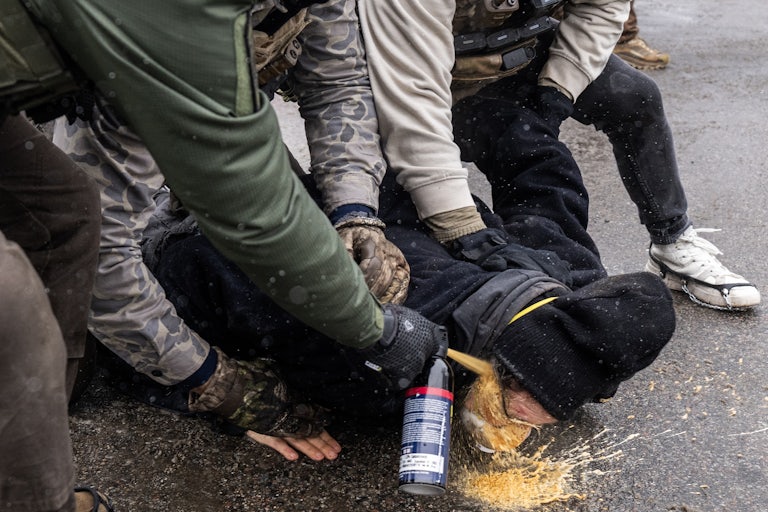
Bovino went on to suggest that support for ICE and Border Patrol comes from a silent majority, evidenced by compliments he’s received from people “under their breath.” Somehow, in Bovino’s world, that’s because the commenters are afraid of some “5 or 10 percent of agitators” rather than of provocation by the relatively untrained and violent militias that have captured and killed their neighbors and have been expressly permitted to operate under the Department of Homeland Security with impunity.
BOVINO: With those inner city residents, what we're seeing is fantastic public support. Here in Minneapolis a lot of thumbs up and a lot of 'good jobs.' Now, a lot of it is under their breath because they are afraid of that 5 or 10% of agitators are rioters
— Aaron Rupar (@atrupar) January 23, 2026
VITTERT: Come on,… pic.twitter.com/iXFgFNQKrK
Meanwhile, thousands of Minnesotans participated in a general strike Friday to express their fury and frustration with ICE’s ongoing presence in their state. The “Day of Truth & Freedom” protest is no small feat. It involves “no work, no school, no shopping,” with hundreds of local businesses closing in solidarity as the state attempts to make a bold statement after ICE agents shot and killed 37-year-old Renee Nicole Good on January 7.
The Minneapolis City Council also endorsed the community blackout, as did local and state labor unions.
“I think what generated the idea for this action comes out of the need to figure out what we can meaningfully do to stop it,” Kieran Knutson, the president of Communications Workers of America Local 7250 in Minneapolis, told The Guardian. “The government in the state of Minnesota has not offered any path towards stopping these attacks, this violence.”
In a memo issued on January 19, Homeland Security Secretary Kristi Noem claimed that the department had arrested 10,000 “criminal illegal aliens who were killing Americans” in Minneapolis—with 3,000 of those arrests occurring over the preceding six weeks.
But it has become glaringly obvious over the course of the last year (or even just this last week) that the Trump administration’s pledge to focus on deporting violent criminals was little more than centrist lip service.
In reality, immigration agents have arrested practically anybody—including U.S. citizens—in order to meet Homeland Security adviser Stephen Miller’s quota of 3,000 or more arrests per day. On Tuesday, ICE agents detained a 5-year-old preschooler, Liam Ramos, in his driveway shortly after he and his father arrived home.
In an attempt to defend their own city from the state-sponsored violence, some Minneapolis residents have opted to openly carry their firearms, brandishing their Second Amendment right to bear arms. Locals have formed neighborhood watches to follow ICE vehicles, banging pots and pans and screaming to alert others when agents enter their residential neighborhoods.
Local politicians—including Minnesota Governor Tim Walz—have advised ICE and Border Protection to exit their cities and state, arguing that the federal agents have done more harm than good. In 2025, before Good’s death, the agency killed 32 people—its deadliest year in more than two decades.
A CBS News poll published earlier this week found that 61 percent of surveyed Americans felt that ICE agents were “too tough” when stopping and detaining people—an increase of 5 percent from November.
Some 52 percent of respondents said that ICE was making communities “less safe,” while a similar percentage of respondents (53 percent) felt that ICE operations should decrease in light of recent events in Minneapolis.