Breaking News
Breaking News
from Washington and beyond

Kyrsten Sinema Says 51 Senate Seats Is a “D.C. Thing to Worry About”

After switching from Democrat to independent, the Arizona senator refuses to say how she'll vote in the Senate.

Drew Angerer/Getty Images

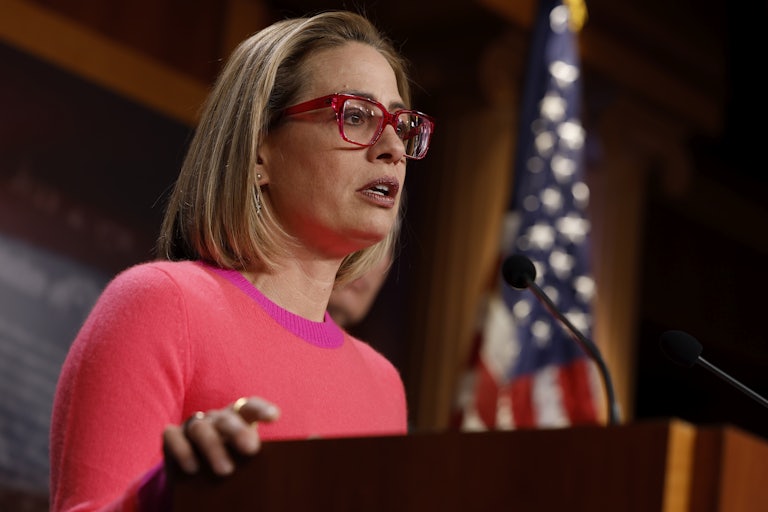
Kyrsten Sinema seems unaware of or unwilling to acknowledge the potential consequences of changing parties just days after the Democrats secured a 51-49 majority in the Senate.

The Arizona senator announced Friday that she was changing her political affiliation from Democratic to independent, a major blow to her now former party. But when she was asked by CNN’s Jake Tapper about how her move will affect Democrats’ power in the Senate, she dodged.

Sinema insisted that concerns about 51 versus 50 seats was “kind of a D.C. thing to worry about” and said she was more focused on sticking to her values and those of her voters.

Except, the difference between 51 and 50 set votes for the Democratic Party is not a “D.C. thing.” It has massive implications for national legislation and the future of the country.

There’s a reason that Senator Raphael Warnock campaigned so hard during the Georgia runoff. Even though Democrats already had 50 seats in the Senate, his victory would have given them far more influence in the chamber.

Fifty-one seats meant that Democrats would control committees and could more easily approve judicial appointments. They could block dangerous legislation or investigations from the Republican-controlled House.

And crucially, 51 seats meant that if a Democratic senator stonewalled—usually Sinema herself or Joe Manchin—then major legislation would no longer automatically tank. Now, Sinema’s decision has thrown all of that up in the air once more.

Sinema has not said if she will run for reelection, but she told Politico she also would not caucus with Republicans. She said she intends to vote the same way she has for the past four years.

Her spokeswoman told reporters that Sinema “intends to maintain her committee assignments through the Democrats. She has not ever and will not attend caucus messaging and organizational meetings.”

But considering her history, there would seem to be small comfort in that.
The Chaos Maker: Kyrsten Sinema Ditches the Democrats

The Arizona senator says “nothing will change about my values or my behavior,” but Democrats should be forgiven for not taking much solace in that.

Anna Moneymaker/Getty Images

Friday started out with an undeniable political bombshell: Senator Kyrsten Sinema, the former-Green Party-turned-conservative-Democrat, has decided to once again switch parties and become an Independent. She’s making this announcement through embargoed news interviews and an op-ed in The Arizona Republic. She also taped a short two-minute video:

Sinema throughout the Biden administration has been a thorn in Democrats’ side. She managed to leverage her way into countless one-on-one meetings with President Biden as she dangled her support for the Biden administration’s Build Back Better set of proposals. There were always rumors floating around that Sinema would leave the party and maybe, just maybe, even join the Senate Republican caucus.

Turns out Sinema was in fact toying with leaving the party. She says she’s going to continue to caucus with Democrats and get her committee assignments. Her announcement, conspicuously, comes after Senate Majority Leader Chuck Schumer was reelected majority leader and after Senator Raphael Warnock won reelection out in Georgia. Democrats’ majority is not in full jeopardy. She told Schumer of her decision on Thursday.

At the same time though, when Sinema says “nothing will change about my values or my behavior,” Democrats should be forgiven for not taking much solace in that. Sinema has established herself as a Democrat open to bucking the party. She may not be a Republican now, but her decision to shrink the actual Democratic majority back to 50 seats scrambles the dynamic, gives Senator Joe Manchin more power, and opens Sinema up to doing pretty much what she’s always done: whatever she wants.

In a round of snap interviews with some top Democratic Senate staffers Friday morning, one predicted to me that Senate Democratic leadership will continue to engage with her the way they have: “not an automatic vote on tough issues.” That’s been the status quo up until now but given the opportunity to make things slightly easier for the Democratic Party, Sinema, once again, opted to go in a different direction.

Her future is unclear. She won’t say whether she will run for reelection. It’s up to Schumer and the Democratic Senatorial Campaign Committee to decide whether it will provide air cover for her if she does or let an extended Democratic primary in a purple state sort itself out. Congressman Ruben Gallego, a potential candidate for Sinema’s seat, is already interviewing consultants, according to Politico. What’s clear in terms of that 2024 race and the Democratic Party’s agenda now is that it all just got a little more chaotic.

Thousand of Airport Workers Across the Country Strike

The workers are pushing for a bill in Congress that would bring better pay and working conditions.

Photo by Horacio Villalobos/Corbis/Getty Images
Few passengers are seen in Humberto Delgado International Airport, due to a strike called by the National Union of Aviation Flight Personnel, or SNPVAC, on December 8, in Lisbon, Portugal, in solidarity with U.S. airport workers.

On Thursday, thousands of airport workers from at least 15 American airports rallied to call for better working conditions. In three airports—Boston Logan International, Chicago’s O’Hare International, and Newark Liberty International—workers went on a full strike, calling attention to unfair labor practices by their employer, Swissport USA and Swissport Cargo, including poor working conditions and improper payment and wage theft.

The workers are pushing Congress to pass the Good Jobs for Good Airports Act. The bill would introduce national wage and benefit standards, setting a $15 minimum wage for all airport service workers (including those working at vendors like restaurants or retail stores) and baseline benefit standards for paid time off and health care.

Introduced in June by Representative Jesús “Chuy” Garcia and Senator Ed Markey, the bill holds 15 Senate and 89 House co-sponsors. There has been little Republican support for the bill, even as Republicans last week pretended to care about America’s rail workers.

Senators Markey, Blumenthal, Schumer, as well as Representative Garcia and D.C. House Delegate Eleanor Holmes Norton appeared alongside workers on Thursday in Washington, D.C., lobbying for the bill’s passage.

Resonance with the rail workers’ struggle can’t be missed. “We don’t get enough paid time off. We’re supposed to get a week of paid sick days. But we’re so short-staffed they make it almost impossible for you to take a sick day,” said Omar Rodriguez, a ramp agent and cabin cleaner employed by Swissport USA, in a statement provided by the SEIU. “We get blamed for delays, but we’re only given a few minutes to clean and don’t have enough people to do the work.”

“No one wants to stay because the pay and benefits are not enough for what we do,” he added.

The Latest NDAA Has Sparked an Unexpected Debate Over Judicial Security and the First Amendment

The just-passed defense spending bill includes provisions designed to protect judges from violence. But legal journalists say these measures infringe on their rights.

Tasos Katopodis/Getty Images
Abortion rights protesters demonstrate outside U.S. Supreme Court Justice Samuel Alito's home on June 27, in Alexandria, Virginia.

The House of Representatives passed the behemoth $858 billion annual defense bill on Thursday in a 350–80 vote. Among its many provisions is one aimed at improving security for federal judges, which became part of the final bill despite some criticism from judicial watchdog groups.

The provision, known as the Daniel Anderl Judicial Security and Privacy Act of 2022, would generally forbid the unauthorized disclosure of a judge’s personal information or that of an immediate family member. It would cover home addresses, phone numbers, license plate details, and information about next of kin’s workplaces, schools, and daycares, and similar data.

The bill is named after the son of Judge Esther Salas, whose New Jersey home was targeted in an apparent assassination attempt in 2020. The gunman killed Daniel and wounded Salas’s husband before fleeing the scene. Local police later identified the assailant as Roy Den Hollander, a lawyer against whom Salas had previously ruled on a procedural matter. He died by suicide before he could be apprehended. After her son’s death, Salas advocated for stronger security protections for federal judges. New Jersey’s two senators, Cory Booker and Bob Menendez, introduced the bill that eventually became part of the defense budget package this week.

Attacks on the federal judiciary are relatively rare in the United States but not unheard of. Three federal judges were assassinated in the twentieth century and a fourth, John Roll, was killed when a gunman attacked an event held by then–Arizona Representative Gabby Giffords in 2011. In 2005, Judge Joan Lefkow’s husband and mother were murdered in a targeted attack in suburban Chicago. The U.S. Marshals Service, which is charged with protecting judges and courthouses, has told Congress that the number of threats has increased in recent years.

The bill’s breadth nonetheless drew some criticism in recent days from judicial transparency advocates and from some journalists. The Free Law Project, a nonprofit group that tracks the federal courts, said the bill was “unconstitutional” and warned that it would lead to censorship against them. “If this bill becomes law, we’ll have to fight it in court or take down vital accountability information from our site,” the group wrote on Twitter on Wednesday night. “This is not OK.” Fix the Court, a Supreme Court–oriented watchdog group, also described it as “clearly unconstitutional.”

Much of the criticism centered on provisions that would allow immediate members of a judge’s family to take down information about their employers. “Lawmakers have just added a provision to the National Defense Authorization Act protecting Supreme Court spouses from having to reveal any outside employer, in the name of security,” Jane Mayer, a New Yorker staff writer who has written about the Supreme Court justices, claimed on Wednesday. “If it passes, Ginni Thomas’s professional entanglements would effectively be state secrets.” Thomas, who is married to Supreme Court Justice Clarence Thomas, has come under intense scrutiny over the last two years for her ties to groups that sought to overthrow the 2020 election.

If signed into law, the bill could face legal challenges from websites and publishers that decline to take down information about judges’ families. Those challenges would then have to survive the scrutiny of federal judges who have watched with concern as the number of threats against them grew in recent years. Any lawsuit would also likely face the ultimate test before the Supreme Court, most of whose members saw protests outside their homes after the court voted to overturn Roe v. Wade earlier this year. Persuading them to make it easier to disclose private information about their family members might be a tall order for any lawyer.

First Gen Z Member of Congress Says He Can’t Find an Apartment Due to Bad Credit

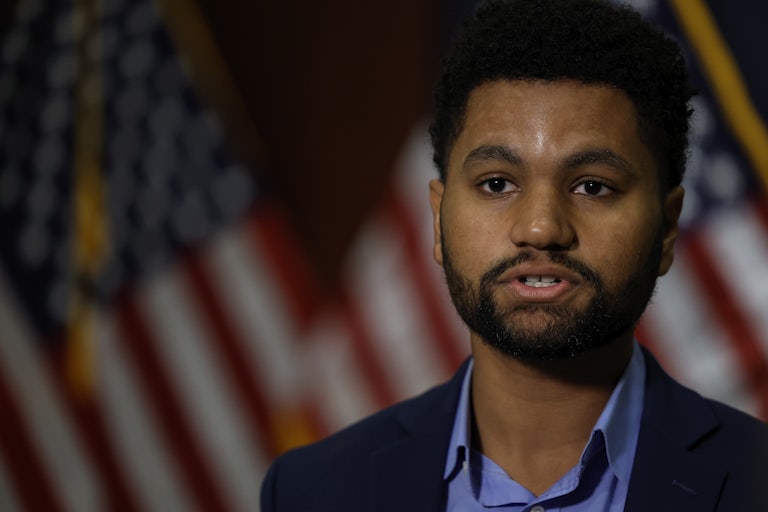
Representative-elect Maxwell Frost said he was denied an apartment in Washington, D.C., due to his “really bad” credit.

Anna Moneymaker/Getty Images
Representative-elect Maxwell Frost

On Thursday, Representative-elect Maxwell Frost, who will become the first Gen Z member of Congress, said he was denied an apartment in Washington, D.C., due to his “really bad” credit. He also lost his application fee.

Such an outcome is familiar to many. After all, housing nationwide seems to only get increasingly expensive, as landlords and rental companies enjoy the mountain of fees they rake in from renters desperate to find a home.

The ridiculousness of it all is only heightened while individuals elected to serve in the nation’s capital can’t even afford to live there.

Like Frost, Representative Alexandria Ocasio-Cortez was a member who, upon arriving in D.C. in 2018, had trouble finding housing before receiving her congressional salary of $174,000.

Frost explained that his credit worsened after he ran up debt while campaigning over the past year and a half, noting he did not make enough money driving for Uber.

“It isn’t magic that we won our very difficult race,” Frost wrote. “I quit my full time job cause I knew that to win at 25 yrs old, I’d need to be a full time candidate. 7 days a week, 10-12 hours a day. It’s not sustainable or right but it’s what we had to do.”

The amount of money a candidate has is important—particularly if you are a challenger like Frost or Ocasio-Cortez, whose races required all the more time and effort to win.

How difficult it is for someone to get involved in a country’s politics tells you something about said country. Especially if that country purports to be a “representative democracy.” Frost offers yet another example of how America really does not encourage working people—who perhaps need the most advocacy in halls of power—to get involved.