Breaking News
Breaking News
from Washington and beyond

Senate Passes Respect for Marriage Act Protecting Marriage Equality

The vote on the bill, which will protect same-sex marriage and interracial marriage, was 61–36.

Chip Somodevilla/Getty Images

The Senate voted 61–36 Tuesday to approve a bill enshrining marriage equality.

The Respect for Marriage Act, which applies to both same-sex and interracial marriage, would require that two people be considered married so long as their marriage was legal in the state in which it was performed. The act also repeals a 1996 law defining marriage as between a man and a woman, which has remained on the books despite being declared unconstitutional by the Supreme Court in 2015.

Thirty-six Republican senators voted against the bill, including Mitch McConnell, who is in an interracial marriage.

Many civil rights activists have warned that after the Supreme Court overturned Roe v. Wade in June, same-sex marriage may be next on the chopping block.

The Senate voted 62-37 on November 16 to advance the bill to a final vote. The chamber had added an amendment to the bill clarifying certain protections for religious organizations.

It will now return to the House of Representatives before President Joe Biden can sign it into law.

The act already passed the House over the summer, although 156 voted against it—including a shockingly hypocritical nay vote from Representative Glenn Thompson, who attended his son’s same-sex wedding just a week later.

Critics of the bill say, though, that it does not go far enough with LGBTQ protections. Part of the amendment says that religious organizations do not have to marry same-sex couples, which would allow groups to continue to be homophobic, and the bill does not require all states to actually issue same-sex marriage license.

Oath Keepers Founder Convicted of Seditious Conspiracy in January 6 Case

The charges show the Justice Department’s ability hold the January 6 insurrectionists accountable.

Aaron C. Davis/The Washington Post/Getty Images

A federal jury on Tuesday convicted Oath Keepers leader Steward Rhodes of seditious conspiracy for his role in creating and inciting the violent plot to overturn the 2020 election results.

Rhodes and four other members of the Oath Keepers, a far-right anti-government militia, were found guilty of various crimes related to the January 6 attack on the United States Capitol. The members were convicted by a jury in Washington, D.C., on numerous charges.

Swarms of Oath Keepers were among the mob that invaded the Capitol and forced Congress into hiding.

Rhodes and subordinate Kelly Meggs were both found guilty of seditious conspiracy. Three other members—Jessica Watkins, Kenneth Harrelson, and Thomas Caldwell—alongside Rhodes and Meggs, were found guilty of obstruction of an official proceeding and aiding and abetting for their actions on January 6, 2021. Meggs and Watkins were also charged with conspiracy to obstruct.

Seditious conspiracy charges have been brought against far-right militia members in the past, but to little avail. Today’s convictions alter that pattern and open the door to holding other nefarious actors actually accountable for anti-democratic violence.

Rhodes’s conviction in particular is among the most significant developments to come from the web of investigations into the January 6 attack on the Capitol. Elected officials, rioters, and former Trump allies all are under various investigations. Such a conviction shows that there indeed is capacity to hold actors to account—and that those under investigation now are no exception to that standard.

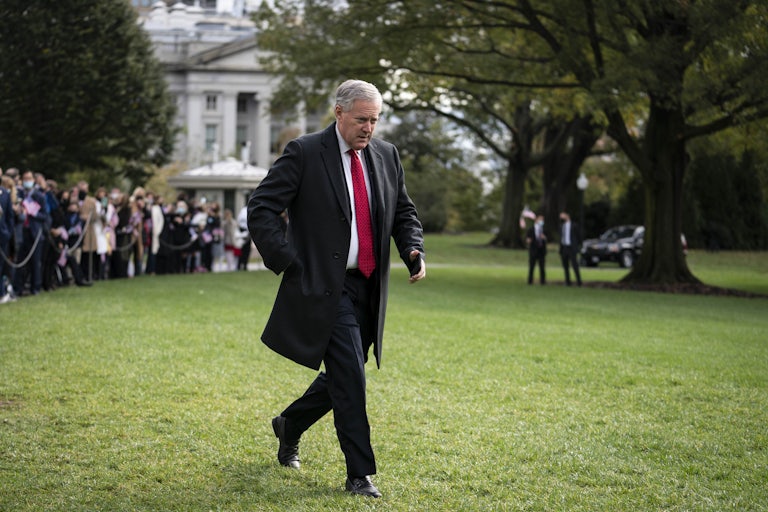
Mark Meadows Ordered to Testify on Georgia 2020 Election Interference

The former White House chief of staff was on the line when Trump called Georgia’s secretary of state, pressuring him to “find” votes.

Sarah Silbiger/Getty Images

South Carolina’s Supreme Court on Tuesday unanimously ordered former White House chief of staff Mark Meadows to testify about efforts to overturn the 2020 election results in Georgia.

“We have reviewed the arguments raised by [Meadows] and find them to be manifestly without merit,” the justices wrote.

The ruling affirmed a lower court that required Meadows to testify to the grand jury investigation. Meadows had appealed the decision but was rejected by the state supreme court.

Meadows was initially scheduled to testify on November 30. It is yet to be determined if that appearance will remain on time.

The former White House chief of staff was involved in numerous efforts to meddle with the 2020 election results. In December 2020, Meadows attended a White House meeting with Trump and others, where the topic of discussion was voter fraud and state electoral vote certifications. The very next day, Meadows traveled to Georgia, seeking to observe an audit of absentee ballot signatures.

Meadows also sent emails to Justice Department officials, demanding investigations into baseless claims of voter fraud. And in January 2021, Meadows was on the line as Trump called Georgia Secretary of State Brad Raffensperger, pressuring him to “find 11,780 votes,” the amount needed to win Georgia.

The rejection of Meadows’s appeal follows an earlier attempt by him to avoid complying with the investigation. In October, a South Carolina county judge entertained Meadows’s challenges but promptly deemed him “material and necessary” to the Georgia investigation, compelling him to testify.

The investigation first began in February 2021, spurred in part by Trump’s plea to Raffensperger—again, a call that Meadows participated in. Since then, the probe has investigated and subpoenaed dozens of witnesses including Boris Epshteyn, Rudy Giuliani, Newt Gingrich, Michael Flynn, and Lindsey Graham (who similarly unsuccessfully tried appealing out of the investigation).

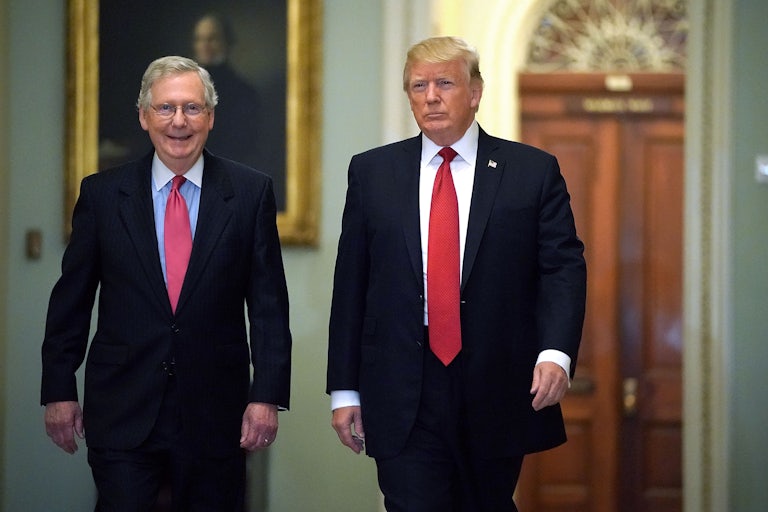
Mitch McConnell Is Really Good At Not Condemning Trump’s White Supremacy

Free-thinking Republican unable to just say Trump might not be great.

Chip Somodevilla/Getty Images

For a political party that claims to be the home of free thinkers, the GOP is pathetically subservient to a fragile, self-absorbed loser.

On Tuesday, Senate Majority Leader Mitch McConnell told reporters that “there is no room in the Republican Party for antisemitism or white supremacy, and anyone meeting with people advocating that point of view, in my judgement, are highly unlikely to ever be elected president.”

McConnell’s comments come after twice-impeached, twice-popular-vote-losing former President Donald Trump met with Kanye West and Nick Fuentes, a Holocaust denier, white nationalist, and racist who has threatened murder against Jews and expressed approval for the Taliban.

But despite McConnell’s supposed disapproval of antisemitism and white supremacy, he refused to say he wouldn’t support Trump if he wins the 2024 Republican nomination.

That McConnell won’t explicitly disavow Trump reveals how comically docile the GOP is. Recall the 2016 Republican primaries, when Trump made fun of Ted Cruz’s wife’s appearance and spread conspiracies about his father being involved in the assassination of JFK. Cruz initially expressed disapproval of Trump.

“I am not in the habit of supporting people who attack my wife and attack my father,” Cruz said. “That pledge was not a blanket commitment that if you go and slander my wife that I am going to come like a servile puppy dog for maligning my wife and maligning my father.”

Fast forward to late October 2022: Cruz said with a straight face on national television that his wife and father just had a nice laugh at Trump’s attacks. Cruz was among those seeking to challenge the 2020 election results and keep Trump in power.

As Trump’s first bid showed, it only takes a few primary wins to gain steam—especially if there’s a wide field of candidates splitting votes. If Republicans actually care about stopping Trump, their submission is just not going to cut it.

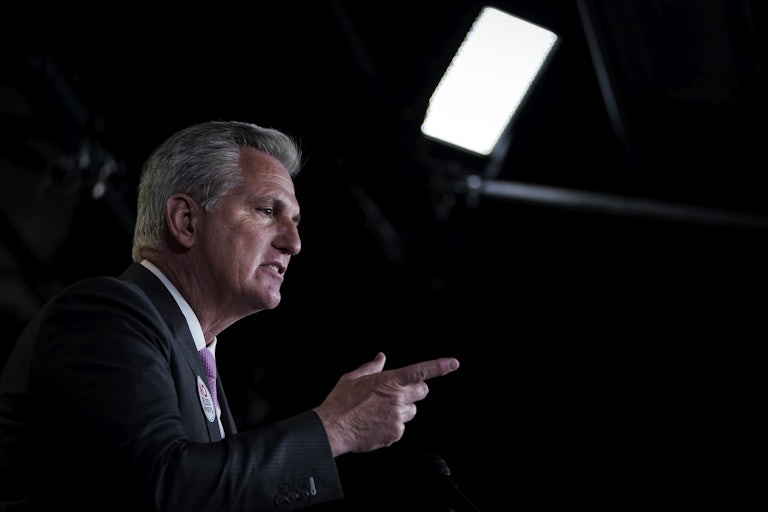
Kevin McCarthy Lies And Says Trump Condemned Fuentes (He Never Did)

The potential House speaker said Donald Trump condemned white supremacist Nick Fuentes four times. In reality, he hasn't condemned Fuentes even once.

Drew Angerer/Getty Images

House Republican leader Kevin McCarthy finally spoke out Tuesday on Donald Trump meeting with a white supremacist…sort of.

It has been one week since Trump met with Nick Fuentes, a Holocaust denier and white supremacist, and rapper Kanye West, another outspoken antisemite. Republicans have been largely silent on the matter, or they have avoided explicitly criticizing Trump. The few exceptions, such as Liz Cheney, Adam Kinzinger, and Mitt Romney, were already vocal Trump critics and are not in party leadership positions.

McCarthy, the GOP nominee to be the new speaker of the House, condemned Fuentes Tuesday, telling reporters: “I don’t think anybody should be spending any time with Nick Fuentes. He has no place in this Republican Party.”

But he then repeatedly insisted that Trump “came out four times” against Fuentes and didn’t know who he was to begin with. Both statements are straight-up lies.

Trump has not condemned Fuentes, and although he claimed not to know who Fuentes is, the former president has previously retweeted a clip from his internet show. 

McCarthy is likely refraining from calling Trump out because condemning him risks alienating the former leader’s supporters still in Congress. McCarthy will need every vote he can get if he is to become speaker, a goal he has not been shy about publicizing.

Earlier Tuesday, MSNBC host Joe Scarborough slammed McCarthy’s (lack of) actions as “sad and pathetic.”

McCarthy “thinks his support depends on having white nationalists and supporters of neo-Nazis voting for him for speaker of the House,” Scarborough said.”

Despite a poor showing by MAGA candidates during the midterms, Trump still holds considerable sway in Congress. The GOP establishment seems to be souring on him, but they still need his support to present a unified front.