Breaking News
Breaking News
from Washington and beyond

Ron DeSantis Explodes When Asked About His Role in Guantánamo Torture

One of the supposed 2024 front-runners can’t seem to handle questions from the media.

Amir Levy/Getty Images

Ron DeSantis is showing an increasingly poor ability to handle the spotlight.

The Florida governor, who is expected to announce a presidential campaign, served as a lawyer at the notorious Guantánamo Bay prison in 2006. During a press conference Thursday at the Museum of Tolerance in Jerusalem, a reporter asked him about claims by a former detainee that DeSantis had attended his force-feeding session. DeSantis snapped immediately.

“No, no, all that’s BS,” DeSantis said. “No, totally, totally BS.”

“How would they know me?” he demanded, his voice rising. “Do you honestly believe that’s credible?”

DeSantis arrived at Guantánamo in the midst of mass hunger strikes among detainees protesting their treatment at the prison. DeSantis arrived as part of a team of military lawyers to help solve the situation.

The Florida governor himself admitted in a 2018 interview that he was one of the people who suggested force-feeding prisoners, something that many human rights organizations have decried as torture. DeSantis was also sent to Guantánamo the same year that three inmates died, the worst loss of life in the prison’s history. The official report was that the three men died by suicide, but many people, including a former Guantánamo guard, dispute that finding.

Two former detainees have called out DeSantis specifically for his role in the unbearable situation at Guantánamo. One, Abu Sarrah Ahmed Abdel Aziz, told The Washington Post he is “100 percent” certain he spoke to DeSantis multiple times. Abdel Aziz spoke fluent English and was trying to report mistreatment claims to JAG officers.

Abdel Aziz said he didn’t know DeSantis’s name at the time, but the then JAG promised to look into the complaints. But conditions got worse instead.

Another former inmate, Mansoor Adayfi, said he saw a photo of DeSantis on Twitter in 2021 and recognized the governor immediately. “It was a face I could never forget. I had seen that face for the first time in Guantanamo, in 2006—one of the camp’s darkest years when the authorities started violently breaking hunger strikes and three of my brothers were found dead in their cages,” Adayfi wrote in an essay for Al Jazeera.

Adayfi said he shared a photo of DeSantis with several other former inmates, and they all recognized him from Guantánamo. Adayfi vividly remembers DeSantis watching from behind a fence as he was force-fed, “smiling and laughing with other officers as I screamed in pain.”

DeSantis has largely avoided talking about his time at Guantánamo, but now that the national spotlight is on him, it’s going to keep coming up. And so far, it looks like he can’t handle that scrutiny.
Republicans Break Ranks to Save Abortion Rights in Nebraska and South Carolina

At least a few Republicans are finally listening to what the people want.

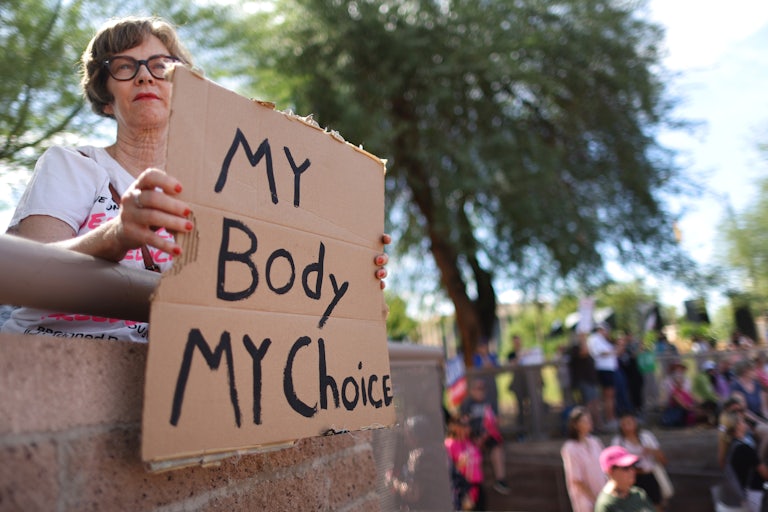
A woman outside holds a sign that reads "My body my choice."
Mario Tama/Getty Images

Strict abortion bans died in the South Carolina and Nebraska state legislatures, a rare bit of good news in the Republican-led assault on reproductive rights. And in both states, Republican dissenters doomed the abortion bans.

The two bills would have banned abortion after six weeks, before many people even know they are pregnant, with few exceptions. Both measures failed to overcome a filibuster in the state Senates. Abortion is now still legal in South Carolina and Nebraska until 22 weeks, although both states have multiple restrictions, such as a mandatory 24-hour waiting period and biased counseling aimed at running out the clock.

In South Carolina, the only female senators—three Republicans, one Democrat, and one independent—led the filibuster. “Abortion laws have always been, each and every one of them, about control,” said Republican Sandy Senn. “And in the Senate, the males all have control. We the women have not asked for … nor do we want your protection. We don’t need it.”

She said the abortion ban “insulted” women, adding, “The only thing that we can do when you all, you men in the chamber, metaphorically keep slapping women by raising abortion again and again and again, is for us to slap you back with our words.”

The chamber ultimately voted 22–21 on Thursday to delay the bill until next year. The measure is unlikely to make it back to the floor: There are not enough days in the current legislative session for the House to re-pass it, and the Senate’s Republican majority leader has indicated they are unlikely to try and pass the bill again when it’s clear they don’t have the support.

The South Carolina measure was similar to a six-week trigger ban that went into effect after Roe v. Wade was overturned. The state Supreme Court blocked that law in January, and the new bill was an attempt to circumvent the ruling.

The Nebraska Senate also failed to overcome a filibuster on Thursday, with senators voting 32–15 to end debate on the bill—just one vote short. Two senators, Republican Merv Riepe and Democrat Justin Wayne, voted “present.” The two are considered swing votes should this bill be revived, as both say they are “pro-life.”

Wayne did not explain his vote, but Riepe, a former hospital administrator, had said he would only support the bill if it was amended to ban abortion at 12 weeks. He said the six-week window was too short, citing arguments from doctors he has known for decades, and warned that the measure was too extreme to be popular among voters.

Riepe is one of the few Republicans who is actually (sort of) paying attention to current abortion events. About two-thirds of Americans think abortion should be legal in all or most cases, according to the Pew Research Center. A new study from the center also shows that 43 percent of people who live in states where abortion is restricted think it should be easier for someone to access the procedure in the area where they live, compared to just 31 percent in 2019.

Abortion rights win elections. Every time an abortion-related issue has been on the ballot, the people vote in favor of protecting reproductive rights, not taking them away. It seems like at least a handful of Republicans are finally taking heed.

Trump Comforts Convicted January 6 Rioter Who Called to Execute Members of Congress

“Listen, you just hang in there,” the former president told Micki Larson-Olson, before hugging her in front of the cameras.

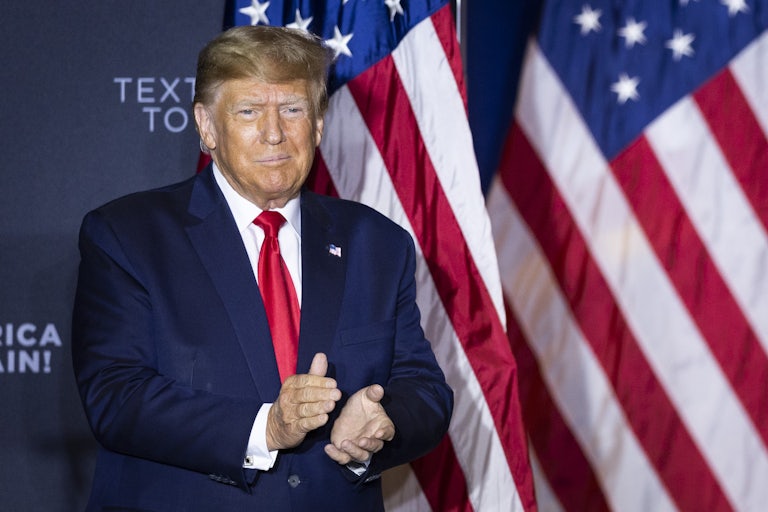
Donald Trump
Adam Glanzman/Bloomberg/Getty Images

Micki Larson-Olson was convicted of defying police orders during the January 6 riots that sought to overturn the 2020 election. If she had had it her way, she would’ve done more. In an interview last year, the Texas woman said that members of Congress should be executed “for being traitors,” accusing them of being “domestic terrorists.”

And on Thursday, Donald Trump signed her backpack and gave her a warm hug.

“Listen, you just hang in there,” the twice-impeached and criminally indicted former president told the convicted rioter. “You guys are gonna be OK.”

The shared connection between the two criminals came during a campaign stop for Trump—who is currently on trial for rape—in New Hampshire; Larson-Olson found the former president at a diner after his event, according to The Washington Post.

“President Trump, will you please sign my Trump backpack that I carried up to Jan. 6?” Larson-Olson bellowed as she entered the restaurant. “I went to jail for 161 days for Jan. 6. I’m an Iraq War veteran.”

“Patriots, I hear the woman,” Trump said in response. “It’s terrible,” he continued. “What they’re saying is so sad, what they’ve done to Jan. 6.”

Trump took a photo with his fellow “patriot,” embracing her with a hug, and even gifting her the marker he used to sign the backpack.

“You just take care of yourself,” Trump told her. “You’ve been through too much. You’re going to wind up being happy.”

Larson-Olson had driven 30 hours from Abilene, Texas, all the way to Manchester, New Hampshire, to see Trump, according to the Post. Immersed in the revelry of his fandom, Trump embraced someone who had said execution “should happen to each and every person that hijacked the voice of the people”—which, in her eyes, would seemingly be any member of Congress who supported certifying the results of the 2020 election.

Since completing her sentence, Larson-Olson has apparently joined Negative48, a QAnon spin-off group that has become a new staying presence at Trump events.

The convicted rioter stands by her actions on that fateful day in January.

“It was the most patriotic day of my life,” she told the Post. “I refused to walk down from the stairs … because I took an oath to support and defend the Constitution against all enemies, foreign and domestic, and those politicians are domestic enemies to our republic.”

Larson-Olson apparently choked up after Trump had left the diner.

“It’s so surreal, I can’t believe that,” she said. “The fact that the president knows my story … this most amazing man knows what I went through in the jail.… It’s just crazy. And he gave me the pen.”

Every Detail in the E. Jean Carroll Case Is Proof of Why Rape Victims Don’t Come Forward

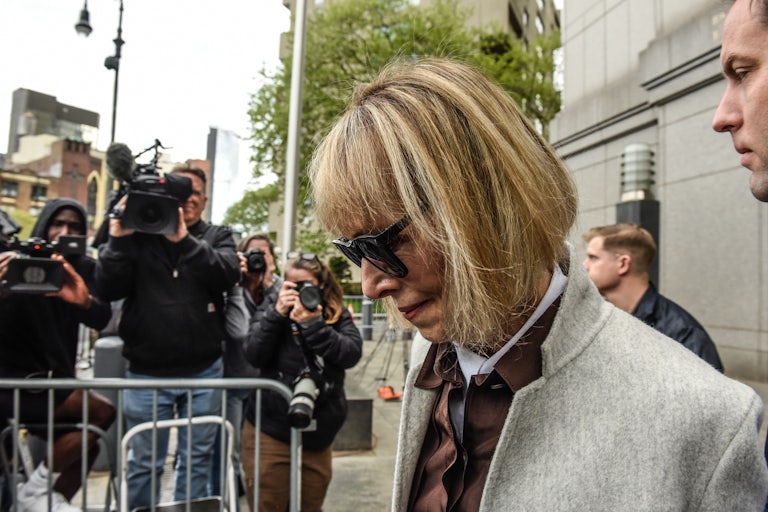
“He raped me, whether I screamed or not.”

E. Jean Carroll
Stephanie Keith/Bloomberg/Getty Images

Donald Trump is on trial for rape. Every detail in the case thus far shows that things haven’t really changed since the #MeToo movement.

Writer E. Jean Carroll is suing Trump for defamation and sexual assault. Trump has rejected the rape allegation. He has yet to appear at the trial, which began earlier this week.

During cross-examination Thursday, Trump lawyer Joe Tacopina tried to show that Carroll was making her story up. “You were supposedly raped?” he asked early on.

“Not ‘supposedly.’ I was raped,” Carroll responded.

Carroll accused Trump in her 2019 memoir of raping her in the Manhattan Bergdorf Goodman department store in the mid-1990s. She has sued him twice for defamation: first in 2019, when he said she made up the rape allegation to promote her book, and again in November for posts he made about her on social media.

Tacopina went on to ask her Thursday whether she screamed during the alleged assault. When Carroll said she didn’t, Tacopina repeatedly pressed her on the point.

“He raped me, whether I screamed or not,” Carroll replied, nearly shouting, according to reporters in the courtroom.

Carroll also said that if she had been lying, “I would say I was screaming my head off.” Maybe then more people would have believed her, she added.

Tacopina also asked Carroll why she only told two friends instead of going to the police. Carroll said that she was scared of what Trump might do to her, pointing out that “he has two tables full of lawyers here today.”

Carroll has at least some reason to be concerned. At least 26 women have accused Trump of sexual harassment or assault since the 1970s, all of which he has denied. He then went on to become president of the United States.

And the line of questioning in the case shows exactly why so many people, not just Carroll, hesitate to come forward after they have been sexually assaulted. Nearly 80 percent of rapes and sexual assaults go unreported, according to a 2016 Justice Department report. Many survivors are afraid of retaliation—from both the perpetrator and society in general—as well as that their allegations will be distorted. Another major concern is simply that they won’t be believed.

The #MeToo movement was supposed to be a watershed moment, when society began pushing back on sexual assault and the people who perpetrate it. Instead, people like Carroll are accused of lying for money or told their story isn’t believable because they didn’t react a certain way. They’re also attacked all over again, as if what happened to them is their fault.

Carroll told the court Thursday that she logged on to Twitter in the morning and found a slew of comments calling her a “liar,” a “slut,” “ugly,” and “old.” But then, getting emotional, she said, “I couldn’t be more proud to be here.”

Nebraska Democratic Lawmaker Under Ethics Investigation for Having a Trans Son

The complaint alleges that state Senator Megan Hunt has a “conflict of interest” while discussing anti-trans legislation.

Marvin Joseph/The Washington Post/Getty Images
Nebraska state Representative Megan Hunt

Democrats are literally just trying to advocate for people’s basic civil rights. But from Tennessee to Montana, Republican lawmakers have twisted ethics and decorum rules to attack them for doing so. The latest? A Nebraska Democratic lawmaker is under an ethics investigation for having a transgender child.

State Senator Megan Hunt is now under attack for having a “conflict of interest” because she has a transgender son.

The investigation comes from a complaint from Omaha lawyer David Begley, who claims that Hunt is financially implicated in the fate of a bill that would ban gender-affirming health care for anyone under the age of 19. Bagely writes that Hunt and her son would have a “more than average chance of obtaining Medicare coverage if the bill fails.” For her part, Hunt has said she has already tried four times to receive care for her son, to no avail; Nebraska’s Medicaid policy does not currently cover gender-affirming care anyhow.

Of course, the complaint is ridiculous. Every bill that lawmakers address is one they are implicated in; after all, they are also members of the society those bills would impact and change.

Senator Wendy DeBoer put it quite simply. “Every time we have a tax bill, I’m a taxpayer. So I may be involved in that every time. We have a bill that involves families, well, I have a family. So I may be involved,” she told Nebraska Public Media. “Every time we have a bill on basically anything in here, I’m involved because I care about my state. I care about the people in my state, and I’m involved with them, just like Senator Hunt is.”

While some Republicans have supported Hunt against the ethics complaint, the senator says that is not enough.

What’s happening in Nebraska is a parallel of what we saw unfold in Tennessee and Montana earlier this month. Tennessee Republicans expelled two Black Democrats for standing in solidarity with thousands of people protesting against gun violence after a school shooting. Montana Republicans censured the state’s first and only transgender legislator for speaking out against vicious attacks on transgender lives, barring her from the House floor for the rest of the legislative session.

By the way, Begley, the complainant and self-purported former Democrat, once told then-presidential candidate Pete Buttigieg that he should “just tell the Black people of South Bend to stop committing crime and doing drugs.” He has also called for arming teachers and making gun ownership even more widespread in a country where there are more mass shootings than days in a year. Just a few weeks ago, he called Nebraska Democrats “Jacobins” and part of the “cults” of “Net Zero Carbon” and “Transgenderism.”