Breaking News
Breaking News
from Washington and beyond

Period-Havers Have the Last Laugh Over the “Red Wave”

As one jokester put it, “More like light spotting.”

Stefani Reynolds/Getty Images

Turns out there was a “red wave” on Election Day after all, just not the ones that Republicans hoped for. Women, particularly women of color, voted overwhelmingly Democratic during the 2022 midterms, exit polls found. Inevitably, some found the joke that was … just sitting there.

The midterm elections saw record-high voter turnout, both early and in person, and according to the exit polls, access to abortion was one of the top issues at the ballot box. Additionally, five states had abortion rights issues on the ballot, and all five states voted to either increase or maintain access to the procedure.

Republicans had been promising a tsunami-like sweep in the midterms but ended up stunned to see major losses across the board. Although many of the marquee national races remain tight, Democrats pulled off upset wins and flipped state legislatures. In Michigan, the state government went Democratic, and abortion was the primary driver.

Right-wing media outlets and commentators have freaked out, trying to explain why their red wave slowed to a trickle. They have tried to blame everything from Donald Trump to voters being too young. They can’t seem to grasp—or won’t admit—that people vote for issues that matter to them.

But Washington Post writer Monica Hesse explained, “Buddy, it was right in front of you. The red wave rolled in with Aunt Flo on a longboard.”

Many others have been quick to mock the so-called red wave, noting it both sounds like a euphemism for a period and symbolizes how period-havers turned out in droves to vote against the Republicans.

“So, contrary to all these major media outlets, the red wave coming is my period on Friday,” tweeted professor Uju Anya.

Podcaster Allison Gill joked that “the ‘red wave’ is more like light spotting.”

Writer Akilah Hughes sympathized: “I get it, sometimes I think it’s a red wave but then my period hasn’t actually shown up.” But, she hastened to add, “It’s just that I’m not on TV affecting anyone’s life with that miscalculation.”
Republicans Are So Mad at the Huge Youth Turnout They Want to Increase the Voting Age

Gen Z came out in huge numbers this election. Now Republicans are trying to decide what the new voting age should be.

Thomas Simonetti/Washington Post/Getty Images
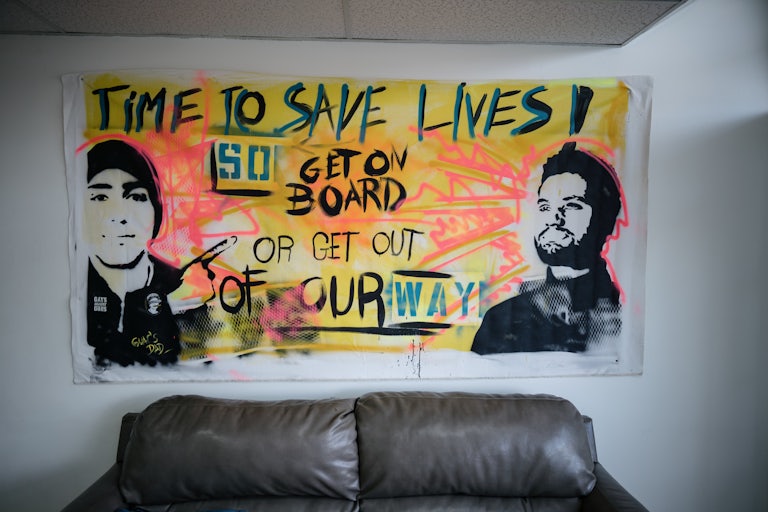
A view inside the campaign headquarters of Maxwell Frost, who was recently elected to the House of Representative from Florida’s 10th congressional district.

Young voters turned out in record numbers for Election Day and overwhelmingly voted Democratic—sending Republicans into a moralistic panic over the voting age.

About a third of voters under age 30 participated in the midterm elections, according to a study by Tufts University’s Center for Information & Research on Civil Learning and Engagement.

There was 27 percent turnout overall, and 31 percent turnout in battleground states. In fact, young voters—who favored Democrats by about a 2-to-1 margin—helped tip the scale left in several crucial races, including Pennsylvania and Michigan.

As a result, not only was there no much-promised “red wave” on election night, but many states swung in the opposite direction, although the national races remain tight. Democrats took control of state legislatures in Pennsylvania, Michigan, and Minnesota.

By Thursday morning, conservatives were clamoring to raise the voting age, although they couldn’t seem to agree on what the new age should be: There were arguments for 21, 25, 30, or simply until voters had gotten “a lil life experience.”

The demand is, of course, as ridiculous as it is hypocritical. There is no talk of also raising the age for military enlistment or, say, consent. Instead, it shows that the right is rushing to preserve its power over Gen Z rather than appealing to them through legislation.

But while it’s easy to poke fun at Republicans, a call to raise the voting age is still a call to violate voter rights.

“The fact that there are republicans calling to raise the voting age to 21 because Gen-Z showed up in HEAVY Democratic numbers last night is both laughable and terrifying,” tweeted Olivia Julianna, from the nonprofit Gen-Z for Change.

Fox News Is Having a Meltdown Over the Election Results

Right-wing media simply cannot understand the election results.

Chip Somodevilla/Getty Images

In the wake of Republicans falling short of their foretold “red wave,” right-wing media reactions have run the whole gamut.

But no other outlet has had a meltdown like Fox News:

These hosts are so unable to fathom the results that they have gone to great length introducing other convoluted theories for why Republicans lost. Fox News host Jesse Watters, for example, claimed that the Democrats are working to keep women single, and if single women just get married, things would look way different:

It’s not just Fox News, of course. On The Charlie Kirk Show, Benny Johnson yearned for a Republican who “utilizes and wields power over his enemies, and then destroys his enemies and makes them grovel, makes molten salty tears flow from their faces.” (Yes, this is an exact quote.) On Pray Vote Stand, Michelle Bachmann said the results simply don’t make sense given how much praying and repenting the right did.

These nonsensical right-wing media reactions substantiate one case for why Republicans lost. The Republican project to win majorities off of disinformation, or by desperately trying to frame Democrats as “out of touch,” can only go so far when your own project has nothing to offer.

Republicans and the media, and Fox News specifically, have for months framed Democrats as too focused on “social issues” instead of “kitchen table issues.” But voters just showed how these issues are one and the same—and that Democrats are the ones speaking to them.

Marijuana legalization, abortion access, a free and fair democracy are all ideas that have won this week, and all things—alongside items like student debt cancellation and climate and Medicaid expansion—that have buoyed Democratic success. Republicans simply do not have a plan to recoup young voters, or women voters (beyond begging for them to get married).

If Republicans remain saddled in their aimless meltdown, pointing fingers left and right and everywhere in between, we’ll keep seeing moments like these:

Can Democrats Still Win Congress? Here’s Where We Stand.

There wasn't a “red wave,” like expected.

Samuel Corum/Getty Images

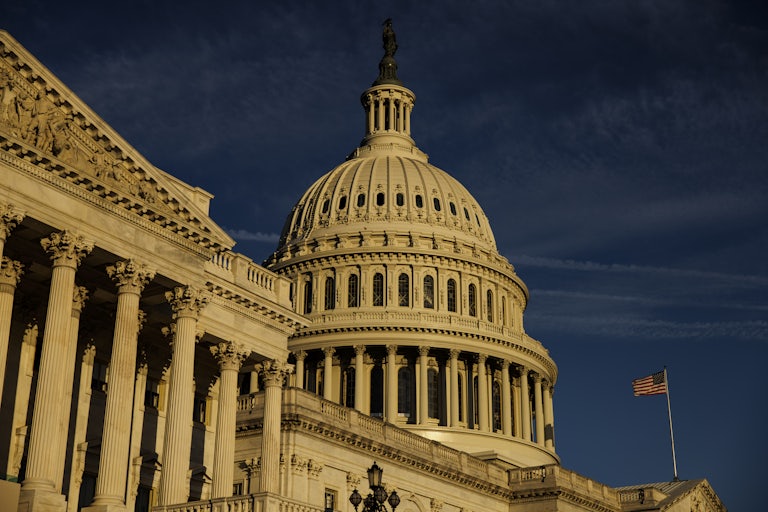
Although there was no feared “Red Wave” on Election Day, it’s still a tight race for Democrats to maintain control of Congress.

As of Thursday morning, The New York Times showed Democrats holding 189 seats in the House of Representatives, while Republicans had 207.

The Senate is still a tossup, with Arizona and Nevada not yet called and Georgia heading to a runoff in December. Arizona election officials said they may not finish counting until Friday, but since that is the Veterans’ Day holiday, it’s unclear if they’ll announce results then. We won’t know Nevada results until next week.

Some people are still optimistic that the Democrats can still pull off keeping the House, albeit by the thinnest of margins.

David Beard, who specializes in election coverage, said Wednesday night that it looked like the Democrats would win a House majority, when examining both races that had already been called and races that were not yet called but strongly favored Democrats.

Daniel Nichanian noted that Republicans were leading in the vote count for 220 seats, but only 207 had been called at the time, still leaving a lot of uncertainty.

Dozens of races still have yet to be called, as not all votes have been counted. A record-high number of people voted early, at least 44 million, and more record numbers turned out to vote in person.

It might take weeks before we know who won each state, so until then, it’s still anybody’s game.

This piece was updated to better reflect Beard and Nichanian’s tweets.

This Election Proved You Can Win on “Social Issues”

A series of Democratic wins and passed ballot initiatives show that people will show up to vote on abortion, LGBTQ rights, and criminal justice.

Jeff Swensen/Getty Images
Guests cheer at a campaign rally for now Pennsylvania Governor-elect Josh Shapiro.

In the lead up to the election, pundits strained themselves bending over backwards to claim that Democrats’ focus on so-called “social issues” leaves them out of touch from the everyday concerns “ordinary” people deal with.

But surprise: The results of the 2022 midterms prove otherwise.

All five states with abortion on the ballot—California, Michigan, Vermont, Kentucky, and Montana—voted to increase access. These are not all blue states. The results also come after voters in typically conservative Kansas voted in August to keep abortion protections in the state constitution.

Voters in Maryland and Missouri elected to legalize recreational use of marijuana, opening pathways to expunge convictions for people punished for conduct now legal under the new law. While Maryland is a reliably blue state, Missouri is not. Former President Donald Trump won Missouri by 15 points in 2020.

Even in states where marijuana legalization initiatives did not pass, the measures overperformed relative to Democratic results. In North Dakota, the measure failed by just under 10 points, while in South Dakota it fell short by about six. In Arkansas the measure failed by about 13 points. Trump had won by over 25 points in all three of those states in 2020.

Candidates who were unafraid to embrace “social issues” also fared well.

Los Angeles city controller candidate Kenneth Mejia won after a campaign where he explicitly called for cuts to the police budget—placing giant billboards displaying how outsized the city’s police budget was, and asking voters to reconsider where their tax dollars were going.

The 32-year-old beat Paul Koretz—who had been on the city council since 2009—by over 20 points.

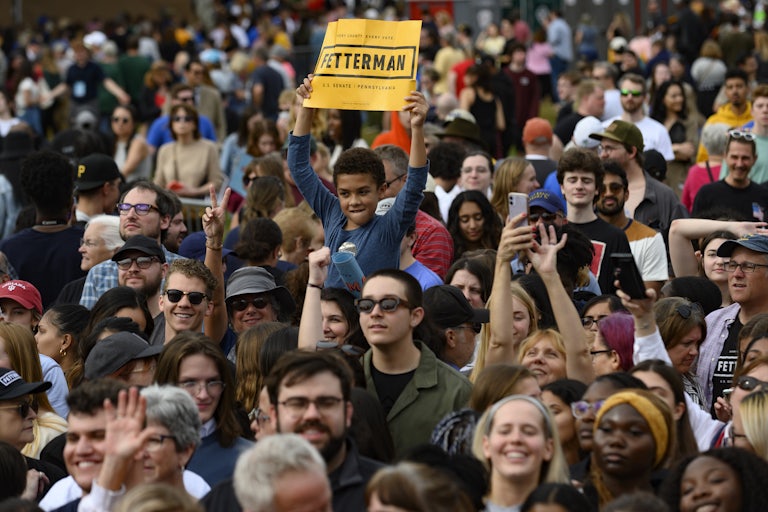
In Pennsylvania, John Fetterman bested Mehmet Oz, flipping a seat formerly held by a Republican. Fetterman has been just as outspoken on trans rights as on eliminating price gouging and enacting a more fair tax code.

Alongside Fetterman was Josh Shapiro, who handily won Pennsylvania’s gubernatorial race. Just days before the midterms, Shapiro went viral for remarks he made at a rally explaining what exactly freedom is. He connected same-sex marriage, book bans, and abortion access alongside public education investment, union membership, and a secure democracy.

His ideas—and the public’s overwhelmingly positive response to them—shows how “social issues” are not in contention with “kitchen table issues.” They never were. It’s offensive to pretend otherwise.