Newsletter
Fighting Words
What got me steamed up this week

The Trump Indictment: He’s Had this Coming for Years

There are things we know about the indictment, and things we don’t know. But there’s One Big Truth: This feels like justice coming.

Trump in Grimes, Iowa
Al Drago/Bloomberg via Getty Images
Trump in Grimes, Iowa, on June 1

So Donald Trump has been indicted on seven counts related to the classified documents he took to Mar-a-Lago, the charges reportedly including violation of the Espionage Act, making false statements, and obstruction of justice. Here are some other things we know, and some things we don’t know.

We know: This is historic. A never-before development for a 247-year-old democracy that has historically shown extraordinary deference to its presidents and ex-presidents. Trump and his defenders will twist this to suggest that he’s being attacked by a weaponized “deep state.” On planet Earth, it means that Trump singularly may have (even he is still presumed innocent!) violated laws and norms that everyone else followed.

We know: There is a real and undisputed record of Trump ignoring polite requests from the FBI to cooperate in their investigation into the matter, and later stonewalling the bureau when it decided it had to stop being polite.

We know: Despite Trump’s ridiculous protestations, his flagrant disregard of classification laws makes this case very different from those of Mike Pence and Barack Obama and, most saliently, Joe Biden. Biden’s situation has not yet been resolved, and that may take some time. But it seems likely that some aides made some mistakes, and that’s what the probe will find, as it just did with Pence (I’m obviously no fan of Pence, but he, like Biden, is not a blatant lawbreaker). It will be important to keep pounding on this distinction, because Trump will hammer on it.

We don’t know: precisely what these seven counts entail and spell out. Obstruction of justice is reportedly present in those seven counts. And that’s the big deal—if Trump had said okay, you’re right, sorry, and returned the documents? Probably no case.

We don’t know: what’s in the documents Trump kept.

We don’t know: how seriously he may have compromised U.S. intelligence gathering or sources.

We don’t know: when this may go to trial. In federal court in Washington, it takes a year. In south Florida, it could all happen much faster, on the “rocket docket.” The Manhattan judge on Trump’s first indictment, brought by Manhattan DA Alvin Bragg, has already set a March 24 trial date—the thick of the later presidential primaries. What if this goes to trial around the same time? And remember, there is probably at least one more indictment coming, down in Georgia.

The key thing here is what’s in the documents. That’s where public opinion will say: Yes, this was a justified and necessary action by the federal government, or no, this is political. We know that about 35 percent of the country will view this as a witch hunt. I think a bit more, say 45 percent, will view it as justified. But that leaves 20 percent—a 20 percent that includes a lot of Trump voters. U.S. special counsel Jack Smith, who seems like one bad dude, knows what’s in the documents. I doubt he’d uncork an indictment if the documents featured talking points of condolence for the ambassador of Mongolia upon the death of the head of state.

In other words: What Trump did here is alarming, in terms of law and process. It’s also, maybe, an open-and-shut case. Former Attorney General Eric Holder told MSNBC’s Chris Hayes on Thursday night: “This is not a particularly difficult case.” That may be, legally. But politically, the American people will want to see that what Trump did was genuinely reckless. My bet is that Smith has that political horse sense. We’ll soon see.

But the bottom line here, and the One Big Thing that we know above all else? Donald Trump has had this coming. For years. This feels like justice coming.

It’s not just that he mocked and ignored the law for decades when he was in the scuzzy world of New York real estate, although it is that, to some extent. But it’s much more: He became, by means fair or foul, the president of the United States. Presidents have obligations to the people—all the people—that no one else in our system has. They have to, or certainly should, embody the best of our traditions. They should, like Biden does, genuinely and from the heart, venerate the Americans who gave their lives for this country. I have very mixed feelings about a lot of our wars. But I want the president, who by the bye is also the commander in chief, to humble himself before the memory of people who died in them. I do not want him to call them suckers and losers, as Trump did.

And they have to revere the law. This has been a given, throughout our history—until Trump. Well, Dick Nixon, but once he was caught, he, too, admitted he was wrong and surrendered power. Only Trump knows and respects no law. He got away with that when he was in the inherently sleazy business of slapping his name on casinos. But the presidency of the United States is not an inherently sleazy business. Or at least it’s not supposed to be. Trump made it that. If there is any justice left in this country, he will die in a jumpsuit that matches his cratered skin.

This article, which has been updated, first appeared in Fighting Words, a weekly TNR newsletter authored by editor Michael Tomasky. Sign up here.

An Ugly Republican Primary? It’s About Time!

Why 2024 may look nothing like 2020.

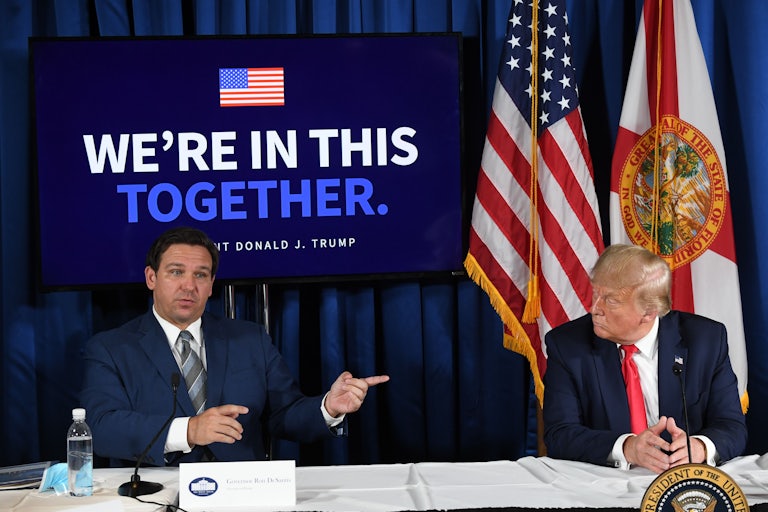
Ron DeSantis and Donald Trump sit at a table with a banner reading "We're in this together" behind them.
SAUL LOEB/GETTY IMAGES
They're getting ready to rumble.

Donald Trump and Ron DeSantis are laying into each other. Trump makes his juvenile cracks about how to pronounce DeSantis’s name. Dee/DuhSantis counters by calling Trump’s jibes, well, “juvenile,” and had a bus paid for by a super PAC supporting him follow Trump across Iowa, mocking him.

Politico calls this “savagery,” or at least a “path of savagery.” That seems a little overstated to me, at least for now, but this is something new, and it’s worth thinking about: The 2024 GOP presidential primary could get mean and brittle in a way no Republican primary has been since … well, let’s think:

Since 2020? No, that was just Trump.

Since 2016? That race had its moments of bitterness, but the governing dynamic, as you may recall, was that most of the other Republicans refrained from attacking Trump on the assumption that he wouldn’t last and they would gather up his supporters. Marco Rubio notably broke from this mold and lobbed some grenades Trump’s way, but he ended up sounding more like Don Rickles than a candidate for president.

Since 2012? There were some tense moments between Mitt Romney and Rick Santorum. But the bottom line was that you never thought Romney was really going to lose.

And this is why 2024, just maybe, could be different: There just might be actual drama about the outcome.

I know it doesn’t seem that way now. Trump is way ahead. And the more people who join the race—there are seven well-known candidates now (and two no-names), and Chris Christie next week is going to make it eight—the more it favors Trump, because he is presumed to have his 30 percent, which leaves seven people splitting the other 70 percent. Even I can do that math.

But just this once let’s play around with this hypothetical. Trump is indicted by Jack Smith. That’ll be indictment number two. Then he is indicted by Fani Willis in Georgia. That’s number three. The conventional wisdom is that this will merely galvanize his supporters, and that’s surely true of many or probably most of them. But all of them?

Elections are about percentages. Sweeping statements of conventional wisdom tend to ignore this. Some percentage of Trump’s base will, in fascist fashion, adhere to him all the more loyally, and they’ll buy all the deep-state garbage he dumps into the civic bloodstream. Some percentage will basically stay with him but start to entertain some practical doubts about whether he’s the best person to send into battle. And finally, he’ll lose some percentage.

It’s anybody’s guess as to what that number is. But let’s say it’s a quarter of his base. If we’re calling his base 30 percent, that’s 7.5 percent of the electorate. That takes him down closer to 20 percent. That’s a different race.

Now throw on top of the indictments the reality that at least two candidates, DeSantis and Christie, will be attacking Trump directly. People tend to roll their eyes about Christie’s candidacy, and eye-rolling is the right response if the question is “Can he win?” But that’s the wrong question. Nobody thinks Christie can win. I very much doubt even Christie thinks he can win. No—he’s getting in to stop Trump. There’s no other rationale.

Christie’s track record with respect to Trump is a long way from consistent and admirable, and Fox will have no trouble finding clips of Christie sucking up to Trump. But lately, he’s been a consistent critic. He called Trump “Putin’s puppet.” As USA Today reported this week, Christie is basically going to camp out in New Hampshire, ignoring Iowa and other early states. The idea is obviously to try to convince New Hampshire’s sometimes prickly and unpredictable electorate to turn on Trump and stop him.

If that works, and Trump loses New Hampshire, then we have a race. The outcome will actually be in doubt, at least for a while. Christie and DeSantis, and by that time perhaps others, will lay into Trump. This will be new. What will this Trump—thrice indicted, under constant barrage of attack—be like on the campaign trail?

There really aren’t any serious fissures in the Republican Party today. It’s an ethnonationalist, anti-democratic, neofascist, anti-freedom party that really only cares about creating a moral panic over certain Americans it finds threatening to its brittle and reactionary righteousness. There’s no serious disagreement about any of that. There are merely people who are gung ho about it, and people who would prefer for various reasons to soft-pedal it. But they’re all on board with the basic program. If they weren’t, they’d nominate a candidate who opposed all that, but there is no chance of that.

The only fissure is a tactical one, over Trump. Is he the best field marshal to advance the moral panic? That’s what the 2024 primary will be about. The odds still favor it not being much of a fight. But the Trump-DeSantis pre-savagery this week, combined with Christie’s coming entry, means there’s a chance that all this could get desperately ugly next year. Make that nasty. It will already be ugly.

This article first appeared in Fighting Words, a weekly TNR newsletter authored by editor Michael Tomasky. Sign up here.
This Was a Wagnerianly Bad Week for Donald Trump

With legal cases piling up, the former president may be destined for a jumpsuit to match his skin tone.

Andrew Milligan/Getty Images

Nearly every week is a bad week for Donald Trump these days, but this week brought developments that, while extremely gratifying from my perspective, are monumentally, roaringly, Wagnerianly bad for the former guy. It now looks somewhere between probable and certain that as he seeks the presidency, Trump will be staring—at not one, not two, but three indictments—as well as at least one criminal trial, which we learned this week is going to happen in the thick of the presidential primary season.

I don’t want to speak too soon. The wheels of justice grind slowly, and they can roll very timidly where presidential office-seekers are concerned. But we’re getting closer with each passing week to being able to say that by running for and becoming president, Trump finally went too far and made his biggest mistake. If you’re a rich private citizen in this country, you can break the law all you want, short of things like actual murder, and the law might never catch up with you. But take a public office, and suddenly an entirely different set of laws applies to you, the scrutiny of your words and deeds—past and present—becomes white-hot intense, and the system takes your misdeeds far more seriously than a mere failure to pay your taxes. This can take a person who became accustomed to ignoring the law over the course of 50 years by surprise—though in fairness, it could be a big reason more white-collar criminals don’t run for president.

Let’s go through the three cases, with which you may have some familiarity. The first is the criminal indictment already unsealed, that of Manhattan DA Alvin Bragg, over the Stormy Daniels hush money and the whole National Enquirer “catch and kill” business. This week, Judge Juan Merchan (by the way, he is a native of Colombia; I’m starting an over-under pool on when Trump starts pointing this out) set the trial date for next March. Also on the schedule for next March: No fewer than 25 primaries—13 on Tuesday, March 5 (Super Tuesday), and another dozen following over the course of the month.

Picture it: It’s Tuesday, March 12. The date of the primary in the crucial state of Georgia, the state Trump most blatantly tried to steal in 2020. Ron DeSantis is in the Atlanta suburbs. Nikki Haley is in Columbus. Tim Scott is in Macon. Asa Hutchinson is in Augusta. Mike Pence is barnstorming his way from Valdosta to Albany to Vidalia. And Donald Trump is in a courtroom in Manhattan testifying, lying his brains out, as will be obvious to everyone watching except the MAGA people.

Case number two is the big one: where special prosecutor Jack Smith enters the chat. Reports came out this week that Smith could be within weeks—some say within days—of bringing charges against Trump. The Washington Post reported Thursday that two Mar-a-Lago employees moved boxes of papers the day before a June 2022 visit by FBI agents (this was not the raid—that was August—it was just a visit) looking to collect classified documents pursuant to a subpoena that May.

It could be a coincidence. (There are a lot more coincidences in this world than people think.) But it looks pretty weird. Legal experts seem to be in agreement that the classified documents situation represents Trump’s biggest legal Achilles’ Heel. And remember—Smith is also investigating Trump’s role in the January 6 attacks. We all saw Trump egg on the violence in a way that meets any human common-sense standard. But meeting a legal standard is a higher bar. So that may be harder to reach.

But the encouraging development along these lines this week? There is renewed speculation about what’s going on behind the scenes with Mark Meadows, the White House chief of staff at the time. CNN reported this week that Meadows is quietly advising the House Freedom Caucus on the debt-limit fight. But that report also noted that Meadows is no longer in touch with Trump, which has led to speculation about whether Meadows is cooperating with Smith. A former Defense Department counsel tweeted the CNN story and wrote: “If he’s cooperating, game over.” Others were skeptical that Meadows would cooperate against Trump. But prosecutors have leverage. If Meadows is cooperating, well, there’s probably no one, not even Melania, who possesses a fuller mental log of the things Trump did and said that day.

We circle back to Georgia to consider the third case: Fani Willis’s probe into Trump’s frantic search for the famous 11,780 votes he called for to be added to his short-of-Biden’s-tally total. Willis appears almost certain to bring an indictment against Trump in August, a date she announced a week ago today. (See what I mean about this being a spectacularly bad week?) This investigation has long seemed the most open-and-shut of all the cases against Trump, given that the whole world has heard him on the telephone instructing state officials to go find him the votes.

So, let’s assume indictments from Smith and Willis. When would those trials commence? In all likelihood these, too, would kick off sometime next year. (Though I suppose that maybe one will have to wait for the other; all indictments answered in the order they are received and all that,) Still, it’s just wild to imagine what this could all look like, what kind of presidential campaign we might have if one candidate is moonlighting as a semi-professional defendant.

We must, of course, admit of the possibility that the GOP will nominate Trump anyway and, by Election Day, he will be thrice acquitted.

But it sure seems more likely that a harsher outcome awaits him. Let’s just look at the post-presidential legal track record. In December 2022, the Trump Organization was found guilty on all charges of tax fraud. Earlier this month, a jury took about three minutes (okay, not literally) to agree that Trump sexually abused E. Jean Carroll. There’s a pattern here.

There remains the question of whether there’s a point at which this all becomes too much even for Republican primary voters. A third indictment may be a bridge too far; they might decide at long last that Trump’s no longer worth the trouble. But he’ll turn this into Armageddon. It will get ugly—perhaps terrifyingly so. But the end times are coming, all right—not for the world, but for Trump. If he’d stayed a private citizen, the law wouldn’t have gone to the expense and trouble of nailing him. But he became a public servant. As corrupt as our country and legal system are in many ways, you just can’t do anything you want as a public servant. The system eventually says enough. Let’s sit back and enjoy every delicious minute of watching him learn this lesson.

This article first appeared in Fighting Words, a weekly TNR newsletter authored by editor Michael Tomasky. Sign up here.
Did Donald Trump Seriously Sell Pardons?

The sexual assault lawsuit against Rudy Giuliani is chock-full of other shocking allegations.

DON EMMERT/AFP via Getty Images
DON EMMERT/AFP/Getty Images
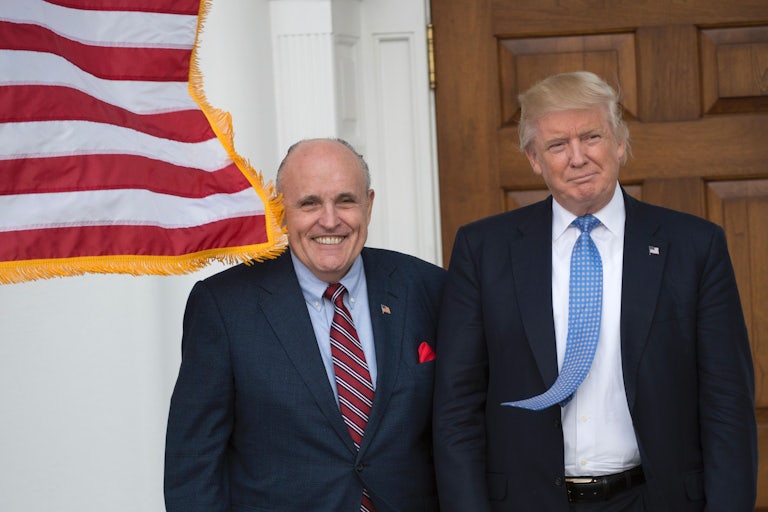
Trump and Giuliani in 2016

It’s established fact that Donald Trump is deep in the legal soup. The Trump Organization was found guilty of criminal tax fraud. Trump was indicted by Manhattan District Attorney Alvin Bragg over the payment to Stormy Daniels and those “catch and kill” payments that buried negative stories about him. A separate New York jury found that he sexually abused E. Jean Carroll.

That would be reasonably “impressive” for any gangster, but for Trump, it’s just the appetizer. Fani Willis, district attorney of Fulton County, Georgia, is expected to drop the hammer by August. And special prosecutor Jack Smith continues to look like he’s loading the cannon with grapeshot, getting ready to indict Trump on both January 6–related charges and his … expropriation of classified documents.

But this week, we learned that it’s quite possible that none of that is the worst thing he may have done. Noelle Dunphy, who worked for Rudy Giuliani back in 2019, filed a complaint this week alleging all manner of grotesque behavior by her old boss. But even as I waded through that sordid muck, I gasped when I got to paragraph 132:

[Giuliani] also asked Ms. Dunphy if she knew anyone in need of a pardon, telling her that he was selling pardons for $2 million, which he and President Trump would split. He told Ms. Dunphy that she could refer individuals seeking pardons to him, so long as they did not go through “the normal channels” of the Office of the Pardon Attorney, because correspondence going to that office would be subject to disclosure under the Freedom of Information Act. 

What?

This hasn’t gotten nearly the attention it deserves, partly because the bulk of her complaint is far more sensational and gross, as it has to do with allegations of forced sexual service and morning boozing, and partly because the news cycle has been pretty crowded this week.

But think about it. A president selling pardons is morally and ethically right up there with the Catholic Church selling indulgences, a practice that has gone down rather poorly in history—and that led, more or less, to the rebellion against the Church that became the Protestant Reformation. As Trump’s possible crimes go, it may not be quite the equal of trying to orchestrate the overthrow of the U.S. government. But it’s bad. It’s impossible to imagine any other recent American president having contemplated such a thing (Nixon? No, not even Nixon, I don’t think). But with Trump … well, of course this is just an allegation, but who on this earth—this earth, not Jim Jordan earth—thinks he’s above such a thing? And Giuliani? The Giuliani I knew 30 years ago would not have done such a thing. But this Giuliani?

Let me put it to you this way. Bill Barr was on Fox this week. Bret Baier asked Barr if he thought such an allegation could be true. Barr sighed: “Uh, I’m skeptical about that. I don’t think Rudy Giuliani would do that. I hope he wouldn’t, but I don’t know.”

Note that Barr expressed the hope that Giuliani wouldn’t do such a thing. But with respect to Trump, he expressed no such hope. Left unsaid but clearly implied: Of course Trump would do such a thing! And this is the guy who shilled for Trump on several occasions.

There’s reason to suspect there may be some fire behind this smoke because this has come up before. In January 2021, when everybody was obsessing over the insurrection, The New York Times reported on the “brisk market” in fees for Trump allies helping to arrange last-minute pardons for various people. There was the case of a onetime Trump adviser who was paid $50,000 to try to get a pardon for John Kiriakou, a former CIA officer convicted of selling classified information. The Times reported that Kiriakou was “separately told” (by whom, it didn’t say) that Giuliani could help him secure a pardon for … $2 million. Kiriakou rejected the offer. Someone told the FBI about it. Giuliani denied it.

Kiriakou appeared on Democracy Now! this week and told Amy Goodman of a meeting he had with Giuliani and others at Trump’s Washington hotel. Kiriakou said he asked Giuliani about a pardon. Giuliani got up and went to the rest room. Kiriakou asked the aide what just happened. The aide said, “You never talk to Rudy about a pardon. You talk to me about a pardon, and I’ll talk to Rudy.” Kiriakou said OK. The aide said: “Rudy’s gonna want $2 million.”

There it is. So paragraph 132 of Dunphy’s complaint didn’t materialize out of thin air (although the fact that it was public previously could conceivably mean Dunphy’s lawyers included it based on those news accounts).

Now let’s look at some of the folks Trump pardoned, or whose sentences he commuted, just before he left office. It was a long, long list. There were a lot of narcotics traffickers, and while this doesn’t exactly mesh with the Republican Party’s hard-line stance on the matter, let’s be kind and assume that some of those were actually sort of humane.

But there were at least seven or eight people who were involved in Ponzi schemes or other forms of fraud. I’m not accusing these people of anything. I’m just pointing out that Trump pardoned (or commuted the sentences of) people who probably had access to or could rustle up a significant amount of cash.

Trump’s already-known abuse of the pardon system is that he pardoned or gave commutations to so many people who were involved with him—Michael Flynn, Roger Stone, and so on. This constituted a flagrant abuse of power. At the Constitutional Convention, when they were debating the pardon power, George Mason said the president “ought not to have the power of pardoning, because he may frequently pardon crimes which were advised by himself. It may happen, at some future day, that he will establish a monarchy, and destroy the republic” (big points for prescience there, eh?). James Madison rejoined that, well, Congress could always impeach such a president. Right.

So Trump has already violated the spirit of the pardon language. Now we learn he might have violated laws too (specifically, these laws). Again, we don’t know it to be true. But surely there’s good reason for the Justice Department to look. And it’s safe to say that this is unlikely to be the last shocking allegation we’ll hear about the man who remains the GOP front-runner for 2024.

This article first appeared in Fighting Words, a weekly TNR newsletter authored by editor Michael Tomasky. Sign up here.

Remember “Defund the Police”? Well, Guess Who’s Actually Proposing Doing It.

The House Republican’s debt ceiling bill has several nasty surprises for anyone who “backs the blue.”

Drew Angerer/Getty Images
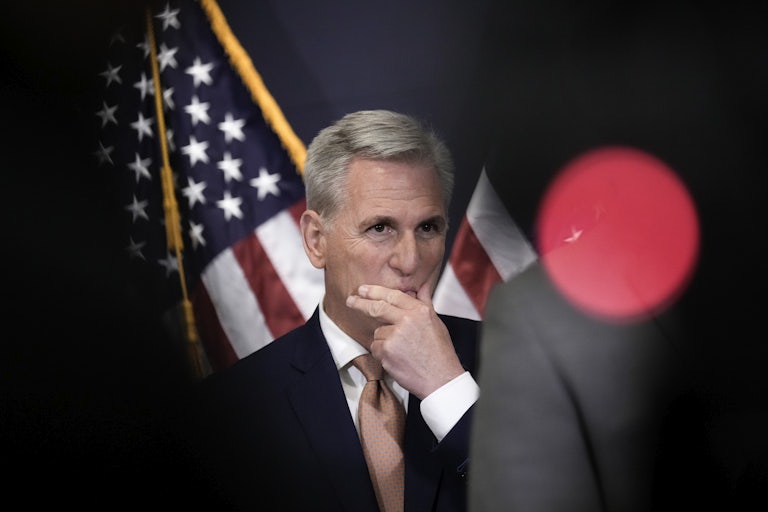
Speaker of the House Kevin McCarthy

We hardly go a week without seeing yet another example of Republican hypocrisy. They claim to live according to God’s law and family values, and yet some hectoring moralists in their ranks will splash into the tabloids after getting caught in a love nest. They preach about the rule of law and then back every lawless move Donald Trump makes. They natter on about freedom, but when it comes to the freedoms of women and LGBTQ people, well... I could, as you well know, go on and on.

But here’s a particularly hilarious and galling example of Republican hypocrisy, on display in the ongoing debt ceiling fight. Last week, the House Republicans passed their debt-limit budget bill, with all but four members of their caucus voting aye. The bill puts off the debt limit problem for a year, but in exchange, it demands a raft of the usual right-wing priorities—work requirements for poor people getting government assistance, the repeal of student-loan relief, attacks on Joe Biden’s renewable energy priorities, and, just to show us all how proud they are of their hatred of science, boosts for fossil-fuel production.

The bill also would result in massive cuts to most government programs, because it shields the Pentagon, which eats up about 16 percent of the federal budget, from any trimming. Around two-thirds of federal spending goes to things Congress can’t really change like entitlements and interest payments. That places the remainder of federal spending under the guillotine. The White House says most domestic programs would face cuts of 22 percent.

The list of affected programs includes the usual things Republicans hate. But it also includes some things Republicans claim to love.

What am I referring to here? Well, let’s recall how, in the aftermath of George Floyd’s murder, activists introduced the phrase “defund the police” into the public discourse. At the time, Republicans tried to hang that phrase on President Joe Biden and Democrats like stink on a pig. But while a handful of Democrats in deep blue districts took up the call, the rest of the party from Biden on down said no, we don’t support that. (Perhaps they should: If we lived in a world where we could have a rational debate about these things, we might be able to agree that police departments handle some matters that would be better attended to by social-service agencies, but that isn’t our world.)

Institutionally, Democrats have never wanted to defund the police. In fact, last year, Biden sought $37 billion in additional federal funding for police departments. The Republican debt ceiling bill, however, would defund the police! At both the local and federal levels.

Let’s look at the numbers. Federal spending on local law enforcement isn’t a huge program. But there are two categories of federal spending on police that are reasonably significant. The Community Oriented Policing Services program, or COPS, doles out $225 million in grants to local police departments. Another grant program called the Byrne-JAG hands out a little more, around $270 million or so. These dollars are used for personnel, equipment, crime prevention, and so on. A lot of money goes to small-city and small-town departments—which is to say, police departments in red America.

Democrats are more inclined, given their interests and priorities, to make noise about social-service cuts. They should do that—those cuts are unpopular too. Some examples: The Office of Management and Budget estimates that the GOP bill would result in the layoffs of 108,000 teachers, and 30 million fewer outpatient visits for veterans.

Americans generally like teachers and veterans. I have days when I think Biden should just roll over, let the Republicans have their way, and say to America, “Okay, folks, let’s live according to Republicans’ priorities for a while,” just so people can feel the impact of the cruelty and hypocrisy in their daily lives. But as a liberal, I actually give a crap about things like kids having an adequate supply of teachers and veterans getting decent care, so I’d rather not subject ordinary Americans to the full impact of the Republican Party’s grand social experiments, edifying though they may be.

Oh—I haven’t even mentioned the border! The southern border is just about all that Republicans talk about. Whenever there’s a huge story that runs against them in the news, a Trump indictment, or some other scandal, I flip on Fox to see how they’re handling it. And nine times out of 10, they’re handling it by yammering about the border. “Border” is the GOP’s safe word. But their debt ceiling bill would eliminate funding for 2,000 border agents!

Finally, their bill would eliminate funding for more than 10,000 FBI personnel. This no longer counts as hypocrisy, I suppose, since Trump has turned those people into deep staters. But it sure can’t be popular. And it will have obvious knock-on effects that could land heavily on ordinary people.

Biden and the Democrats have two roads they can travel here on the debt limit debate in these next three weeks. One is to highlight Republicans’ heartlessness. The other is to showcase their hypocrisy. I see no reason why they can’t do both, and I sure hope Democrats don’t ignore the hypocrisy angle. That theme would also highlight the fact that Republicans happily passed debt limit increases during the Trump presidency when they controlled the Senate and House—twice when they controlled Congress, and once when Democrats did (and Kevin McCarthy voted for all three, by the way).

Republicans do these things because they’re shameless, and they know that the average person is too busy living their lives to sit down and connect these complicated dots on their own. That’s why it’s the White House’s job to do that for them. It’s how Democrats win this fight.

This article first appeared in Fighting Words, a weekly TNR newsletter authored by editor Michael Tomasky. Sign up here.