Breaking News
Breaking News
from Washington and beyond

Rudy Giuliani Is a Disgusting Creep (Who Also Tried to Sell Pardons)

A new lawsuit against Giuliani has some horrifying details—of how he allegedly raped an employee and how he plotted to undermine our democracy.

Rudy Giuliani
Spencer Platt/Getty Images

Former New York City Mayor and Trump lawyer Rudy Giuliani allegedly promised to pay a woman a $1 million annual salary to be his close associate, and instead raped and abused her over the course of two years. He was allegedly constantly drunk, plotted to sell pardons to criminals, and made racist and antisemitic comments. And he also apparently never paid the woman he abused for months on end.

The litany of disturbing accusations come in a $10 million lawsuit buttressed by phone records, thousands of emails, and recorded conversations, all brought by the victim, Noelle Dunphy. The bombshell lawsuit reveals in great detail how Giuliani sexually assaulted his employee and, at the same time, how he has long been planning to undermine our democracy.

Dunphy’s lawsuit states that Giuliani allegedly first met her in 2016, in the lobby of the Trump Tower. The Trump lawyer asked her details about her life and suggested his interest in hiring her. Three years later, Giuliani sent Dunphy a Facebook message and friend request.

Incredibly odd timing, but Dunphy was coincidentally looking for a job. Soon enough, Giuliani offered her a proposal that seemed too good to be true: Be his director of business development for the Giuliani Companies and also his personal executive assistant—all for a $1 million salary.

But it all came with one strange provision: Her pay would have to be deferred, and her employment kept a “secret” until Giuliani’s divorce proceedings finished up. Giuliani apparently claimed his ex-wife and her legal team were monitoring his finances and so he was somehow limited in his financial decisions; moreover, his ex-wife would “attack” and “retaliate” against any female employee he would hire.

A final attachment to the offer? After Giuliani found out Dunphy was a domestic abuse survivor, he offered to represent her pro bono in any legal matters related to her case.

According to the lawsuit, the grossness immediately ensued. Literally after the interview, Giuliani made Dunphy come to a meeting with his team and Ukrainian associates to discuss her work with the company. During that meeting, Giuliani drank excessively and pressured Dunphy to join along. Afterward, Giuliani told his bodyguard to buzz off, so he could have some private time with Dunphy in the backseat of a limo serviced car.

Once alone, Giuliani kissed Dunphy and asked if he could come into her home; she declined and thanked him for the job. But before the goodbye could happen, Giuliani leaned even further in, saying that since the pair would be working from different locations, he would like it if Dunphy sent him flirtatious photos. After Dunphy finally escaped, Giuliani still called her five times that same evening.

And that repellent first day characterized much of what was to come. The lawsuit’s allegations are too numerous to detail, but here are just a few disturbing accusations.

On many occasions, as soon as four days into the job, Giuliani forced Dunphy to give him oral sex; he often made this demand while he was on the phone with high-profile individuals, including then–President Donald Trump. He forced Dunphy to begin working at his apartment, rather than the Giuliani Companies office. He demanded that “she work naked, in a bikini, or in short shorts with an American flag on them that he bought for her.” Even when apart, he directed Dunphy to remove her clothes and would meanwhile visibly touch himself.

Giuliani rapidly grew more possessive, texting Dunphy things like “You’re mine,” and “Nobody will ever have you now,” and even giving her a battery pack for her phone so she had no excuse not to be at his beck and call. Soon, he forced Dunphy to have sexual intercourse with him; he allegedly would not take “no” for an answer. He also wholly disregarded Dunphy’s boundaries as a domestic violence survivor, imposing his interest in BDSM (bondage, dominance, sadism, and masochism) onto her on numerous instances. And during sex, he called her a “cunt,” a “bitch,” and “Rudy’s slut.”

“I think of you as my daughter. Is that weird?” he once asked Dunphy while sexually abusing her.

Outside of the constant sexual abuse and surveillance, Giuliani told Dunphy that if she knew anyone in need of a pardon, he and Trump were going in on selling them for $2 million a pop. He confided in her various plans to try to overturn the 2020 election results if Trump lost the election, including spreading the theory that “voter fraud” occurred.

And Giuliani’s abuse wasn’t limited to Dunphy, according to the lawsuit. Giuliani also made numerous inappropriate comments about other women. He told Dunphy of his being in love with three or four women, including his attraction to a 20-year-old employee more than 50 years younger than him. He apparently fantasized about her, and kissed her on the lips but did not “consummate” the relationship. He “just could not control” himself around her, he said, in a recorded conversation.

Beyond being a sex pest and cartoonish criminal, Giuliani also apparently was a Luddite; he had to have Dunphy explain to him what a podcast was.

When all was said and done, by the time Giuliani fired Dunphy two years later, she alleges she was paid only $12,000 of what should’ve been $2 million—for the job she was told she was getting.

The vile extent of Giuliani’s alleged behavior is, again, too long to list here. A final taste of what else he reportedly said: He used the word “fag” to refer to actor Matt Damon. He mocked Senator Elizabeth Warren, saying: “Pocahontas was a really hot babe, and Warren does not look like a babe. She looks like a person in search of a gender.” He also later said he was “very hot” for Warren. He stated that he would “get in trouble with underage girls” if they were 16 but looked 20. He implied that Jewish men’s penises were inferior, due to “natural selection.” He told Ms. Dunphy that “black guys hit women more than anybody else does … and so do Hispanic guys—it is in their culture.” He said, “Jews want to go through their freaking Passover all the time, man oh man. Get over the Passover. It was like 3,000 years ago. The Red Sea parted: big deal. It’s not the first time that happened.” And he made comments about “freakin Arabs” and Jews.

To Giuliani, it seems, the most praiseworthy people are 16-year-old girls he could get away with sexually harassing.

Again, the lawsuit alleges that recordings for a lot of these comments exist, so expect this story to only get worse from here on out.

Helen Gym Is Not Here to Tinker Around the Edges

The progressive Philadelphia mayoral candidate wants you to reimagine what it means to build a movement.

Philadelphia mayoral candidate Helen Gym seated with a bookcase behind her
Samantha Laub /AL DÍA News/Getty Images
Philadelphia mayoral candidate Helen Gym

“The only thing that is fixed or that could be fixed is the idea that you stay silent when everything is happening around us.… Our task is to not stay silent.”

This is what Helen Gym told The New Republic Sunday, just hours before she took the stage alongside Senator Bernie Sanders and Representative Alexandria Ocasio-Cortez at a rally with over 1,000 attendees.

Gym is among a crowded field of candidates vying to earn the Democratic nomination for Philadelphia mayor during Tuesday’s primary. Recent polls have shown Gym tied with at least two other candidates, and a whole front-runner’s worth of voters who remain undecided.

But what makes Gym’s candidacy distinct is her track record for challenging conventional modes of thinking—whether on preventing crime; building safer communities; or what it means to be an activist, a teacher, or a politician.

The Philadelphia race follows the victory of Brandon Johnson in Chicago’s mayoral election, in which the former educator himself won a platform that reimagined public safety.

Gym spoke with TNR about what brought her to the race at all, her long history fighting for her neighbors, and why relentless action in the face of stacked odds is not “blind hope” but rather just building capacity to fight bigger and bigger battles.

Prem Thakker: How are you?

Helen Gym: That’s a hard question. I feel good. No, we feel really great. Today is a great day. It’s been a great weekend.… People are energized. People are listening, paying attention. They’ve been watching debate. You know, it’s great.

P.T.: Do you listen to music, and if so, what have you been listening to lately?

H.G.: Oh, I do … I’m obviously a Lizzo fan of course. About Damn Time. About Damn Time is our song.

P.T.: Could you tell me about your time as a teacher, what you learned about the city during that time, and how that propelled you further into activism?

H.G.: Yeah, I don’t see those as being separate, just to be clear. I mean, one of the things that I think I really loved about teaching was that it just opened up a world of activism. I would obviously teach during the day, but right after school I get on the 47 bus and take it 10 miles or so into Chinatown, where I would be working at Asian Americans United to stop communities from being displaced, to make sure that people’s civil and voting rights were upheld, and to have an even bigger space to talk about education and healthier families and strong communities and neighborhoods.

Teaching also opened me up to a broader national movement. I joined national-level organizations, including some which are now defunct, but national-level organizations that were really focused on teaching and learning curriculum, vibrant, multiethnic curricular practices. You know, how teachers can lead from the classroom, as well as being the friend of a classroom, and real investment in young people. So to me the classroom was my profession, but teacher activism was my life. And I helped start a citywide education newspaper during that time. I joined the founding board of an arts organization that is still in existence today. And then, of course, continued to actively mobilize in Chinatown and with immigrant communities that were fighting mass detention and deportation as well as mass incarceration. In other words, education never felt limited. It felt like it was just an expansive introduction to a world of hope and activity and change.

P.T.: You use the words “hope” and “expansive.” That speaks to this seeming upsurge of candidates from all over the country—whether it’s Jamaal Bowman, or Brandon Johnson, or you—former educators who, in coming from the education system, seem to hold this sort of intimate understanding of how we perhaps are failing children, or how we could be doing even better for them or giving them more hope, or by building our school system, we could build a better future. I wonder if you’ve thought about that pattern.

H.G.: Definitely. And, can I just add to this, Congresswoman Hayes, who was Teacher of the Year, out of Connecticut. And Latoya Cantrell, who is the mayor of New Orleans. She didn’t come out of education and teaching, but she came out with a strong identity as a mother and an activist, post-Katrina. I think what is very clear is that for many of us … I believe that building the care and keeping of children and, by extension, their families, communities, and neighborhoods, as well as the public institutions that serve them are fundamental to our politics.

If you can leave a child behind, right, if you can deny them a functioning public school, arts and music opportunities, a roof over their heads, you will leave behind their parents, you will leave behind their neighborhoods, and you will ultimately leave behind that city. And I think many of us who have dedicated our lives to building stronger youth and families understand that this is not an education agenda. It is an economic security agenda. It is a public safety agenda. It is a, you know, city revitalization agenda, and that’s what we’re trying to lead with. I think we have gotten some things twisted about what actually drives the American economy, what helps cities grow, and what builds a resilient and prosperous and safer community. And that is actually by investing in children and families, and the institutions that surround them. And people who have like, understood that, rather than just using it as a platform talking point, are increasingly winning in local offices all the way up to the federal level, and I think that’s a good thing. I think that’s a healthy thing.

P.T.: You’ve been active for so many years now. I wonder if you reflected on perhaps how you’ve evolved over time … who you were before, who you are now, what worldviews you’ve refined over time throughout your activism and time teaching in the community?

H.G.: I learned very early on that our politics never started with politicians. They always started with us. And that is because, in times of crisis, when encountering people who had the power, the title, and the money to actually effectuate change, I often saw the least amount of creativity and too often the least amount of courage. And I never got that when I was organizing in communities. In communities, you found a clarity of purpose, a level of prioritization, and the need for urgent action that I never got out of City Hall, state legislatures, or Congress. And we need that kind of clarity of purpose, that sense of energy, and that sense of urgency right now. Our politics are stuck, and we get them unstuck by mobilizing at the local level and seeing real concrete changes happen.

Certain things pop up in the media now and then, and movements last. So, for me, I’ve always been invested in the sustainability of movements, growing new leadership, expanding out. One of the most important things that I think is particularly needed within the progressive movement is an ability to deliver concrete outcomes at scale that actually make a difference in people’s lives. I wanted to show that somebody who came out of real community struggle and was driven by the need for transformation had to deliver when I got into office. That’s how we ended a state takeover and put nurses and counselors and social workers back into our schools and led a $500 million initiative to really repair and build schools inside and out. That’s how I was able to deliver safe drinking water to every child in every school; how we created the most successful eviction prevention program in the country that slashed evictions by almost 70 percent during the pandemic, kept over 50,000 people housed, and distributed $250 million in rent assistance; that’s how we expanded labor rights for 130,000 hourly workers who needed a fair advance schedule. We’re not here to tinker around the edges.

P.T.: This sort of ambition seems all the more relevant in a race like many other city elections, in which crime permeates throughout so much of it. How have you navigated such a race, and what do you think a victory like yours would signal, as you’re proffering this different vision of how to address crime and public safety—and reimagining and transforming it in a way?

H.G.: Yeah, so first, I’m very clear that my work got started around safety. You know that a lot of our work was about safety and creating a sense of community safety, for neighbors and people who are long left out of those conversations. My work got started with victims of crime and victims of hate crime, for example. I was on the ground almost 15 years ago to turn around a public high school that was considered one of the most dangerous in the country, and we were able to turn it around in less than two years, with a real, energized level of work that changed the culture within this school and the school district. Retrained teachers and educators that made sure that safety is a whole city mission. So to me, this conversation about what keeps us safe is not different from the work that I have been doing. So much is on the line, and so much of our resources are going toward things which have been limited in their ability to actually not just react to crime but to prevent it. I’ve been very clear: Violence is rooted in disinvestment. And thus a safety mission must be rooted in investment.

That’s why we’ve talked about an absolute, immediate response to crime, but I’ve called for a state of emergency on gun violence, which approaches it from a public health perspective. I talked about promoting more detectives so we can actually solve cases, fixing our 911 response time, and taking a targeted look at individuals who are, in the past, violent, and making sure that we take illegal guns off the streets. But I’m also very clear that the investment agenda is also about a real emphasis on mental health resources and an expanded effort to really deliver 24/7 citywide crisis response units, so we can deal with concerns around mental health, homelessness, and addiction. I talked about a guaranteed jobs plan for youth in particular, so that we can get young people onto a path for opportunity. And I’ve talked about a real investment in our public schools over the next 10 years. So we can actually modernize them and make them be an anchor institution in neighborhoods and communities, and an affordable housing plan that actually is about affordability for residents and not just for developers.

P.T.: Have you thought back to any moments, whether throughout the campaign or beforehand, when you’ve seen success in changing someone’s mind and introducing them to the sort of convention-changing way that you’re introducing?

H.G.: I mean, in some ways, like, that is sort of my whole body of work, I think—going into a situation where the politics are pretty monstrous and trying to transform the ways in which people see one another. 

I think back to a time when we were fighting the construction of a stadium in Chinatown. It was like one of our first big really at-scale battles. And we were doing all these different public forums and everything like that, and odds were obviously stacked against us. You had the mayor, the governor, you had Major League Baseball, and all City Council and moneyed interests lined up … and you had a largely immigrant, non-English-speaking community on the other side. And I remember at one of our public forums, a very young person came up to me, who was in college, and asked me, “Do you think you’re doing the wrong thing, by giving people hope that something could happen?”

And I think what I said was that nothing is actually fixed in this world, and the only thing that is fixed or that could be fixed is the idea that you stay silent when everything is happening around us. And I said that our task is to not stay silent, and to continue to exhort for our world … even when all the odds are stacked against us, then it’s even more important to imagine a world that people deserve and that people need right now. And I think that that is a root of—it’s not a blind hope—it is taking action and teaching us how to build our capacity to continue to take on bigger and bigger things.

And, you know, I’m not sure if he actually bought that. But I will say: We did win.

P.T.: What do you see as not only the spirit of Philadelphia, but also the aspiration?

H.G.: We’re the original city of rebels and revolutionaries, and we are here to write a blueprint for a new city and ultimately for this nation that’s centered around the needs of people in communities. Nobody fights harder for Philadelphia than Philadelphians themselves. And I think that is why we are the city that we are, and it’s pretty fucking awesome.

This interview has been edited for length and clarity.

Someone Entered a Democratic Congressman’s Office With a Baseball Bat

The growing political violence in this country is a serious threat.

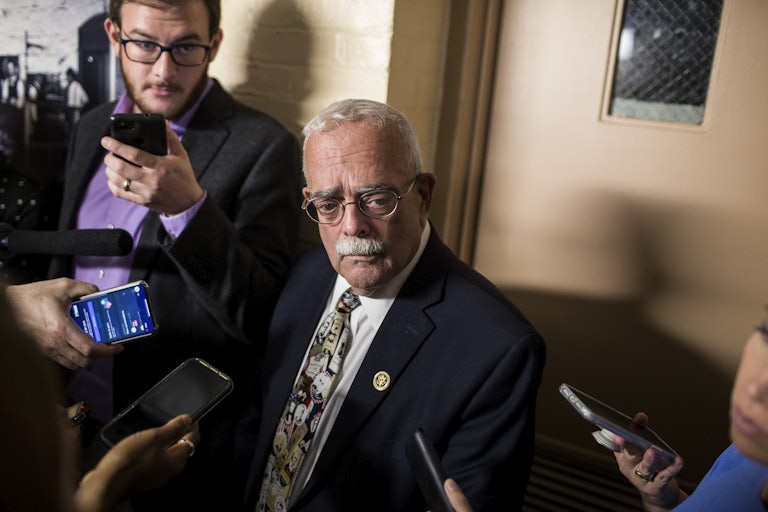
Represenative Gerry Connolly speaks with reporters
Zach Gibson/Getty Images
Representative Gerry Connolly from Virginia

A person wielding a baseball bat attacked two staffers at a Virginia Democratic representative’s office on Monday, after they couldn’t find the congressman himself, the latest in a trend of violence that seems to be targeting liberal political figures.

Gerry Connolly said the assailant had initially asked for him when they entered his office. Connolly was at a ribbon-cutting ceremony for a food bank, so the assailant turned on the office staff, hitting one senior aide in the head with the metal bat and an intern on the side, according to CNN’s Manu Raju. It was the intern’s first day on the job.

Connolly said the attacker was in police custody and that both members of his team had been hospitalized with “non-life threatening injuries.”

“Right now, our focus is on ensuring they are receiving the care they need,” he said in a statement, which did not include more details about the attacker or what may have motivated them. But the U.S. Capitol police identified the suspect as Xuan Kha Tran Pham, a 49-year-old resident of Fairfax, Virginia.

Pham reportedly sued the CIA last year, claiming the agency had been “wrongfully imprisoning [him] in a lower perspective based on physics.” He alleged he was being “brutally tortured…from the fourth dimension” and sought $29 million in damages, as well as to be “cured” by an unspecified form of technology.

His complaint matches beliefs held by conspiracy theorists, many of whom claimed they are being secretly surveilled and psychologically tortured using nonexistent technology. The CIA moved to dismiss the trial last month, but Pham ended up representing himself in court.

This attack marks the fifth attack on a political figure on the left—and the third to injure someone—in recent memory. Michigan alone has seen two attempts, starting in 2020 when four men plotted to kidnap Governor Gretchen Whitmer because of the Covid-19 safety restrictions she had implemented. They also thought she would tighten gun regulations. In March, the FBI arrested a man for plotting to kill all Jewish Michigan elected officials, including state attorney general Dana Nessel.

Nancy Pelosi’s husband Paul had to get emergency surgery on his skull in October after a man broke into the couple’s San Francisco home and, upon failing to find the former House speaker, attacked her spouse with a hammer. Paul Pelosi appears to be recovering.

And just a few weeks ago, a man was arrested for allegedly committing arson at two mosques in Minneapolis and vandalizing Representative Ilhan Omar’s district office, as well as a patrol vehicle assigned to a Somali city police officer and a marketplace known locally as the Somali Mall. None of this, of course, includes the pipe bombs sent to prominent Democrats and Trump critics in 2019, or the targeting of Democratic members of Congress during the January 6 attack on the Capitol.

All of these attacks, or attempted attacks, have been on left-leaning political figures. Meanwhile, their right-wing colleagues have either remained silent or actively pushed conspiracy theories and crude jokes about the attempts on people’s lives. In doing so, they are only condoning political violence—and potentially encouraging people to keep trying.

One such Republican is Virginia Governor Glenn Youngkin. He condemned the attack on Connolly’s office, tweeting that “violence does not belong in our political system.”

“We’ve seen this against our legislative branch and it has no place in our Commonwealth,” Youngkin said.

But the day that Paul Pelosi was attacked, Youngkin used the assault as the punchline to a joke. “There’s no room for violence anywhere, but we’re going to send her back to be with him in California,” he said of Nancy Pelosi. Youngkin sent a personal note to Pelosi to apologize, but only after weeks of backlash.

This story has been updated.

Ron DeSantis Signs Bill Launching All-Out Assault on Academic Freedom

The new law goes after DEI, certain university degrees, and even how professors can talk about race and gender.

Scott Olson/Getty Images
Florida Governor Ron DeSantis

Florida Governor Ron DeSantis signed a bill Monday that launches the greatest attack on academic freedom yet.

The new law prohibits state universities from spending state or federal funds on diversity, equity, and inclusion programs, which are widely recognized as crucial in combating implicit bias and providing support for students or employees who are members of a minority community. The measure also dramatically limits what professors can teach about race and gender and bans degrees in gender studies and critical race theory.

Moreover, students would be required to take classes on the history and philosophy of Western civilization, which many scholars recognize as coded language for white supremacist ideology.

“If you look at the way this has actually been implemented across the country, DEI is better viewed as standing for discrimination, exclusion, and indoctrination,” DeSantis said during a press conference at the New College of Florida, in Sarasota. “And that has no place in our public institutions. This bill says the whole experiment with DEI is coming to an end in the state of Florida.”

His decision to hold the signing at the New College was particularly significant—and petty. The New College is a historically liberal enclave, not just in deeply red Florida but also in the county where it is located. The college’s board of trustees was overhauled in early January when DeSantis appointed six new conservative members. The very next month, the board ousted New College President Patricia Okker and installed Christopher Rufo, a DeSantis loyalist.

The college’s students have repeatedly protested DeSantis and his ultraconservative policies, and Monday was no different. The demonstrations against the new anti-DEI law were so loud that they could be heard during the signing ceremony.

DeSantis is desperate to establish himself as the new standard-bearer for the right wing, but he’s doing so at the cost of his constituents. Many of his policies are hugely unpopular in the state, but he’s forging ahead for political clout. Just last week, he signed a bill that will allow doctors and health insurance companies to deny care to anyone they want.

Kyrsten Sinema Thinks You Need Bougie Hotels and Limousines to Run a Marathon

And she’s using campaign funds to expense it all.

Arizona Senator Kyrsten Sinema
Chip Somodevilla/Getty Images

Senator Kyrsten Sinema has a history of making questionable choices for personal gain. And now she seems to be strategically planning campaign fundraisers to justify bougie travel and accommodation expenses for personal competitions.

A new report from The Daily Beast found that Sinema raised $16,000 in campaign donations from a small group of Massachusetts-based donors in April 2022. That same month, her campaign paid nearly $8,500 for a stay at the Ritz-Carlton. Though the campaign filing did not specify which Ritz location, Sinema tweeted a photo of herself and a friend posing in a Ritz hotel room after finishing the Boston Marathon.

And it’s not the only time Sinema appears to have planned a fundraiser in the same place she was going to run a race. The Daily Beast found at least six other such instances since 2019, such as in May that year, when Sinema competed in a marathon in Ventura County, California. In the two weeks around the race, she raised $21,000 from PACs and donors in the state, while her campaign spent $400 on lodging in Santa Barbara.

Other campaign expenses include more than $5,200 on limo service in Boston in October 2021, when Sinema merely attended the Boston Marathon. She coincidentally held a fundraiser that month that raised $36,000 from Massachusetts donors.

The Federal Election Commission bars political candidates from using campaign funds for any expenses unrelated to running for or holding public office. By allegedly tacking fundraisers on to her race travel, Sinema is technically not breaking any rules. But her behavior is definitely shady.

“It is one thing to ask donors for money to support your campaign and get your message out to voters, it is another to ask them to bankroll your personal life,” Brendan Fischer, deputy executive director for the watchdog group Documented, told The Daily Beast. But “if an officeholder is using donor dollars to subsidize their lifestyle or finance personal expenses, then campaign contributions pose a much greater risk of corruption.”

Fischer also pointed out that athletes plan far in advance for big races, making it “highly unlikely that Sinema’s fundraising activity was scheduled as the priority,” according to the Beast.

We also already know that Sinema seems to prioritize her race training above everything else. Another Daily Beast report from December found that Sinema’s training regimen appears to take up the bulk of her time. Citing an internal memo and anonymous former staffers, the report found that Sinema should be considered unreachable during her daily training sessions. Races are scheduled into her calendar, and she requires an hour-long massage and two 45-minute physical therapy sessions each week. Actual senatorial duties are confined to specific time blocks each week.

Sinema has proudly declared she doesn’t stand for anything. She seems to have undergone a political 180 since reaching Capitol Hill, voting against measures she campaigned on, such as raising the minimum wage, and switching political affiliation to independent in what was widely seen as an attempt to improve her reelection chances.

So maybe it’s not that she doesn’t stand for anything. Maybe it’s that Sinema only stands for herself.