Breaking News
Breaking News
from Washington and beyond

Alina Habba Makes Last-Ditch, Pathetic Attempt to Overturn E. Jean Carroll Trial

Donald Trump’s lawyer is pulling out all the stops to try to throw out the damning $83.3 million verdict.

Trump lawyer Alina Habba stands outside at nighttime before several press mics. She points her right index finger to emphasize what she is saying. She appears to be wearing a black fur coat.
GWR/Star Max/GC Images

Donald Trump’s lawyer has made another desperate bid to throw out E. Jean Carroll’s case against the former president, but legal experts say Alina Habba’s request is doomed to fail.

A jury ruled last week that Trump owes Carroll $83.3 million for defaming her in 2019 after she revealed he sexually abused her in the mid-1990s. But Habba argued in a Monday court filing that the ruling should be thrown out.

In the document, Habba cited a New York Post article that reported Carroll’s lawyer Roberta Kaplan had worked at the same firm as Judge Lewis Kaplan (no relation), who presided over both of Carroll’s trials against Trump, in the 1990s. The Post article stated the now judge had been like Kaplan’s mentor.

“The underlying defamation case tried last year, and the damages trial completed last week, were both litigations in which there were many clashes between Your Honor and defense counsel,” Habba said in her letter. “We believe, and will argue on appeal, that the Court was overtly hostile towards defense counsel and President Trump, and displayed preferential treatment towards Plaintiff’s counsel.”

Habba also said that Carroll’s other lawyer, Shawn Crowley, had served as Judge Kaplan’s law clerk, and the judge allegedly co-officiated Crowley’s wedding.

Multiple legal experts brushed off Habba’s attempt to overturn the Carroll verdict. “This is a bogus motion by the Trump team. There’s nothing here,” CNN legal analyst Elie Honig said Monday night. “Every judge in that courthouse knows, socializes with, has worked with, sometimes maybe mentored, dozens, hundreds of attorneys in this city.”

“I used to practice in that courthouse in front of judges who used to be my colleagues, my supervisors,” Honig continued, citing his career as an assistant U.S. attorney for the Southern District of New York. “If anything, they were tougher on me as a result of it. That is not enough for a conflict of interest.”

Attorney Andrew Fleischman noted on X (formerly Twitter) that it could be argued that the judge would have had a conflict of interest if Carroll had sued Trump in 1992, “and then the lawsuit languished for 32 years, and one of the original lawyers who filed that suit was still with the firm.” But Carroll didn’t bring her first lawsuit until 2019.

Former U.S. attorney Joyce Vance pointed out that Habba has previously tried to leverage tenuous professional relationships. Habba appeared to suggest in early January that the three Supreme Court justices that Trump appointed owe him allegiance.

This isn’t the first time Trump has tried to get Carroll’s cases against him thrown out, or at least delayed. Trump unsuccessfully claimed that he was protected against the legal proceedings by presidential immunity. In June, Trump ally James H. Brady argued Carroll’s 2019 defamation suit should be thrown out because the former president was being unfairly treated because he is a “white Christian.”

Trump has also demanded a do-over of the first trial, which took place in May. The jury unanimously found Trump liable of sexual abuse and battery against Carroll and of defaming her in 2022. The jury recommended Carroll be awarded $5 million in damages.

Trump claimed that the damages should be reduced, and the second lawsuit thrown out altogether, because he only sexually abused Carroll instead of raping her. So Judge Kaplan clarified the situation, stating that the jury found that the former president did indeed “rape” Carroll based on the common definition of the word.

New York penal law has a “far narrower” definition of the word “rape” than “common modern parlance,” Kaplan said.

“The finding that Ms. Carroll failed to prove that she was ‘raped’ within the meaning of the New York Penal Law does not mean that she failed to prove that Mr. Trump ‘raped’ her as many people commonly understand the word ‘rape.’”
E. Jean Carroll Gives Unbelievably Amazing Description of Trump in Court

Writer E. Jean Carroll shared her experience of being in the same courtroom as Donald Trump.

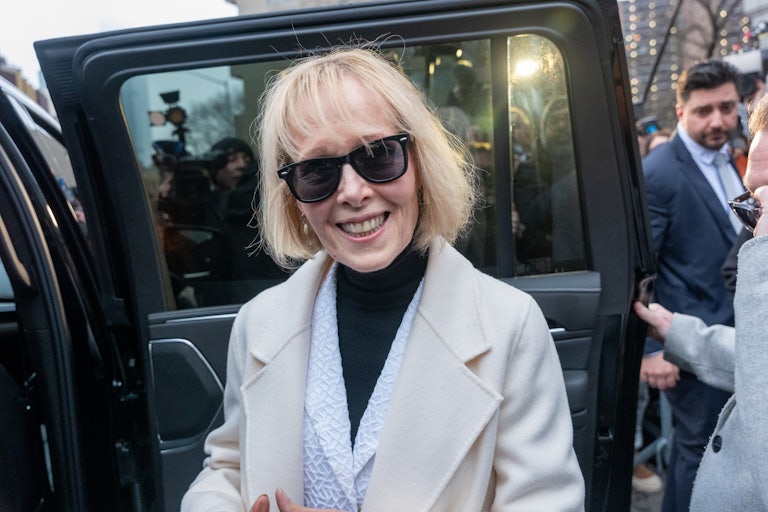
E. Jean Carroll smiles wearing a beige pea coat, a white blazer, a black turtleneck, and sunglasses. A car door is open behind her, and there are other people and cameras in the background.
Spencer Platt/Getty Images

Writer E. Jean Carroll had some special language to describe Donald Trump, referring to the GOP front-runner as an empty vessel. 

“This team of brilliant young people have, as you said, stood up to the man,” Carroll told MSNBC’s Rachel Maddow Monday evening. “Who, by the way Rachel, is not even there. He’s nothing.”

“He is like a walrus snorting, and like a rhino flopping his hands—he is not there. That was the surprising thing to me,” she continued.

“Well on that point, talking about you know being face to face with him, being in the same physical space with him for the first time since when you say he assaulted you in 1996, what you’re describing there, in terms of him being nothing—him feeling like an animal, him feeling not intimidating, was that a shock to you?” Maddow asked.

“No, Rachel—I was terrified. I was just a bag of sweating corpuscles as we prepared for trial. And four days before trial I had an actual breakdown. I lost my ability to speak, I lost my words, I couldn’t talk, I couldn’t go on. That’s how frightened I was,” Carroll responded.

“But oddly, we went into court, [my attorney] took the lectern, I sat in the witness chair like this, and she said, ‘Ms. Carroll, good morning. Could you please spell your name for court?’ And amazingly, I looked out, and he was nothing. He was nothing. He was a phantom,” she continued.

“It was the people around him who were giving him power. He himself was nothing. It was an astonishing discovery for me. He’s nothing. We don’t need to be afraid of him. He can be knocked down.”

Carroll won her defamation case against Trump on Friday, earning her $83.3 million in a historic verdict that octupled her legal team’s original asking price for damages after the former president was depicted bragging about his wealth during a legal deposition.

The jury awarded $7.3 million for damage to Carroll’s reputation, $11 million for emotional harm, and $65 million for punitive damages.

It was Carroll’s second defamation case against Trump, which came after the Apprentice host spent years attacking the writer’s character and claimed that he didn’t harass or even know Carroll, even after he was found liable by a jury for sexually abusing her.

On Monday, Carroll revealed she was looking forward to using cash for “something Donald Trump hates”—a “fund for the women who have been sexually assaulted by Donald Trump.”

Pennsylvania Supreme Court Sets Up Showdown on Medicaid Abortion Ban

A new ruling from the court could massively change abortion law in the state.

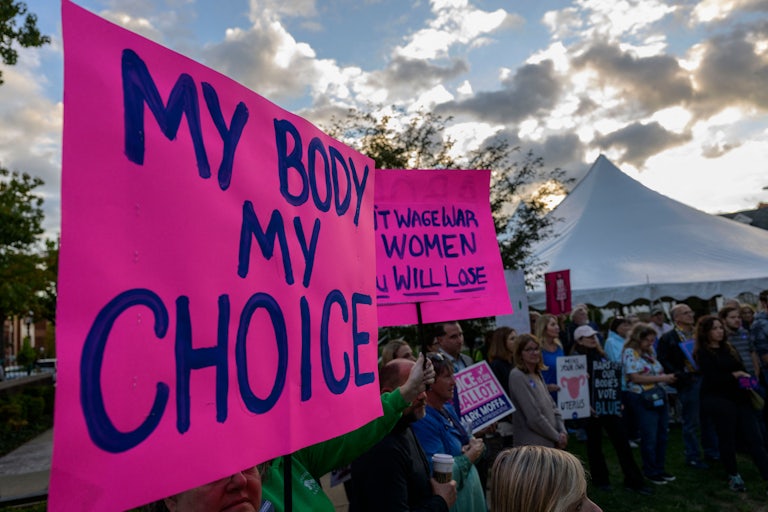
An abortion rights protest with dozens of people in the photo. A large pink sign in the foreground reads "My body my choice." Another in the background threatens that "You will lose" if you wage war with women. (Part of the text is cut off.)
ANGELA WEISS/AFP/Getty Images

The Pennsylvania state Supreme Court ruled Monday that a 40-year-old law banning Medicaid from covering abortions could be considered discriminatory based on sex, and sent the case back to a lower court, setting up a battle to establish financial coverage for the procedure.

The case stems from the Pennsylvania Abortion Control Act of 1982, which prohibits Medicaid from covering abortions unless the pregnancy is the result of rape or incest or it puts the patient’s life at risk. A state Supreme Court ruling three years later established that the law is not a form of sex discrimination, meaning it cannot be challenged under the Pennsylvania Equal Rights Amendment.

In 2019, a coalition of seven state abortion providers filed a lawsuit arguing that the law discriminates based on sex and therefore violates the ERA. The plaintiffs urged the justices to recognize that the state constitution guarantees people the right to abortion access.

On Monday, the justices stopped just short of stating a constitutional right to abortion, but they did rule 3–2 that the state’s ERA applied to Medicaid coverage of abortion access. Justices Christine Donohue and David Wecht, who were in the majority, said that “the right to reproductive autonomy, like other privacy rights, is fundamental.”

In the 219-page majority opinion, Donohue wrote that “the right to make healthcare decisions related to reproduction is a core important right encompassed by the enmeshed privacy interest protected by our Charter.”

“Whether or not to give birth is likely the most personal and consequential decision imaginable in the human experience. Any self-determination is dependent on the right to make that decision,” she said.

Justice Kevin Dougherty, who concurred with the overall majority decision, called Donohue and Wecht’s argument “incredibly insightful.” But he said he felt the gist of the current case was too narrow to decide the constitutionality of abortion.

Donohue noted that refusing to cover abortion discriminates against people trying to exercise the right to reproductive autonomy and therefore violates state constitutional protections against discrimination by the government.

“The government does not bear a constitutional obligation to provide medical care to the indigent, nor is the government required to financially support the exercise of a fundamental right, including a woman’s exercise of her right to reproductive autonomy,” Donohue wrote.

“However, once the government chooses to provide medical care for the indigent, including necessary care attendant to pregnancy for those women exercising their right to reproductive autonomy who decide to carry a pregnancy to term, the government is obligated to maintain neutrality so as not to intrude upon the constitutional right to full reproductive autonomy, which includes the right to terminate a pregnancy.”

The case will now return to the lower Commonwealth Court to determine if Medicaid should cover abortion and if abortion is constitutionally protected. The state government must prove that banning Medicaid from covering most abortions does not violate the ERA.

David Cohen, one of the lawyers for the plaintiffs, told The New Republic that the Pennsylvania government has a “very high bar” to clear to justify Medicaid excluding abortion coverage after this ruling.

The government must prove it has a “compelling state interest” in prohibiting Medicaid from covering abortion, and no other “less intrusive methods” to implement the policy, Cohen, who is also a constitutional law professor at Drexel University’s Kline School of Law, explained. The “least intrusive method” is a way of analyzing laws to determine whether they do the least amount of harm possible in achieving the measure’s stated goal.

“The court said that [the law] is a form of sex discrimination and that sex discrimination under the state’s Equal Rights Amendment needs to be very strictly scrutinized,” Cohen said. “But it’s not an absolute bar. It’s not like the court didn’t say all sex discrimination is prohibited. It’s just a very difficult hurdle for the state to overcome.”

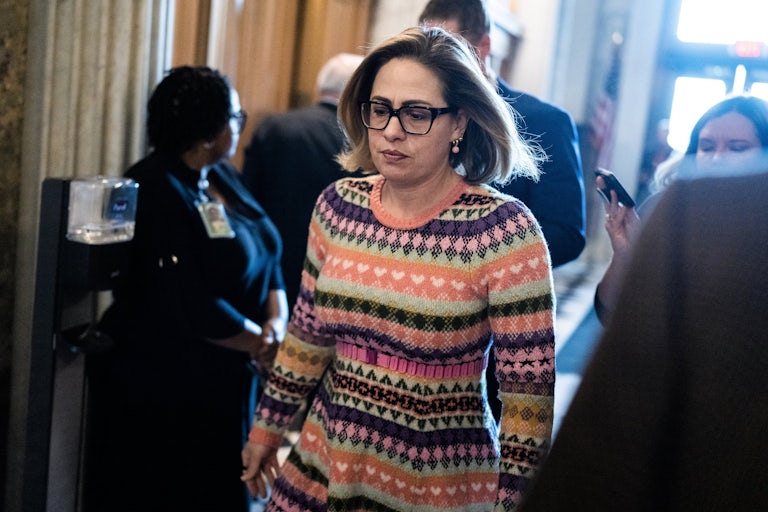
Kyrsten Sinema Stuck Taxpayers With a Massive Private Jet Tab

A new report shows the Arizona senator loves private jet travel a little too much—and she’s totally OK with using taxpayer money to pay for it.

Tom Williams/CQ-Roll Call, Inc/Getty Images

Arizona Senator Krysten Sinema has spent an outsize portion of her U.S. Senate office budget on charter private jets.

The former Green Party turned Democrat turned independent politician has reportedly spent roughly $210,000 of her $4.1 million taxpayer-funded budget on private jet travel, shipping herself and her staff around the country, according to a public records analysis by The Daily Beast.

Since 2020, Sinema has booked at least 11 private trips, with almost half of them occurring in 2023 alone. Nearly all of the flights were chartered for travel within the boundaries of Arizona, shuttling Sinema and her staff around the state on one- or two-day trips, reported the Beast.

On August 8, 2023, Sinema flew herself and four staffers from Washington to the Grand Canyon with Florida-based Monarch Air Group—which cost a whopping $50,250—for a national park law signing featuring President Joe Biden and other federal and state politicians.

While it isn’t against the rules for lawmakers to use their annual budgets for private air travel, there are several reasons why it’s problematic. Being scrupulous with your money means you can stretch your budget further and spend taxpayer money, instead, on things like hiring extra aides and staff to help accomplish the job you were elected for.

In Sinema’s case, the Arizona lawmaker has spent more on private jets in just one year than she paid practically every member of her staff. Her flight to the Grand Canyon alone cost nearly as much as the annual income of her deputy press secretary or her military and veterans affairs representative, according to reports by the secretary of the Senate.

Arizona’s other Senate representative, Democratic Senator Mark Kelly, has never used his Senate budget for privately chartered jets, despite the fact that he is more often than not traveling to the same locations as Sinema, according to the Beast.

Watch: GOP Congresswoman Tries to Take Credit for Bills She Voted Against

Representative Maria Salazar freaked out after being reminded how she actually voted on the funding projects.

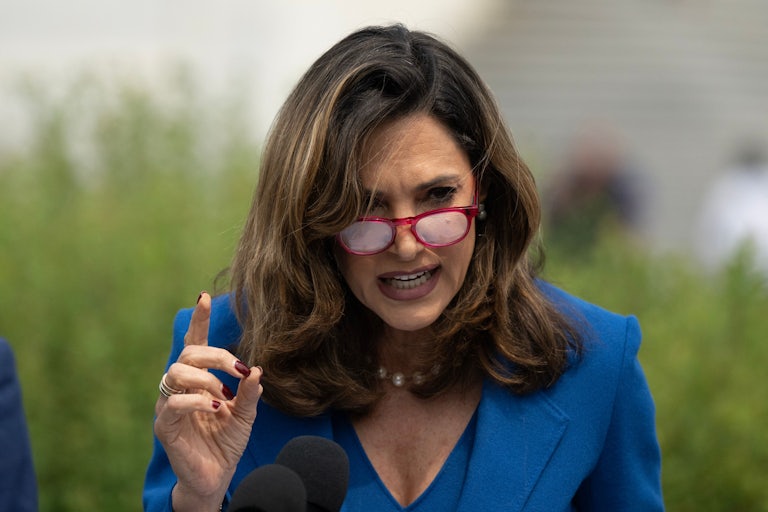
Representative Maria Salazar wears a blue blazer and red glasses. She is speaking outside and gesturing with her index finger raised.
ANDREW CABALLERO-REYNOLDS/AFP/Getty Images

Florida Representative Maria Salazar said she doesn’t remember voting against two key pieces of legislation—even though she’s regularly claimed credit for their successes in her congressional district.

In an interview on CBS News Miami, Salazar aggressively skirted direct questions about her voting record on the CHIPS and Science Act and the Consolidated Appropriations Act of 2023, at one point telling the host that she needed to speak to her staff to remind her of her voting record in Washington, D.C.

“The money that you talk about—the $40 million that you bring back to the district—sometimes that money comes from bills that you voted against,” pressed CBS News’s Jim DeFede. “You voted against the CHIPS Act and yet you praise the fact that the south Florida climate resilience tech hub is going to be started in Miami, right? You voted against the infrastructure bill and you talk about all the money that comes back to the airport.”

“So, at the same time that you’re taking credit for the money that you bring back to the district in Washington, you’re voting against these projects on party line votes,” he added.

“Listen I, that was, I think, last cycle, I cannot really remember right now, but just look, just look at the Americas Act,” Salazar started before DeFede cut her off, asking why she doesn’t want to explain her vote.

“I mean right now, and I’m not trying to be a politician, there’s so many bills that I’ve introduced and I know that many of them—,” Salazar continued while DeFede interjected again that she had voted against the bills.

“I understand and, but, the—OK. Sometimes I vote, and sometimes I don’t, but let’s look at the positive, let’s look at the $40 million that I brought, and let’s look at the dignity,” she said, still trying to take credit for the funding she voted against.