Breaking News
Breaking News
from Washington and beyond

Judge in E. Jean Carroll Trial Gives Jury Ominous Warning After Damning Trump Verdict

Judge Lewis Kaplan thanked the jurors for their verdict on Donald Trump—and then warned them about how to stay safe.

Donald Trump in the courtroom. Others stand around him, including his legal team and a security guard.
Michael M. Santiago/Getty Images

Judge Lewis Kaplan had just a few short words to share with the jury moments after they issued a whopping $83.3 million verdict against Donald Trump in the defamation case brought by writer E. Jean Carroll.

“My advice to you is that you never disclose that you were on this jury,” Kaplan said.

That foreboding warning—which sounds more like something you’d expect to hear in a trial against a mob boss rather than a former president—is just one of many extraordinary measures that Kaplan has taken to keep his jury safe. Prior to the trial’s start, Kaplan also decided to keep the jury partially sequestered and fully anonymous, instructing them not to use their real names even with one another.

Trump proved moments after the trial that there’s a good reason for the extra precautions, launching into a social media diatribe in which he claimed he would be attempting to appeal the decision.

“Absolutely ridiculous! I fully disagree with both verdicts, and will be appealing this whole Biden Directed Witch Hunt focused on me and the Republican Party,” Trump posted on Truth Social. “Our Legal System is out of control, and being used as a Political Weapon. They have taken away all First Amendment Rights. THIS IS NOT AMERICA!”

Trump was already found liable for sexually assaulting Carroll. With fines from the previous trial, he now owes Carroll a total of $88.3 million.

NRA Leader Confirms Insane Details of Lavish Lifestyle in Corruption Trial

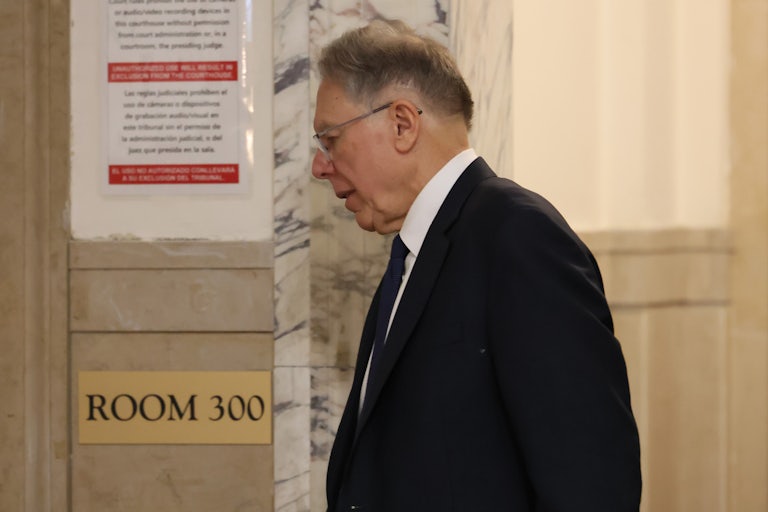
Former NRA leader Wayne LaPierre testified before a jury on how he used the gun rights group to fund his own opulent lifestyle.

Michael M. Santiago/Getty Images

The outgoing chief of the National Rifle Association got a chance to revisit some of his more luxurious expenses in a Manhattan courtroom on Friday.

Wayne LaPierre stands accused by New York Attorney General Letitia James of using the massive gun rights nonprofit as his personal piggy bank as well as overseeing a scheme to cover up the embezzlement.

During hours of testimony, LaPierre confirmed that he had used the organization’s resources to charter private jets to and from luxury destinations around the world, including India, the Bahamas, and the Greek Isles.

“When you’d go to the Bahamas, you’d take a private flight to get there?” asked Assistant Attorney General Jonathan Conley.

“Yes,” responded LaPierre.

“And the NRA would pay for those flights?” Conley continued.

“Yes,” LaPierre reiterated.

LaPierre would never disclose the trips ahead of time, and never got the approval of the board.

The benefits of free flights didn’t stop at the NRA head, who also effectively allowed his family to use the company credit card for trips, charging the NRA more than $1 million for flights around the country, including a $26,995 flight from Dallas to Orlando, a $15,495 flight from Las Vegas to Nebraska, and a $8,825 flight from Madison, Wisconsin, to Nebraska.

But it wasn’t always a bowl of cherries, according to the NRA head. Sometimes, when LaPierre would visit longtime NRA vendor David McKenzie’s luxury yachts—another perk of his role that he should have reported but didn’t—he wouldn’t have the comfort of a private chef.

“A chef would prepare you meals?” Conley asked at one point.

“Not all of the time,” LaPierre replied.

Meanwhile, the NRA was doling out $1.8 million to shoot episodes of its TV series Crime Strike at McKenzie’s mansion, starring LaPierre himself.

Despite all this, LaPierre signed official disclosures with the organization that claimed neither he nor any relative of his had received anything worth more than $300 from someone looking to do business with the gun lobbying group.

Very Stable Genius Trump Must Pay $83.3 Million to E. Jean Carroll

Donald Trump just can’t stop losing in court.

E. Jean Carroll smiles and points to something off camera. She's wearing a brown coat and sunglasses.
Spencer Platt/Getty Images

Donald Trump owes the writer E. Jean Carroll $83.3 million for defaming her after she revealed the former president sexually abused her in the mid-1990s, a jury determined on Friday.

The jury awarded $7.3 million for damage to Carroll’s reputation, $11 million for emotional harm, and $65 million for punitive damages.

The jury deliberated for less than three hours, a remarkably speedy end to a high-profile case. In Trump’s first trial against Carroll, that jury also deliberated for less than three hours.

Trump now owes Carroll a total of $88.3 million. In May, a separate jury unanimously found Trump liable of sexual abuse and battery against Carroll and of defaming her a different time. That jury recommended Carroll be awarded $5 million in damages.
Carroll is far from the only woman to accuse Trump of sexual assault, but her lawsuits have been the first to make it to a courtroom. Trump has vehemently denied all of the allegations, aiming particular vitriol at Carroll—including during this trial. Some of his posts insulting her on social media became evidence almost in real time.

Trump sat in the courtroom for every day of the trial except one, when he attended his mother-in-law’s funeral. He also testified on Thursday, a marked shift from the first trial when he declined to show up at all. He was on the stand for just three minutes, during which he said he stood “100 percent” behind his deposition denying that he had assaulted Carroll or even met her before.

Trump was not, however, present in the courtroom when the verdict was read out. As it turns out, all his protestations didn’t change the facts of the matter. This trial was only to set damages, after presiding Judge Lewis Kaplan ruled in September that since Trump has already been found liable for sexual abuse, his comments are by default defamatory.

Carroll accused Trump in her 2019 memoir of raping her in the Manhattan Bergdorf Goodman department store in the mid-1990s. Her first lawsuit against him was for the assault and for posts he made about her on social media in November 2022.

The trial that wrapped up Friday was for comments he made in 2019 and in 2023. Trump alleged in 2019 that Carroll had made up the rape allegation to promote her book. And then, hours after he was found liable for sexual abuse, he went on CNN and repeated comments about Carroll that had just been deemed defamatory.

Andrew Cuomo Sexually Harassed Even More Women Than Initially Reported

A final Justice Department settlement documents more details about the former New York governor’s history of sexual harassment.

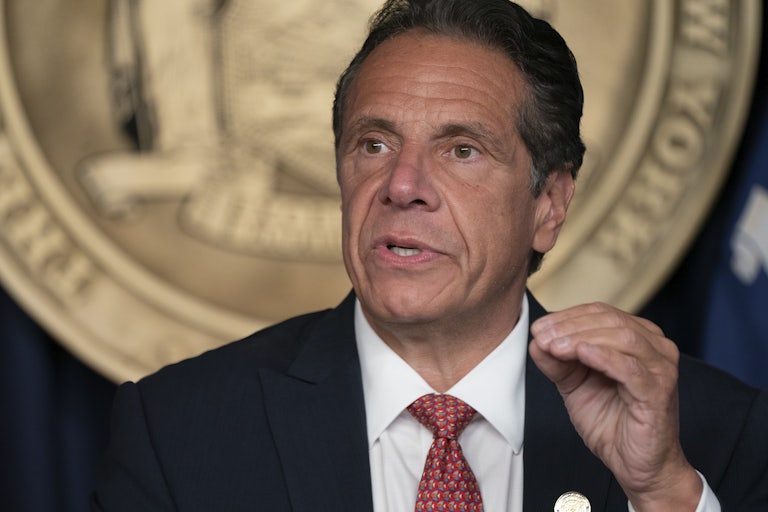
Andrew Cuomo, wearing a suit, speaks and gestures with his hand
Lev Radin/Pacific Press/LightRocket/Getty Images

Former New York Governor Andrew Cuomo, who resigned in 2021 over sexual misconduct allegations, harassed even more women than previously reported.

The U.S. Department of Justice announced Friday that it had settled with New York state over the sexually hostile work environment cultivated under Cuomo.

The Justice Department investigation revealed that Cuomo’s Executive Chamber “(1) subjected female employees to a sexually hostile work environment; (2) tolerated that environment and failed to correct the problem on an agency-wide basis and (3) retaliated against employees who spoke out about the harassment,” according to a press release from the office of the U.S. attorney for the Eastern District of New York.

The department also found that at least 13 female state employees were victims of Cuomo’s harassment. “Governor Cuomo repeatedly subjected these female employees to unwelcome, non-consensual sexual contact; ogling; unwelcome sexual comments; gender-based nicknames; comments on their physical appearances; and/or preferential treatment based on their physical appearances,” the report said.

Previous reports only listed 11 women as victims, not all of whom were state employees. Cuomo has also been accused of harassing women he met at public events.

Since Cuomo left office, the Executive Chamber has carried out a series of reforms under Governor Kathy Hochul to prevent harassment and retaliation. The Justice Department settlement calls for further reforms, including expanding the chamber’s Human Resources Department, creating new channels to externally report and investigate incidents of harassment, and removing the employees who were identified as enabling Cuomo’s harassment. The chamber must also develop and implement anti-harassment and anti-retaliation programs.

Cuomo served as New York’s governor for 10 years, gaining national attention and praise for the way he navigated the Covid-19 pandemic. But everything came crashing down in 2020, when his first accuser came forward. Soon after came revelations that he actually handled the pandemic terribly, as well as a damning 165-page report from New York Attorney General Letitia James detailing Cuomo’s long history of sexual harassment.

Finally, in August 2021, with no major supporters left, Cuomo stepped down.

Lauren Boebert’s First Debate Went as Spectacularly Badly as You’d Expect

It sure looks like bad news for Representative Lauren Boebert this election year.

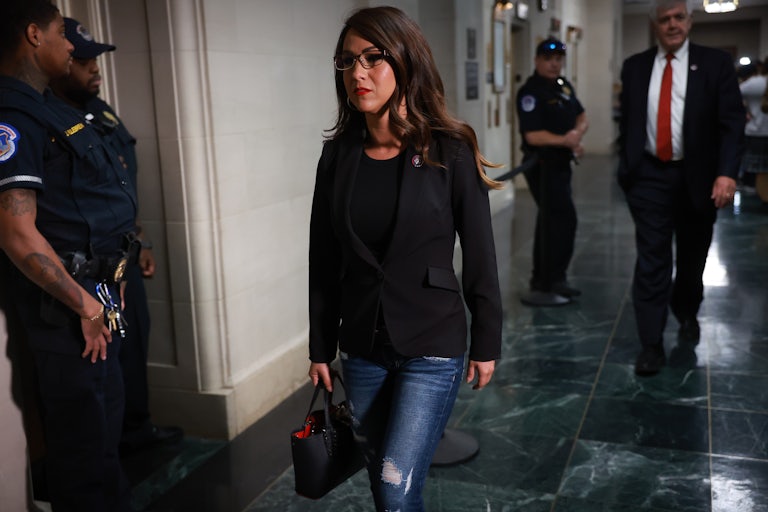
Representative Lauren Boebert walks down a hallway. She is wearing jeans, a black shirt, a black blazer, and has a black purse in her hand. She looks serious and/or distressed. Three security guards are nearby and another man wearing a suit is in the background..
Joe Raedle/Getty Images

Representative Lauren Boebert did not receive the warm welcome she was hoping for after switching Colorado districts, with her rivals accusing her of being a “carpetbagger” during the first primary debate.

Boebert, who currently represents the Centennial State’s 3rd district, announced in December that she would run for election in the 4th district in 2024, instead. The decision comes after she was reelected in 2022 by such a narrow margin that the election nearly went to a recount. Her public image has taken a massive battering in recent months, as well.

The far-right congresswoman attempted to defend her decision during the debate Thursday night, saying she made the switch because she wanted a “fresh start” for her family.

I am here to earn your vote. This is not a coronation,” she said. “The crops may be different in Colorado’s 4th District, but the values are not.”

But her opponents—and potential new constituents—were having none of it. In an informal straw poll, Boebert ranked fifth out of the eight candidates. While on stage, none of her opponents said they would support her if they ended up dropping out.

At one point, state Representative Mike Lynch asked Boebert, “Can you give the definition of ‘carpetbagger’ to me?”

This isn’t the first time Boebert has been labeled an opportunist. When she announced she was switching districts, state Representative Richard Holtorf also slammed Boebert for “carpetbagging.”

“Seat shopping isn’t something the voters look kindly upon,” Holtorf, another of Boebert’s primary opponents, said in a statement. “If you can’t win in your home, you can’t win here.”

Boebert’s victory in the 4th district was never a given. She has been struggling with a public image that casts her as a political extremist, and she received a humiliating dose of national backlash after she and a date were caught on security cameras talking, using their phones, vaping, and groping each other while seeing a performance of Beetlejuice.

But fortunately for her, she’s not alone in having a candidacy marred by controversy. Lynch resigned as state House minority leader earlier this week, after revelations that he was trying to hide a DUI arrest and gun charges from 2022.

Holtorf, who is an anti-abortion politician, recently admitted that he helped a girlfriend pay for an abortion. The procedure helped her “live her best life,” he said.

And another candidate, former state Senator Ted Harvey, launched a “scam PAC” in 2013 that spent 87 percent of the millions it raised on supposed operating expenses. In reality, the organization was set up so its leadership could make massive profits.