Breaking News
Breaking News
from Washington and beyond

House Republicans Pass Draconian Measure Censoring Public Data

The amendment bans giving the State Department funds to cite the Gaza Health Ministry’s data.

People stand around a crater made by Israeli bombardment in Gaza City
Omar Al-Qattaa/AFP/Getty Images

The House of Representatives voted Thursday to bar the State Department from using funds from the international affairs budget to cite any number of Palestinians killed by Israel in Gaza.

The House voted 269–144 to add an amendment mandating the change to an appropriations bill for the State Department. The amendment was co-sponsored by representatives across party lines, although the votes in favor were overwhelmingly Republican. The appropriations bill still needs to pass the Senate, and it is unclear how it will fare in the second chamber. But if it passes, then the Orwellian move will effectively make the denial of Palestinian deaths U.S. policy.

Representative Rashida Tlaib, the only Palestinian American in Congress, tore into her colleagues for putting forward the measure.

“Since 1948, Mr. Speaker, there has been a coordinated effort, especially in this chamber, to dehumanize Palestinians and erase Palestinians from existence,” Tlaib told the chamber prior to the vote. “My colleagues want to prohibit our own U.S. officials from even citing the Palestinian death toll.”

Tlaib went on to read the latest casualty figures of Palestinian deaths from Israel’s brutal war in Gaza into the congressional record: 37,718 killed, including more than 15,000 children, with more than 86,377 injured.

“Six children, Mr. Speaker, six are killed in Gaza every single hour. But Palestinians are not just numbers. Behind these numbers are real people—mothers, fathers, sons, daughters who have had their lives stolen from them and their families torn apart, and we should not be trying to hide it,” Tlaib said.

“There is so much anti-Palestinian racism in this chamber that my colleagues don’t even want to acknowledge that Palestinians exist at all. Not when they’re alive, and now, not even when they’re dead. It’s absolutely disgusting. This is genocide denial.”

It appears that many in Congress, their financial backers, and maybe even President Joe Biden want to hide what’s going on in Gaza. Some lawmakers have said that they supported a ban on TikTok because it was a major source of advocacy for Palestine, while others want to ship college students protesting for Gazans to Gaza itself. The House voted to censure Tlaib in November, even though many in Congress have used inflammatory, violent, and racist rhetoric in supporting Israel’s attacks on Palestinians.

Their goal seems to be for Israel to continue the war indefinitely with U.S. support, which only perpetuates the human rights crisis in Gaza. Perhaps these politicians don’t want a peaceful end to the conflict. After all, they refuse to say no to Israel’s Prime Minister Benjamin Netanyahu, even though he is accused of war crimes, and they refuse to end weapons shipments to Israel to force an immediate cease-fire.
Election Denier MTG Snaps Under Pressure During Live Interview

Marjorie Taylor Greene threw a serious temper tantrum when asked about the election results.

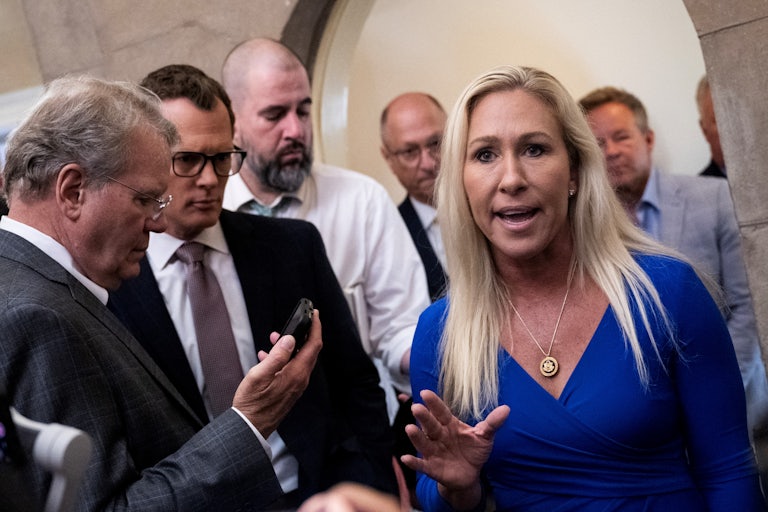
Marjorie Taylor Greene yells and holds up a hand as if to say Stop. Reporters surround her.
DREW ANGERER/AFP/Getty Images

Georgia Representative Marjorie Taylor Greene will do practically anything to avoid saying she’d accept the 2024 election results no matter the outcome—even going so far as to throw a temper tantrum live on air.

During an interview with the Australian Broadcasting Corporation on Wednesday, Greene refused to answer whether she would support the outcome of the presidential election if it swung in favor of Joe Biden, and then proceeded to get testy with the interviewer, accusing the Australian host of being a sellout to the U.S. Democratic Party when she attempted to switch the topic.

“If it doesn’t go your way, if Biden wins, will you accept the results?” asked 7.30 host Sarah Ferguson.

“Again, what does this have to do with Julian Assange?” Greene asked. “Seriously, really?”

But Greene wouldn’t let her answer, instead chattering as Ferguson attempted to explain it’s the “next natural question about truth.”

“What network is this? What is this, ABC Australia? Is she getting her marching orders from the Democrat Party? Is this what she decided to come up with today?” Greene said, looking off-camera.

“You’re a prominent figure in U.S. politics. The first debate is tomorrow. The result of the election is on the minds of not just Americans but the whole world, so it’s a natural point of curiosity,” Ferguson continued. “But I understand we’ve reached the end of the questions that you want to answer, thank you for talking to us about Julian Assange and for joining the program.”

In April, Greene lamented that the Capitol rioters were unsuccessful in stopping the certification of the presidential election results on January 6, and claimed that if she “had it [her] way,” Biden “wouldn’t even be president.”

Amy Coney Barrett Breaks Ranks on Supreme Court’s Dangerous EPA Ruling

Even Amy Coney Barrett thought the conservative justices’ ruling on the agency’s “good neighbor” rule was out of bounds.

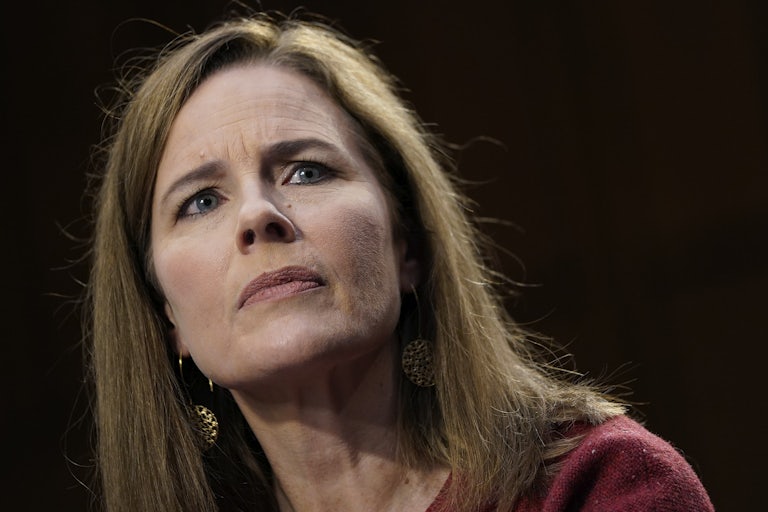
Supreme Court Justice Amy Coney Barrett looks grim
Drew Angerer/Getty Images

The Supreme Court on Thursday halted the Environmental Protection Agency’s “good neighbor” rule intended to combat air pollution. In a 5–4 decision, the conservative majority of the court upheld a stay against an EPA regulation that requires states limit their emissions to offset the effects in states downwind of their pollution, claiming the rule would cause “irreparable harm.” In a stunner, conservative Justice Amy Coney Barrett broke from the conservative bloc and wrote the dissenting opinion, joined by liberal justices.

Justice Brett Kavanaugh led in the court’s decision against the EPA, arguing that the good neighbor policy was too difficult to reasonably implement because who would be included is dependent on the winds. Barrett ripped that finding to shreds, writing that the court’s decision “enjoins the enforcement of a major Environmental Protection Agency rule based on an underdeveloped theory that is unlikely to succeed on the merits” and that the Supreme Court’s decision “downplays EPA’s statutory role in ensuring that States meet air-quality standards.”

The EPA issued its good neighbor rule in response to several states failing to create their own plans for implementing federal ozone pollution reduction rules issued in 2015 under the Clean Air Act. As Barrett notes, the 23 states that either didn’t submit any plans or submitted ones that didn’t meet EPA standards have been found by the agency to have “significantly contributed to ozone pollution in downwind states.” Twenty-one states “proposed to do nothing to reduce their ozone emissions,” the dissent adds. The EPA is statutorily required to ensure states comply with federal air quality standards, and to create a federal implementation plan if they don’t: In this case, it created the good neighbor plan. Upwind states promptly sued to prevent the EPA from rejecting their plans and to keep the good neighbor plan from going into effect, joined by regulated industries.

The Supreme Court’s decision to stay the good neighbor rule follows lower court rulings that deterred its implementation in 12 of the 23 states included in the ruling. Lawyers for the EPA noted during oral arguments that which states are included in the rule isn’t fixed, since wind patterns change.

The concept behind the policy takes into consideration states that are downwind of other states emitting pollutants. If, for example, states are buckets on a slope, and they’re all limited to filling a gallon bucket with water, the buckets further down the slope will inherently end up overflowing with the water poured into buckets further up slope from them. The good neighbor rule intends to reduce the amount of water poured into buckets further up the slope so those further downstream aren’t overloaded. Except in this case, the water is toxic pollutants and the buckets are giant industrial manufacturers toxifying our air and soil, with downwind states getting choked by pollutants emitted by their upwind neighbors.

The Supreme Court’s decision halting the implementation of the good neighbor rule is another step by the court’s conservative majority to curtail the EPA’s regulatory power, and, according to Barrett, it’s a step that’s not going to hold up on its merits if the case comes back to the Supreme Court.

Georgia’s Republican Governor Reveals He Didn’t Vote for Trump—Yet

Brian Kemp says he didn’t vote for Donald Trump during the Georgia primary, but things will be different come November.

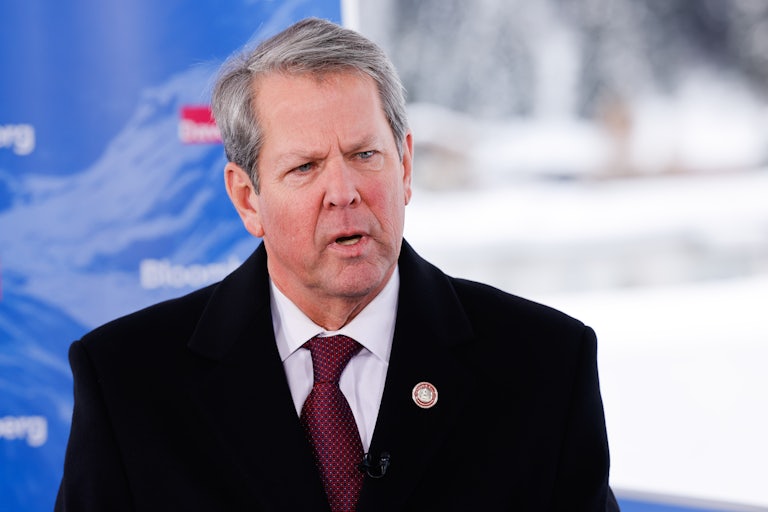
Brian Kemp speaks
Stefan Wermuth/Bloomberg/Getty Images

Georgia Governor Brian Kemp admitted that he didn’t vote for Donald Trump in the state’s primary elections last week, only one day before the presumptive Republican nominee takes the stage in a presidential debate in Atlanta.

While Kemp had previously condemned Trump’s claims of election fraud in the 2020 presidential election, and even supported his subsequent indictment, the spineless conservative governor said he will still vote for Trump in November.

Now it seems his voting record is equally contradictory: Kemp couldn’t be bothered to back Trump in June. But he didn’t exactly take a stand, either.

“I didn’t vote for anybody. I voted, but I didn’t vote for anybody,” Kemp told CNN’s Kaitlan Collins on The Source Wednesday, noting that the race “was already over when the primary got here,” as Trump is already the party’s presumptive nominee.

It seems that Kemp has been suffering from the same lack of enthusiasm many voters are experiencing in the lead-up to November. Backing a convicted felon who you believe attempted to overthrow the results of your state’s democratic election will do that.

“I always try to go vote and, you know, play a part in it, but look, at that point, it didn’t really matter,” Kemp said.

The governor maintained, though, that he would “support the ticket” come November. To Kemp, it seems the only thing that matters is turning Georgia red again.

Sotomayor Torches Supreme Court’s Short-Sightedness in SEC Ruling

Justice Sonia Sotomayor called out her conservative colleagues for ignoring a “mountain of precedent.”

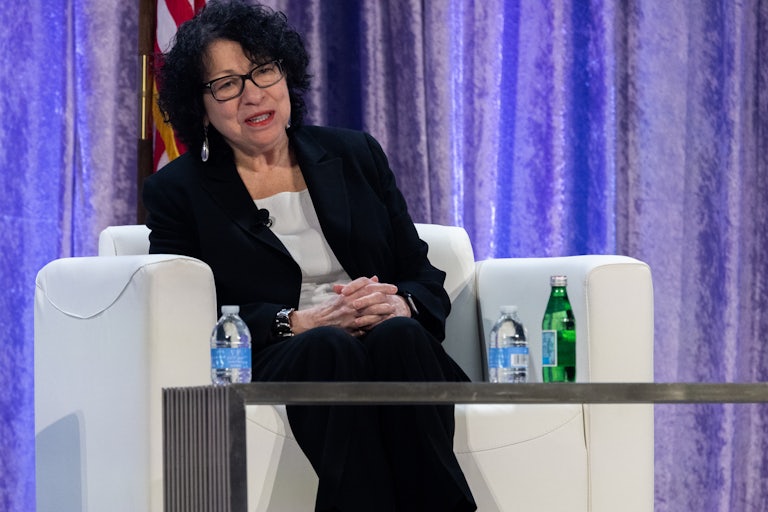
Supreme Court Justice Sonia Sotomayor speaks while sitting in a chair
Nathan Posner/Anadolu/Getty Images

U.S. Supreme Court Justice Sonia Sotomayor wrote a scathing dissent Thursday, arguing that the court’s decision to gut the Security and Exchange Commission’s power to seek civil penalties was a threat to the separation of powers.

In a 6–3 majority opinion penned by Chief Justice John Roberts, the Supreme Court held that when the SEC seeks civil penalties, the defendant is entitled to a jury trial in federal court.

This decision was a major hit to a provision of the Dodd-Frank Act, which allowed the SEC to impose civil penalties during administrative proceedings against those who break the law. Justices Clarence Thomas, Samuel Alito, Neil Gorsuch, Brett Kavanaugh, and Amy Coney Barrett joined Roberts.

In her dissent, Sotomayor brutally rebuffed the majority opinion as “plainly wrong” and slammed her conservative colleagues for undermining Congress’s authority to impose rules that entitle the government to civil penalties. She warned that the decision came as a result of ignoring a “mountain of precedent against it.”

“Beyond the majority’s legal errors, its ruling reveals a far more fundamental problem: This Court’s repeated failure to appreciate that its decisions can threaten the separation of powers,” she wrote. “Here, that threat comes from the Court’s mistaken conclusion that Congress cannot assign a certain public-rights matter for initial adjudication to the Executive because it must come only to the Judiciary.”

“The majority today upends longstanding precedent and the established practice of its coequal partners in our tripartite system of Government. Because the Court fails to act as a neutral umpire when it rewrites established rules in the manner it does today, I respectfully dissent.”

The decision has the potential to significantly weaken the ability of federal agencies, including the National Labor Relations Board, the Federal Trade Commission, and the Federal Communications Commission, to enforce fines against those who break laws, as those agencies lack the resources to pursue complaints in federal court. Functionally, the court’s decision will allow financial fraudsters to get off scot-free.