Breaking News
Breaking News
from Washington and beyond

Ketanji Brown Jackson Blasts Supreme Court Ruling That “Wreaks Havoc”

The Supreme Court justice ripped her conservative colleagues’ “flawed” decision to kneecap the federal government.

Supreme Court Justice Ketanji Brown Jackson looks forward
Tom Williams/CQ-Roll Call, Inc/Getty Images

U.S. Supreme Court Justice Ketanji Brown Jackson railed Monday against the decision in Corner Post, Inc. v. Board of Governors of the Federal Reserve System, arguing in her dissent that the “flawed reasoning and far-reaching results” of the majority opinion “[wreak] havoc on Government agencies, businesses, and society at large.”

In a 6–3 ruling along ideological lines, the court decided that the clock on a statute of limitations for complaints against an agency regulation doesn’t begin when the regulation is put in place, but when the plaintiff is injured. The majority opinion was delivered by Justice Amy Coney Barrett, with all three liberal justices dissenting.

In her dissent, Jackson explained that this decision makes way for a torrent of litigation challenging long-settled statutes, in what could potentially be a massively destabilizing ruling against the federal government.

“After today, even the most well-settled agency regulations can be placed on the chopping block,” she wrote.

Under the new doctrine, for a regulation to be challenged, all one needs to do is create a new entity that is “injured” by the regulation. The plaintiff then has six years to pursue a legal challenge against the supposedly injurious rule. As easily as a new entity can form, a new challenge can be levied, culminating in a torrent of litigation that could overwhelm federal capacities, handing over all power to the judiciary.

“Any established government regulation about any issue—say, workplace safety, toxic waste, or consumer protection—can now be attacked by any new regulated entity within six years of the entity’s formation. A brand new entity could pop up and challenge a regulation that is decades old; perhaps even one that is as old as the APA itself,” Jackson wrote, referencing the Administrative Procedure Act, which was passed in 1946. “No matter how entrenched, heavily relied upon, or central to the functioning of our society a rule is, the majority has announced open season.”

While some agency actions rely on more specific statute of limitations rules, which could potentially shield them from the court’s ruling, it’s also likely that plaintiffs will be able to seek out far-right district court judges who will be more likely to rule in their favor against federal agencies.

In explaining the ramifications of the majority decision, Jackson referred to Friday’s decision obliterating the Chevron deference, severely undermining administrative law by requiring that challenges to ambiguous doctrine in agency statutes be heard in court.

“Seeking to minimize the fully foreseeable and potentially devastating impact of its ruling, the majority maintains that there is nothing to see here, because not every lawsuit brought by a new industry upstart will win, and, at any rate, many agency regulations are already subject to challenge,” Jackson wrote. “But this myopic rationalization overlooks other significant changes that this Court has wrought this Term with respect to the longstanding rules governing review of agency actions.”

“The discerning reader will know that the Court has handed down other decisions this Term that likewise invite and enable a wave of regulatory challenges—decisions that carry with them the possibility that well-established agency rules will be upended in ways that were previously unimaginable. Doctrines that were once settled are now unsettled, and claims that lacked merit a year ago are suddenly up for grabs.”

One clear example of this is the mifepristone ruling, when the court ruled earlier this month to temporarily preserve access to the abortion pill. But the case hinged not on whether people have a right to bodily autonomy but whether the plaintiffs had standing to challenge a federal agency’s decision. And that same question has already been applied to gun control in a lower court.

“The tsunami of lawsuits against agencies that the Court’s holdings in this case and Loper Bright have authorized has the potential to devastate the functioning of the Federal Government,” Jackson warned, and she urged Congress to pass protections “to address this absurdity and forestall the coming chaos.”

“It can opt to correct this Court’s mistake by clarifying that the statutes it enacts are designed to facilitate the functioning of agencies, not to hobble them,” she wrote.
More about the Supreme Court’s attacks on federal agencies:

Gretchen Whitmer Gives Dire Warning to Team Biden After Debate: Report

Michigan Governor Gretchen Whitmer isn’t interested in replacing Joe Biden, but she does have some words of caution.

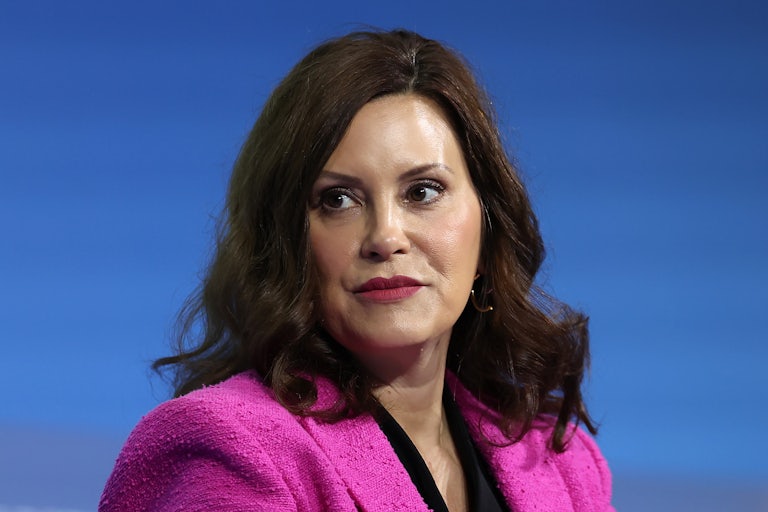
Michigan Governor Gretchen Whitmer
Kevin Dietsch/Getty Images

Despite calls for her to replace Joe Biden as the Democratic nominee for president in November, Michigan Governor Gretchen Whitmer wants no part of it. But she may have warned the president that her state is now unwinnable for him.

Politico reports that Whitmer made a phone call to the Biden campaign Friday night saying that she was upset with her name being floated as a replacement for Biden, and that she had nothing to do with it.

However, Politico columnist Jonathan Martin wrote that he was alerted to the call by a national Democratic rival to Whitmer, who said the Michigan governor also called to tell the Biden camp that the debate had ruined the president’s chances in the state.

Whatever the case may be, this is not great news for Biden, except for Whitmer wishing to stay out of replacement discussions. The fact that a “Draft Gretch” movement has quickly arisen after Thursday night’s debate disaster shows that at least a segment of Democrats want to replace Biden. And if Whitmer actually called the campaign to tell them Michigan was lost, which she would have insight into as governor, that’s a key battleground state at risk in November.

Michigan was the target of a coordinated effort for voters to select an “uncommitted” option during the Democratic presidential primary elections to protest Biden’s support of Israel’s brutal war in Gaza. “Uncommitted” ended up with 13.2 percent of the vote in Michigan’s February primary and jumpstarted a national effort, with several other states with the option on their ballots registering strong showings. In total, 37 uncommitted delegates will be present at the Democratic National Convention in August, and could be a factor if confidence in Biden’s ability to defeat Donald Trump continues to drop.

Right now, Democrats and the Biden campaign are still reeling from Thursday’s debate, with calls echoing from across the Democratic Party spectrum for him to step aside or refuse to run again. While former President Barack Obama attempted to tamp down those calls with a tweet Friday afternoon, others have urged him to make a more forceful intervention. It seems that the next few weeks and months could have a crucial effect not only on November’s election but on the fate of the country at large.

Supreme Court Hands Donald Trump Ultimate Power in Immunity Ruling

The Supreme Court has sent the question of Donald Trump’s immunity back to a lower court, essentially scuppering any chance of a preelection trial.

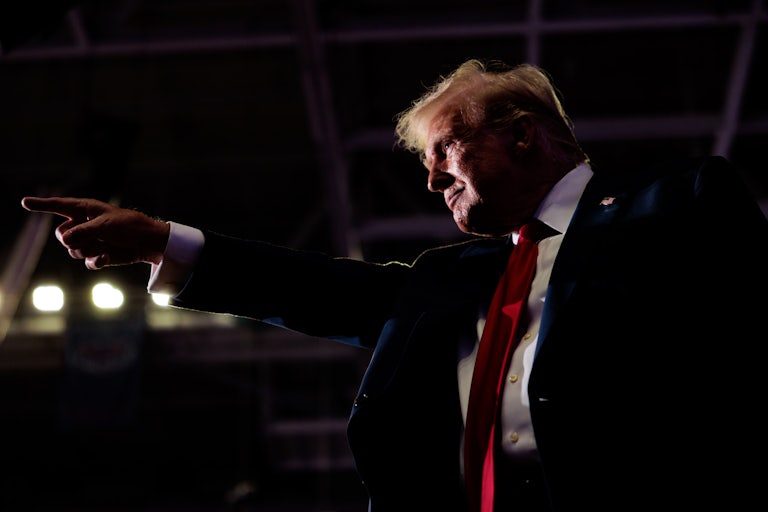
Donald Trump points
Hannah Beier/Bloomberg/Getty Images

The Supreme Court ruled Monday that Donald Trump cannot be held accountable for some of the actions he took to overturn the 2020 election results.

The case, Trump v. United States, sprang out of Trump’s federal election interference trial as a preemptive defense, arguing that Trump could not be tried on conspiracy and obstruction charges due to presidential immunity privileges that he held during office—but few expected Monday’s outcome.

In a 6-3 ruling along ideological lines, the court ruled that some of the actions Trump was indicted for could be categorized as official acts during his presidency.

“Under our constitutional structure of separated powers, the nature of Presidential power entitles a former President to absolute immunity from criminal prosecution for actions within his conclusive and preclusive constitutional authority,” read the opinion’s syllabus. “There is no immunity for unofficial acts.”

Writing the majority opinion, Chief Justice John Roberts outlined that the president is not immune from criminal prosecution—except on some occasions.

“The President is not above the law,” Roberts wrote. “But under our system of separated powers, the President may not be prosecuted for exercising his core constitutional powers, and he is entitled to at least presumptive immunity from prosecution for his official acts.”

In a dissenting opinion, Justice Sonia Sotomayor feared for the future of a country that legally permits the executive branch authority to commit crimes under the cloak of the office, arguing that the court’s decision made a “mockery” of the Constitutional principle that “no man is above the law,” and that its “own misguided wisdom” gave Trump “all the immunity he asked for and more.”

“Never in the history of our Republic has a President had reason to believe that he would be immune from criminal prosecution if he used the trappings of his office to violate the criminal law,” Sotomayor wrote. “Moving forward, however, all former Presidents will be cloaked in such immunity. If the occupant of that office misuses official power for personal gain, the criminal law that the rest of us must abide will not provide a backstop. With fear for our democracy, I dissent.”

The decision from the conservative majority overturned a federal appeals court ruling that had unanimously rejected all three of Trump’s presidential immunity arguments in his January 6 case, “patiently, painstakingly, and unsparingly” dismantling his arguments in an “airtight” opinion, according to George Conway, a conservative attorney and ex-husband of former Trump advisor Kellyanne Conway.

“This opinion is so good, and so clear, so comprehensive, there’s nothing in it that could be possibly attacked. I don’t see how even the Supreme Court could write—I don’t see how any judge, any court, anywhere, including the Supreme Court, could write a better opinion that more accurately states what the law is and should be,” Conway told CNN in February before the Supreme Court opted to hear the case.

Monday’s decision effectively kills the January 6 trial, which would have been overseen by U.S. District Judge Tanya Chutkan.

This story has been updated.

Trump’s Midnight Tantrum: The Pelosi Comment He Couldn’t Handle

Donald Trump went on a wild rant about Nancy Pelosi in the middle of the night.

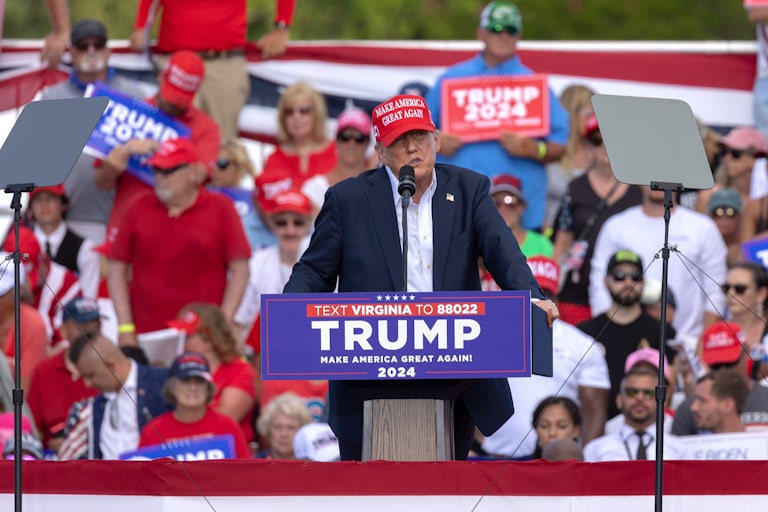
Donald Trump speaks at a lectern
Anna Moneymaker/Getty Images

Donald Trump stayed up well past his bedtime Sunday and, like so many people who have a toxic relationship with social media, spent his night rage-posting about Nancy Pelosi.

At 12:30 a.m. E.T., Trump fumed at Pelosi’s Sunday morning appearance on MSNBC, where she described Trump’s debate last week as a “manifesto of lies” and recalled when she shredded a copy of his State of the Union address in 2020. This apparently roiled Trump, who falsely claimed Pelosi was “exposed by her daughter, a filmmaker, as being fully responsible for the lack of security on January 6th” before declaring Pelosi is “a sick ‘puppy,’ and always has been!!”

Truth Social Donald J. Trump @realDonaldTrump: Crazy Nancy Pelosi, who the other day was exposed by her daughter, a filmmaker, as being fully responsible for the lack of security on January 6th is, in my opinion, more cognitively impaired than Crooked Joe Biden. I just watched her do an interview, and she was way “off.” Additionally, she is suffering from TRUMP DERANGEMENT SYNDROME, sometimes referred to as TDS, and her case is terminal! She is a sick “puppy,” and always has been!!!

During her interview on MSNBC, Pelosi pointed out that it was Trump’s own inactions that aided in the riotous storming of the Capitol on January 6, 2021, likening it to Trump’s downplaying of Covid-19 and elevation of Covid-related conspiracy theories which, Pelosi and public health experts agree, greatly exacerbated the pandemic.

“This is a dangerous person and evil,” Pelosi told MSNBC.

Trump blamed Pelosi for the Capitol riot during his debate—but Pelosi didn’t block the National Guard from mobilizing as Trump supporters rioted at the Capitol. She doesn’t even have authority to reject them—and footage captured by her daughter on January 6, 2021 showed Pelosi desperately calling military contacts to ask why the National Guard hadn’t mobilized.

The morning after the debate, Pelosi pointed out the absurdity of Trump’s claim, telling reporters with CBS, “He thinks I planned my own assassination? He’s sicker than I thought.”

That Lazy “Black Americans for Trump” Event Exposed as Deceptive Ploy

Donald Trump is now fighting with the owner of the barbershop where he hosted the recent event.

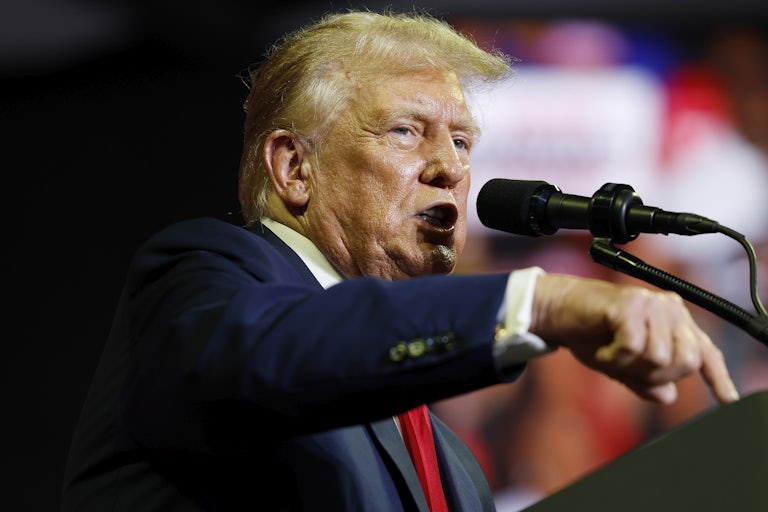
Donald Trump speaks at a podium
Parker Michels-Boyce/Bloomberg/Getty Images

Donald Trump’s attempts to win over Black voters are still doing the exact opposite.

The Trump campaign suggested Saturday night that the owner of a Black barbershop in Atlanta was lying when he claimed he was never informed that the roundtable of Black conservatives he hosted last week was in benefit of the former president.

“The business owner signed an agreement with the Trump campaign and received payment for the time spent in his location for this event,” the campaign wrote in a post on X, sharing snapshots of the venue use contract, which refers to event security as the “Secret Service” and the campaign as “DJTFP24” and a “private political committee.”

Rocky Jones, the owner of Rocky’s Barber Shop, said he wanted to return the money (just $4,800, per the contract) once he discovered that the event for which he closed his shop was actually for Trump’s campaign. Jones claimed that a friend had reached out to him to set up the event, misrepresenting its purpose. Jones also said he had never been in contact with anyone from Trump’s team or campaign and that he never understood the intention of the event from the verbal communication he had received.

“I really take pride in my business,” Jones told Atlanta News First, noting that he had received multiple upset calls from his community over the event. “It’s never been about politics.… I feel like I’ve been betrayed.”

Jones had jumped at the opportunity under the impression that it was an opportunity to lift up other small, Black-owned businesses.

“Just me agreeing to do a Black, small business roundtable,” Jones said. “I thought it was something private.”

But when Trump called in to the event, Jones was shocked. “Why is the … ex-president calling somebody in my barber shop?” he said. “This has nothing to do with small Black businesses.”

The roundtable featured Representatives Byron Donalds and Wesley Hunt, as well as former Trump Housing and Urban Development Secretary Ben Carson, but Trump himself failed to show. Instead, he opted to literally phone it in to discuss the tax cuts he intends to make for billionaires and the ultrarich should he win in November.