Breaking News
Breaking News
from Washington and beyond

Clarence Thomas Pushes Dangerous Definition of Assault Weapons

Thomas was not happy the Supreme Court declined to hear arguments against an assault weapons ban in Illinois.

Associate US Supreme Court Justice Clarence Thomas
Olivier Douliery/AFP/Getty Images

The Supreme Court declined Tuesday to take up a challenge to Illinois’s ban on assault weapons, though not every justice on the high court agreed with the decision to do so.

In a separate opinion, Justice Clarence Thomas appeared keen to uproot future bans, urging the court to take up another such case on the basis that some semiautomatic guns, such as the AR-15, are among the most popular weapons in the nation, thereby claiming that more guidance is needed to delineate which weapons are “dangerous” and “unusual.” He further called the Seventh Circuit’s decision to uphold the state ban, which stemmed from a landmark 2008 Supreme Court decision that ruled that military grade weapons such as M-16 rifles are not protected under the Second Amendment, as “nonsensical.”

“The Seventh Circuit’s contrived ‘non-militaristic’ limitation on the Arms protected by the Second Amendment seems unmoored from both text and history,” Thomas wrote. “It is difficult to see how the Seventh Circuit could have concluded that the most widely owned semiautomatic rifles are not ‘Arms’ protected by the Second Amendment.”

The Illinois ban was instituted after a 2022 Independence Day parade shooting in Chicago’s Highland Park took the lives of seven people and injured 48 others. The law prohibits the sale of semiautomatic “assault weapons,” which are commonly used in mass shootings, including the AK-47 and AR-15 rifles, as well as the sale of some handguns. The ban also forbids the sale of magazines that use more than 10 rounds for long weapons, or 15 rounds for handguns, as well as rapid-fire devices known as “switches” that convert semiautomatic weapons into automatic machine guns.

“This assault weapons ban is a step in the right direction,” Illinois Governor J.B. Pritzker said at a press conference following the law’s passage. “But there’s no magic fix, no single law that will end gun violence once and for all. So we must keep fighting, voting, and protesting to ensure that future generations will only have to read about massacres like Highland Park, Sandy Hook, and Uvalde in their history books. It’s our burden and our mandate, one that we carry with solemn honor for our children who will grow up in a better and safer world.”
This is not the first time this term that Thomas has sought to dramatically expand access to deadly weapons. Last month, he joined the majority decision to overturn a federal ban on bump stocks and dissented from a ruling barring domestic abusers from owning guns.

Supreme Court Sets Up Legal War to Weaken the Government

The high court sent nine cases back to the lower courts in light of recent rulings weakening federal agency authority.

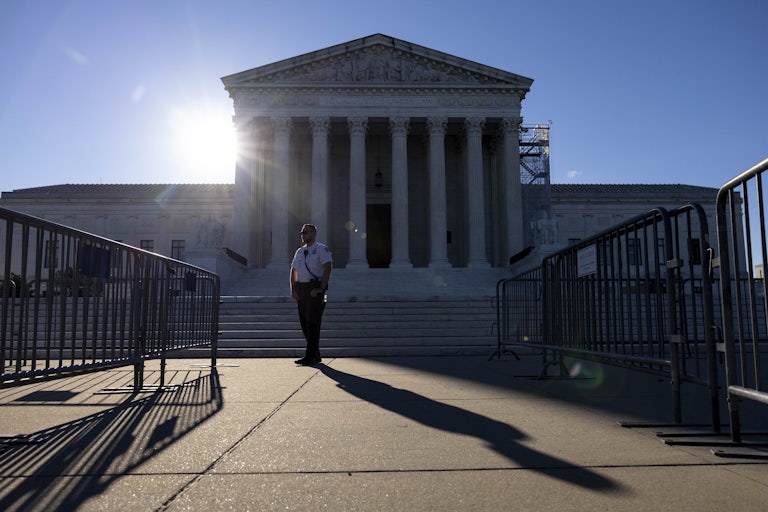
A security guard stands in front of the Supreme Court building
Amanda Andrade-Rhoades/The Washington Post/Getty Images

The U.S. Supreme Court announced Tuesday that it is sending a whopping nine cases back to the lower courts after its ruling in Loper Bright Enterprises v. Raimondo, the first sign of the chaos from overturning the Chevron deference.

The court ruled Friday to upend Chevron, a 40-year-old doctrine that requires judges to defer to a federal agency when determining the meaning of any ambiguous laws that agency should try to enforce. In his majority opinion, Chief Justice John Roberts wrote that, instead, “Courts must exercise their independent judgment in deciding whether an agency has acted within its statutory authority, as the [Administrative Procedures Act] requires.”

The decision in Loper Bright now allows the federal judiciary to play pretend as scientists and policymakers, while stripping the administrative agencies that are staffed by experts who get their directives from democratically elected officials with the power to determine policy. As a result, several cases with questions about ambiguous language are now headed back to the lower courts.

For example, of the cases that have been remanded back to the appeals courts, there are four cases that have to do with the interpretation of ambiguous language in the Immigration and Nationality Act—a law enforced by the U.S. Citizenship and Immigration Services, an agency under the authority of the Department of Homeland Security, which is run by Biden-appointed Homeland Security Secretary Alejando Mayorkas.

Now the question will no longer be referred to immigration experts at the department, or to policymakers representing the current administration, but left to the discretion of appeals judges in the Fourth, Ninth and Eleventh Circuits.

Other questions sent back to the lower courts have to do with energy, agriculture, labor practices, and the Internal Revenue Service to name a few.

In the wake of Loper Bright, right-wing judges—who have pushed for years to oppose Chevron and embrace deregulation—have the functional ability to veto any new federal regulation they decide is too “ambiguous.” As these cases continue to pile up, which they no doubt will, the law will no longer be determined by Congress, or even the executive branch, but by injunction.

Trump Lawyer Argues Fake Electors Were “Official” Presidential Act

Donald Trump is already using the Supreme Court immunity ruling exactly how you’d expect.

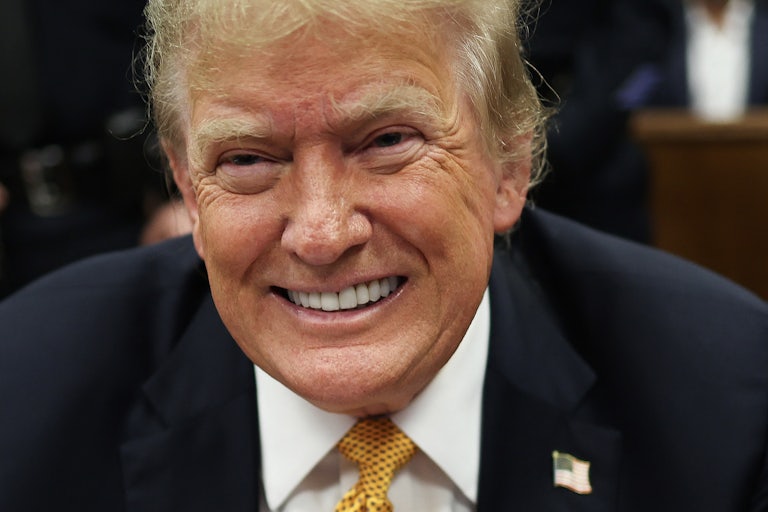
Donald Trump smiling (close-up photo)
CHARLY TRIBALLEAU/POOL/AFP/Getty Images

The Supreme Court’s ruling on presidential immunity means that the president can attempt to overturn elections, according to one of Trump’s lawyers.

Will Scharf told CNN’s Kaitlan Collins Monday night that “alternate slates of electors have been a method used by previous presidents, most notably Ulysses S. Grant, to ensure the integrity of prior elections.”

“We believe the assembly of those alternate slates of electors was an official act of the presidency,” Scharf said, referring to the attempts by Trump allies to subvert the 2020 election results in different states. “That’s what we argued before the Supreme Court.”

After the 2020 election, Trump and his allies tried to present fake electors in states across America to flip results in his favor, including Georgia, Wisconsin, Pennsylvania, Michigan, New Mexico, Nevada, and Arizona, resulting in criminal charges in many cases. In Georgia, Trump himself was charged, along with 18 of his allies, but the case is in limbo while an appeals court considers whether prosecutor Fani Willis should be thrown off of the case.

The nation’s highest court seems to have opened the floodgates for any kind of presidential crimes, so long as the president can argue it was an “official” act. Now, sitting presidents can argue they cannot be prosecuted, evidence cannot be collected against them, and the Justice Department is not independent of the White House. There are probably more devastating interpretations yet to come. Meanwhile, Trump is attempting to get his hush-money conviction thrown out over how some of the evidence was collected.

Supreme Court Trump Immunity Ruling Already Having Terrifying Effects

Donald Trump is trying to leverage his newfound power in his other legal battles.

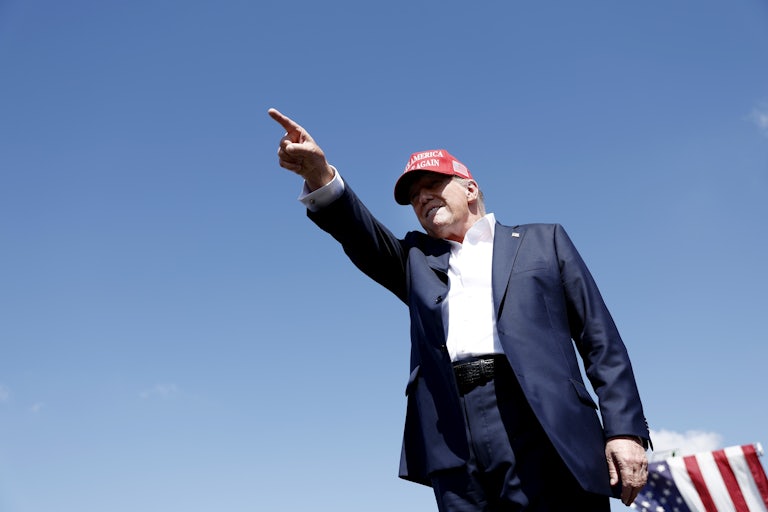
Donald Trump points
Anna Moneymaker/Getty Images

The work to undo Donald Trump’s criminal charges—and his recent conviction—in light of the Supreme Court’s ruling on presidential immunity has already begun.

Hours after the ruling Monday, the former president’s legal team requested that Judge Juan Merchan set aside Trump’s hush-money conviction and delay the sentencing scheduled for next week, citing the Supreme Court’s expansion of presidential immunity.

Trump’s attorneys argued that some evidence presented in the case constituted official presidential acts, according to a copy of a letter obtained by the Associated Press. That could refer to some of the communication Trump had about his former fixer Michael Cohen, which his legal team had previously attempted to redact from the trial on the same presidential immunity claim. But that was before the Supreme Court expanded the definition of immunity.

“Under our constitutional structure of separated powers, the nature of Presidential power entitles a former President to absolute immunity from criminal prosecution for actions within his conclusive and preclusive constitutional authority,” read the consequential ruling. “There is no immunity for unofficial acts.”

The high court’s decision already effectively killed Trump’s federal election interference trial, which sought to hold Trump accountable for his role in the effort to overturn the 2020 election results and the far-right mob that stormed the U.S. Capitol building on January 6. Now it could overturn one of the few cases where Trump is being held accountable.

Trump was accused of using Cohen to sweep an affair with porn star Stormy Daniels under the rug ahead of the 2016 presidential election. He was convicted on 34 felony charges in May for allegedly falsifying business records with the intent to further an underlying crime in the first degree. Merchan could sentence Trump to up to four years in prison on the charges. He could also impose probation, supervised release, or order Trump to do community service or pay fines.

Watch: Bill Barr’s Priceless Reaction as Steve Bannon Heads to Prison

The former U.S. attorney general couldn’t help but laugh.

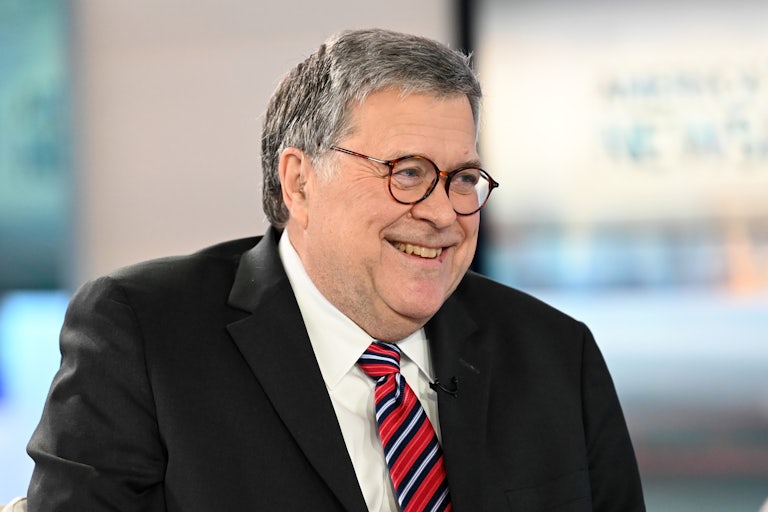
Bill Barr smiles
Slaven Vlasic/Getty Images

Former Attorney General Bill Barr couldn’t help but laugh at the mention of Donald Trump’s erstwhile strategist Steve Bannon sitting in a federal prison cell.

During an interview on Fox News’s Your World Monday night, host Neil Cavuto asked Barr what impact he believed that presidential immunity, which Trump was freshly granted by the Supreme Court earlier that day, would have on Trump’s behavior if reelected to the White House. Cavuto asked Barr if he thought Trump would even care about being punished if he’d be 82 years old by the time he left office.

“Well, I would say, you know, the president acts through people,” said Barr. “And maybe he wouldn’t worry about it, although I think he would, but his, the people who are around him and are being asked to do things, certainly I think are going to make sure that they’re behaving within the law.”

“I understand people’s concern given his frequently incendiary rhetoric, I’m just saying, having experienced working with a person and being a subordinate of his,” Barr continued. “You know, Bannon says I’m the first person to go to prison under President Trump. I don’t lose any sleep over it. I’m not worried about that.”

Cavuto laughed, before pointing out, “I think he’s in prison right now, himself.”

Barr burst into laughter.

“I don’t mean to make light of that,” Cavuto said, moving on to his next question.

Bannon chaotically reported to Danbury federal prison in Connecticut on Monday, after being found guilty on two counts of contempt of Congress. In recent weeks, the former Trump strategist made several desperate attempts to avoid jail time, all of which were clearly unsuccessful. While the American system of mass incarceration is no laughing matter, perhaps the MAGA mastermind will reenter society with a new perspective on prison abolition?

During his appearance on Fox News, Barr also took aim at Justice Sonia Sotomayor’s dissent in the immunity case, in which she slammed the majority opinion for making the president a king by giving him the immunity to assassinate his political enemies.

“The president has the authority to defend the country against foreign enemies, armed conflict and so forth. He has the authority to direct the justice system against criminals at home. He doesn’t have authority to go and assassinate people. So whether he uses the SEAL team or a private hitman, it doesn’t matter, it doesn’t make it a carrying out of his authority. So all these horror stories really are false,” Barr said.

This isn’t the first time that Barr has downplayed the violent rhetoric of his former boss. In April, Barr claimed that Trump would “lose his temper” and “blow off steam” by calling for the execution of his enemies, but said, “I doubt he would’ve actually carried it out.” In just the past 24 hours, the possibility of Trump following through on any of his wild remarks promising violent retribution has become all the more real.