Breaking News
Breaking News
from Washington and beyond

Humiliating New Polls Spell Doom for J.D. Vance … and Trump

J.D. Vance has somehow managed to become even more unpopular.

J.D. Vance walks on Donald Trump’s plane
Anna Moneymaker/Getty Images

J.D. Vance was not seen as the popular choice when Donald Trump selected him as his number two—and the Ohio senator has proven even less popular since joining the ticket.

Several polls have indicated that Vance has overwhelmingly underperformed among American voters, making him the least popular nonincumbent veep candidate since 1980. Vance’s popularity has sunk by 8.8 percentage points since his vice presidential candidacy was announced at the Republican National Convention, according to a polling average aggregated by FiveThirtyEight.

One poll conducted by Public Policy Polling on July 31 found that 47 percent of polled Americans found Vance to be unfavorable, while just 30 percent considered him favorable. An ABC News-Ipsos poll conducted between July 20 and July 27 found that Vance’s favorability had dropped by nine points, and an AP-NORC poll conducted between July 15 and July 29 saw Vance’s favorably drop by eight points.

That’s in stark contrast to other recent vice presidential nominees, who all managed to keep their heads above water in the weeks following their nominations.

Voting blocs that have turned away en masse from Vance include women, independents, and Black voters. His favorability with those groups has tanked by double digits, according to The Washington Post. Vance’s reputation has also collapsed with college-educated voters, with whom his image has declined by 28 percent, according to an August Marist poll.

But confusingly, Trump has continued to send Vance out to campaign events all week, while the Republican presidential nominee has remained largely out of the public eye. Given Vance’s low appeal, it’s unclear how this strategy helps the campaign.


Read more about Vance:

Republicans Officially Enact Their Most Extreme School Book Ban

A Republican trifecta in Utah has taken school book bans to their most dystopian level yet.

A student sits at a table in the library with her chin resting on her hands, reading the laptop in front of her. A row of bookcases is in the background.
Brandon Bell/Getty Images

Utah has become the first state to institute a statewide book ban, prohibiting 13 books by authors including Margaret Atwood, Judy Blume, and Rupi Kaur in public school classrooms and libraries. 

The move comes after the state passed a bill on July 1 that allowed for books with “pornographic or indecent” material to be banned. Utah has a Republican governor and GOP supermajorities in both its state House and Senate. 

Six of the 13 banned books were written by fantasy romance author Sarah J. Mass. Twelve of the 13 have women authors. School districts as well as charter schools must now “legally” dispose of these books, which “may not be sold or distributed.”

The nonprofit free expression organization PEN America called the ban “a dark day for the freedom to read in Utah.”

The state’s ban “will impose a dystopian censorship regime across public schools and, in many cases, will directly contravene local preferences,” the organization’s Freedom to Read program director, Kasey Meehan, told The Guardian. “Allowing just a handful of districts to make decisions for the whole state is anti-democratic.”

Banning books is a theme across a lot of  dystopian fiction, for instance in Fahrenheit 451 and Nineteen Eighty-Four, titles that ironically could be banned next under Utah’s new law. In real life, book bans commonly occur in repressive and authoritarian societies. That fits into a pattern with Utah Republicans, who have also proposed monitoring which public restrooms people use. Utah’s extremism isn’t unique among red states, though: In Oklahoma, the state is requiring that the Bible be taught in schools.

According to The Salt Lake Tribune, the full list of banned books in Utah is:

  • Blankets by Craig Thompson
  • A Court of Frost and Starlight by Sarah J. Maas
  • A Court of Mist and Fury by Sarah J. Maas
  • A Court of Silver Flames by Sarah J. Maas
  • A Court of Thorns and Roses by Sarah J. Maas
  • A Court of Wings and Ruin by Sarah J. Maas
  • Empire of Storms by Sarah J. Maas
  • Fallout by Ellen Hopkins
  • Forever by Judy Blume
  • Milk and Honey by Rupi Kaur
  • Oryx & Crake by Margaret Atwood
  • Tilt by Ellen Hopkins
  • What Girls Are Made Of by Elana K. Arno

J.D. Vance Tries Cowardly Excuse to Get Out of Debating Tim Walz

Vance is taking a page out of Donald Trump’s playbook.

J.D. Vance stands with his arms crossed during a tour of a police station
Emily Elconin/Getty Images

Donald Trump has tried desperately to back out of his presidential debate with Kamala Harris, which was previously scheduled for September 10—so now, J.D. Vance has offered to take it off his plate.

During Vance’s rally in Eau Claire, Wisconsin, Wednesday, the Republican vice presidential nominee inexplicably invited Harris to debate next week.

“So here’s my offer to Kamala Harris: If she’d like to do a debate with me on August 13, I’ll do it,” Vance said.

Before President Joe Biden dropped out of the race, Harris had agreed to debate Vance on CBS News on either July 23 or August 13. But Trump declined to commit his running mate to a debate.

In the weeks since, Harris has been elevated to the Democratic presidential nominee (she was officially certified as the nominee on Tuesday), challenging Trump to a debate. While Harris’s circumstances have obviously changed, Vance voiced his skepticism that anything was certain.

“I don’t think she wants to anymore, because one, she probably doesn’t even know that she’s going to be the Democratic nominee, and two we don’t know who the vice presidential nominee is going to be, either,” he said.

Vance claimed that it was still unclear whether Minnesota Governor Tim Walz, whom Harris tapped on Tuesday, would be the nominee because “he’s got a lot of skeletons that are coming out of the closet.”

“We’ll see if the Democrats pull a bait and switch on Tim Walz, or on Kamala Harris, just like they did with Joe Biden,” Vance warned.

Just as Vance can’t seem to come to terms with the fact that he’s not debating Harris anymore, Trump can’t seem to cope without Biden.

On Tuesday night, Trump wrote a surreal post on Truth Social in which he imagined Biden crashing the Democratic National Convention to seize the nomination back from Harris.

Fanfiction aside, Trump and Vance just can’t seem to face the reality that this is a fundamentally different race from the one they signed on for. Their slate of bad excuses for not debating Harris and Walz respectively has betrayed the depths of their obstinate, delusional approach to campaigning, as well as something much more troubling: that the two are plainly incapable of adapting to their new opponents.

Meanwhile, Walz seems more than happy to debate Vance. “I can’t wait to debate the guy,” Walz said at a rally in Pennsylvania Tuesday night. “That is, if he’s willing to get off the couch and show up.”

Kamala’s Latest Polling Win Is a Devastating Blow to Trump

Kamala Harris has inched ahead of Donald Trump in two key polls.

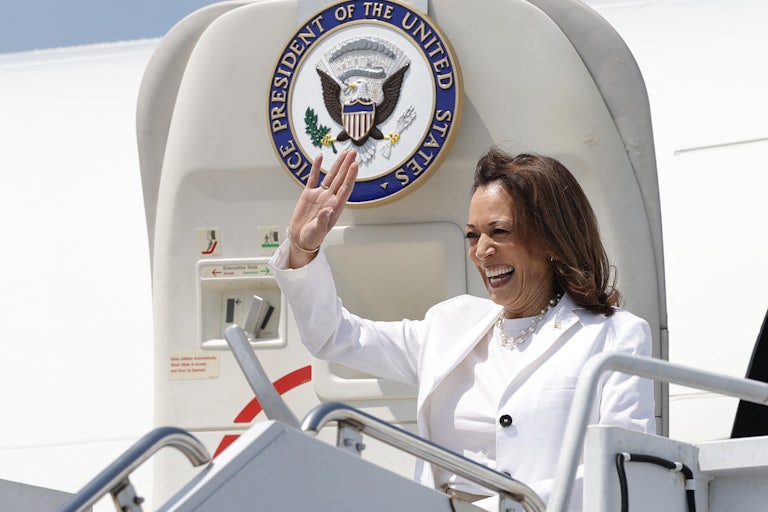
Kamala Harris smiles and waves as she exits her official plane
Kamil Krzaczynski/AFP/Getty Images

Kamala Harris has officially pulled ahead of Donald Trump, according to two key national polling averages.

Harris and Trump were neck and neck toward the end of July, with Harris leading by a narrow 0.2 percent on July 28, according to FiveThirtyEight.

Over the course of little more than a week, the gap between Harris and her Republican opponent widened to 1.8 percent, after several recent polls found that she was polling between one and four points ahead of Trump. 

As of Wednesday, the vice president was leading Trump 45.2 percent to 43.3 percent, according to Project 538.  

Real Clear Politics, another poll aggregator, had Harris trailing Trump by 1.8 to 2 percent at the end of July. Over the course of the last week, Harris officially surpassed Trump, leading 47.4 percent to 46.9 percent. 

While that polling average reported a smaller lead for Harris, only 0.5 percent, it represents a major change in momentum for the Democratic Party, which has uniformly trailed Trump over the last six months, according to RCP.  

Several other polls have also found Harris seizing the lead. VoteHub’s national poll aggregation found that Harris was leading by 0.3 percent. A poll The Economist published Tuesday had Harris in the lead, as well, beating the former president 47 percent to 46 percent. An NPR/Marist poll published Tuesday found that Harris had secured a lead, at 51 percent to Trump’s 48 percent. 

Across the board, Harris has seen a significant uptick in positive polling in early August, which should cause Trump some concern.

Last week, the former president claimed he didn’t need to debate Harris because he was “leading in the polls, it seems, by quite a bit, still,” though Harris had already begun to pass him. 

It Just Got Easier for Trump to Block Election Results in Georgia

The state election board voted to make it easier to delay or refuse to certify election results.

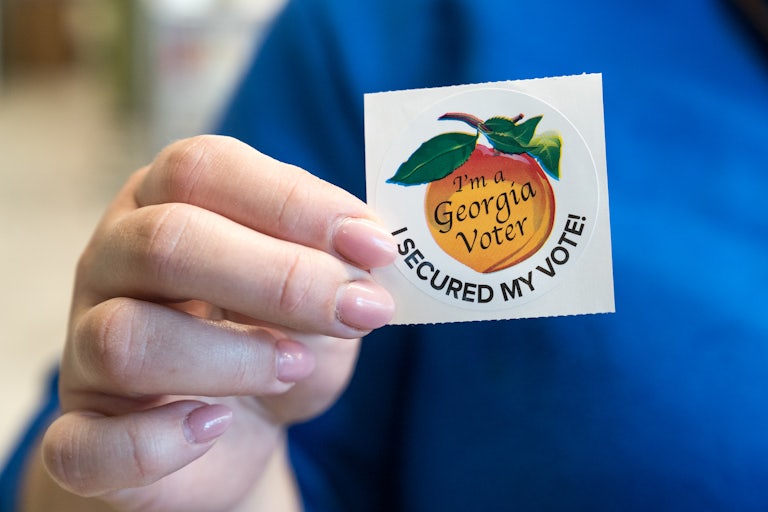
A person holds up an “I Voted” sticker from Georgia
Megan Varner/Washington Post/Getty Images

The Georgia State Election Board voted to make it easier for county election officials to delay or refuse certification of election results.

In a 3–2 vote on Tuesday, members voted in favor of a new rule requiring a “reasonable inquiry” before certifying election results. The board did not elaborate, however, on what exactly that inquiry would look like, according to The Atlanta Journal-Constitution.

That could spell chaos come November, especially considering that at least 70 election officials across 16 counties in key swing states, including Georgia, have been identified as pro–Donald Trump election denialists.

Trump praised the MAGA members of Georgia’s board days before the vote, describing Janice Johnston, Rick Jeffares, and Janelle King as “pit bulls fighting for victory.”

“I don’t know if you’ve heard, but the Georgia State Election Board is in a very positive way,” Trump said at his rally in Atlanta on Saturday. “They’re on fire, they’re doing a great job.”

According to the state election board’s website, the body is “entrusted with a variety of responsibilities and authority to protect all Georgians’ right to cast a ballot.”

Georgia has had the largest number of certification refusals since 2020 of anywhere in the country. The five-person board has been accused of ethics violations—including one instance in which its Trump-friendly majority failed to give proper notice to their Democratic colleagues about a meeting that they used to advance changes to state election rules.

And Republicans are already well into cooking up other strategies to undermine future election results. In May, Fulton County election board official Julie Adams launched a lawsuit seeking a court ruling on whether her duty to certify election results could be considered “discretionary, not ministerial, in nature.”

Meanwhile, the Fulton County election interference case—which intended to deal with Trump and his allies’ election chicanery in the state—has been put on hiatus until after November by the Georgia Court of Appeals as it weighs whether to allow Fulton County District Attorney Fani Willis to stay on the case.

Willis was allowed to remain on the Georgia RICO case after a judge determined she had not hired special prosecutor Nathan Wade—a man she had a relationship with and who billed her office (and taxpayers) more than $728,000 in legal fees—for personal financial gain.