Breaking News
Breaking News
from Washington and beyond

Trump’s Failing Stock Just Hit Its Lowest Point Yet

Donald Trump can finally sell his Truth Social stock. Too bad it’s worth so little now.

A phone screen shows Donald Trump’s Truth Social account
Matt Cardy/Getty Images

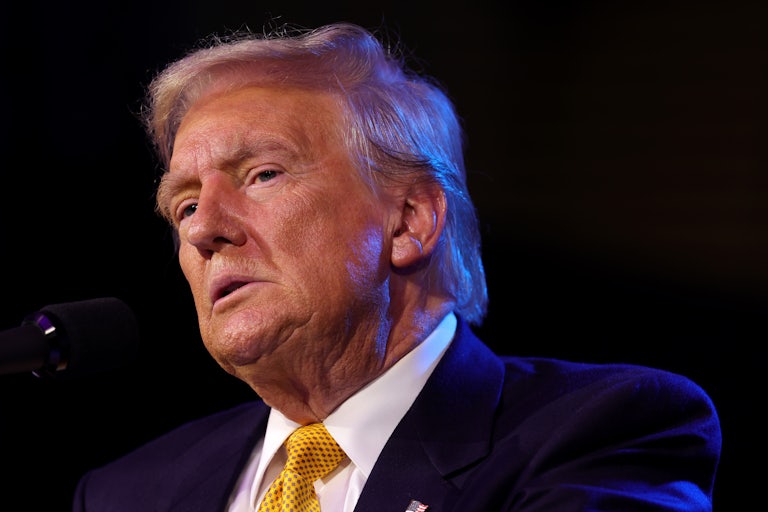
Trump Media & Technology Group stock dropped to its lowest price yet Friday, the first day Donald Trump is allowed to sell his shares in the social media venture. 

Shares dropped more than 7 percent to $13.68 per share, putting the value of the company at $2.74 billion. It’s a far cry from when the stock price peaked at nearly $80 per share in March after its initial public offering.

Trump owns 115 million shares of TMTG, about 57 percent of the company, and the stock seems to fluctuate based on public sentiment toward the former president and convicted felon. His poor debate performance against Kamala Harris last week caused a steep drop in the stock price, and the stock also took a hit last month when Trump posted on X (formerly Twitter) after a long hiatus.  

Until Friday, the Republican presidential nominee wasn’t allowed to sell any of his shares unless he had permission from the company’s board of directors. Last week, he promised that he wouldn’t immediately sell his shares, giving the stock a slight bump. But that was quickly erased after the debate and with Friday’s arrival. 

Now what was once a sure cash cow for Trump has lost most of its value, and the former president must be tempted to squeeze whatever profit he can out of it. He has unpaid bills, legal fees, and a massive fraud judgment against him in New York, where the state might seize his assets. He has resorted to absurd moneymaking schemes such as selling NFT trading cards, his own branded Bibles, his own cryptocurrency scam, and assassination-themed sneakers

The moment he decides to sell his stock, though, investors’ confidence will plummet and the stock will hit the floor, and that might be the end of Truth Social. The question is what Trump loves more: a quick and easy profit, or his own branded social network. 

Watch: James Comer Has Wild Excuse for Pro-Trump Probe into Tim Walz

James Comer has no excuse for his blatantly political investigation into Tim Walz.

James Comer smiles and points at reporters
Tom Williams/CQ-Roll Call, Inc/Getty Images

Republican Representative James Comer attacked Minnesota Governor Tim Walz’s family Friday, while defending his blatantly political investigation into the Democratic vice presidential nominee.

During an appearance on Fox Business’s Mornings With Maria, Comer tried to defend the House Oversight Committee’s investigation into Walz, which was announced last month, alleging that the Democratic governor has a “long-standing cozy relationship with China.”

“Yeah, that’s a scary family there,” Comer said of Walz’s family. “It looks like the type of family that’s been indoctrinated.”

As Comer spoke, host Maria Bartiromo looked horrified, and the producers cut away from her.

“They believe that there is a better way to do business,” Comer said. “Some of the things that the Walzes have said about China, their affection for China. That’s very concerning for me because we don’t want to set our business model like China.”

It’s clear, however, that Comer’s investigation is a political ploy to help out Donald Trump. The same week Comer announced his probe into Walz’s ties with China, the House Oversight Committee chair also announced that he would investigate Kamala Harris’s work on the southern border. He previously attempted a similar gambit by spearheading an investigation into the Biden family—which crumbled, having not produced any evidence of the president’s, or his family’s, supposed wrongdoings.

Representative Maxwell Frost, a Democrat from Florida, eviscerated Comer Thursday for going after Walz, as well as his other obvious steps to help Trump.

Frost accused Comer of violating House rules to hold a blatantly political hearing on the alleged failures of the Biden-Harris administration. “How can we allow this hearing to continue, when we are in direct violation of the House rules?” Frost asked.

“This committee functions as an extension of the Trump campaign,” Frost said. “First, we went after President Biden with a nonsense impeachment hearing. Then we went after his son. Now we’re going after the vice president because she’s the nominee. And my question is, Mr. Chairman, are we going after Tim Walz next, next week?

“I hear from my staff that you’re planning a hearing on Governor Tim Walz, even though he’s been governor for five years and his name hasn’t been uttered in this room, or in this committee, until something happened recently—oh yes, he became the vice presidential nominee. Is he next?”

During Frost’s takedown, Representative Jamie Raskin could be seen grinning.

Comer was completely unable to defend his blatant politicking. “His son is going to jail,” Comer said, speaking about Hunter Biden. Frost clarified he was asking about Walz, and Comer sighed, “Ohhh, I’ll have to check.”

Frost said anyone involved in the “blatant use of official resources for a political campaign” should be “ashamed of themselves.”

Clearly, Comer is shameless, and so bent on helping Trump he’ll say anything, no matter how egregious.

Pro-Trump Election Officials Disrupt Voting Process in Key State

Donald Trump’s allies in Georgia are working to help him win the state.

Donald Trump stands in front of a microphone
Kevin Dietsch/Getty Images

Donald Trump’s allies on the Georgia State Election Board voted 3–2 Friday to require the state’s counties to count all election ballots by hand, which would considerably delay the results and cast doubt on the process.

The move comes thanks to the pro-Trump majority on the board, which has taken several steps in the hopes of helping the former president win the state in November. The three board members have sought to make it easier for county election officials to reject election results, and have had an ethics complaint lodged against them for trying to make significant changes to the rules governing Georgia’s elections.

The Georgia Attorney General’s Office warned Thursday that the rule changes would likely be considered illegal or invalid under state law and break ballot chain of custody.

The new rule, one of 11 that the board planned to vote on Friday, would require ballots to be counted by hand the night of the election or by the next day, which many local election officials say would be impossible in most of the state’s counties. In public comments Friday, some officials said it was too late to institute rules that require staff training and funds they don’t have.

“Military ballots have already been issued,” said Irwin County elections supervisor Ethan Compton. “The election has begun. This is not the time to change the rules. That will only lower the integrity of our elections.”

Saira Draper, a Democrat in Georgia’s state legislature and an election lawyer, saw the rule change as a blatant effort to cause chaos on Election Day.

“It makes me question whether members of this board are operating in good faith,” Draper said. “Putting 11, maybe 12 new rules into play days before Election Day is a grift. We are setting up our counties to fail. Why do we know they are going to fail? Because they are telling you that.”

A Georgia judge has already thrown out one right-wing attempt to mess with certification procedures in the state, and it seems likely that this new rule will be challenged in court too. But it won’t stop Trump’s allies in the state, who are strategizing behind the scenes to help the former president and convicted felon. If they succeed, they could end up nullifying a Democratic victory in the state.

Republicans Are Trying to Block Voters in a Crucial Swing State

The Republican National Committee is trying to block votes in Pennsylvania.

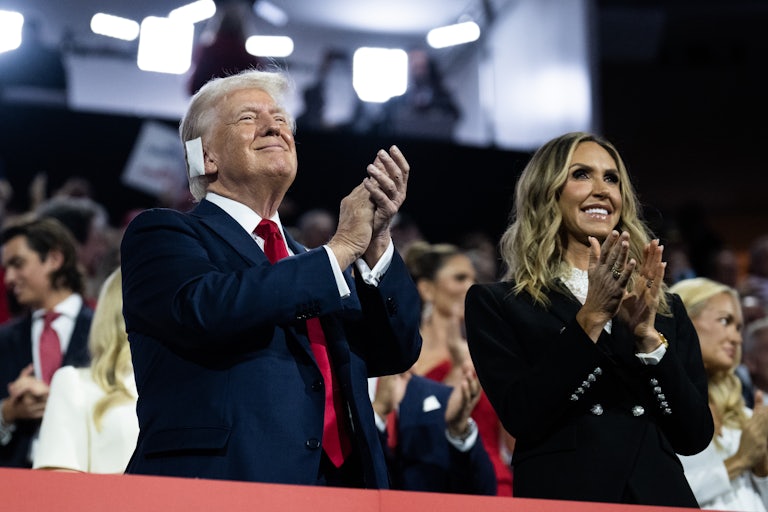
Donald Trump and his daughter-in-law, RNC co-chair Lara Trump, clap while standing next to each other
Tom Williams/CQ-Roll Call, Inc/Getty Images

If Republicans get their way in Pennsylvania, voters won’t be able to correct technical problems with their ballots.

The Republican National Committee and the Pennsylvania Republican Party filed a lawsuit in the Pennsylvania Supreme Court Wednesday against the state’s 67 county election boards and Secretary of State Al Schmidt, a Republican. The lawsuit not only would stop ballot correction but would also prevent voters from being able to cast a provisional ballot if their mail ballot is rejected for technical reasons.

Republicans claim that state law bars election officials from telling voters about such issues and allowing their ballots to be fixed and counted. In many other states, such corrections are allowed, such as when a date or signature is missing on a ballot or envelope, or when signatures don’t match. A restriction on provisional ballots could hurt voters who run into problems after showing up at their polling place, such as their name not appearing on the registration rolls.

Schmidt’s office responded to the lawsuit, saying they support “allowing voters to rectify technical deficiencies so their vote is counted.”

“We will continue to fight for every eligible citizen’s right to vote and have their voice heard,” a spokesperson said.

Donald Trump has railed against mail-in balloting, attacking the U.S. Postal Service and claiming it’s ridden with fraud, in an attempt to undermine confidence in the voting option, which is more likely to be used by Democrats. Pennsylvania has been a particular target of the former president and convicted felon, as he has claimed without evidence that 20 percent of mail-in ballots in the state are fraudulent.

The USPS may be a major factor during the 2024 election, as service has worsened in many states in the past few years. Many battleground states such as Georgia still have lower than average delivery times, and Postmaster General Louis DeJoy, a Trump appointee, has been accused of deliberately hurting the postal service to pursue a privatization agenda.

Read more about Republican voting initiatives:

Lindsey Graham’s Dangerous Ploy Could Upend Election in Trump’s Favor

How changing Nebraska’s voting system could swing the election away from Kamala Harris.

Lindsey Graham looks at reporters
Anna Moneymaker/Getty Images

Republicans’ plan to change how electoral votes are distributed in Nebraska could have far-reaching effects to hurt Kamala Harris’s chances at the presidency.

Nebraska splits its five Electoral College votes, granting two of them to the winner of the state’s popular vote, while the other three are given to the winner of the three congressional districts. In the past few months, Republicans in the state have pushed to return to a model where all the votes would be granted to the winner of the whole state.

Earlier this week, South Carolina senator and apparent errand boy for Donald Trump Lindsey Graham traveled to Nebraska to shore up support for this change among state lawmakers.

In ensuring that all of the state’s electoral votes go to one candidate, Republicans are essentially securing the presidential election in Nebraska for Trump, by siphoning away a spare point that Harris would earn from a district with a large metropolitan area.

If Nebraska changes its rules, it’s likely that Maine would seek to do so too, which has the potential to help Harris regain some ground lost in Nebraska.

Maine also splits its four electoral votes, with two appointed based on the winner of the popular vote within each congressional district and then two based on the winner of the state-wide popular vote.

Maine’s Democratic House Majority Leader Maureen Terry issued a statement in April indicating that if Nebraska were to change its Electoral College rules, she would “be compelled to act in order to restore fairness.”

In 2020, Maine delivered one electoral vote to Trump and the other three to Joe Biden. If Maine changed its Electoral College rules and votes similarly to how it did four years ago, all four Electoral College votes would be delivered to Harris, giving her back the one vote she may have lost in Nebraska.

However, there’s one major problem: It may be too late for Maine to change its rules, according to Politico.

In Maine, a bill becomes law 90 days after it’s passed. Only 46 days remain until polls open in November, and only 87 days until electoral votes will be cast.

A bill can be made into law immediately if it receives a two-thirds vote in each chamber. While the Democrats have majorities in both houses, they don’t have the kind of numbers to ensure supermajority support.

We’re 46 days away from November 5, and 87 days from December 16, when electoral votes are set to be cast.

If Nebraska is able to change but Maine is not, it’s possible that Harris will lose out on one electoral vote, which, according to one projection, means that she will need to do more than win the key battleground states of Wisconsin, Michigan, and Pennsylvania to have a shot at 270—she’ll need to win at least one other swing state too.

While Harris is polling competitively in North Carolina and Georgia, Nebraska Republicans’ plot to change the state’s Electoral College rules makes these battleground states even more make-or-break for Harris’s campaign.