Breaking News
Breaking News
from Washington and beyond

Donald Trump Still Wants to Dismantle Critical Hurricane Agency

If the former president and his cronies have their way, future superstorms will be a much more chaotic and horrific experience.

A sign displays a hurricane warning along a roadside as preparations are made for the arrival of Hurricane Helene, in Cedar Key, Florida on September 25, 2024.
Miguel J. Rodriguez/Getty Images
A sign displays a hurricane warning along a roadside as preparations are made for the arrival of Hurricane Helene in Cedar Key, Florida, on September 25

Hurricane Helene has derailed the Republican presidential ticket’s campaign across the South, forcing Trump’s vice presidential pick, J.D. Vance, to cancel several stops in Georgia. But the 20-foot storm surge–inducing, tornado-spawning weather event hasn’t yet changed Trump’s stance on his plan to tear down the National Oceanic and Atmospheric Administration, or NOAA, root and branch.

The climate agency, whose responsibilities include providing free weather forecasts as well as tracking and predicting hurricanes, would be completely gutted under Project 2025, the 920-page Christian nationalist manifesto that purports to be Trump’s second-term agenda. (Trump has haltingly and not particularly convincingly attempted to disavow Project 2025; a recently unearthed video features one of the project’s authors bragging that there will be “one-to-one mirroring” of the policies laid out in the document and Trump’s proposals.)

“The National Oceanographic and Atmospheric Administration (NOAA) should be dismantled and many of its functions eliminated, sent to other agencies, privatized, or placed under the control of states and territories,” the proposal reads on page 664.

That would effectively privatize weather forecasts, forcing U.S. citizens to pay for weather subscriptions that would include national weather alert systems for emergencies like flash flooding, extreme heat, earthquakes, and others.

Project 2025 has advanced a slew of seemingly outrageous policy positions, including tearing down staples of the executive branch, such as the Department of Education. It also proposes revisiting federal approval of the abortion pill, banning pornography nationwide, placing the Justice Department under the control of the president, slashing federal funds for climate change research in an effort to sideline mitigation efforts, and increasing funding for the U.S.-Mexico border wall.

Trump has spent months trying to distance his campaign from Project 2025, but a flurry of the Republican presidential nominee’s recent comments, which include reiterating his intention to demolish the Department of Education, has practically glued him to its policy points.

By Friday afternoon—less than 24 hours after the Category Four storm made landfall on Florida’s coast—22 people were dead, and 4.5 million locals were without power, reported USA Today.
The Walz-Vance V.P. Debate Rules Are Out—and They Guarantee Chaos

CBS News has released all the details on the first (and only) vice presidential debate with Tim Walz and J.D. Vance.

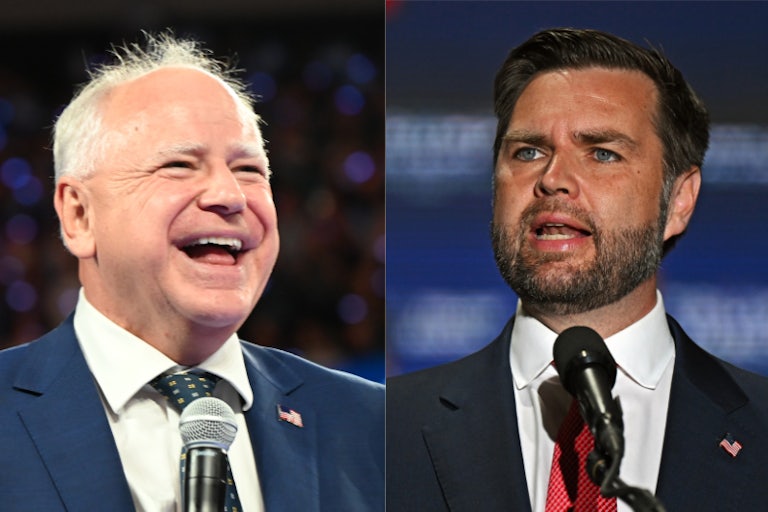
Tim Walz and J.D. Vance splitscreen
Getty x2

The rules are set for Tim Walz and J.D. Vance’s vice presidential debate on Tuesday, and they promise to give everyone watching a spirited, if not chaotic, contest.

For one, both of the candidates’ microphones will remain on while one of them is talking, although CBS News, which is hosting and moderating the debate, says it reserves the right to hit the mute button. This is a departure from ABC News’s decision to mute microphones during both previous presidential debates.

The V.P. debate will take place at 9 p.m. at the CBS Broadcast Center in New York, and, just like Harris and Trump’s debate in Philadelphia, there will be no audience in the studio. Candidates will have two minutes to answer the questions posed to them, with the opposing candidate also allowed two minutes to respond. Following that, each candidate gets one minute for a rebuttal.

At their discretion, the moderators can give candidates more time to continue a topic. The candidates will have lights on their podiums to indicate how much time they have to speak, and they’ll each have a countdown clock. At the end of the debate, which will last for 90 minutes, Vance and Walz will each get two minutes for a closing statement. Vance won a coin toss held Thursday, and chose to go second and have the final word.

Vance has had a rough time since being named as Trump’s running mate in July, with a number of damaging interviews and statements resurfacing in the weeks since. Walz, on the other hand, helped launch the Democrats’ best attack line in years by calling Republicans and their policies “weird.” Vance has unsuccessfully attempted to attack Walz’s military record, and, along with Trump, egged on a racist lie against Haitian immigrants in Ohio.

It will be interesting to see how the Ohio senator will handle any questions about Haitian immigrants, which will almost certainly be brought up, or if he will try to make personal attacks against the Minnesota governor. Vance does not appear to have any issues of cognitive decline, unlike Donald Trump, so his debate performance might be the clearest articulation of the policies proposed by the Republican ticket. But, judging by Vance’s statements during the campaign, those policies might not sound any better in his words.

The Fear That’s Keeping Mitt Romney From Endorsing Harris

The Utah senator has cited the dangers of Trump-inspired political violence many times over the years. They still worry him today.

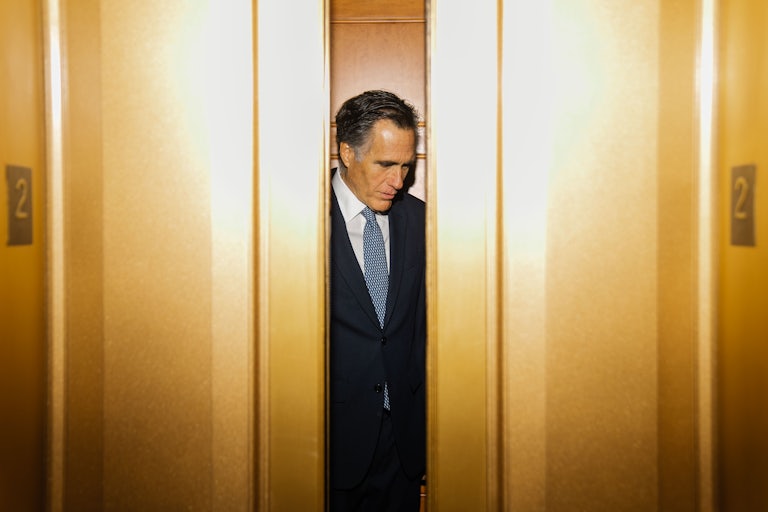
Mitt Romney departs the Senate Chamber following a vote at the U.S. Capitol.
Kent Nishimura/Getty Images
Mitt Romney departs the Senate Chamber following a vote at the U.S. Capitol.

Republican Senator Mitt Romney, who has said he would not vote for Donald Trump, has expressed some reticence about endorsing Trump’s opponent over a particularly grim worry.

The Washington Post reported Friday that Romney has cited concern for his family’s safety as one of the reasons he has not publicly supported Kamala Harris, according to one person familiar with the Utah politician’s thinking.

This isn’t the first time that Romney has expressed this particular fear. After the January 6 riot, the former Republican presidential nominee started paying $5,000 a day for private security for his family, according to The Atlantic. Romney said he could understand why some of his colleagues were fearful about voting to impeach Trump, because it might place figurative bull’s-eyes on their backs, ripe targets for the more violent members of Trump’s base.

In an interview with The Atlantic published earlier this week, Romney fretted over his ability to keep his entire family safe from Trump’s ire, should he be reelected in November. (Trump has made it clear that his plans for a second term include seeking revenge on those who’ve wronged him.)

“How am I going to protect 25 grandkids, two great-grandkids?” Romney told The Atlantic. “I’ve got five sons, five daughters-in-law—it’s like, we’re a big group.”

Republicans being influenced by the threats and intimidation campaigns of MAGA members is hardly a new phenomenon.

Romney has also questioned the value of his endorsement in a post-Trump America, and whether it might hurt his credibility as a conservative voice, according to the Post. Earlier this year, Romney said he would not vote for Trump but refused to say whether he would support Joe Biden.

Romney has remained quiet, unlike other Republicans who have found themselves targeted by MAGA Republicans, like former Wyoming Representative Liz Cheney, who endorsed Harris last month. (Her dad did too!)

Earlier this month, more than 100 former GOP officials signed a public letter endorsing Harris, warning that Donald Trump is “unfit” for the presidency or “any office of public trust.”

Elon Musk’s PAC Is Pumping Millions to Help Republicans Keep the House

Elon Musk’s America PAC is spending millions to help Republicans down ballot. Here’s who’s getting the most money.

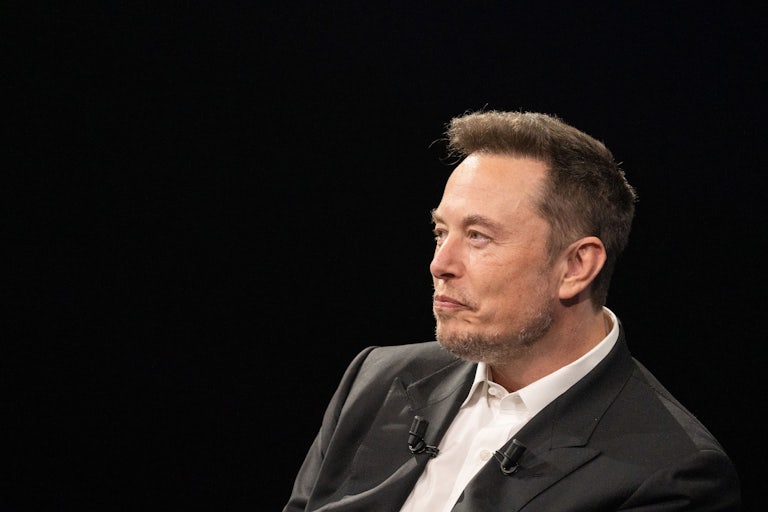
Elon Musk
Nathan Laine/Bloomberg/Getty Images

Last week, The Washington Post reported that Elon Musk’s political action committee is “playing a key role in the effort to win Trump a second term.” But the billionaire’s America PAC is also pouring hefty sums into downballot races.

Business Insider’s Bryan Metzger reports that the super PAC backed by the world’s richest man “has spent more than $5 million across 15 competitive House races.” In each of those contests, America PAC funds are in support of the Republican candidate and against the Democratic candidate.

Here’s where Musk’s PAC is spending most to help out Republican incumbents:

  • $699,000 in Republican Representative Mike Lawler’s race against Mondaire Jones in New York’s 17th district
  • $557,100 in Republican Representative Ken Calvert’s race against Will Rollins in California’s 41st district
  • $472,700 in Republican Representative Michelle Steel’s race against Derek Tran in California’s 45th district.

In each of the other 12 House races, spending is also in the six figures.

And there’s likely more on the way for Republican candidates for the House, as the PAC has reportedly “set aside $10 million for ‘voter turnout’ in House races around the country.”

That this money is going only to Republican candidates is unsurprising—given Musk’s now full-fledged embrace of the right—but it’s perhaps worth noting. When Musk announced America PAC in July, he said, “It’s not meant to be sort of a hyperpartisan PAC.” Setting aside America PAC’s support of the Trump campaign, what other word but “hyperpartisan” is there for its spending on these House races?

Trump’s Meeting With Zelenskiy Went About as Well as You’d Expect

The former president gushed about his relationship with Vladimir Putin while standing next to the leader of Ukraine.

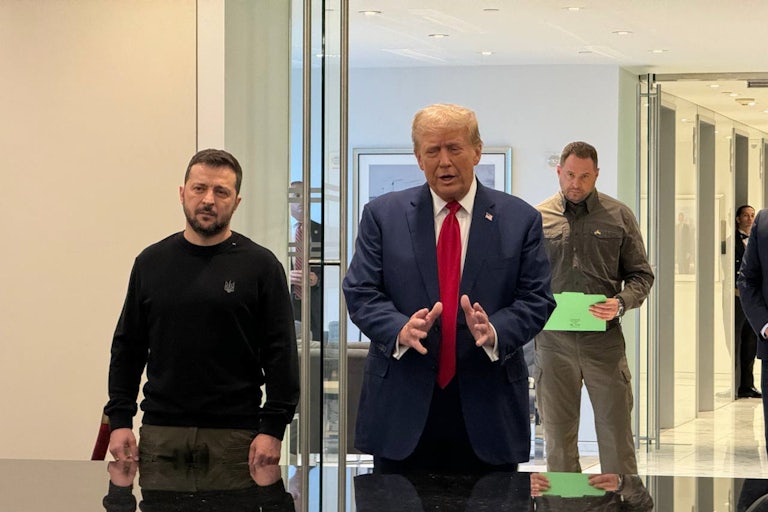
Two men stand behind a table.
Uliana Boichuk/Novyny LIVE/Global Images Ukraine/Getty Images
Donald Trump and Volodymyr Zelenskiy on Friday

As Donald Trump and Ukrainian President Volodymyr Zelenskiy stood together to address members of the press, the former president couldn’t help but brag about his cozy relationship with Russian President Vladimir Putin, who is currently leading a deadly war in Zelenskiy’s home country of Ukraine.

“We have a very good relationship … and I also have a very good relationship, as you know, with President Putin,” Trump boasted. “And I think, uh, if we win, I think we’re going to get it resolved very quickly.”

“I hope we have more good relations with us,” Zelenskiy interrupted, gesturing between himself and Trump.

“We’re gonna have—oh, ha ha, I see,” Trump said. “But you know, it takes two to tango.”

Trump has previously touted his skills as a dealmaker when promising to bring an end to the war in Ukraine, which has killed more than 11,000 people. When asked more specifically during the presidential debate just how he would end the conflict, Trump said, “I’ll speak to one, I’ll speak to the other, I’ll get ’em together.”

In reality, Trump’s plan would involve Ukraine ceding part of its territory to Russia, a deal that is more or less what the Kremlin is looking for. And Trump is far from a neutral arbiter. The former president has gone from publicly gushing about Putin to flat-out saying that Zelenskiy should just give in to Russia’s violent invasion. When asked during the debate who exactly he wanted to prevail in the conflict, he wouldn’t deign to say.

Ahead of the meeting Friday, Trump had begun regularly criticizing Zelenskiy during campaign rallies, calling him the “greatest salesman in history” for his ability to acquire defense funding from the U.S.

While speaking about the war in Ukraine on Tuesday, the former president said he doubted anyone could beat Russia. “That’s what they do is they fight wars. As somebody told me the other day, they beat Hitler, they beat Napoleon. That’s what they do, they fight,” Trump said. Hitler and Napoleon, of course, both invaded Russia—Russia, in this instance, is the aggressor.

Trump also claimed that Zelenskiy had supported the former president during his “impeachment hoax” by calling him to say that “President Trump did nothing wrong.” Trump also inexplicably claimed that the Ukrainian president had called Trump to “congratulate me on his victory.”

In a separate interview, Trump said that Zelenskiy was seeking a “fair transaction” to end the war in Ukraine. “The president wants it to stop. And I’m sure President Putin wants it to stop. And that’s a good combination.”