Breaking News
Breaking News
from Washington and beyond

Trump’s Own Intel Agencies Destroy His Main Defense on Deportations

A newly declassified memo destroys Trump’s justification for using a wartime powers law to round up Venezuelan immigrants and deport them to El Salvador.

Donald Trump speaks to reporters outside the White House.
Tasos Katopodis/Getty Images

U.S. spy agencies do not believe that the Venezuelan government has authority over the Tren de Aragua gang—a development that directly contradicts Trump’s justification for his illegal, extrajudicial deportations of Venezuelans to a prison in El Salvador.

“While Venezuela’s permissive environment enables TDA to operate, the Maduro regime probably does not have a policy of cooperating with TDA and is not directing TDA movement to and operations in the United States,” a memo from the Office of the Director of National Intelligence read, according to The New York Times.

Trump has been claiming the exact opposite since he invoked the wartime Alien Enemies Act of 1798 in March to summarily round up Venezuelan immigrants and deport them without basic due process.

Trump first invoked the wartime powers act in March, asserting that “this is a time of war. Because Biden allowed millions of people, many of them criminals, many of them at the highest level.… Other nations emptied their jails into the United States, it’s an invasion. These are criminals, many many criminals … murderers, drug dealers at the highest level, drug lords. People from mental institutions. That’s an invasion.” He also said Tren de Aragua gang members were committing crimes in the United States “at the direction, clandestine or otherwise, of the Maduro regime in Venezuela.”

The memo directly delegitimizes his argument, further confirming that Trump is operating well outside the bounds of his executive powers.
RFK Jr. Wildly Defends Terrifying Idea for Registry of Autistic People

Robert F. Kennedy Jr.’s idea was so bad that the Department of Health and Human Services walked it back.

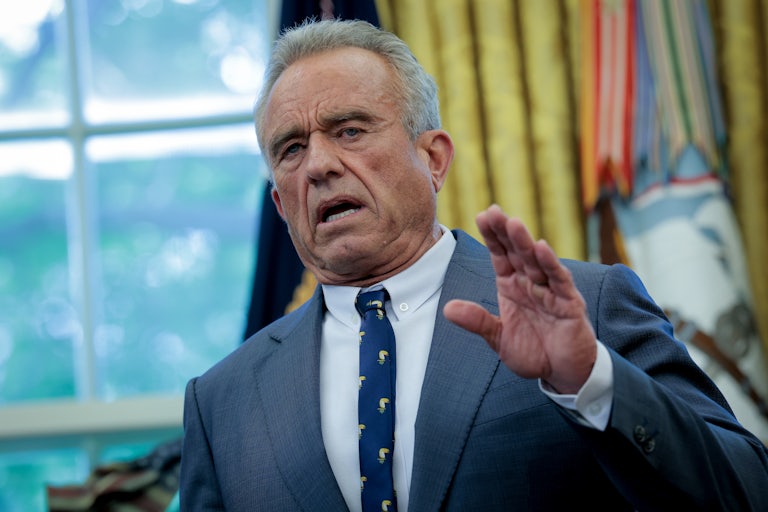
Robert F. Kennedy Jr. gestures while speaking in the Oval Office
Anna Moneymaker/Getty Images

Health Secretary Robert F. Kennedy Jr. is still advocating for the creation of a disease registry that tracks people diagnosed with autism.

During an appearance Monday night on Fox News’s The Ingraham Angle, Kennedy tried to explain why the government would need to collate citizens’ private medical records into a massive database—a plan that was announced last month by the National Institutes of Health, and then reportedly abandoned two days later after severe backlash.

“One in every 31 kids today. In California, which has the best database, it’s one in every 20 children, one in every 12.5 boys,” Kennedy claimed.

“This is an existential disease,” Kennedy continued. “Every other disease like this has a registry so that—and its voluntary—public health officials can monitor the numbers. It’s not private information, it’s not information that is gonna go out to other agencies, it’s a voluntary system where your privacy is protected. Just a system for keeping track of a disease that is now becoming debilitating to the American public.”

A Centers for Disease Control and Prevention report published last month found that one in 31 children aged 8 years old has been identified with autism spectrum disorder. Days before that report had come out, Donald Trump was already spouting those exact numbers before claiming that autism could potentially be caused by vaccines.

While the CDC has documented an increase in diagnoses from 2000, when only one in 150 children born in 1992 was diagnosed with autism, experts have attributed some of the rise in diagnoses to a widening definition of autism spectrum disorder, which encapsulates a broader range of symptoms, as well as people being more aware of and willing to get diagnostic testing, according to ABC News.

Under Kennedy’s guidance, the CDC has launched a study on connections between vaccines and autism, despite extensive research debunking the conspiracy theory.

Pete Hegseth Made an Order on Ukraine Trump Knew Nothing About

In the early days of Trump’s term, an order came from Hegseth’s office that sent national security officials scrambling.

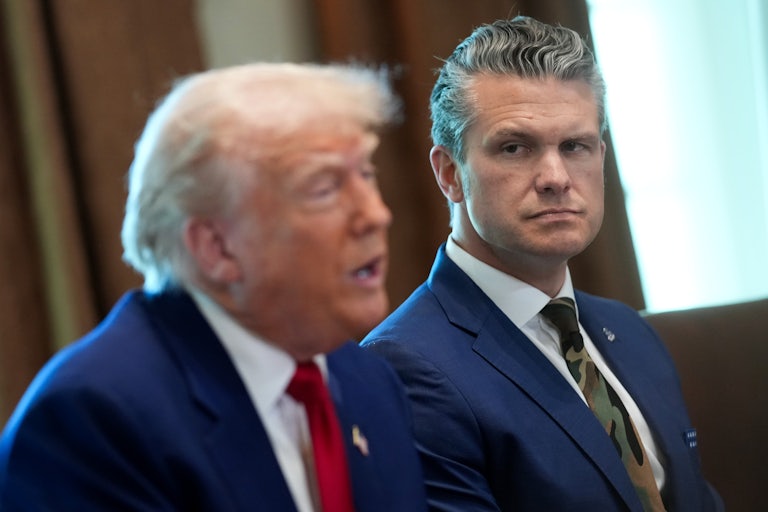
Defense Secretary Pete Hegseth watches as Donald Trump, seated beside him in the White House, speaks.
Andrew Harnik/Getty Images

Pete Hegseth canceled military aid flights to Ukraine just a week into Trump’s second term without the president even knowing, according to Reuters.

The ignominious defense secretary called off 11 Ukraine-bound planes carrying artillery, shells, and other weapons. Trump was completely unaware that Hegseth had made the call, as the TRANSCOM records simply show a verbal order from “SECDEF”—the secretary of defense—stopping aid flights to Ukraine until February 5.

The order initially sparked mass confusion within the administration, as national security officials in the White House, the Pentagon, and the State Department couldn’t figure out who ordered the halt in flights.

This is yet another example of the chaos and lack of cohesion that Hegseth has brought to the Pentagon from day one. But the administration is treating the communication failure like business as usual.

“Negotiating an end to the Russia-Ukraine War has been a complex and fluid situation. We are not going to detail every conversation among top administration officials throughout the process,” White House press secretary Karoline Leavitt told Reuters. “The bottom line is the war is much closer to an end today than it was when President Trump took office.”

The move also aligns with the growing anti–European Union, anti-Ukraine, pro-isolationist views that Hegseth and Vice President JD Vance hold, as evident in their infamous Signalgate group chat messages.

“This is consistent with the administration’s policy to move fast, break things, and sort it out later,” said retired Marine and defense expert Mark Cancian. “That is their managing philosophy.”

This is one of multiple reports on the internal disarray at Hegeth’s Defense Department.

Remember That Wild Photoshoot of Young Barron Trump and His Many Toys?

As Donald Trump preaches about buying kids fewer dolls, the internet has resurfaced photos of some of the toys Barron Trump grew up with.

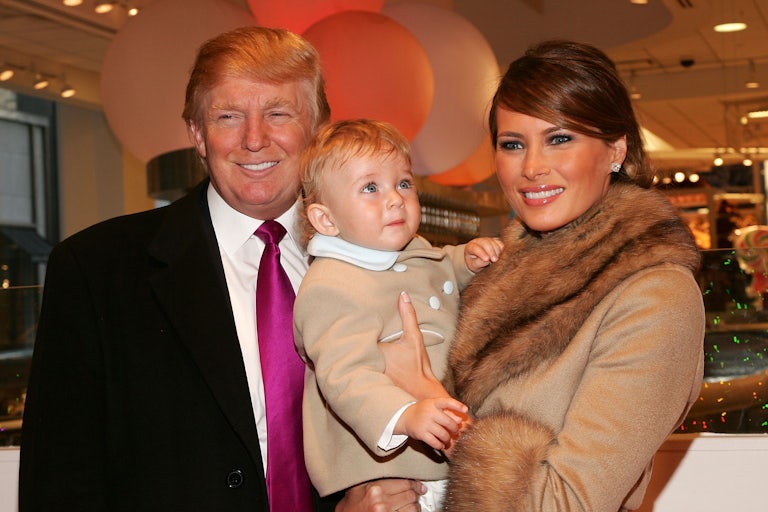
Donald Trump and Melania Trump smile as she holds a baby Barron in her arms.
Bryan Bedder/Getty Images
Donald Trump, Melania Trump, and Barron Trump in 2007

“Abundance for me but not for thee” seems to be Donald Trump’s new motto.

The president’s argument that children should just have fewer dolls rattled the nation last week. Trump’s tariffs proposals—which were discovered and confirmed by the White House to be based on bad math—have sent markets tumbling and pushed the U.S. economy closer toward a recession. The boss of the biggest shipping port in the country told AFP News Agency that American consumers can expect “less choice and higher prices” once current inventory runs out, which he predicted would occur within the next five to seven weeks.

In the face of rising costs and a slowing job market, Trump’s solution is just as simple as it is un-American: Buy less.

“I don’t think a young lady, a 10-year-old girl, 9-year-old girl, 15-year-old girl, doesn’t need 37 dolls. She can be very happy with two or three or four or five,” Trump reiterated to reporters aboard Air Force One Sunday.

But Trump—whose net worth is estimated by Forbes to be $5.1 billion—wouldn’t know the first thing about living a modest lifestyle. His own children have been photographed in the lap of luxury, playing with lavish toys backdropped by the ornate interiors of his New York City penthouse, as the internet was quick to point out.

X screenshot Marlow Stern @MarlowNYC just some of barron trump’s toys… including a mini mercedes convertible (photos)

Some of Barron Trump’s childhood toys included a customized mini Mercedes convertible featuring a “BARRON” license plate, several life-size stuffed animals, and famously, a Louis Vuitton “soot-case” that reportedly now retails for nearly $10,000. They resided in an entire floor of Trump’s apartment, which Barron apparently had all to himself, Melania told Entertainment Tonight in 2010.

Other images of Trump’s brood include photos of Melania holding a baby Barron in front of golden doors, marble floors, and an elaborate pram.

Bluesky screenshot photo of Melania Trump holding a baby Barron amid all gold
More on Trump talking about limiting kids’ toys:

Horrifying Report Showcases Dire Conditions in ICE Facilities

At least seven migrants have died in ICE custody since the start of Trump's second term.

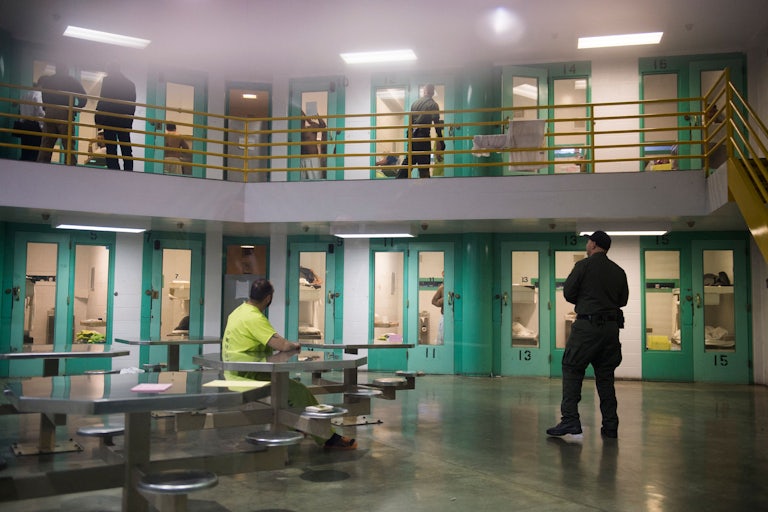
tables and holding cells in a prison
ROBYN BECK/AFP/Getty Images
An Orange County Jail that was also being used to house immigration detainees in 2017

President Donald Trump’s first 100 days in office have proved fatal for seven people who were detained by Immigrations and Customs Enforcement, as part of the president’s massive deportation efforts.

Of the seven immigrants who have died in ICE custody over the past three months, the agency has only published reports on three of the deaths, which were all reviewed by the Spanish newspaper El Paīs.

According to the outlet, all three individuals arrived in detention in good condition, and saw their health rapidly decline.

Makysm Chernyak, a 44 year-old Ukrainian man, was arrested in January on assault charges and transferred to ICE detention in Miami where he was found to be totally healthy, with the exception of an elevated heart rate. For a week in mid-February he was in and out of the clinic, after reporting nasal congestion and a cough. On February 18, he was found vomiting and trembling in his cell, and while awaiting transfer to the hospital he suffered six seizures, and vomited blood. Doctors shortly discovered he’d had a hemorrhagic stroke and was determined to be brain dead. He was declared dead two days later.

Marie Blaise, a 44 year-old Haitian woman was detained on February 12 in the U.S. Virgin Islands when she tried to board a flight to North Carolina without a valid immigration visa. Another woman detained in Deerfield Beach detention center told the Miami Herald that Blaise began to complain of chest pains on April 25. She was given some pills and told to rest, but hours later she awoke screaming in pain. Later that night she was announced dead, and her cause of death is still under investigation, according to El Paīs.

Last week, Florida Representative Sheila Cherfilus-McCormick, the only Haitian American member of Congress, slammed ICE over Blaise’s death. “Marie had been complaining about chest pain for hours,” she said on the House floor. “They gave her some pills and told her to go lie down. Unfortunately, Marie never woke up.”

ICE is required to report on all in-custody deaths within 90 days, but Cherfilus-McCormick called for a “full, independent investigation” into Blaise’s death. Chernyak and Blaise are two of three immigrants who died in detention in Florida. The other was Genry Ruiz Guillén, a 29-year-old Honduran detained at the Krome center in Florida who died on January 23. Others died in custody in Texas, Arizona, Puerto Rico, and Missouri.

In a statement, ICE insisted that it was providing proper care to detainees. “All people in ICE custody receive medical, dental and mental health screening and 24-hour emergency care at each detention facility,” it said.

A 2024 report from the American Civil Liberties Union found that 95 percent of deaths at ICE-operated facilities between 2017 and 2021 could have been prevented “if appropriate medical care had been provided.” In a whopping 88 percent of the deaths reviewed as part of the report, medical staff at the ICE detention centers had “made incorrect, inappropriate, or incomplete diagnoses.”