Breaking News
Breaking News
from Washington and beyond

Trump Rewards His Lawyer With Nomination for Lifetime Judge Gig

Emil Bove is about to get a whole lot more power—for life.

Trump lawyer Emil Bove in court during the hush-money trial.
Jeenah Moon/Pool/Getty Images

President Trump just awarded Emil Bove, his personal lawyer, with a nomination for a lifetime federal judiciary appointment.

Bove, who unsuccessfully defended Trump in the Stormy Daniels hush-money trial, could now soon be a judge on the United States Court of Appeals for the Third Circuit, if confirmed by the Senate.

“It is my great honor to nominate Emil Bove to serve as a Judge on the United States Court of Appeals for the Third Circuit. Emil is a distinguished graduate of Georgetown Law, and served as Assistant U.S. Attorney in the Southern District of New York for nearly a decade, where he was the Co-Chief of the Terrorism and International Narcotics Unit,” Trump wrote on Truth Social on Wednesday. “Emil is SMART, TOUGH, and respected by everyone. He will end the Weaponization of Justice, restore the Rule of Law, and do anything else that is necessary to, MAKE AMERICA GREAT AGAIN. Emil Bove will never let you down!”

Bove was serving as acting deputy attorney general before Todd Blanche was confirmed. He was key in dropping the multiple corruption charges against New York City Mayor Eric Adams, in exchange for Adams’s loyalty. He also fired prosecutors who investigated January 6 and accused the FBI of “insubordination” for not turning over the names of other staffers who worked on January 6 investigations. As a New York state prosecutor, he was described by colleagues as someone who could not “be bothered to treat lesser mortals with respect or empathy.”

“In my experience litigating against him, what he enjoyed most as a prosecutor was wielding power — the single worst possible trait for a public servant,” former federal prosecutor and Bove legal opponent Christine Chung told the Associated Press. “But people won’t speak against him publicly because he’s also vindictive, as he is now making abundantly clear.”

This story has been updated.
Trump Confirms He Got Into a Fight With Netanyahu Over Iran Plans

Donald Trump said he got into a fight with the Israeli prime minister, who is desperate to bomb Iran.

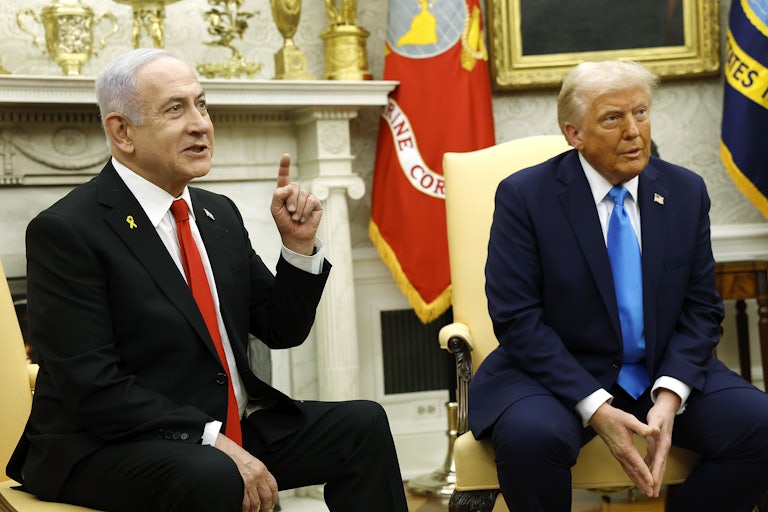
Donald Trump and Israeli Prime Minister Benjamin Netanyahu sit during a meeting in the Oval Office of the White House. Netanyahu points a finger in the air while speaking, as if to make a point.
Anna Moneymaker/Getty Images

President Trump on Wednesday confirmed reports of a disagreement he had with Israeli Prime Minister Benjamin Netanyahu regarding Netanyahu’s desire to bomb Iranian nuclear enrichment facilities—while Trump is in the middle of negotiating a nuclear deal with Iran.

“Did you warn Prime Minister Netanyahu against taking some sort of action that could disrupt the talks there, in a phone call last week?” a reporter asked Trump, after he swore in former Fox News host Jeanine Pirro as interim U.S. district attorney for D.C.

“Well, I like to be honest,” Trump said. “Yes, I did. Next question please?”

Rather than taking another question, Trump continued to describe the latest spat between himself and the Israeli prime minister.

“It’s not a warning. I said I don’t think it’s appropriate.”

“What exactly did you tell him?”

“I said I don’t think it’s appropriate, we’re having very good discussions with [Iran], and I said, ‘I don’t think it’s appropriate right now.’ Because if we can settle it with a very strong document, very strong … no trust, I don’t trust anybody. So no trust. I want it very strong, we can go in with inspectors, we can take whatever we want, we can blow up whatever we want, but nobody getting killed,” he rambled.

“I told [Netanyahu] this would be very inappropriate to do right now because we’re very close to a solution. Now, that could change at any moment. It could change with a phone call. But right now, I think [Iran wants] to make a deal, and if we can make a deal, [that would] save a lot of lives.”

This disagreement is the latest in a small but notable series of events in which the Trump administration has circumvented Netanyahu in a way the Biden administration did not. In March, the Trump administration sent its hostage envoy, Adam Boehler, to negotiate directly with Hamas to free Edan Alexander without Netanyahu’s consent.

When faced with criticism, Boehler stated that the Hamas officials were “pretty nice guys” who “didn’t have horns growing out of their head” and were “actually guys like us.” His response led to uproar among the Israeli center right.

Trump also skipped over Israel on his recent Middle East trip, suggesting that Netanyahu does not have the same sway with Trump as he did with the Biden administration.

“There’s a cadre in the administration who doesn’t particularly care for Israel; they have no special attachment to Israel. They view them as a partner but not one we should be going out of our way to be doing favors for,” a former Trump administration official told Politico, during Trump’s Middle East trip. “Netanyahu is one of those people who pushes and pushes, and that can rub Trump the wrong way.”

More on Trump’s foreign policy in the Middle East:

Trump Freaks Out When He Learns About Humiliating New Nickname

Investors have started referring to the TACO theory, which stands for “Trump Always Chickens Out.”

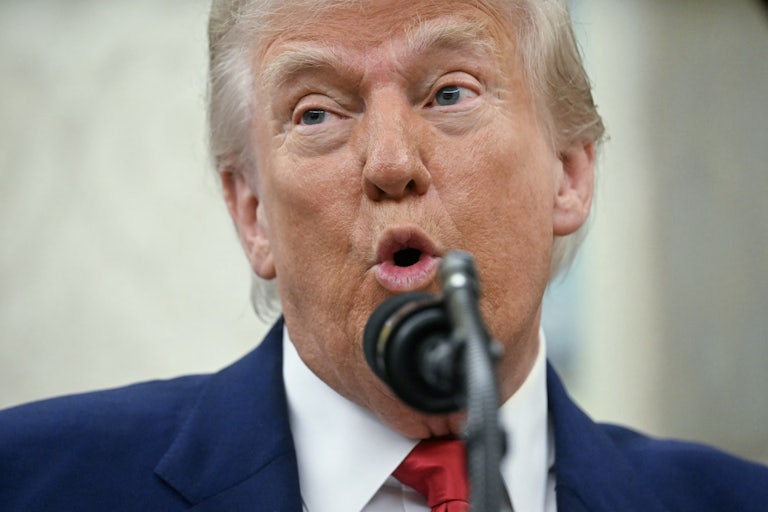
Donald Trump speaks into a microphone in the Oval Office
Jim Watson/AFP/Getty Images

The president is taking his new Wall Street nickname very personally.

Earlier this month, Financial Times columnist Robert Armstrong coined an acronym to describe a popular new trading strategy centered around Donald Trump’s start-and-stop tariff policies: TACO, or “Trump Always Chickens Out.”

But when confronted with the reality of his new reputation, during a White House press briefing Wednesday, Trump flipped out.

“I kick out?” Trump said initially, misunderstanding the acronym.

“Chicken out,” the reporter clarified.

“Oh, isn’t that nice. ‘Chicken out,’ I’ve never heard that,” Trump said before ranting that he hadn’t lacked follow-through on his trade policies, referring to his arrangements with China and the European Union. Instead, Trump claimed that he had heard complaints he was too tough.

“You call that chickening out? Because we have $14 trillion now invested, committed to investing—when Biden didn’t have practically anything; Biden, this country was dying,” Trump said. “You know, we have the hottest country anywhere in the world. I went to Saudi Arabia, the king told me, he said, ‘You’ve got the hottest count—we’ve got the hottest country in the world right now.’ Six months ago, this country was stone-cold dead. We had a dead country.

“We had a country of people that didn’t think it was going to survive, and you ask a nasty question like that,” Trump continued, apparently blaming the media for reporting on the talk of the town.

The Art of the Deal author then continued to rant about how he had gone high on his initial tariff proposals with the aim of keeping the final negotiation at a higher rate than previously accepted. (This has proven to not be the case. In the last month, several countries, including South Korea and Japan, have decided to follow China’s tariff negotiating strategy, gambling that public pressure from within the U.S. will force the Trump administration to fold on its unpopular trade policy before their own economies feel the sting.)

“Don’t ever say what you said. That’s a nasty question. To me that’s the nastiest question,” Trump scolded the reporter.

In a Wednesday note obtained by Market Watch, Sevens Report Research founder Tom Essaye insisted that Trump does, in fact, always chicken out. So far, that’s been true for enacting additional tariffs on Mexico and Canada, postponing his “reciprocal” tariff plan on dozens of countries after his “Liberation Day” announcement went south, delaying a tariff on imports from the European Union, and smashing his plan to fine China, temporarily decreasing tariffs on Chinese products to 30 percent from 145 percent.

“So, the returns are somewhat conclusive: The TACO trade has worked and buying stocks on extreme tariff-related threats has worked,” Essaye wrote, noting that the known gambit’s growing popularity will translate to diminished returns.

Trump Admits He Has No Leverage Over Putin in Ukraine

Donald Trump claimed his words would be enough.

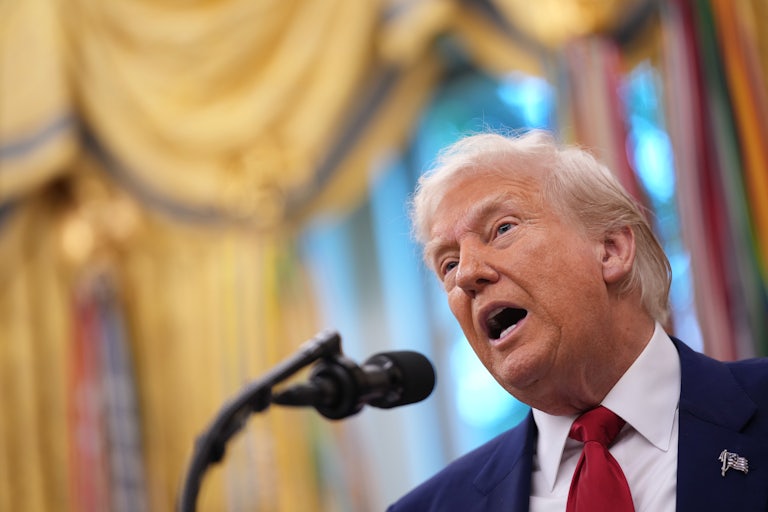
Donald Trump speaks into a microphone in the Oval Office
Andrew Harnik/Getty Images

As the Russians predicted, the U.S. president’s “fire” has amounted to nothing.

Speaking with reporters in the White House Wednesday, Donald Trump was unable to pinpoint one consequence that Russia would face for continuing to attack Ukraine.

“Well, I’m not going to tell you exactly,” Trump said when asked. “The words speak pretty loud. We’re not happy about that situation.

“I think we’re going to see something very sensible, because there are only two outcomes,” he continued, completely evading specifics. “There’s a smart outcome and a violent outcome, and I don’t think anybody wants to see the second.… They still have to agree to the final stages of a document.”

On Tuesday, Russian state media effectively called Trump’s bluff, predicting that he wouldn’t have any follow-through on a social media–posted threat that Russia was “playing with fire” by refusing to negotiate toward an achievable peace deal with Ukraine.

Trump’s heavy hand on Ukraine and his repeated concessions toward Russia’s enduring violence have been interpreted by Kremlin propagandists as a massive win for Russian President Vladimir Putin, resulting in televised laughter at the downfall of American power. In the months since he took office, Trump has claimed that Russia has come ready and willing to reach a peace deal, even though many of their demands—such as staking a Russian flag in Crimea—reverse long-standing U.S. policy.

Following a deadly airstrike on Kyiv over the weekend, European leaders urged Western countries to enact sanctions on Moscow as a way to reel Putin back to the negotiating table. But when pressed Wednesday as to why America was still wringing its hands, Trump claimed that applying pressure would “hurt” a deal.

“If I think I’m close to getting a deal, I don’t want to screw it up by getting that,” Trump said, before attempting to redirect blame for the ongoing conflict. “This isn’t my war, this is Biden’s war, Zelenskiy’s war, and Putin’s war. This isn’t Trump’s war. I’m only here for one thing, to see if I can end it.”

But it’s unclear exactly how or when Trump will accomplish that. The president—who campaigned on a pledge to end the war within days of returning to the White House—told reporters Wednesday that he would circle back within two weeks with an answer as to whether Putin is even interested in ending the conflict.

Just about everyone in the U.S.—including Trump’s own party—wants the White House to act. Earlier this week, Senate Republicans resorted to begging Trump to take a stand against Russia while they mulled over the possibility of going over his head to enact the internationally recommended sanctions.

“The sanctions bill has 82 co-sponsors,” Senator Lindsey Graham wrote in a Wall Street Journal op-ed Tuesday. “As [Senator John] Thune said last week, if Mr. Putin continues to play games, the Senate will act. I’m hoping for the best, but when it comes to the thug in Moscow, we should all prepare for more of the same.”

Marco Rubio Announces Hypocritical “Free Speech” Visa Restrictions

In a sign that irony is dead, the secretary of state has revealed new visa restrictions for those who violate Americans’ free speech rights.

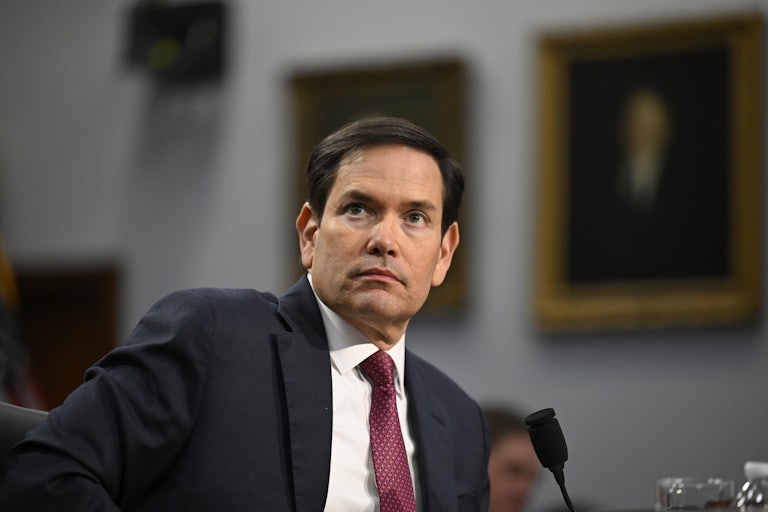
Secretary of State Marco Rubio testifies in Congress.
John McDonnell/Getty Images

Secretary of State Marco Rubio announced some bizarre new visa rules Wednesday against foreign officials curtailing the rights of Americans.

“For too long, Americans have been fined, harassed, and even charged by foreign authorities for exercising their free speech rights,” Rubio announced on X. “Today, I am announcing a new visa restriction policy that will apply to foreign officials and persons who are complicit in censoring Americans. Free speech is essential to the American way of life—a birthright over which foreign governments have no authority.”

In a follow-up post, Rubio said, “Foreigners who work to undermine the rights of Americans should not enjoy the privilege of traveling to our country. Whether in Latin America, Europe, or elsewhere, the days of passive treatment for those who work to undermine the rights of Americans are over.”

It’s not clear what prompted these new rules, or if there’s a particular case of an American being punished by a foreign government that Rubio is referring to. However, Elon Musk is facing legal issues in a number of countries over incendiary posts on X, such as Brazil, which briefly banned the platform last year amid rampant disinformation about the country’s 2022 election.

Musk also pushed disinformation last summer over far-right riots in the United Kingdom and continues to attack the country’s Labour government, earning a rebuke from Prime Minister Keir Starmer in January. Last month, European Union regulators were reportedly considering fines for the X platform and demanding product changes for breaking EU laws against illicit content and disinformation.

Is Rubio’s move designed to protect Musk, a major benefactor of Trump and the Republican Party? It’s ironic for the country’s top diplomat to complain about the free speech of Americans overseas when Rubio himself is targeting immigrants in the U.S., particularly international students, for exercising their own free speech rights, revoking their visas and trying to deport them.

One such student, Rümeysa Öztürk, was arrested after writing an opinion piece about Israel’s war on Gaza in her school newspaper, and Rubio even seemed to confirm last week that her detention and visa revocation were for that reason. Whatever is behind these new visa rules, it’s highly likely that they’re for something other than free speech because Rubio is clearly a hypocrite.