Breaking News
Breaking News
from Washington and beyond

Trump’s Not-So-Genius Team Botched a Deal to Free American Prisoners

The Trump administration fumbled an opportunity to free American prisoners in Venezuela at the last moment.

Secretary of State Marco Rubio
Joe Raedle/Getty Images

Due to conflicting efforts by Secretary of State Marco Rubio and special envoy Richard Grenell, the Trump administration bungled a deal that would have freed 11 U.S. citizens and green card holders detained in Venezuela, along with a number of Venezuelan political prisoners, according to a new report from The New York Times.

The two diplomats brought contradictory deals to the same Venezuelan officials.

Under Rubio’s deal, in exchange for Venezuela freeing the Americans, green card holders, and Venezuelan political prisoners, the U.S. would have facilitated the repatriation of 250 Venezuelan immigrants it deported to El Salvador. (While the Trump administration has previously claimed no control over the Venezuelan detainees, the Times reports that, here, “it was willing to use them as bargaining chips.”)

Rubio’s plan progressed to a point where the U.S. and Venezuela had arranged to send planes to retrieve their respective prisoners. But Grenell, Donald Trump’s special envoy to Venezuela, had a different idea.

Not believing Trump would sanction a swap in which “accused gang members” would be released, the special envoy reportedly pursued a deal extending Chevron’s oil license in Venezuela in exchange for American prisoners. Grenell’s terms were “more attractive” in Venezuela’s eyes, as the government relies on oil revenue.

Grenell reportedly rang Trump, and left the call believing he had the president’s blessing. But a U.S. official told the Times that wasn’t the case. The special envoy’s plan would have offended a group of Florida Republicans who’d threatened not to support Trump’s “big, beautiful bill” if he were to walk back oil sanctions against Venezuela.

Both conflicting deals involved speaking with Venezuelan National Assembly President Jorge Rodríguez, according to the Times, and “the lack of coordination left Venezuelan officials unclear about who spoke for” the president.

“You would think they would be duly coordinated,” the mother of a Navy SEAL detained in Venezuela told the Times, which reports that the White House is still open to conducting a swap, but not to extending Chevron’s license.
Russia Reacts to Leaked Audio of Trump’s Unhinged Bomb Threat

Trump bragged to donors that he threatened to “bomb the sh*t out of Moscow.”

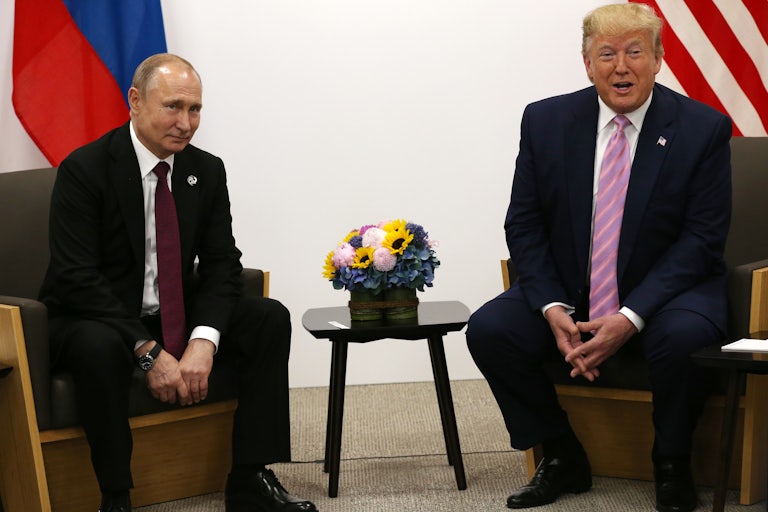
Donald Trump and Vladimir Putin sit on chairs next to each other.
Mikhail Svetlov/Getty Images
Donald Trump and Vladimir Putin at the 2019 G20 Summit in Osaka, Japan.

Last year, President Trump told donors that he had a phone call with Russian President Vladimir Putin in which he threatened to “bomb the shit out of Moscow” if Putin invaded Ukraine. Kremlin spokesman Dmitri Peskov (mostly) denied that the phone call ever happened.

“It’s hard to say. There were no phone calls at that time,” Peskov said, according to CNN’s Kaitlan Collins. “As far as I understand, we’re talking about a period when Trump was not yet president of the United States.”

According to the recording obtained by CNN’s Josh Dawsey, Tyler Pager, and Isaac Arnsdorf, Trump told donors: “With Putin I said, ‘If you go into Ukraine, I’m gonna bomb the shit out of Moscow. I’m telling you I have no choice.’

“So he goes like, ‘I don’t believe you.’ He said, ‘No way,’ and I said, ‘Way,’” Trump continued.And then he goes like, ‘I don’t believe you,’ but the truth is he believed me 10 percent.”

There are a lot of questions here. It would not be shocking if Trump was lying about all of this just to impress some donors. But if he wasn’t, then why was he on the phone with Putin threatening to bomb Russia before he was even president? And why has he strayed so far away from that gusto now, allowing Putin to continue to bulldoze Ukraine? He was just complaining on Tuesday that the Russian president had thrown “a lot of bullshit” at the United States. Where has the energy of that fundraiser evening gone?

Trump was also heard at this fundraiser threatening to throw pro-Palestinian people out of the country and called working-class Democratic voters “welfare people.”

Guess Who Forgot to Tell Trump He Was Pausing Ukraine Aid?

Pete Hegseth forgot a crucial step.

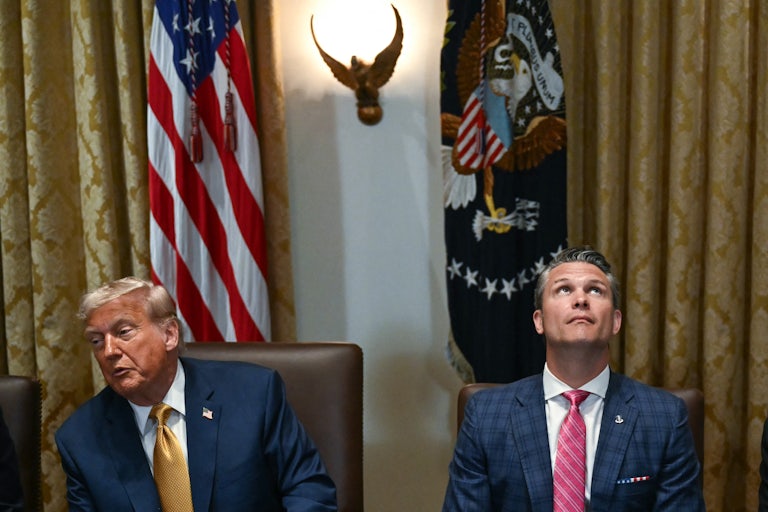
Donald Trump speaks to someone to the side while sitting next to Pete Hegseth, who looks up, during a Cabinet meeting
Andrew Caballero-Reynolds/AFP/Getty Images

The president is not in control of his own government.

Last week’s sudden pause on a weapons shipment to Ukraine was the handiwork of Defense Secretary Pete Hegseth—who didn’t bother to inform the president before enacting it, five sources familiar with the situation told CNN. Practically everyone was blindsided by news of the halted shipment, including the White House, the State Department, Congress, Kyiv, and America’s European allies, setting off a mad dash within the administration to explain the unexpected directive.

Donald Trump told Ukrainian President Volodymyr Zelenskiy that he was “not responsible” for the canceled shipment, telling the war-battered leader that he had directed a review of U.S. stockpiles but did not order the freeze, according to sources that spoke with The Guardian. The president reiterated that point during a Cabinet meeting Tuesday, telling reporters that he didn’t know who authorized the move.

It’s not the first time that Hegseth has intervened in U.S. foreign policy without Trump’s express approval: In February, the Pentagon chief executed the same flub, pausing a weapons shipment to Ukraine despite the fact that Trump had announced the flow would continue.

Two of the sources that spoke with CNN claimed that Hegseth’s poor planning was in part due to the boiling drama around him at the Pentagon. With no chief of staff or trusted advisers, Hegseth is making major policy decisions solo.

The decision to cancel the shipment was grounded in the Pentagon’s global munitions tracker, The Guardian reported Tuesday. The tracker had highlighted that a number of critical munitions had fallen below a minimum readiness standard for several years, at least since President Joe Biden began sending weapons to assist Ukraine in its war against Russia. But senior military officials and Democratic lawmakers have insisted that there’s no evidence that America’s munitions supply would warrant peeling back support from Ukraine.

Pentagon press secretary Kingsley Wilson told CNN that “Secretary Hegseth provided a framework for the president to evaluate military aid shipments and assess existing stockpiles.”

“This effort was coordinated across government,” Wilson told the network.

White House press secretary Karoline Leavitt said that Trump still has “full confidence” in his defense secretary.

GOP Senators Stunned by Terrible Rule in Budget Bill They Voted For

Did these senators actually read the bill?

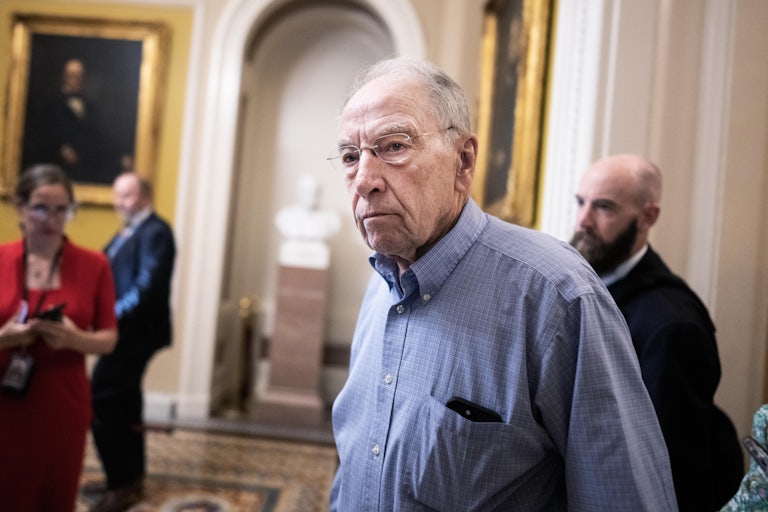
Senator Chuck Grassley walks in the Capitol
Tom Williams/CQ-Roll Call, Inc/Getty Images

In the latest installment in “Dude, What Law Did I Just Pass?” some Republicans were shocked to learn of a provision in Donald Trump’s behemoth budget bill that will tax gambling losses, HuffPost reported Tuesday.

Under the new provision, gamblers will no longer be allowed to deduct 100 percent of their losses from their income tax, and instead will only be allowed to deduct 90 percent. “Now, for example, gamblers who win $100,000 but lose $100,000—coming out even—would still be required to pay taxes on $10,000,” according to HuffPost.

The provision was apparently added at the last minute by Idaho Senator Mike Crapo, chairman of the Senate Finance Committee.

Republican senators, who had been in a mad rush to see Trump’s tax and spending legislation passed by the Fourth of July, admitted that they didn’t know what the provision was.

“If you’re asking me how it got in there, no, I don’t know,” said Iowa Senator Chuck Grassley during an interview on Tuesday.

Texas Senator John Cornyn admitted, “I don’t know anything about it. I’m not sure what it does.”

“I was so focused on Medicaid, I wasn’t looking for other reasons to be against the bill,” said North Carolina Senator Thom Tillis, one of just three Republicans to vote against the bill. “But that would be another one.”

Already, bipartisan efforts have sprung up in the House and Senate on provisions to repeal the rule, concerned that it will attract big bettors to black-market gambling in an attempt to escape the rule.

KBJ Rips “Senseless” Supreme Court Decision on Trump’s Mass Firings

Supreme Court Justice Ketanji Brown Jackson called out her colleagues for greenlighting Trump’s “legally dubious” layoffs in the federal government.

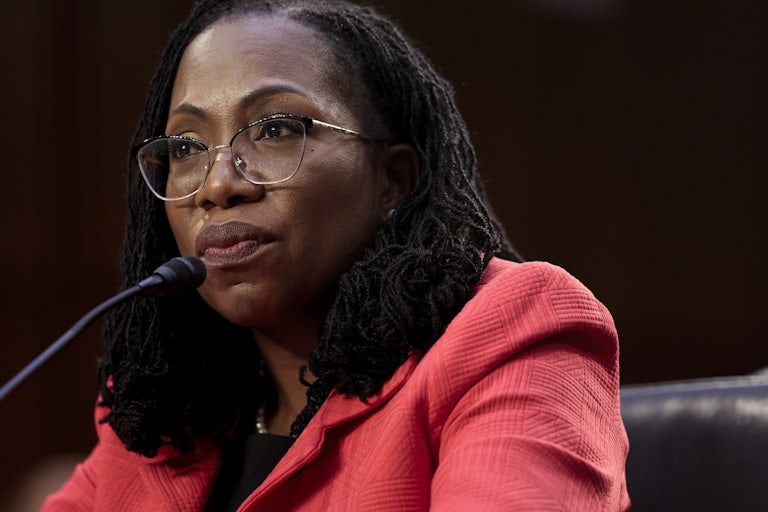
Supreme Court Justice Ketanji Brown Jackson testifies in Congress.
Anna Moneymaker/Getty Images

In a 15-page dissent, Justice Ketanji Brown Jackson torched the Supreme Court’s Tuesday ruling allowing President Trump’s mass government layoffs to resume.

Trump in February issued an executive order directing agencies to implement “large-scale reductions in force,” or RIFs, per DOGE’s plan to slash the federal government. A number of unions and nonprofit groups challenged the order in court, and a district court issued an injunction temporarily blocking it as legal proceedings continued.

Trump turned to the Supreme Court with an emergency request to lift the freeze, which the majority granted Tuesday (without yet weighing in on “the legality of any Agency RIF and Reorganization Plan produced or approved pursuant to the Executive Order”).

Justice Jackson said the lower court’s injunction had been a “temporary, practical, harm-reducing preservation of the status quo,” which was nonetheless “no match for this Court’s demonstrated enthusiasm for greenlighting this President’s legally dubious actions in an emergency posture.”

She added that the Supreme Court ought to defer to lower court judges, who “have their fingers on the pulse of what is happening on the ground and are indisputably best positioned to determine the relevant facts.”

In this case, the lower court carefully reviewed the evidence and issued “a detailed 55-page opinion,” she wrote. The Supreme Court, meanwhile, “from its lofty perch far from the facts or the evidence,” cannot “fully evaluate, much less responsibly override, reasoned lower court factfinding about what this challenged executive action actually entails.”

And yet, Jackson said, her colleagues made the “truly unfortunate,” “hubristic,” and “senseless” decision to override the injunction—a decision Jackson described as SCOTUS stepping in to “release the President’s wrecking ball” while legal challenges to Trump’s order were just underway.

Beyond being procedurally “troubling,” Jackson torched the majority’s decision as “puzzling, and ultimately disheartening, given the extraordinary risk of harm that today’s ruling immediately unleashes.” Trump’s order, after all, paves the way for “mass employee terminations, widespread cancellation of federal programs and services, and the dismantling of much of the Federal Government as Congress has created it,” Jackson wrote.

Such assertions of executive power that potentially step on Congress’s toes must undergo careful scrutiny, Jackson wrote, considering that:

What one person (or President) might call bureaucratic bloat is a farmer’s prospect for a healthy crop, a coal miner’s chance to breathe free from black lung, or a preschooler’s opportunity to learn in a safe environment. The details of the programs that this executive action targets are the product of policy choices that Congress has made—a representative democracy at work.

Throwing caution to the wind, Jackson wrote, the majority clears the way for “the immediate and potentially devastating aggrandizement of one branch (the Executive) at the expense of another (Congress), and once again leaves the People paying the price for its reckless emergency-docket determinations.”