Breaking News
Breaking News
from Washington and beyond

Judge Throws Out Flimsy Terrorism Charges Against Luigi Mangione

The 27-year-old accused of killing the United Healthcare CEO had his charges reduced.

Luigi Mangione in court
Curtis Means/Daily Mail/Bloomberg/Getty Images

A New York state court on Tuesday dismissed all terrorism charges against Luigi Mangione, the 27-year-old accused of killing UnitedHealthcare CEO Brian Thompson, with Judge Gregory Carro ruling they were “legally insufficient.”

To meet the definition of terrorism, Carro noted, an action must have the intent to “intimidate and coerce a civilian population.”

But while the prosecution put “great emphasis on [Mangione’s] ‘ideological’ motive,” Carro wrote, ideological belief does not necessarily meet that criteria, despite the prosecution falsely conflating the two.

“There is no indication in the statute that a murder committed for ideological reasons (in this case, the defendant’s apparent desire to draw attention to what he perceived as inequities or greed within the American health care system), fits within the definition of terrorism, without establishing the necessary element of an intent to intimidate or coerce,” Carro ruled.

“While the defendant was clearly expressing an animus toward UHC, and the health care industry generally, it does not follow that his goal was to ‘intimidate and coerce a civilian population,’” and there was “no evidence presented” that he had such a goal, the judge said.

Mangione still faces second-degree murder charges in New York, as well as federal charges and Pennsylvania state charges.

This story has been updated.
Pam Bondi Forced to Backtrack After Bonkers “Hate Speech” Comments

The attorney general scrambled to contain the backlash to her bizarre comments.

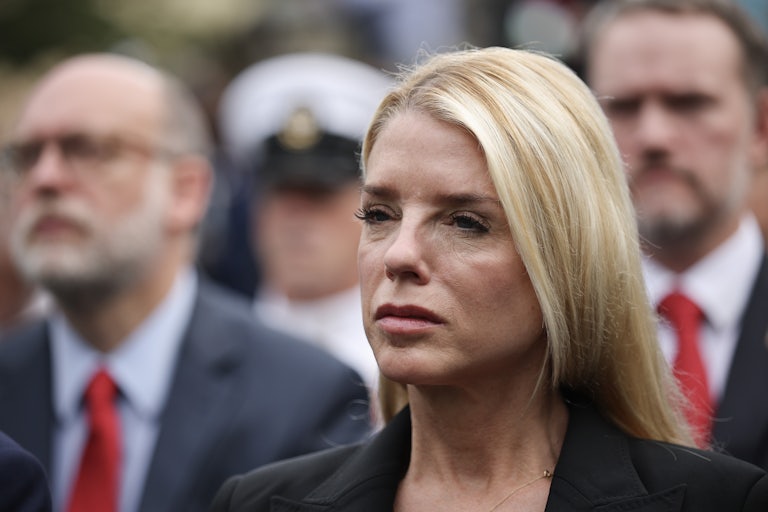
Attorney General Pam Bondi stands during a 9/11 memorial service
Win McNamee/Getty Images

Attorney General Pam Bondi accidentally revealed that she doesn’t have a clue how First Amendment law works in the United States—that, or she just doesn’t care.

Speaking on The Katie Miller Podcast Monday, Bondi, who regularly pushes the legal limits to support President Donald Trump, said she planned to crack down on “hate speech” following the death of right-wing activist Charlie Kirk.

“There’s free speech, and then there’s hate speech, and there is no place, especially now, especially after what happened to Charlie in our society,” she said, adding: “We will absolutely target you, go after you, if you are targeting anyone with hate speech, anything, and that’s across the aisle.”

But Bondi may have a hard time “targeting” anyone, as there is no legal definition for hate speech in the United States, and it is generally protected by the First Amendment—no matter how heinous.

It also seems clear that, despite her words, Bondi has her own narrow definition of hate speech—specifically, that it was only rhetoric about right-wing figures. For example, she seems entirely unbothered by her boss calling his political enemies “vermin,” promising to imprison his opponents, and joking about Nancy Pelosi and her husband being attacked or putting Liz Cheney in front of a firing squad.

Later, speaking on Fox News, Bondi claimed that employers had an “obligation” to fire workers who spoke ill of conservatives.

“You need to look at people who are saying horrible things. And they shouldn’t be working with you,” she said. “Businesses cannot discriminate. If you wanna go in and print posters with Charlie’s pictures on them for a vigil, you have to let them do that. We can prosecute you for that.”

Crucially, there is no legal obligation to get rid of employees for their speech. Businesses are barred from discrimination on the basis of race, religion, sex, or national origin—not political affiliation. They can discriminate based on speech, but only if it targets one of those protected characteristics.

Bondi’s remarks quickly summoned a torrent of criticism from figures across the political spectrum with any knowledge of how the First Amendment works. The Daily Wire’s Matt Walsh wrote on X that there “obviously shouldn’t be any legal repercussions for ‘hate speech,’” and conservative talk show host Erick Erickson noted, “Our attorney general is apparently a moron.”

The attorney general tried desperately to defend herself Tuesday.

“Hate speech that crosses the line into threats of violence is NOT protected by the First Amendment,” she wrote on X. “It’s a crime. For far too long, we’ve watched the radical left normalize threats, call for assassinations, and cheer on political violence. That era is over.”

Bondi cited a federal law stating it was illegal to transmit “any communication containing any threat to kidnap any person or any threat to injure the person of another” across state borders. She also cited a federal law that bars using the U.S. Postal Service to send threats, and another law against threatening to assault the family members of public officials.

“You cannot call for someone’s murder. You cannot swat a Member of Congress. You cannot dox a conservative family and think it will be brushed off as ‘free speech.’ These acts are punishable crimes, and every single threat will be met with the full force of the law,” she wrote. “Free speech protects ideas, debate, even dissent but it does NOT and will NEVER protect violence.”

In fact, it’s the far right that has undertaken a massive doxing campaign in the wake of Kirk’s death.

Bondi even noted that she didn’t think hate speech cut both ways. “It is clear this violent rhetoric is designed to silence others from voicing conservative ideals,” she added.

Trump Announces Massive Lawsuit Against New York Times

Donald Trump accused the paper of actively working against him.

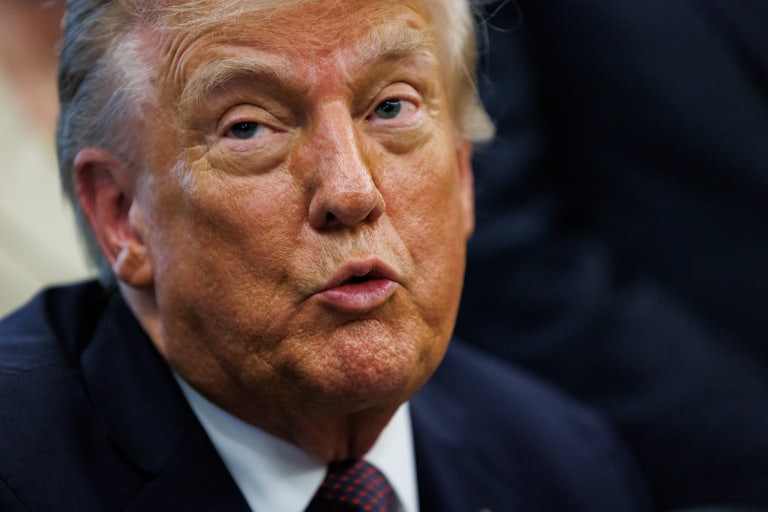
Donald Trump puckers his lips while speaking in the Oval Office
Samuel Corum/Sipa/Bloomberg/Getty Images

Donald Trump has once again turned to the court system to do his dirty work.

The commander in chief announced a $15 billion defamation lawsuit against The New York Times Monday night, claiming that the paper had deliberately lied about MAGA conservatives and the “nation as a whole.”

“Today, I have the Great Honor of bringing a $15 Billion Dollar [sic] Defamation and Libel Lawsuit against The New York Times, one of the worst and most degenerate newspapers in the History of our Country, becoming a virtual ‘mouthpiece’ for the Radical Left Democrat Party,” Trump posted to Truth Social. “I view it as the single largest illegal Campaign contribution, EVER.”

He also took particular issue with the Times’ 2024 endorsement of former Vice President Kamala Harris—a tradition that practically every newspaper editorial board partakes in.

“Their Endorsement of Kamala Harris was actually put dead center on the front page of The New York Times, something heretofore UNHEARD OF!” he wrote.

Trump made it very clear where he pulled his inspiration and precedent for the behemoth lawsuit: his prior “successful litigation against George Slopadopoulos/ABC/Disney, and 60 Minutes/CBS/Paramount,” which he claimed had smeared him via routine editing decisions made regarding a sit-down interview with Harris last year.

Trump insisted that the network had selectively edited Harris’s answers to a question regarding Israeli Prime Minister Benjamin Netanyahu—a detail made all the more confusing since CBS’s 60 Minutes and Face the Nation cut and aired different portions of her 21-second response on different days. An independent review by the Federal Communications Commission showed that the two answers were in fact cut from the same longer response, and media law experts believed that Trump’s legal offensive would be an easy win for CBS.

But in July, CBS’s parent company, Paramount, settled the apparently cut-and-dry lawsuit with Trump—much to the dismay of network staff—so that Paramount’s controlling shareholder, Shari Redstone, could close a multibillion-dollar merger that required the Trump administration’s sign-off.

The fallout of the interview—and Trump’s response to it—have been cataclysmic. The longtime head of 60 Minutes, Bill Owens, quit after Paramount executives attempted to interfere with the show’s content, reportedly pressuring him to change how the show reports on the president. The former president of CBS, Wendy McMahon, resigned under similar circumstances shortly afterward.

Trump had promised to rope the Times into the lawsuit for months, arguing that the paper’s decision to report on the lawsuit was tantamount to tortious interference.

A spokesperson for the Times roundly rejected Trump’s suit.

“This lawsuit has no merit,” the spokesperson said in a statement. “It lacks any legitimate legal claims and instead is an attempt to stifle and discourage independent reporting. The New York Times will not be deterred by intimidation tactics. We will continue to pursue the facts without fear or favor and stand up for journalists’ First Amendment right to ask questions on behalf of the American people.”

This story has been updated.

Trump’s Biggest Corruption Scandal Isn’t Getting Enough Attention

Donald Trump cashed in on a massively corrupt foreign crypto deal—and no one blinked.

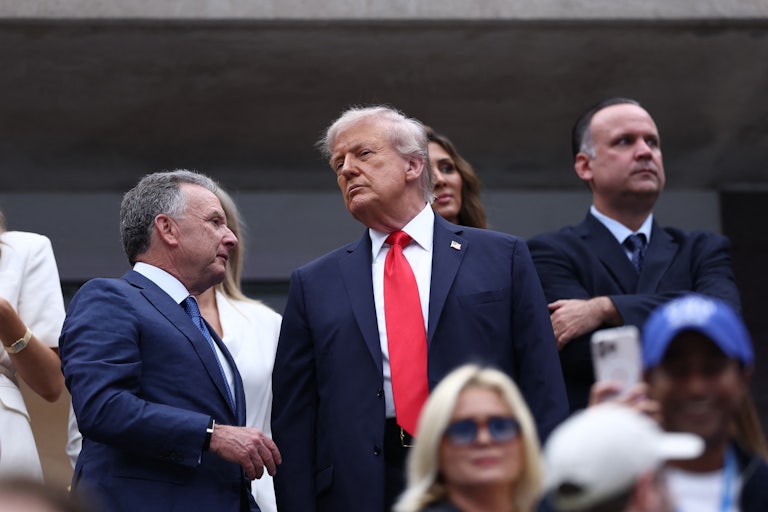
Steve Witkoff says something to Donald Trump as they stand in the crowd at the U.S. Open.
CHARLY TRIBALLEAU/AFP/Getty Images
Donald Trump and special envoy Steve Witkoff

A New York Times exposé published Monday tells the tale of two back-to-back deals that enriched three powerful families: the Trumps, the Witkoffs (as in Trump’s Middle East envoy, Steve Witkoff), and the ruling family of the United Arab Emirates.

In one deal, announced in May, a firm of Emirati royal Sheikh Tahnoon bin Zayed Al Nahyan invested $2 billion in World Liberty Financial, a cryptocurrency company owned by the Trump and Witkoff families—which consequently became among the most prominent crypto firms overnight.

In the other, negotiated “at the same time and by some of the same people,” the White House two weeks later agreed to sell the UAE hundreds of thousands of the world’s most valuable artificial intelligence chips, despite national security concerns.

The Times revealed that some officials in the Trump administration were wary about the chip deal due to UAE-China ties. But a key dissenter at the National Security Council, David Feith, was taken out of the equation when MAGA provocateur Laura Loomer questioned his (and five other NSC members’) loyalty, leading to their removal by the president. Silicon Valley investor David Sacks, Trump’s AI and crypto czar, then took a leading role in the negotiations—and received a White House ethics waiver in order to do so.

While the Times reports that there is no evidence that the two deals constituted an explicit quid pro quo—and the White House, and those involved, maintains they were not linked—they do “violate longstanding norms in the United States for political, diplomatic and private deal-making among senior officials and their children,” according to ethics lawyers cited in the report.

On Bluesky, economist Ryan Cummings, who served on President Joe Biden’s Council of Economic Advisers, wrote that the deals, if linked, would represent, by far, “the largest public corruption scandal in the history of the United States”—amounting to a $2 billion bribe, whereas the most comparable incident, the Harding administration’s Teapot Dome scandal, involved bribes amounting to about $10 million in today’s dollars, he said.

Dan Nexon, a political scientist at Georgetown University, observed that the report reveals how “U.S. foreign policy is much easier to understand once you accept that the main ‘grand strategy’ of the Trump administration is straight-up kleptocracy.”

“The Trump Administration is cashing in on foreign crypto deals—and weakening guardrails that protect our advanced technology,” wrote Senator Elizabeth Warren on X. “We should not pass any crypto legislation without shutting this down.”

Trump Officially Spreads His Fascist Military Takeover to Memphis

Donald Trump just signed a memorandum launching a military crackdown on Memphis, Tennessee.

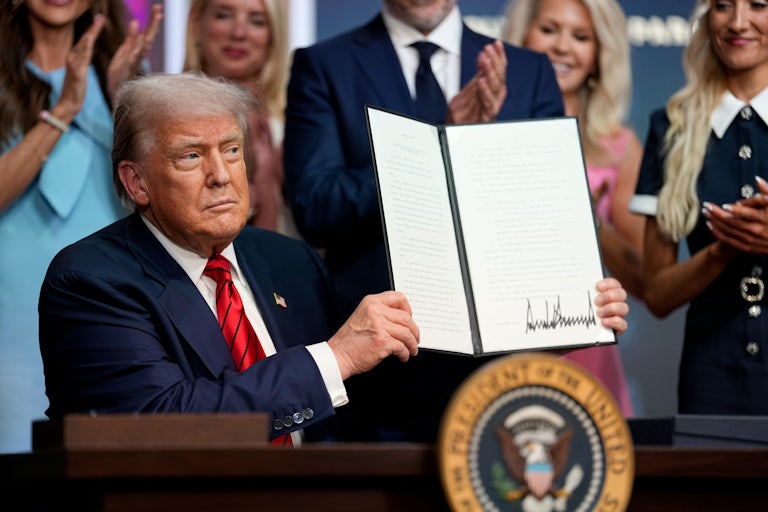
Donald Trump holds up a signed order seated at his desk in the White House while others stand behind him clapping.
Kent Nishimura/Bloomberg/Getty Images

President Trump and Attorney General Pam Bondi want to “Make Memphis Great Again.”

On Monday, the president signed a presidential memorandum to establish the “Memphis Safe Task Force,” delivering on weeks of threats to send federally controlled law enforcement into the Blackest city in America. The National Guard, FBI, ATF, DEA, ICE, Homeland Security Investigations, and the U.S. Marshals will all be present.

Trump used a perceived crime wave as justification for the memorandum, a move similar to his federal takeover of D.C. last month.

“A person is four times more likely to be murdered in Memphis, Tennessee, today than in Mexico City. And you know Mexico City is not a cakewalk,” Trump told reporters at the White House. “It’s been overrun with carjackings, robberies, shootings, and killings … so we’re not gonna allow this kind of savagery to destroy our society anymore. We’re stopping it.”

Trump also reaffirmed that he was still planning the same operation in Chicago, although he noted that the administration would wait a bit, perhaps to prepare legal defenses to the lawsuit that would surely come from Illinois Governor JB Pritzker.

Trump’s attack on Memphis—along with his threats to Chicago and Baltimore—reaffirms his aggressiveness toward Democratic, majority-Black cities with Black leaders.

Memphis Mayor Paul Young has already made his disapproval of the president’s decision clear.

“It’s not something that I believe is going to reduce crime in our city. I think that the way to reduce crime is to invest in the things that are going to intervene and prevent crime in the first place,” Young told the Reverend Al Sharpton Sunday on MSNBC.

This story has been updated.