Breaking News
Breaking News
from Washington and beyond

Trump Reveals Horrifying Military Plan for Gaza’s Future

New governance apparently comes with a new occupation.

A Palestinian family with a man, woman, and five children sits amidst rubble to break their Ramadan fast
Moiz Salhi/Anadolu/Getty Images
Palestinian Mohammed Awdeh Al Mabhuh breaks his fast with his family on the rubble of their home, which was destroyed in Israeli attacks, at the Bureij Refugee Camp in the central Gaza Strip on February 19.

President Trump wants to build a 5,000-person military base in Gaza.

Board of Peace contracting records viewed by The Guardian show that the Trump administration plans to use more than 350 acres of desolate land in southern Gaza full of twisted metal from multiple Israeli bombing campaigns to construct a massive base with 26 armored watchtowers, bunkers, an arms range, and a storage warehouse—all encircled in barbed wire.

The base will serve as the headquarters for the upcoming International Stabilization Force, which the Trump and the Jared Kushner–led Board of Peace say will have de facto control of Gaza. It is unclear what the rules of engagement for this force will be, and whether they will collaborate with the United Nations in any way.

“The Board of Peace is a kind of legal fiction, nominally with its own international legal personality separate from both the UN and the United States, but in reality it’s just an empty shell for the United States to use as it sees fit,” Rutgers law professor Adil Haque told The Guardian.

More importantly, this move shows once again that even amid the destruction and violence of Israel’s genocide, Palestinian sovereignty is still of no concern to the Trump administration, or any parties involved in this so-called Board of Peace.

“Whose permission did they get to build that military base?” asked Palestinian Canadian lawyer Diana Buttu.
Trump Reveals He’s Taking $10 Billion From Taxpayers for His New Board

Critics warn Donald Trump’s Board of Peace is essentially a slush fund he controls.

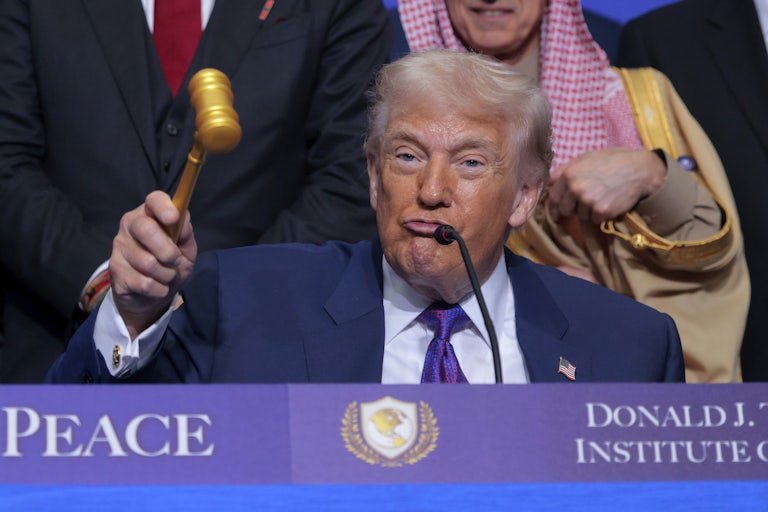
Donald Trump puckers his lips while holding up a gavel
Chip Somodevilla/Getty Images

Donald Trump announced Thursday that he wants the United States to contribute $10 billion to his so-called Board of Peace—essentially forming a slush fund of taxpayer money the president can use however he likes.

Speaking at the board’s inaugural meeting in Washington, Trump assured the folks watching at home that $10 billion was “a very small number when you look at that compared to the cost of war.”

There’s just one problem: Transferring billions of taxpayer dollars would require congressional approval. And Trump has not gotten that.

So far, Trump’s foreign policy has been nothing short of an assault on Congress’s power of the purse. The president has unilaterally declared war against foreign drug smugglers, launching a series of deadly extrajudicial strikes on vessels the government claims—but refuses to prove—are carrying drugs. (These strikes are still ongoing: 11 people were killed as recently as Monday.) Not to mention the massive military operation Trump mounted to depose a foreign leader and steal that country’s oil—all without Congress’s ever declaring war.

Now Trump wants to use U.S. money to facilitate Jared Kushner’s master plan for Gaza—just another luxury real estate grift.

Even if Trump did ask Congress for the funds, it doesn’t seem likely that it would approve. Currently, Democrats and the White House remain in a deadlock over funding for the Department of Homeland Security, resulting in a partial government shutdown. With midterm elections (and a potential upheaval in Congress) on the horizon, now isn’t exactly the best time for the president to make a major foreign policy slush fund, as Republicans may be hoping to convince their constituents they still put America first.

There is one other source of money Trump could potentially dip into. The president previously sold permanent seats on his board for $1 billion a head, but refused to say where that money was going.

Trump Bored to Sleep During Board of Peace Launch

The president couldn’t keep his eyes open in front of several international leaders.

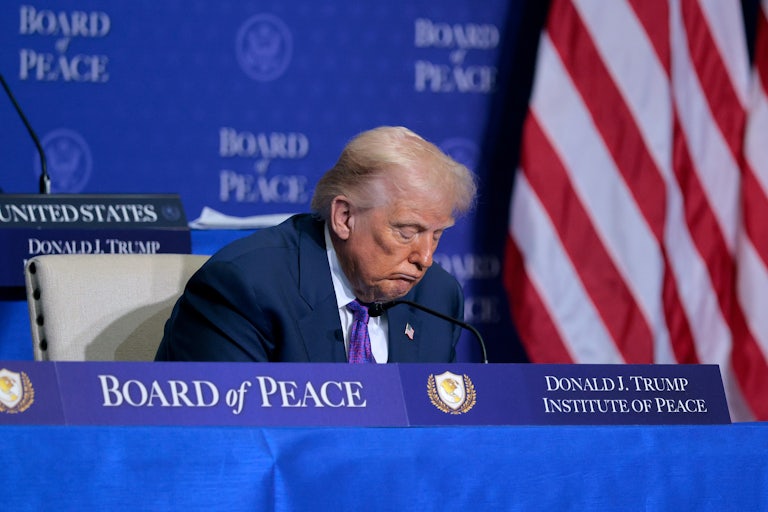
Donald Trump in a seated position, with his head drooping with a blurry American flag behind him to his left and a Board of Peace backdrop behind him.
Chip Somodevilla/Getty Images
Donald Trump’s head droops during speeches at the inaugural meeting of the Board of Peace at the U.S. Institute of Peace on February 19.

President Trump has once again dozed off on camera at his own event.

Footage shows Trump looking extremely drowsy at his inaugural “Board of Peace” meeting on Thursday at the U.S. Institute of Peace in Washington, D.C. His eyelids grew heavy during Major General Jasper Jeffers III’s presentation, and if he didn’t fall asleep completely, he at least looked incredibly disinterested in his own creation.

Trump continued to doze as several international dignitaries spoke.

The “bored of peace” jokes write themselves.

This is only the most recent instance of Trump’s drowsiness getting the best of him. The 79-year-old’s eyes were completely shut at multiple points of his whole-milk legislation signing ceremony last month. He struggled to stay awake during a marijuana rescheduling executive order signing, looked absolutely exhausted at his own Cabinet meeting in December, and fell asleep once again at a Rwanda–Democratic Republic of the Congo peace agreement signing.

This is clearly a pattern of behavior that wouldn’t be out of the ordinary for the average 79-year-old man, but this is the president. Questions of cognitive decline and fitness for office are valid, and should be raised as midterms approach.

MAGA Rep. Loses Endorsement Over Vile Post About Muslims and Dogs

Representative Randy Fine made the Islamophobic post right before Ramadan began.

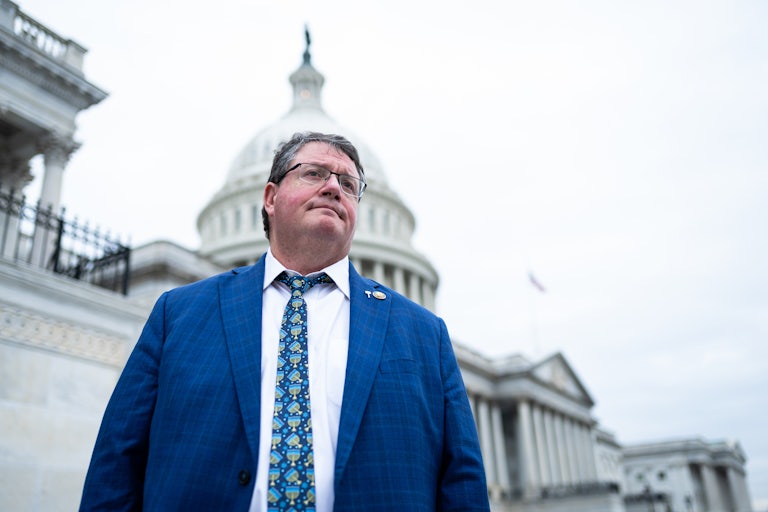
Representative Randy Fine stands outside the Capitol
Graeme Sloan/Bloomberg/Getty Images

Even Florida cops are pulling their support from Representative Randy Fine over the Republican’s recent Islamophobic tirade.

Just days before Ramadan, Fine turned a simple joke about Islam’s prohibition against dogs into plain old bigotry, writing on X that “if they force us to choose, the choice between dogs and Muslims is not a difficult one.”

Fine’s blatant religious intolerance inspired Volusia County Sheriff Mike Chitwood to rescind his endorsement Thursday, writing on Facebook that Fine’s anti-Muslim commentary had carved “a path I just can’t follow.”

“I respect his fight for his faith and his beliefs. But I have to part ways when that fight turns into an attack on our Muslim neighbors,” Chitwood wrote, adding that Fine’s hatred doesn’t “align with my responsibility to stand up and protect the entire community.”

There are two Islamic congregations in Volusia County, compared to thousands of Protestant and Catholic parishioners, according to data from the Association of Religious Data Archives. Yet Chitwood—unlike Fine—recognizes that his public office requires him to protect and represent all religious bodies with equal fervor. In his missive, Chitwood noted that the county’s Muslim residents, who include business leaders, philanthropists, doctors, and teachers, had provided significant contributions to the community.

But it’s far from the first time that Fine has made vile, xenophobic remarks. The Arizonan-born MAGA diehard—who boasted last year that he was AIPAC’s “fastest-ever endorsement”—has come out in favor of starving Gazans, advocated for the mass deportation of Muslim American citizens from the U.S., and pushed for a bill that would allow drivers to mow down pro-Palestinian protesters if they blocked the road.

Chitwood noted in his post that he “[appreciates] the good work Rep. Fine has done to protect our Jewish neighbors, but as Sheriff I just can’t turn a blind eye to the harm he’s doing to our Muslim community.”

“In Volusia County, that community is small, but no less deserving of protection,” he wrote.

After a “frank” conversation with Fine, Chitwood posted another statement to his page, this time penned by Fine, at the lawmaker’s request.

“I respect Sheriff Chitwood and every thing he’s done to keep Volusia County safe, no matter your religious faith,” Fine said, according to Chitwood’s post. “We agree that no one should face discrimination for who they are and that no one should be able to use their faith to force their values on others.”

Trump Has Assembled Record-High Military Presence Near Iran

Donald Trump bragged about his peacemaking abilities as another aircraft carrier was on its way to the Middle East.

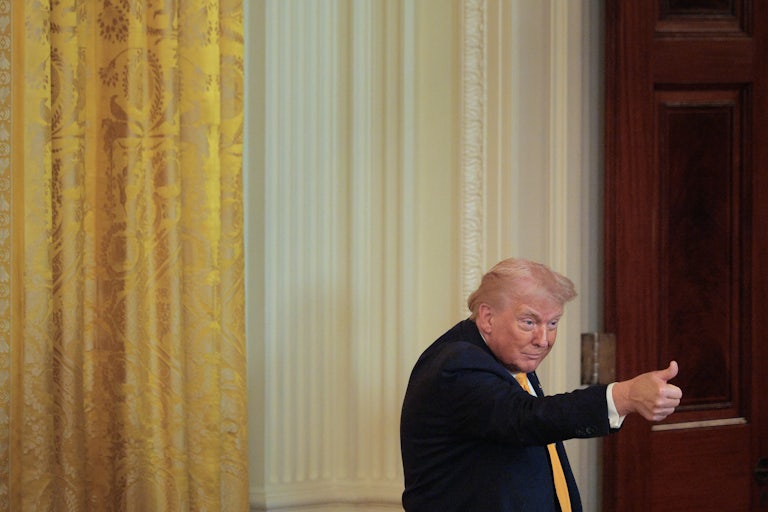
Donald Trump gives a thumbs up during an event at the White House
Chip Somodevilla/Getty Images

President Donald Trump won’t stop bragging about saving lives while making plans for war behind the scenes.

Speaking at the inaugural meeting of his so-called Board of Peace in Washington Thursday, Trump boasted to world leaders about ending foreign wars around the world and saving millions of lives.

Across the world, however, the supposed peacemaker president has overseen a massive military buildup in the Middle East, with the U.S. military deploying 13 warships and a large fleet of aircraft. A second aircraft carrier is on the way. Trump has officially mobilized the second-greatest collection of air power in the Middle East since the United States invaded Iraq in 2003, according to The Wall Street Journal.

At the meeting Thursday, Trump urged Iran to reach a deal through diplomacy or face military action. “We have to make a meaningful deal, otherwise bad things happen,” Trump said.

Trump has reportedly yet to make a final ruling, but Israel raised its alert level Wednesday, indicating a joint attack could be imminent.

While playing peacemaker, Trump didn’t shy away from threats altogether. Like a true mafioso, he warned dignitaries who’d refused his invitation to join the Board of Peace not to “play cute” with him. The list of countries that have rejected his offer isn’t short: It includes France, Germany, the United Kingdom, and the Vatican, to name a few.

Trump’s self-proclaimed reputation as a peacemaker is nothing short of preposterous. In January, he ordered a deadly military operation in Venezuela in order to kidnap President Nicolás Maduro and swipe the country’s wealth of oil. Trump’s Pentagon has also mounted an ongoing series of deadly military strikes on boats the U.S. government claims—but refuses to prove—are smuggling drugs.

Epstein Accomplice Goes Missing Right Before He Was Going to Spill

Jean-Luc Brunel was ready to testify, but then Epstein found out.

A mugshot of a bearded Jeffrey Epstein with an off-white background.
Kypros/Getty Images
Jeffrey Epstein’s 2019 mugshot

Jean-Luc Brunel was ready to testify against Jeffrey Epstein in 2016 in exchange for immunity from his own alleged crimes against women and girls.

But when Epstein heard of Brunel’s plans, he reached out to attorney and former Obama White House counsel Kathryn Rummler, and Brunel went quiet, according to The Wall Street Journal. Epstein would walk free for three more years.

Recently released files from the Justice Department show that Brunel, a high-powered modeling scout, was working with lawyers representing Epstein victims in February 2016.

“One of Epstein’s bfs, Jean Luc Brunel, has helped get girls. He is wanting to cooperate,” according to a federal prosecutor’s notes. “Brunel is afraid of being prosecuted.”

Separate files indicate that Epstein found out about Brunel’s potential move against him in May 2016, and sent a typo-ridden email to an alleged girlfriend, former Obama White House counsel Kathryn Ruemmler.

“I spoke to Mic=el Kodesch. jean lucs friend.? he said that boies&=bsp; got jean luc full immunity and was taking him in to the us attny nxt t=esday. last week they said it was this week, &=bsp; he asked for 3 million dollars so that jean luc . would no= go in, [sic]” Epstein wrote, indicating that Brunel was offered $3 million by someone to keep quiet. “Neither he nor Jean luc lawyer titone are capable of t=lling the truth. howver he said that jean luc was worried=that if he didnt go in on tuesday they woudl arrest him.”

Ruemmler responded to Epstein a few hours later asking him to call and explain, which is understandable given the incoherence of the email. The next day, she sent Epstein an email that read: “Awake now. Talking to Poe in 20 mins.” Poe likely referred to Gregory Poe, Epstein’s attorney in Washington, D.C.

It’s unclear what Poe and Ruemmler discussed, but whatever it was, it seems to have been enough to shut Brunel up and keep Epstein a free man for three more years. Poe insists that he never talked to Ruemmler or Epstein about Brunel.

“It set us back a couple of years,” said attorney David Boies, who filed lawsuits on behalf of some Epstein victims. “We know from our lawsuits that there were more than 50 girls that were trafficked after this.”

A close colleague of Epstein’s, Brunel likely used his position to traffic young women. He was charged in 2020 with rape of minors in France, but was later found dead in his cell in 2022 before any trial could begin. And Ruemmler, who spent significant time with Epstein well after his 2008 conviction, tagging along on “lunches and dinners with celebrities, apartment hunting, and personal beauty appointments,” announced last week that she was resigning from Goldman Sachs.

Reporters Arrested at Trump’s Secret Deportation Compound in Cameroon

Four journalists, including three from the Associated Press, have been locked up—and one was allegedly beaten by police—while attempting to interview the detainees.

Yaounde, Cameroon
J Carrier/Getty Images
Yaounde, Cameroon

Four journalists and a lawyer were arrested in Cameroon trying to cover Donald Trump’s secret deportation program.

The journalists were interviewing deported immigrants at a government detention center in the capital, Yaoundé, when they were detained by police along with a lawyer representing most of the 15 detainees. The compound was known to house African immigrants deported by the U.S. Department of Homeland Security.

The detainees, none of whom are Cameroonian citizens, all had protection orders from U.S. courts barring them from being sent to their home countries for fear of persecution, The New York Times reported. The journalists were separated from the lawyer and taken to the country’s judicial police headquarters to be interrogated.

Three of the journalists are based in Cameroon and were on assignment for the Associated Press. The other journalist is Randy Joe Sa’ah, a freelancer who has worker for the BBC. The AP told the Times that the reporter was slapped but not seriously injured, although Sa’ah and the attorney, Joseph Awah Fru, said that the reporter appeared to have been beaten up and told him that he was attacked by police.

Some of the journalists were held in a cell for hours, Fru and Sa’ah said. Police took their cameras, laptops and phones before releasing them, claiming they contained sensitive government information. The Times unsuccessfully tried to reach police and the Cameroonian Ministry of Justice, and it’s not known if any of the five men face legal charges.

Neither the White House nor the State Department have publicly announced any kind of deal with Cameroon to accept deported immigrants. Some of the migrants held in Cameroon told the Times that they were pressured by local authorities to return to their home countries or be detained indefinitely in Cameroon.

“The state cannot prevent the public from knowing where they are keeping deportees who are not even citizens,” Fru said to the Times. “That goes to the whole idea of shady deals in the dark.”

Third-country deportations to countries like El Salvador were struck down in federal court last week, with U.S. District Court Judge James Boasberg ruling that the immigrants were denied proper notice, due process, or court hearings. Did the immigrants in Cameroon face similar treatment?

Trump, 79, Struggles to Read Names of Multiple World Leaders

Donald Trump invited his Board of Peace to Washington—and then bungled their names.

Donald Trump speaks into a microphone
Chip Somodevilla/Getty Images

The inaugural meeting of Donald Trump’s Board of Peace took place Thursday morning in Washington, convening leaders from two dozen countries in order to oversee the Gaza Peace Plan. But Trump, who spoke at the top of the assembly, very obviously had a difficult time pronouncing his peers’ foreign names.

“President Mirsu-oyev of Uzbekistan who is—where?” Trump said, referring to Shavkat Mirziyoyev. “There he is. A friend of mine, he’s got one of the most difficult names in history, but that’s okay, doesn’t matter.”

Trump tried to avoid other names, such as Egyptian President Abdel Fattah el-Sisi, whom Trump appeared to nearly refer to as a dictator.

“Say hello to the d—general/president,” Trump said as he pointed at Sisi, according to AFP reporter Shaun Tandon.

The “leader of the free world” also bungled naming the leaders of Armenia and Azerbaijan, whom he couldn’t seem to remember while boasting about ending their 30-year conflict.

“It was a great thing you did, you and your new friend,” Trump said in a wordy story that haphazardly avoided pronouncing the names of Armenian President Vahagn Khachaturyan and Azerbaijani President Ilham Aliyev. “These are two tough cookies.”

Trump initially floated his “Board of Peace” idea back in September as part of a 20-point peace plan to control Gaza, promising to include major heads of state as well as former world leaders, such as former U.K. Prime Minister Tony Blair.

But the board’s charter makes little mention of Gaza. Instead, its goals appear to be as lofty as they are broad, seeking to “promote stability, restore dependable and lawful governance, and secure enduring peace in areas affected or threatened by conflict.”

The concept came under new scrutiny in January in light of Trump’s escalating aggression toward Greenland and NATO. Trump has also invited leaders of nations with terrible track records on human rights, such as Russia and Saudi Arabia, to join the board.

Longtime U.S. allies warned that the “Board of Peace” could upend world order, with several refusing to join the board at all, including France, Denmark, Norway, Sweden, and Slovenia.

DOJ Scrubs Record of Interviews With Trump Accuser From Epstein Files

The FBI interviewed one of Jeffrey Epstein’s victims four times over her allegation that Donald Trump assaulted her when she was underage.

Donald Trump stands on Air Force One
Nathan Howard/Getty Images

The Department of Justice spoke four separate times to a woman who credibly accused Donald Trump of having sex with a minor he met through Jeffrey Epstein—but most accusations against the president appear to have been removed from the government’s documents on the alleged sex trafficker.

A 21-page slideshow buried in the massive trove of Epstein-related documents included allegations that sometime between 1983 and 1985, Trump forced a woman to give him oral sex when she was in her early teens. When the woman bit down on Trump’s exposed penis, he allegedly punched her in the head and kicked her out. That same woman told the DOJ that Epstein had introduced her to Trump in 1984.

Yet last week, Attorney General Pam Bondi insisted that there was “no evidence” that Trump had committed any crime—adding to the growing pile of denials from Trump officials that constitute a sweeping cover-up of the president’s alleged wrongdoing.

Justice Department records indicate that the FBI spoke to this woman not once but at least four separate times, according to independent journalist Roger Sollenberger. Now those records appear to have been removed from public viewing—despite the Epstein Files Transparency Act, which requires all documents relating to the alleged sex trafficker to be made public.

Sollenberger discovered a record of four separate interviews, which took place in the summer of 2019, in a separate database of documents downloaded from the government’s public files on Epstein. That document indicated that the first of the four interviews was conducted on July 24, 2019, and the last conducted on October 16, 2019. That document was given to Ghislaine Maxwell’s lawyers as part of her trial, though the specific allegations predated Maxwell’s involvement with Epstein, Sollenberger wrote.

The woman’s first interview was entered into the FBI’s case files on August 9, 2019, just one day before Epstein was found dead in his jail cell. FBI agents typically have a deadline of five working days to file interview write-ups, indicating an abnormal 16-day gap, Sollenberger noted.

What the Latest Bombshell Epstein Arrest Means for Trump

Former Prince Andrew Mountbatten-Windsor was arrested as part of a U.K. police investigation into Jeffrey Epstein.

Police officers stand outside Andrew Mountbatten-Windsor’s home after his arrest
Peter Nicholls/Getty Images
Police officers stand outside Andrew Mountbatten-Windsor’s home after his arrest

The global elite are beginning to face consequences for their affiliations with Jeffrey Epstein, and the dominoes may soon cascade into American politics.

Andrew Mountbatten-Windsor, the former British prince and Duke of York, was arrested Thursday (his birthday) on suspicion of misconduct in public office. Recently released documents from the U.S. Department of Justice’s Epstein files trove surfaced disturbing images of Mountbatten-Windsor climbing over and inappropriately touching Epstein’s young victims.

His arrest is the latest notable instance in which someone with extensive ties to the child sex trafficker has actually faced a modicum of justice, sparking what some observers argue is a shift in the tides for Epstein’s alleged criminal associates—perhaps including Donald Trump.

As The Mirror’s columnist Christopher Bucktin noted Thursday, “Whatever the eventual outcome, the message was unmistakable: status alone no longer guarantees insulation from criminal investigation.”

Bucktin referred back to Attorney General Pam Bondi’s apparent refusal to hold Epstein’s associates accountable, including repeatedly denying requests during a congressional hearing last week to reopen investigations into Epstein’s connections based on the recently made public mounds of evidence in the DOJ’s files.

“If examining credible allegations against powerful individuals, like what the U.K. is now doing, risks shaking institutions, then those institutions demand deeper scrutiny, not gentler handling,” Bucktin continued. “The rule of law cannot function on the basis that some names are simply too significant, too connected, too politically sensitive to examine.”

King Charles said much the same hours after his brother’s arrest, noting in a statement that the “law must take its course” with regard to Mountbatten-Windsor’s alleged transgressions.

Bucktin argued that “justice cannot stop at one imprisoned accomplice while others retreat behind legal teams and influence. It cannot flinch because the truth might prove politically explosive. And it cannot accept that the potential embarrassment of the elite outweighs the public’s right to accountability,” he wrote.

“A birthday arrest on suspicion of misconduct in a public office should not stand alone as a rare spectacle. It should signal something larger: that no title, no fortune, no political office is sufficient armour against the law.”

Read more about fallout from the Epstein files: