Breaking News
Breaking News
from Washington and beyond

Ousted Republican NTSB Member Rejects White House Story on His Firing

J. Todd Inman says his firing was “a political hit job.”

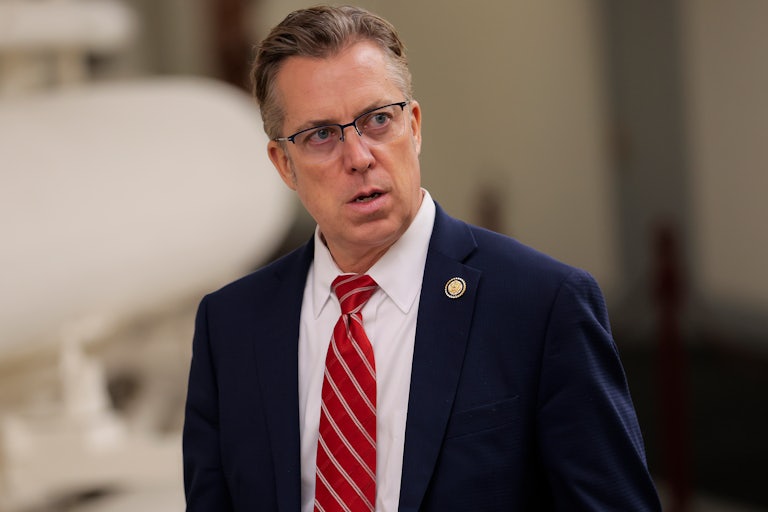
J. Todd Inman wearing an NTSB jacket.
Alex Wong/Getty Images
J. Todd Inman of the National Transportation Safety Board during a hearing on January 27 in Washington, D.C.

Donald Trump has fired a Republican member of the National Transportation Safety Board, or NTSB, accusing him of misconduct on the job.

J. Todd Inman was fired late last week and said he was given no explanation why. On Monday, the White House released a statement accusing him of “inappropriate alcohol use on the job, harassment of staff, misuse of government resources, and failure to attend at least half of NTSB meetings,” saying he was “lawfully removed” due to “highly concerning reports.”

“The Trump administration remains committed to maintaining safety and security for Americans in the air and on the ground,” White House spokesperson Kush Desai said in a statement.

Inman, meanwhile, told The Washington Post that it was all made up.

“I categorically deny the false allegations made in the White House statement,” Inman said. “It has become increasingly obvious this action was a political hit job. While not my original intent I look forward to defending my reputation against those responsible with every legal means possible.”

Inman didn’t tell the Post why he said his firing was political, but he had represented the NTSB at news conferences since an American Airlines flight crashed in Washington, D.C., at the beginning of Trump’s second term.

Last May, Trump fired another member of the NTSB, vice chair Alvin Brown, who was appointed by President Biden. Brown is suing the Trump administration over his ouster, arguing that Trump didn’t have the authority to fire him, even as the Senate confirmed his replacement, John DeLeeuw, last month. The Supreme Court is expected to rule in favor of the Trump administration. Will Inman sue as well?
Guess Who’s Helping Anthropic With Its Lawsuit Against Team Trump?

Anthropic’s lawsuit against the Pentagon has the most delicious twist.

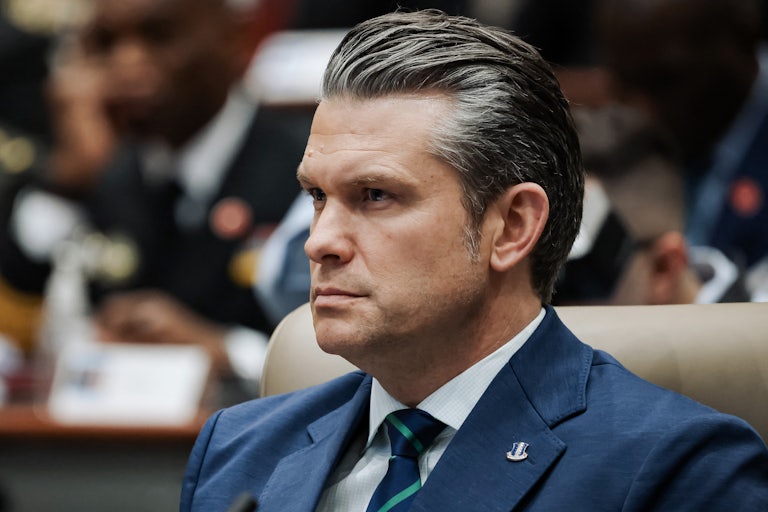
Secretary of Defense Pete Hegseth seated
Eva Marie UZCATEGUI/AFP/Getty Images
Secretary of Defense Pete Hegseth at the Americas Counter Cartel Conference at U.S. Southern Command headquarters in Doral, Florida, March 5

One of the same law firms that President Trump tried and failed to suppress is now representing AI company Anthropic in its lawsuit against the Trump administration.

Last year, Trump signed an executive order demanding that government agencies eliminate WilmerHale’s government contracts, their security clearances, and their access federal buildings, on the grounds that they allegedly “rewarded” Robert Mueller by allowing him to remain on their payroll after his investigation into Trump’s connections to Russian interference in the 2016 presidential election. The executive order was ruled unconstitutional in May.

Now, that same law firm is helping Anthropic sue the Trump administration for labeling them a “supply risk” after the AI company refused to lift regulations restricting government access to surveillance and unmanned weapons systems.

More than a dozen federal agencies are targeted in the lawsuit, including the Departments of Defense, Treasury, State, and Veterans Affairs.

“Anthropic was founded based on the belief that AI technologies should be developed and used in a way that maximizes positive outcomes for humanity, and its primary animating principle is that the most capable artificial-intelligence systems should also be the safest and the most responsible. Anthropic brings this suit because the federal government has retaliated against it for expressing that principle,” the lawsuit reads.

The lawsuit goes on to cite Trump and Defense Secretary Pete Hegesth’s statements on Anthropic against them. “When Anthropic held fast to its judgment that Claude cannot safely or reliably be used for autonomous lethal warfare and mass surveillance of Americans, the President directed every federal agency to ‘IMMEDIATELY CEASE all use of Anthropic’s technology’—even though the Department of War (Department) had previously agreed to those same conditions,” the suit states. “Hours later, the Secretary of War directed his Department to designate Anthropic a ‘Supply-Chain Risk to National Security,’ and further directed that ‘effective immediately, no contractor, supplier, or partner that does business with the United States military may conduct any commercial activity with Anthropic.’

“These actions are unprecedented and unlawful,” the lawsuit adds. “The Constitution does not allow the government to wield its enormous power to punish a company for its protected speech.”

In response, the White House has stated that it “will never allow a radical left, woke company to jeopardize our national security by dictating how the greatest and most powerful military in the world operates.”

Trump Admits He’s Totally Caved to Israel on the Iran War

Donald Trump is no longer going to unilaterally decide when the Iran war ends.

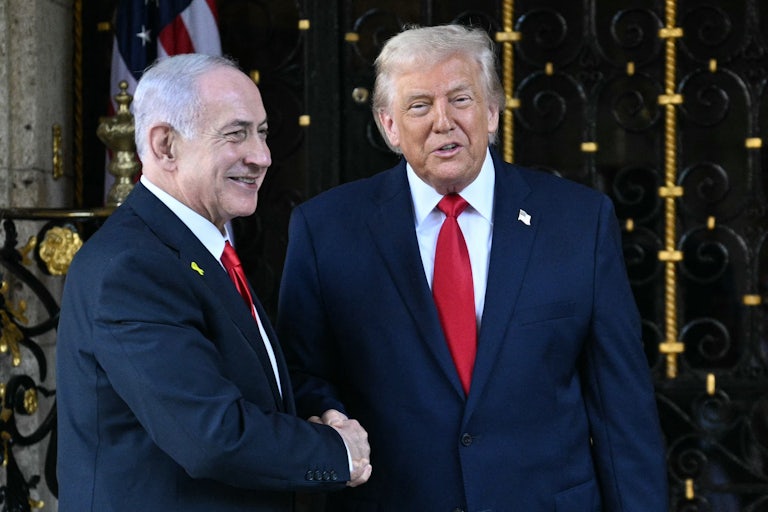
Israeli Prime Minister Benjamin Netanyahu and Donald Trump smile and shake hands
Jim WATSON/AFP/Getty Images

The U.S. will only pull out of Iran when Israel decides it’s time to call it quits.

That’s according to Donald Trump, who told The Times of Israel on Sunday that the decision to end the Iran war will be a “mutual” decision he makes with Israeli Prime Minister Benjamin Netanyahu.

“I think it’s mutual … a little bit. We’ve been talking,” Trump said when asked if he alone would make the decision to end the war. “I’ll make a decision at the right time, but everything’s going to be taken into account.”

He dismissed the idea that Israel could continue its own campaign against Iran even after the U.S. pulls back, telling the Times of Israel, “I don’t think it’s going to be necessary.”

“Iran was going to destroy Israel and everything else around it.… We’ve worked together. We’ve destroyed a country that wanted to destroy Israel,” Trump told the paper.

Trump’s deference to Israel stands in stark contrast to where he supposedly stood on the issue on Friday, when White House press secretary Karoline Leavitt told reporters that the decision to end the war would be solely up to the U.S. president’s discretion.

State Secretary Marco Rubio gave away the game on the rationale for U.S. involvement in the war last week. Speaking to a press huddle, Rubio explained that Israel had forced Trump’s hand in the matter by heedlessly barging forward with its war plans against Iran. That prompted U.S. military assets to strike first, a decision that Rubio chalked up to intel that indicated Iran would retaliate with force against American interests if Israel initiated an attack.

Hours later, Trump decided that messaging was unacceptable, publicly disagreeing with his secretary of state’s interpretation of events.

That required Rubio to reemerge before reporters the following day, frantically backpedalling on the explanation he had offered. Mike Waltz, the U.S. ambassador to the United Nations, claimed later the same day that Rubio’s point-blank comments had been “taken out of context.”

Talk of escalating the conflict with Iran has ramped up in recent days amongst chief White House officials, at times doing so in a remarkably disaffected way. The president declared on Friday that he wants “unconditional surrender” from Iran, and would not negotiate a peace deal without it.

Trump and his Republican allies are privately warming to the idea of a U.S. ground invasion in Iran. Meanwhile, Iranian officials have already said they are “confident” the country could counter a U.S. ground invasion.

So far, seven U.S. soldiers have been killed in the conflict, as have more than 20 Iranian officials, including Ayatollah Ali Khamenei. Eighteen American soldiers have also been seriously injured. More than 1,200 Iranian civilians have been killed, including dozens of children at a girls’ school in the country’s south. A U.S. assessment report found that the strike was “likely” the fault of American forces.

MAGA Congressman Claims “Muslims Don’t Belong in American Society”

Representative Andy Ogles went full bigot after an attempted attack in New York City.

Representative Andy Ogles with his mouth open
Heather Diehl/Getty Images
Representative Andy Ogles

Republican Representative Andy Ogles decided to write off an entire religious community in America on Monday.

“Muslims don’t belong in American society,” Ogles posted on X. “Pluralism is a lie.”

The Tennessee congressman has a long history of bigoted comments. He said America “should kill ’em all” last year regarding Palestinians in Gaza. He called for sending pro-Palestine student protesters to Gaza last May, and used footage of September 11 to attack Zohran Mamdani before he was elected New York City mayor.

In November, Ogles made a series of anti-Muslim comments on his Restoring the Republic podcast, saying, “The only thing they can do is essentially come to our nation and breed their way through our society, and I hate to say that, that’s harsh, it’s going to offend somebody, so what? Wake up.”

What prompted Ogles to post prejudice against Muslims Monday morning isn’t clear, although a protest outside of Mamdani’s mayoral residence in New York on Sunday might have had something to do with it. Anti-Islam provocateur Jake Lang showed up with about 20 protesters outside of Gracie Mansion, only to be met by 125 counterprotesters. Among them were two people allegedly inspired by ISIS who were arrested after throwing homemade bombs that didn’t explode.

If that wasn’t what spurred Ogles’s attack, it could be the war in Iran, or something from one of his four Muslim colleagues in Congress, particularly Representative Ilhan Omar, whom he has attacked in the past. Perhaps he should be more worried about the open federal investigation into his campaign finances or the mounting fact-checks of his lies about his background. Ogles should be censured by Congress at a minimum, but bigotry against Muslims in America is sadly considered normal, especially in the Republican Party.

Trump’s Iran War Is Already Making Money—for Russia

America first?

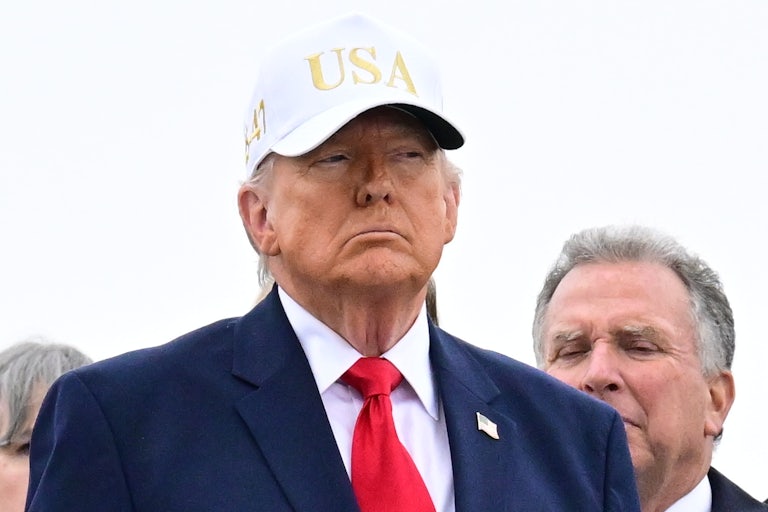
Donald Trump stands while wearing a white "USA" hat
Kyle Mazza/Anadolu/Getty Images

Russia may be about to get rich off of Donald Trump’s illegal war in Iran.

The spiraling regional conflict, sparked by ongoing attacks from the U.S. and Israel, has sent the price of oil skyrocketing to almost $120 per barrel. As a result, demand for discounted Russian oil has spiked.

U.S. Treasury Secretary Scott Bessent announced last week that the U.S. would issue 30-day waivers to allow Indian refiners to purchase Russian oil that was “already stranded at sea,” promising doing so would “not provide significant financial benefit” to the Kremlin.

However, India typically imports an average of 10 million metric tons of crude oil per month through the Strait of Hormuz, Vaibhav Raghunandan, an EU-Russia analyst at the Centre for Research on Energy and Clean Air, told Politico.

“Even if half of this volume is replaced with Russian volumes at sea, it will translate to huge profits for the Kremlin,” Raghunandan said. As of February 2026, Russia’s so-called shadow fleet of stranded oil tankers held approximately 150 million barrels of Russian oil worth an estimated $6.4 billion, according to the Robert Lansing Institute.

“We may unsanction other Russian oil,” Bessent said to Fox Business’s Larry Kudlow Friday. But permitting further sales of Russian oil would undoubtedly offer a financial boon to the country’s ongoing war effort in Ukraine. So far, Trump has largely proven powerless at forging a deal between Moscow and Kyiv—and war with Iran could only make matters worse.

All of this comes after the White House dismissed reports that Russia was assisting Iran in targeting U.S. assets in the Middle East.

Meanwhile, Hungary’s foreign minister, Peter Szijjarto, called for the European Union to lift sanctions on Russian oil amid escalating conflict in the Middle East, which has brought global trade to an abrupt stop. Russian presidential envoy Kirill Dmitriyev echoed Hungary’s request.

“What you propose is very difficult, as it would require EU bureaucrats to think and understand how markets work—and, most difficult of all, to acknowledge their strategic blunders and atone,” he wrote on X. “And yet, they will have to do it very soon.”