Breaking News
Breaking News
from Washington and beyond

DOJ Ends Investigation Into Fed Chair Powell After Republican Backlash

The Justice Department is finally dropping its criminal investigation into Federal Reserve Chair Jerome Powell.

Federal Reserve Chair Jerome Powell
Samuel Corum/Bloomberg/Getty Images
Federal Reserve Chair Jerome Powell

President Donald Trump is backing down from his vendetta against Jerome Powell.

The Justice Department announced Friday that it is dropping its criminal investigation into the Federal Reserve chief over the renovation of the central bank’s Washington, D.C., headquarters.

“This morning the Inspector General for the Federal Reserve has been asked to scrutinize the building costs overruns—in the billions of dollars—that have been borne by taxpayers,” U.S. Attorney for D.C. Jeanine Pirro posted on X. “Accordingly, I have directed my office to close our investigation as the IG undertakes this inquiry.”

“I will not hesitate to restart a criminal investigation should the facts warrant doing so,” Pirro added, appearing to suggest that there was not a factual basis for the previous investigation.

Powell’s term expires on May 15, and Trump’s nomination of Kevin Warsh to fill the position has faced roadblocks, with Republican Senator Thom Tillis threatening to hold up Warsh’s confirmation over the trumped-up investigation of Powell. Tillis’s vote against Warsh would have been enough to sink his nomination.

Trump has threatened to fire Powell for months, citing the made-up headquarters scandal and complaining about interest rates not being lowered enough. Earlier this month, Trump said he would fire Powell if he stayed past his term, even though Powell is legally allowed to remain as chair “pro tempore” until Congress confirms his replacement.

At his Senate confirmation hearings earlier this week, Warsh dodged questions about his financial ties to Jeffrey Epstein and whether Trump had discussed lowering interest rates with him. While a significant roadblock to his confirmation has just been lifted, those questions could still deter his appointment.

This story has been updated.
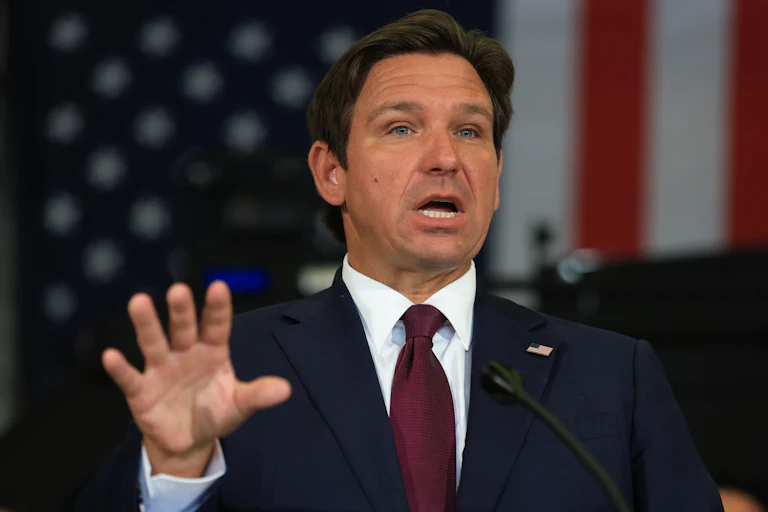
DeSantis Schemes to Sidestep Florida Constitution to Help Trump

Florida Governor Ron DeSantis plans to ignore Florida law in order to help Republicans win the redistricting wars.

Florida Governor Ron DeSantis
Joe Raedle/Getty Images
Florida Governor Ron DeSantis speaking

Florida Governor Ron DeSantis is hoping to get around Florida’s Constitution in order to redraw the state’s congressional map and give Republicans nationally a big advantage.

The Florida Constitution bans legislators from drawing districts with “the intent to favor or disfavor a political party or an incumbent.” DeSantis, who has called a special session of the state legislature to vote on the new maps on Tuesday, plans to get around that provision in three ways, Axios reports.

First, DeSantis’s office has redrawn the new congressional districts in secret, rejecting state legislators’ calls for an open process during their regular session in January. DeSantis is the first governor in state history to submit his own secretly drafted maps, and as of Thursday night, Florida lawmakers still haven’t seen them. The hidden process frustrates legal challenges, making it hard for plaintiffs to access records and prove intent.

Second, since DeSantis’s staff are the ones drawing the maps, he can claim executive privilege as a legal defense to court challenges. He did so in a 2022 court challenge to new legislative maps. In that case, he also invoked the “apex doctrine,” which requires plaintiffs to first depose low-level staff members before higher ones, to shield his staff from depositions. Ultimately, the maps were upheld in federal court.

That doctrine would waste time and help the Florida governor run out the clock on any court challenges to his districts, which is the third part of DeSantis’s plan. The U.S. Supreme Court generally abides by the “Purcell principle,” which limits lower courts from changing election laws too close to an election to protect voters. By running out the clock in court, DeSantis can then invoke that principle to force his maps through in time for November’s midterm elections, although this could backfire if the courts decide DeSantis’s changes are too close to the midterms.

Republicans hope Florida can offset a Democratic redistricting win in Virginia earlier this week, when voters passed a state constitutional amendment to temporarily allow the Democratic-run legislature to redraw the state’s maps. But even if DeSantis successfully gets his new maps approved, there’s no guarantee that Republicans will gain seats.

“The enemy gets a vote,” a Republican consultant involved in the redistricting process told Axios. “And in an environment like this, where independents are breaking hard against us and our people aren’t showing up and Democrats are pissed, we could wind up losing a net number of seats.”

Trump Makes Bonkers Claim About What SPLC Lawsuit Signifies

Donald Trump seems to think that this lawsuit vindicates one of his longest-running conspiracies.

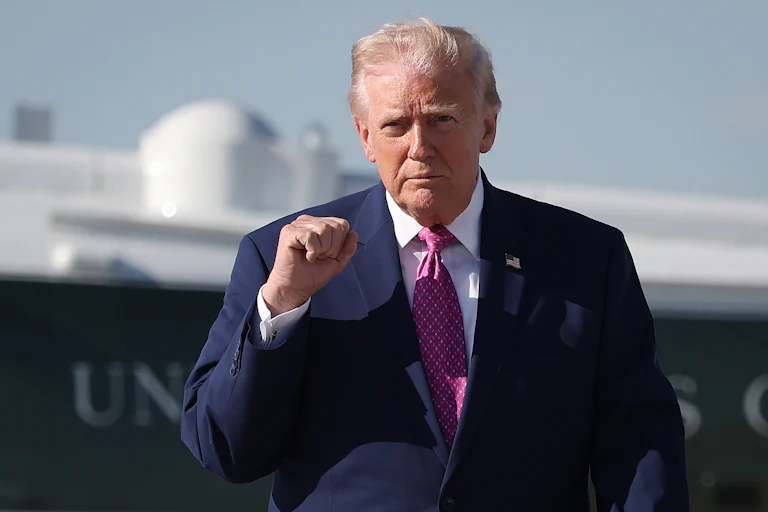
Donald Trump holds up a fist while walking
Win McNamee/Getty Images

Donald Trump appears to believe that his administration’s targeting of an anti-extremism civil rights organization can be leveraged to overturn the 2020 presidential election results.

“The Southern Poverty Law Center, one of the greatest political scams in American History, has been charged with FRAUD,” Trump wrote on Truth Social very early Friday.

“This is another Democrat Hoax, along with Act Blue, and many others,” he continued, referring to the Democratic campaign fundraising platform. “If it is true, the 2020 Presidential Election should be permanently wiped from the books and be of no further force or effect!”

It is unclear how this lawsuit could have any retroactive impact on an election that Trump unequivocally lost.

Acting Attorney General Todd Blanche gleefully announced the indictment against the Southern Poverty Law Center on Tuesday, claiming that the famed anti-racism group was “manufacturing the extremism it purports to oppose by paying sources to stoke racial hatred.”

The Montgomery-based SPLC was founded in 1971 in order to combat white supremacist groups after the Civil Rights Movement. Its activity was never a secret to the government—in fact, the SPLC frequently coordinated with local and federal law enforcement, sharing its findings in order to dismantle hateful institutions.

Yet in the decades since its founding, the nonprofit’s purview has been nationally perceived (at least on the right) as less and less acceptable. Conservative politicians and personalities have railed against the advocacy group, claiming that its work—which includes tracking extremist groups, promoting tolerance, and kneecapping bigotry through litigation—is inherently partisan and overly leftist.

Tuesday’s indictment includes 11 counts against the anti-extremism group related to its undercover activities. They include six counts of wire fraud, conspiracy to conceal money laundering, and charges related to allegedly falsified bank statements. (Observers have already noted that the charges appear, on their face, difficult to prove in court.)

In a statement released earlier this week, SPLC CEO Bryan Fair noted that while the SPLC had used informants to monitor the threat of violence inside extremist organizations, the information the public gleaned as a result was invaluable.

“When we began working with informants, we were living in the shadow of the height of the Civil Rights Movement, which had seen bombings at churches, state-sponsored violence against demonstrators, and the murders of activists that went unanswered by the justice system,” Fair said. “There is no question that what we learned from informants saved lives.”

You Won’t Believe Who Trump Blames for Spirit Airlines Falling Apart

Donald Trump also apparently forgot what year it is.

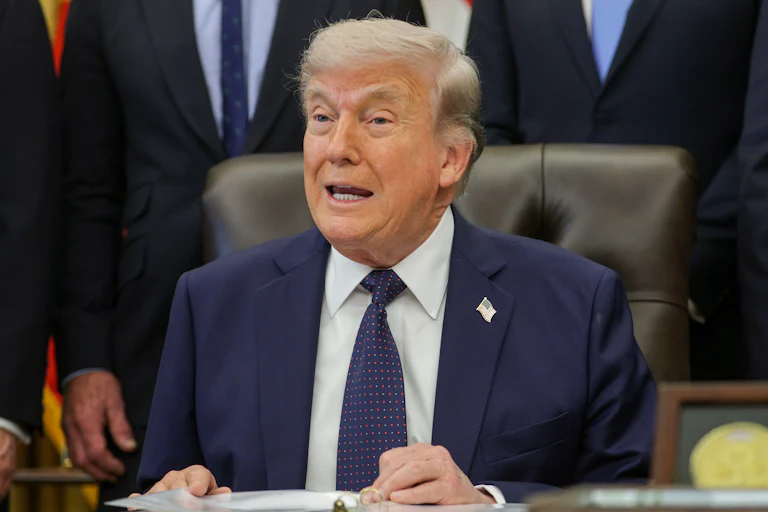
Donald Trump speaks while sitting at his desk in the Oval Office
Alex Wong/Getty Images

President Donald Trump claimed that former President Barack Obama blocked a merger with a defunct airline that hasn’t existed since the 1980s.

Speaking to reporters from the Oval Office Thursday, Trump appeared confused when he was asked whether the government planned to buy a stake in Spirit Airlines, the struggling discount carrier that has twice filed for bankruptcy.

“So, Spirit is, uh, an airline that’s had some trouble. They were going to merge with People Express, or one of them, a number of years ago and Barack Hussein Obama decided it was a bad idea,” Trump said. “How did that work out? It was bad for both of them. That would’ve been a natural merger.”

It would have been a distinctly unnatural merger, as People Express shuttered in 1987. Spirit Airlines as we know it didn’t formally exist until five years later.

It’s likely that Trump was referring to the Spirit’s attempted merger with JetBlue, which was successfully challenged in 2024 under Joe Biden’s administration over concerns that it would eliminate Spirit’s low-cost service, dull competition, and drive up prices.

The Trump administration reportedly neared a $500 million deal with Spirit Airlines Wednesday that would leave the federal government with a 90 percent stake in the company.

“We’re thinking about doing it, helping them out, meaning bailing them out or buying it. I think we just buy it. We’d be getting it virtually debt-free. They have some good aircraft, some good assets, and when the price of oil goes down, we’ll sell it for a profit,” Trump said.

“I’d love to be able to save those jobs, I’d love to be able to save an airline,” he added.

This decision further underscores Trump’s willingness to spend taxpayer dollars without congressional approval. And the president’s mistaking Jet Blue for People Express and Obama for Biden is just another instance of Trump’s apparent cognitive decline.

Democrats Urge USPS to Defy Trump Order Undermining Voting Rights

In a letter shared exclusively with The New Republic, ranking members on the House Oversight and Administration Committees urged the USPS to oppose Donald Trump’s recent executive order regarding mail-in voting.

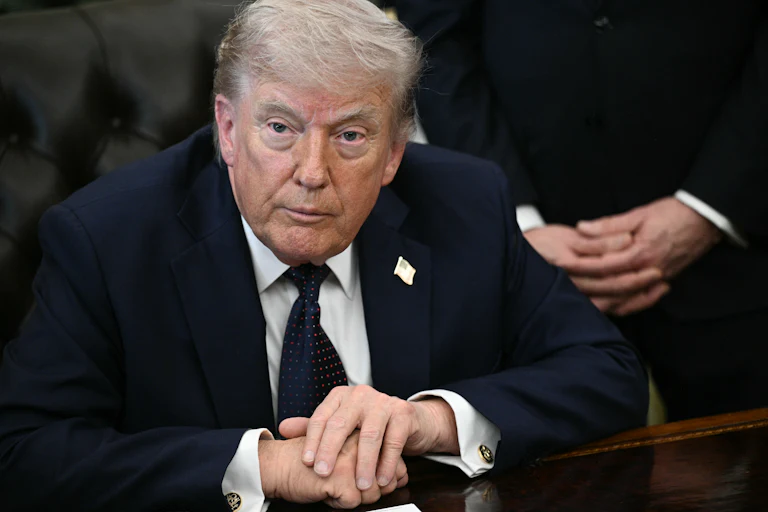
Donald Trump sits at his desk in the Oval Office with his hands folded on the desk in front of him
Will Oliver/EPA/Bloomberg/Getty Images

Lead Democrats on the House Oversight and Administration Committees are urging the U.S. Postal Service to refuse President Donald Trump’s executive order to illegally limit mail-in voting.

In a letter Friday to the U.S. Postal Service’s Board of Governors, shared exclusively with The New Republic, Ranking Members Robert Garcia and Joe Morelle argued the agency should refuse to implement an executive order instructing the USPS to refuse to deliver ballots of anyone who is not on a federal voting list.

The lawmakers argue in the letter that Trump has no authority over the USPS, which is an independent agency only accountable to its own board of governors.

The USPS is specifically barred from making “any undue or unreasonable discrimination among users of the mails,” the letter noted, and Trump’s executive order would have the agency illegally perform election administration duties.

Trump’s order, signed in late March, directed that states could notify USPS whether they plan to allow mail-in or absentee ballots up to 90 days before a federal election, and “should” notify the agency whether they intend to supply a list of eligible voters within 60 days of the election.

The order also directed USPS to produce a set of mail-in and absentee participation lists for each state, and refuse to deliver ballots for anyone who is not on them. However, there is no law that requires states to provide this information to the USPS, or authorizes USPS to require states to provide that data.

The timeline presented by the EO could potentially leave millions of Americans disenfranchised. “All 50 states and the District of Columbia allow voters to register to vote and apply to vote by mail until and up to 60 days before an election, with some states setting vote by mail application deadlines much later than 60 days,” the letter said.

“In addition, it is not clear how the Postal Service would reconcile differences or verify the accuracy of state-supplied voter lists alongside a DHS State Citizenship List. This EO will quickly create a two-tiered voting system where some Americans’ right to vote would be denied,” the letter said.

The Democratic lawmakers requested to know whether the board of governors planned to implement Trump’s order, and which specific provisions it would attempt to satisfy. They also requested a staff-level briefing be held to explain how the agency plans to respond, and address the concerns outlined in the letter.

Officials from at least two dozen states have already sued the Trump administration to oppose this executive order, which threatens states’ constitutional right to oversee their own elections. The letter points to Trump’s threats to “nationalize” or “take over” federal elections, as well as his baseless claims of voter fraud.

Republicans are also still attempting to pass the SAVE America Act, which would prohibit universal mail-in voting, although Senate Majority Leader John Thune has indicated the measure is not his top priority. Under that legislation, voters would have to submit an application to receive a mail-in ballot.

Trump’s Latest Truth Social Rampage Proves He’s Hanging On by a Thread

The president’s social media posting in the middle of the night is somehow getting even more deranged.

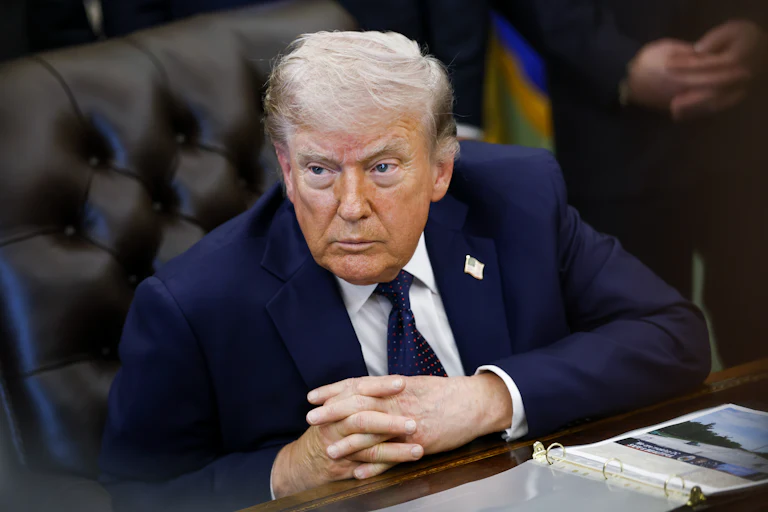
Donald Trump sits at his desk in the Oval Office of the White House
Brendan SMIALOWSKI/AFP/Getty Images

President Trump went on a long, angry social media tirade Thursday night while the entire country was asleep, once again raising doubts about his mental fitness and temperament.

Just after midnight, Trump reposted a message from the Border Patrol union calling on “extreme leftist advocate” Senator Chuck Schumer to resign over his recent comments in which he said “nobody respects” ICE or Border Patrol. Just one minute after that, Trump delusionally reposted a random allegation that former President Obama staged a “seditious conspiracy” to overthrow the U.S. government in 2016. He then made four more posts about how Obama and Hillary Clinton should be charged with treason. This was all before 1:00 a.m.

After his Obama derangement syndrome subsided, he argued that the entire 2020 election—which he lost—should be “permanently wiped from the books and be of no further force or effect!” if the Southern Poverty Law Center loses the DOJ lawsuit against them. (The case is unrelated to the 2020 election.) Then that was followed by a post attributed to actor Clint Eastwood talking about how great Trump is. Eastwood never said that.

Rather than posting about midterms, the affordability crisis, the war on Iran, or just not at all, the president of the United States is crashing out in the middle of the night, attempting to attack political opponents on no real grounds and relitigating an election that every sensible person knows he lost.

Editor’s Pick:

Pentagon Suggests Appalling Ways to Take Revenge on NATO Countries

The Department of Defense is outlining different options to punish NATO members who refuse to help Trump with his Iran war.

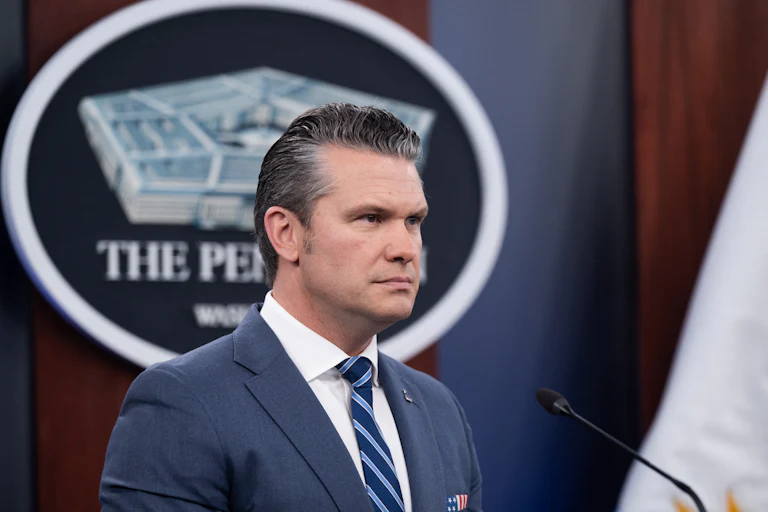
Defense Secretary Pete Hegseth delivers a press conference at the Pentagon
SAUL LOEB/AFP/Getty Images
Defense Secretary Pete Hegseth

The Department of Defense is brainstorming ways to punish NATO members that didn’t support President Donald Trump’s war with Iran.

Reuters, citing an unnamed U.S. government official, reports that the federal government is considering suspending Spain from the transatlantic alliance and reevaluating the United Kingdom’s claim to the Falkland Islands. The official told the news agency that these options were laid out in an internal Pentagon email.

The Trump administration is upset at NATO countries that have refused to grant the U.S. access to their bases or rights to their airspace for the Iran war. The email, circulating at the highest levels of the DOD, reportedly said that those rights are “just the absolute baseline for NATO.”

If the U.S. wants to suspend member countries like Spain, it will likely run into pushback from other NATO members. One NATO official told Reuters that “NATO’s Founding Treaty does not foresee any provision for suspension of NATO membership.”

When asked about the email, the Pentagon’s press secretary, Kingsley Wilson, replied, “As President Trump has said, ​despite everything that the United States has done for our NATO allies, they were not there for us.

“The War Department will ensure that the President has credible options to ensure that our allies are no longer a paper tiger and instead do their part. We have no further comment on any internal deliberations to that effect,” Wilson said.

Trump has repeatedly criticized NATO, even prior to the Iran war, repeatedly threatening to leave the alliance over petty grievances such as countries rebuffing his desire to “take” Greenland. In recent weeks, he has complained that NATO members won’t help to reopen the Strait of Hormuz. On April 1, he again told Reuters that he was “absolutely, without question” considering leaving the organization.

But that would likely require approval from Congress, and Trump would have to go around it and invoke presidential authority over foreign policy, which would face legal challenges. And taking punitive action against our own allies would result in backlash domestically and abroad. But Trump does not respect long-standing alliances, and if he feels slighted, blowing them up is a strong possibility.

Trump Says He’s Still on Schedule in Iran Because He Took “a Break”

It doesn’t sound like the war will be over anytime soon.

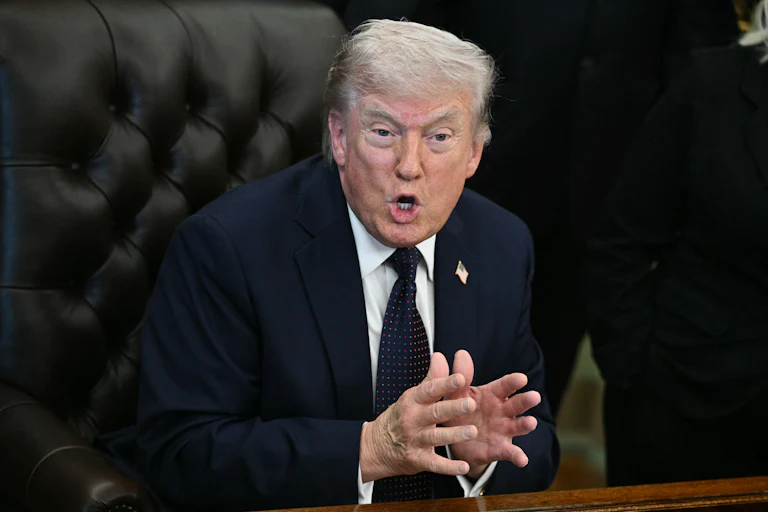
Donald Trump leans forward while sitting in his desk chair in the Oval Office. He holds both hands in front of him, palms almost touching, and speaks.
Brendan SMIALOWSKI/AFP/Getty Images

Donald Trump would get around to ending the bloody conflict in Iran, but come on—we all deserve a break once in a while!

That was essentially what the president told reporters on Thursday when asked about the ongoing war. After Trump falsely claimed the United States had been involved with Iran for only “five and a half weeks,” a reporter piped up.

“It’s [been] eight weeks that the U.S. now has been involved with Iran,” the reporter said. “You initially had said it would be four to six weeks and it would be over.”

“Well, I hoped that, but I took a little break,” Trump retorted. “I gave them a break.”

If true, the idea that Trump took a two-week-long break from dealing with the war is pretty insane. What was he doing during that period? Watching TV? Brushing up on his figure drawing? DoorDashing McDonalds to the White House? (He actually did do that last one.)

In terms of Trump’s claim that we’ve been at war for less than six weeks, we should note how easily the man elected to lead our country finds it to lie to the public. The reporter is correct in that the U.S. and Israel began launching military strikes on Iran on February 28. Including that day, it has been 55 days since the conflict began, or one day less than eight weeks.

If you wanted to be kind to Trump, you could argue that the ceasefire he announced on April 7—after threatening to destroy Iranian civilization earlier that day—means he is technically correct and the war is already over. Trump indefinitely extended the ceasefire on Tuesday.

But the Strait of Hormuz is still closed amid contentious peace talks, and the Marines fired at and seized an Iranian cargo ship on Sunday. While there is potential for both sides to come to an agreement soon, the conflict isn’t over yet.

Trump admitted as much when a different reporter asked how long he was willing to wait to get a response from Iran during his peace talks.

“Don’t rush me,” Trump said. “We were in Vietnam for 18 years. We were in Iraq for many, many years.” Oh well. At least now he’s actually calling it a war.

Trump, 79, Falls Asleep After Bragging That He’s Solved Health Care

The president went to sleep during a White House event on health care affordability.

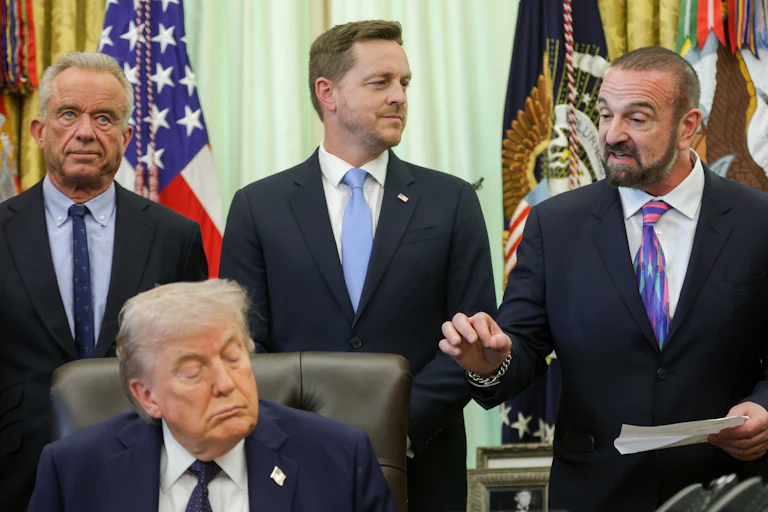
President and Chief Scientific Officer of Regeneron Pharmaceuticals George Yancopoulos speaks alongside Health Secretary Robert F. Kennedy Jr., Director of the Center for Medicare Chris Klomp, and Donald Trump during a White House event on health care affordability in the Oval Office. Trump's eyes are closed.
Alex Wong/Getty Images
George Yancopoulos, the president and chief scientific officer of Regeneron Pharmaceuticals, speaks alongside Health Secretary Robert F. Kennedy Jr., director of the Center for Medicare Chris Klomp, and Donald Trump during a White House event on health care affordability, on April 23.

Our nearly 80-year-old president appears to have nodded off during a meeting, for the umpteenth time

President Trump’s eyes grew visibly heavy around the halfway point of his televised announcement of a deal with drug company Regeneron on Thursday afternoon, closing fully and reopening multiple times while suited Cabinet members and pharmaceutical executives stood behind him in the Oval Office. 

This is the same man who keeps calling former President Joe Biden “Sleepy Joe.” 

The last time Trump dozed off publicly was last month during a Cabinet meeting while Defense Secretary Pete Hegseth ranted against the media’s coverage of the U.S.-Israeli joint war on Iran and Lebanon. And just days before that, he seemed to fall asleep at a press conference about his Memphis Task Force. From the power naps to the unhinged, genocidal Truth Social posts, there is a wealth of evidence that would—at the very least—lead us to question Trump’s present mental acuity.  

Trump DOJ Under Investigation for How It Handled Epstein Files

The Department of Justice’s internal watchdog is scrutinizing how the files were released.

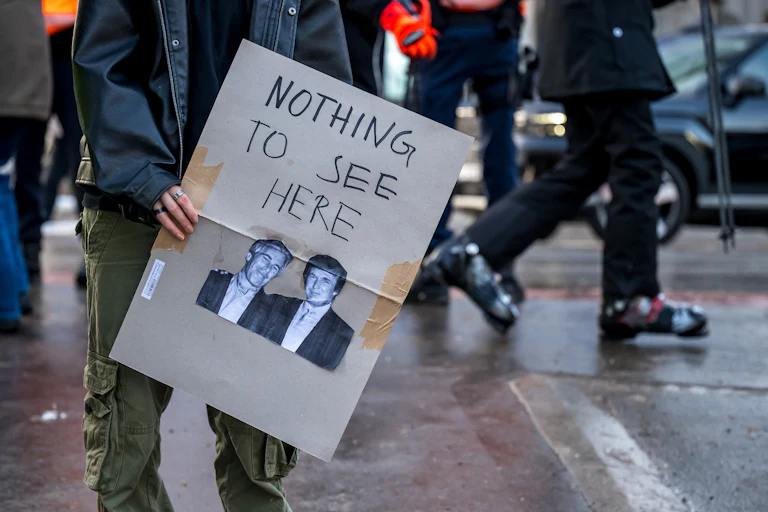
A protester holds a sign that says, "Nothing to see here" with a photo of Donald Trump and Jeffrey Epstein underneath
Fabrice COFFRINI/AFP/Getty Images

The Department of Justice is auditing itself over the chaotic rollout of the Jeffrey Epstein files, the Associated Press reported on Thursday.

The Epstein Files Transparency Act, which was pushed through Congress by an eclectic bipartisan group even after Donald Trump dismissed it as a “hoax,” made millions of government files on the convicted sex trafficker publically available.

But the slow, sloppy, and still incomplete rollout of the files led to serious questions about what the hell the Department of Justice was doing under then–Attorney General Pam Bondi. The DOJ continues to face accusations it is covering up evidence of Trump’s involvement with Epstein.

Now the department’s Inspector General’s Office is looking into the matter, particularly “how the department collected, reviewed and redacted materials in preparation for their release.”

The first issue relating to the rollout of the files is that the DOJ blew past the 30-day deadline it was given by Congress in November, claiming it needed more time as it had coincidentally discovered more records.

Bondi was also caught lying about the files. She bragged to Fox News in February 2025 that Epstein’s client list was “on her desk”—only for the DOJ to backtrack months later and say the list never existed.

In January, the department released approximately three million files. Great—except nearly 100 victims’ names and nude pictures were mistakenly left visible, while information that might have actually led to some justice being done was redacted. The DOJ withdrew thousands of the files, vaguely blaming the mistake on “technical or human error.” (When an individual releases dozens of nude photos of someone without consent, they go to jail. When Trump’s DOJ does it, no one is even fired!)

The aftermath of the rollout has also been frustrating. No one has been arrested in the U.S. for involvement in Epstein’s sex-trafficking ring, even with all the documents outlining his crimes as potential evidence. There are also 2.5 million files that have not yet been released, meaning tons of information about Epstein’s circle is still being withheld from the public.

In a perfect world, this audit would determine what went wrong and be the first step to a full release of the files. But the fact that the review is coming from inside the DOJ gives one little hope that anything will change within the department. Trump has also fired or demoted over 20 inspectors general during his second term, greatly limiting who is able to watch over his corrupt government.