Breaking News
Breaking News
from Washington and beyond

Colorado and North Carolina Offer Hope That There Won’t Be a “Red Wave” This Election

The so-called "red wave" might not really be a wave at all.

Michael Ciaglo/Getty Images

Tonight might not be a blowout after all.

At about 9:35 p.m. ET, or a little more than half an hour after the Colorado polls closed, NBC projected incumbent Democratic Senator Michael Bennet the winner over GOP challenger Joe O’Dea. That was a pretty fast call for a race that in September and October was labeled as one where a seemingly safe Democratic incumbent might be in trouble.

In other words, Bennet was exactly the kind of Democratic who would have tumbled in a major red wave. But the fact that he not only held on but is apparently winning pretty comfortably is a sign of hope.

Item two: About 10 minutes later, NBC shifted the North Carolina Senate race from “too early to call” to “too close to call.” “Too early” means, “Well, we can’t say it yet, but we all really know what’s going to happen”—in this case, that Republican Ted Budd was going to beat Democrat Cheri Beasley. I remember, still, the shudder of involuntary horror that consumed by body on Election Night 2016, at (I think) exactly 8:32 p.m., when NBC shifted that same North Carolina from “too early” (meaning, then, that Hillary Clinton was going to win, but they just couldn’t say yet) to “too close,” which meant that Donald Trump was going to win. And if he was going to win North Carolina, that meant he was going to win period. I still have nightmares.

But tonight, the shift to “too close” appears to bode well for Beasley. Maybe not to the extent that she wins, which would of course be great; but at least to the extent that she’s outperforming late polls, which tells us something interesting.

Things can still change. But right now, around 10 p.m. Eastern time? It’s not yet a red wave kind of night.
We Won’t Get Immediate Election Results in Nevada, Georgia, or Arizona

Three battleground states will take longer to count their votes—and then come the conspiracy theorists.

Anna Moneymaker/Getty Images
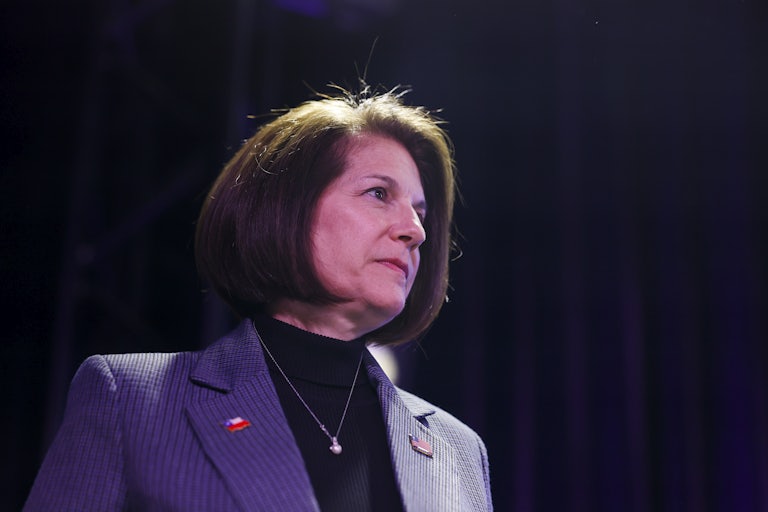
Nevada Senator Catherine Cortez Masto

Add Nevada to the list of states where the results of top ticket races may not be called tonight. That’s according to Jon Ralston, the indispensable Nevada journalist.

Ralston tweeted Tuesday evening that mail-in ballots dropped off in Clark County, the biggest county in the state, won’t fully be counted tonight and may not be until Thursday.

It was highly unlikely that control of the Senate would be decided Tuesday night. Georgia’s Senate race was expected to go to a run-off between incumbent Senator Raphael Warnock and Republican Herschel Walker..

But as election results came in Tuesday night, political strategists and candidates began to caution that election results will also not be immediately clear in Nevada and Arizona. Arizona counts ballots slowly, a Democratic official cautioned. There was also a problem with tabulating machines in Arizona’s Maricopa County, raising the possibility that a winner in the Senate race or governor’s race would not be announced Tuesday.

That three battleground states will likely have undecided Senate and gubernatorial races on Tuesday means that there will be inevitable lawsuits and scrutiny over counting the remaining ballots. And unfortunately, the conspiracy theorists will abound as well.

With Sweeping DeSantis and Rubio Wins, Florida Was a Bloodbath for the Democrats

The Florida Democratic Party is a total and utter disaster.

Tom Williams/CQ Roll Call

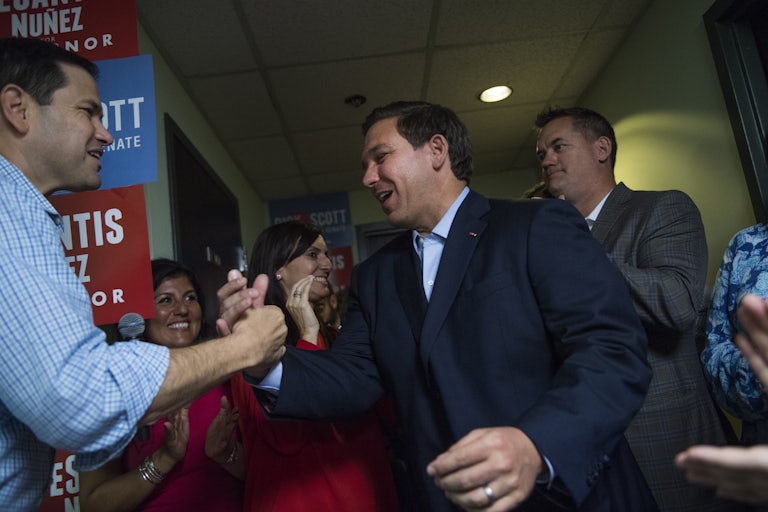
The instant the polls closed in Florida, the calls were made: Ron DeSantis, projected winner in the governor’s race; Marco Rubio, projected winner in the Senate race. Neither was a surprise, but the Senate race was a bit of a disappointment, because Democrats thought they had a good candidate in Represenative Val Demings, and months ago, the polls were pretty close.

On MSNBC, Alex Wagner, Carlos Curbelo, and David Plouffe remarked on what a train wreck the situation was for the Democrats in Miami-Dade, where the swing from Democrat to Republican was on the order of 20 points, maybe more. Could that be real?

Apparently, yes. Under state party chairman Manny Diaz, the Florida Democratic Party has just vaporized. Politico reported back on October 28 that there were “already plenty of signs that Nov. 8 is going to be a rough night for Florida Democrats.”

Diaz got in the middle of some local races between Democrats, and one intra-party critic, Tom Kennedy, charged that “the party was ‘non-existent’ on Spanish-language media and Democrats are getting ‘eaten up’ in early voting.”

How does a major party—in south Florida—become “non-existent” on Spanish-language media? And how does the national party let that go on?

This is a collapse that’s beyond epic. If the state Democratic Party can ever come back from this, it’ll take a decade. And until it does happen, Democratic presidential candidates can kiss 29 electoral votes goodbye.

TNR Hits the Polls as Georgians Turn Out to Vote

Here's what it looked like in a key state this election.

Megan Varner/Getty Images

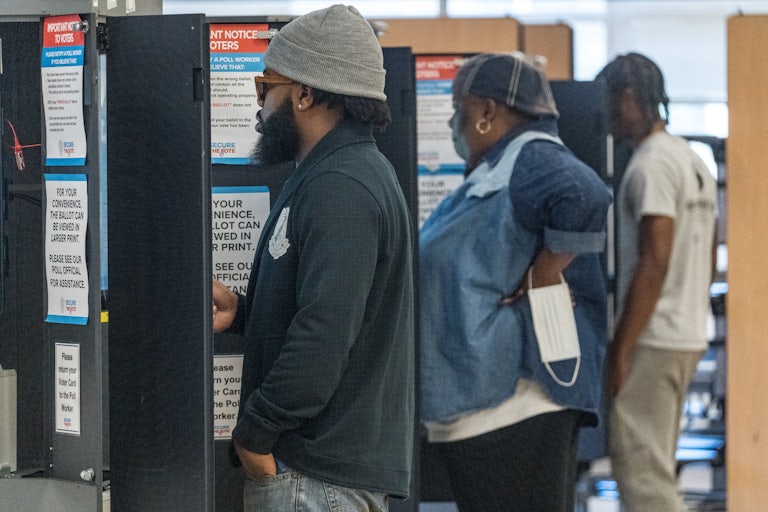
Compared to the long lines voters experienced when casting their ballots during the state’s early voting period, voting on Election Day in Georgia appeared to run smoothly—with few notable exceptions. In Fulton County, which encompasses Atlanta, many voters went in and out of polling locations at a brisk pace.

A poll worker at Park Tavern, which had notoriously long lines in the 2020 election, told me that this Election Day had not seen any significant delays. As the surrounding streets clogged with rush hour traffic, a growing number of voters ducked into the polling place after leaving work.

Ashley Adams, an attorney who volunteers with the Election Protection coalition to assist voters with any issues or concerns they may have regarding voting, told me that she had not received many inquiries from voters with questions about casting their ballot. The steady stream of voters, she said, was due to the “pressure” people were feeling to turn out.

“I think that there’s a bit of election fatigue,” Adams said. She predicted that many voters were hoping no race would go to a runoff—a possibility if candidates in the gubernatorial or Senate races do not obtain a majority of the vote.

It’s a case candidates are making as well. As GOP Governor Brian Kemp told supporters at a rally on Monday evening, if he wins outright, “Y’all won’t be getting mailers and phone calls and watching commercials during Thanksgiving.” “It’s going to be great,” he promised.

Maxwell Frost Wins, Becomes First Gen Z and Afro-Cuban Member of Congress

The 25-year-old from Florida is now the youngest member of Congress.

Thomas Simonetti for The Washington Post via Getty Images

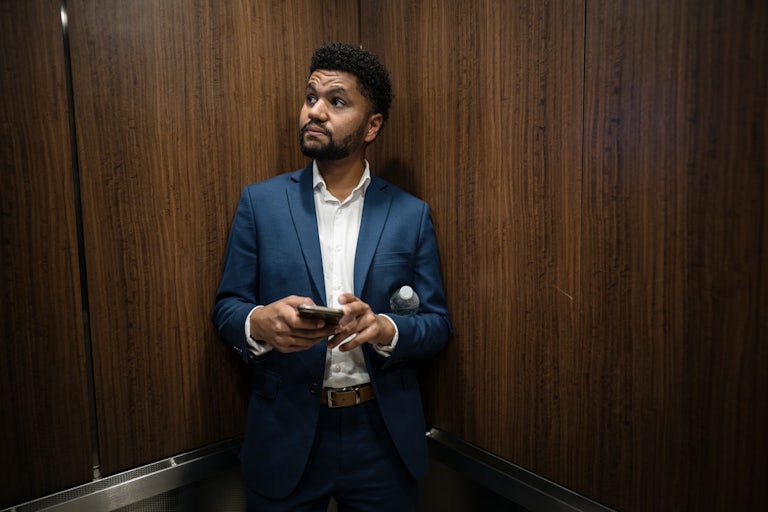
Democrat Maxwell Alejandro Frost has defeated Republican Calvin Wimbish and won the race for Florida’s 10th congressional district, projects the Associated Press.

Frost leads Wimbish 58.8 percent to 39.7 percent, with 98 percent reporting.

Frost’s victory was not unexpected in the district, but his election still marks history. The newly-elected congressman will be the first Gen Z and first Afro-Cuban member of Congress.

A former campaign staffer first for Bernie Sanders and then Hillary Clinton during the 2016 presidential election, Frost has been involved in politics for years. In 2018, Frost organized with the ACLU to lobby voters to support a successful Florida ballot initiative that restored voting rights to felons. Thereafter, Frost served as a national organizing director for gun violence prevention organization March For Our Lives, spurred into action after the tragic high school shooting in Parkland, Florida that killed 17 people and injured another 17.

Frost, a part-time Uber driver, put forth an unapologetically progressive platform. Some of his focus was on big-ticket items including Medicare-for-All, the Green New Deal, and banning assault weapons. Frost also put out targeted proposals including the Homes for All Act, which would direct the construction of 12 million new affordable housing units, and putting an end to a rule that gives 80 percent of transportation funding to highways and only 20 percent to transit.

While age could have been an inhibitor, the 25-year-old, buoyed by nationwide progressive support, overcame the Democratic establishment. Filling in the seat formerly held by Congresswoman Val Demings, Frost emerged from a crowded primary field of nine other candidates including former Florida representatives Alan Grayson and Corrine Brown, and state Senator Randolph Bracy.

Frost enjoyed support from members of congress including Bernie Sanders, Elizabeth Warren, and Jamie Raskin, and figures such as Reverend Jesse Jackson and gun violence activist Fred Guttenberg, whose daughter was killed in the Parkland shooting.

This piece has been updated.