Breaking News
Breaking News
from Washington and beyond

Mondaire Jones Is Pitching a Comeback

The former Democratic congressman from New York wants to win back his seat—after the former DCCC chair essentially bullied him out and then lost the race to a Republican.

Jemal Countess/Getty Images for Take Back the Court Action Fund
Mondaire Jones

A year after being pushed out of his district by losing Democratic Congressional Campaign Committee chair Sean Patrick Maloney, Mondaire Jones is pitching a comeback to Congress.

The former New York congressman announced his bid to take back his seat on Wednesday morning:

Jones is running for New York’s 17th congressional district, one he used to represent before a messy redistricting process pushed him out. With redrawn congressional maps prompted by former New York Governor Andrew Cuomo’s stacked conservative state court, DCCC chair Maloney decided to run in Jones’s district, essentially bullying Jones out. Maloney then got egg on his face by losing to Republican Mike Lawler in a redistricted map that would have voted for Biden by 10 percentage points.

In his video announcement Wednesday, Jones focused especially on gun violence, his role in increasing police funding, and his specific roots to Rockland County.

“Gun violence is a uniquely American problem, and it’s frightening to be a parent and know that I could send my kid off to school and never see them again,” parent Beth Davidson says in the video. “Mondaire has been a champion for keeping people safe.”

Jones also brought out Dave Ryan of the Hudson Valley Police to express his support for Jones because he “funded the police.” While the New York suburbs are actually among the safest communities in the country, they are also home to many of the officers who police New York City. Lawler, among other successful New York Republicans from the last election cycle, peddled fears around crime despite those facts. Many other New York Republicans who secured surprising victories, like Lawler, enjoyed the support of the likes of then-president of the New York City police union Patrick Lynch. Jones seems eager to head off that dynamic—not by pointing out the contradiction but instead by placating those interests.

And given the shaky precedent of Jones being pushed out, then being forced to run in a district he had less connection with, all to come back and run in his old (now slightly modified by redistricting) district, Jones is paying special focus on highlighting his roots to the area.

“I was lucky to grow up in Rockland County,” Jones said in his video. “Raised by a young single mom, who like so many incredible women throughout this district, still had to work multiple jobs to make ends meet.”

In the last election, when all was said and done, Jones was in part victim to the series of dramas that helped Democrats narrowly lose the House majority, setting course for what the day-to-day activity of Congress would look like until 2024.

In November, Maloney became the first party chair to lose an election in four decades. Jones didn’t even make it out of the crowded primary he then ran in, losing to wealthy and massively self-funded Daniel Goldman (who also benefited from a New York Times endorsement, having connections with Times publisher A.G. Sulzberger).

The crowded primary pitted Jones against other progressives, including Yuh-Line Niou, who took second, and Carlina Rivera, who came in fourth behind Jones. Their combined vote totals far outpaced Goldman’s.

Now Jones will be vying to take on Lawler, the vulnerable Republican who beat Maloney. But first he must win a primary that already perhaps feels somewhat resonant of his previous primary. Among others, Jones will be facing off against Liz Geregthy Whitmer, sister to Michigan governor and rising Democratic star Gretchen Whitmer.
Pro-Trump Lawyer Cowardly Quits Rather Than Face Disbarment Trial

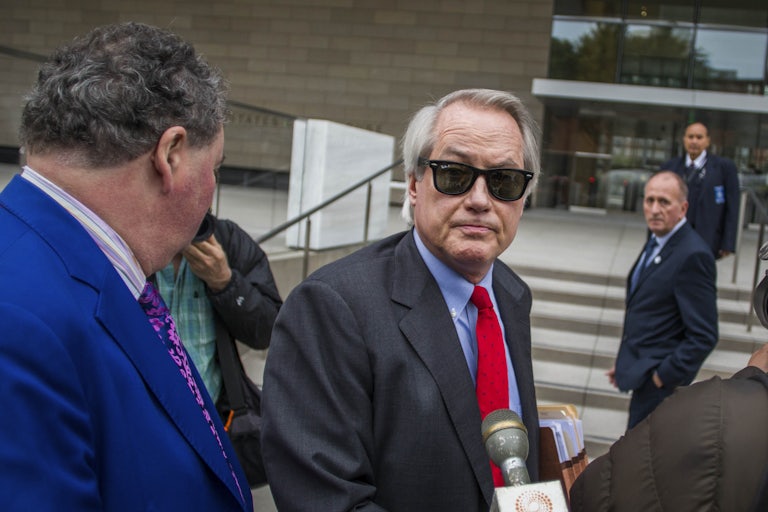
MAGA lawyer Lin Wood is facing disciplinary proceedings for his role in trying to overthrow the 2020 election.

Mondaire Jones
Apu Gomes/Getty Images

A pro-Trump lawyer has requested to permanently retire from practicing rather than face disciplinary proceedings that would have likely resulted in his disbarment.

Lin Wood was one of the first to promote the falsehood that the 2020 presidential election had been stolen. He was part of Donald Trump’s legal team that unsuccessfully tried to overthrow the election. Since then, he has been embroiled in legal drama, after former colleagues sued him for breach of contract and a former QAnon ally sued him for defamation. The Georgia Bar held a trial for Wood in May to determine whether to disbar him, and Wood was sanctioned in Michigan for misconduct over the election fraud lawsuits.

On Tuesday, Wood sent a letter to the Georgia state bar requesting to be “permitted to transfer to Retired Status effective immediately.” He can only transfer if the general counsel’s office grants him permission because there are two disciplinary proceedings currently against him.

“I further understand and acknowledge that if granted Retired Status I am prohibited from practicing law in this State and in any other state or jurisdiction and that I may not apply for readmission,” Wood wrote in the letter.

Wood is the latest Trump lawyer to fall. John Eastman, who also worked on the election fraud cases, is facing disbarment in California. Jenna Ellis was censured by the Colorado Bar for making false statements about the 2020 election. Sidney Powell is also facing disbarment, and was sanctioned in Michigan for alleging election fraud, the same case that saw Wood sanctioned.

Longtime Trump lawyer and ally Rudi Giuliani had his law license suspended for his efforts to overturn the election. He and Powell have been sued by voting machine companies Dominion Voting Systems and Smartmatic for falsely claiming the machines were involved in election rigging.

Giuliani also recently testified for about eight hours in front of special counsel Jack Smith, who has indicted Trump for mishandling classified documents and is still investigating the former president for his efforts to overturn the election. Giuliani answered questions about Trump, the January 6 attack, and Powell.

North Carolina Republicans Are Trying to Disenfranchise Democrats Again

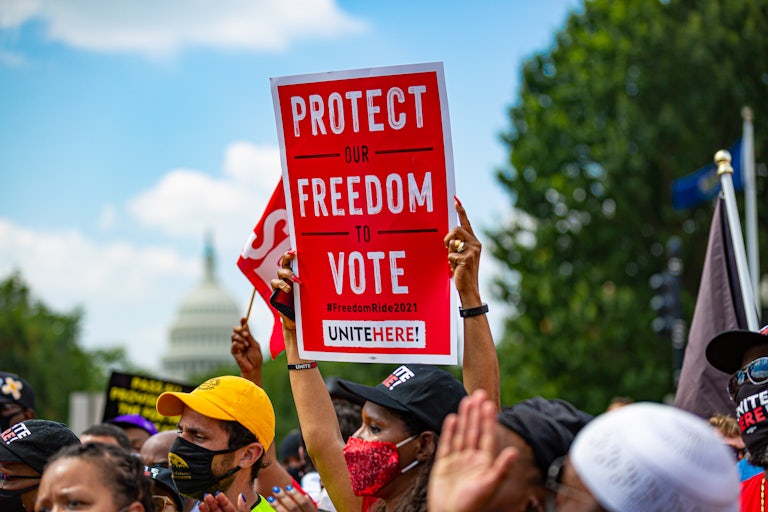
Days after the Supreme Court ruled in favor of voting rights groups in the state, North Carolina Republicans are pushing two new voter suppression rules.

Photo by Michael Nigro/Pacific Press/LightRocket/Getty Images

While voting rights advocates celebrated the Supreme Court’s rejection of North Carolina Republicans’ illegally gerrymandered electoral map, the state’s GOP is not tapping the brakes at all on its efforts to subvert democracy and disenfranchise voters.

Republican House Speaker Tim Moore—whose name was on the rejected Supreme Court case—is leading his colleagues to pass an array of other bills that would erode voting rights and unfairly favor Republicans in state elections. Their efforts have been buttressed after obtaining a veto-proof majority in the House in April—thanks to the defection of a Democrat. Last year, the state’s Supreme Court swung from a 4–3 liberal majority to a 5–2 conservative one. Now Moore is considering two bills aimed at disenfranchising voters that recently passed the state’s Senate.

One, Senate Bill 747, would essentially get rid of same-day voter registration, leaving voters instead to have to cast provisional ballots and then follow up and verify their identities later. It would also remove a three-day grace period for votes sent by mail, requiring mail-in ballots to be received by Election Day.

Another, Senate Bill 749, would remove Democratic Governor Roy Cooper’s ability to appoint board members to state and county boards of elections, giving it to the state legislature instead. Republicans have proposed a board with eight members—four Republicans and four Democrats—that would all but guarantee gridlock. Five years ago, the state Supreme Court ruled that a similar effort to prevent the governor from managing the state board impinged “upon the Governor’s ability to faithfully execute the laws.”  

More on the state Supreme Court: After conservatives secured control, they reversed the court’s prior ruling rejecting Republicans’ gerrymandered map. In the new map approved by the Supreme Court, an evenly divided vote would produce 10 House seats for Republicans and only four to Democrats. North Carolina currently has seven Republican representatives and seven Democratic ones—a reasonable split given that the state narrowly voted for Donald Trump in 2020.

The court also reversed a prior decision surrounding a photo ID requirement. In a case (once again with Moore’s name on it), the court declared such a requirement unconstitutional; but now, a requirement demonstrably targeting minority voters is also set to be on the books, right alongside the gerrymander and aforementioned anti-democratic bills.

Right-wing election deniers like lawyer Cleta Mitchell, who supported Donald Trump’s efforts to overturn the 2020 election, have been working with North Carolina Republicans to try and make all this magic happen.

No Labels Could Hand the 2024 Election to Donald Trump

The self-described “nonpartisan” and “centrist” group is doing Donald Trump and the GOP a huge favor.

Photo by Jeff Swensen/Getty Images

The self-described “nonpartisan” group No Labels is hell-bent on running a third presidential candidate for 2024—and in doing so could hand the election to Donald Trump.

No Labels claims its goal is to create a space for centrists who are fed up with partisan politics and want solutions that appeal to both the right and the left. In reality, it has taken money from Republican billionaire megadonor Harlan Crow—best known for the lavish gifts and vacations he has given to Clarence Thomas—and backed the immensely unpopular former North Carolina Governor Pat McCrory. Even the group’s former allies say No Labels is “dangerous.”

The group insists that voters want someone other than Trump or Joe Biden, so it’s preparing for a third-party campaign—despite enormous pushback from political strategists.

“It is a spectacular combination of hubris and irresponsibility at a level that I have trouble even believing,” Rick Wilson, co-founder of the anti-Trump group the Lincoln Project, told The Wall Street Journal. “They’ve made a financial and personal decision to destroy Joe Biden.” (Wilson should be pretty familiar with this: The Lincoln Project is another group with lofty goals but questionable follow-through.)

If No Labels persists, it could end up giving Trump an easy win. Historically, third-party candidates have performed poorly in presidential elections, typically receiving (at best) a sliver of the electorate. The exceptions (Theodore Roosevelt in 1912; Ross Perot in 1992) prove the rule. But a third-party candidate could peel critical votes away from Biden while Trump cruises to victory on the support of his energized fans.

Another outcome could be that a third candidate prevents anyone from getting 270 electoral votes, meaning that state delegations in the House of Representatives pick the winner. Since the House is currently in Republican hands, it would almost certainly swing for Trump.

No Labels has pledged to back out if Trump does not get the GOP nomination. The current runner-up is Florida Governor Ron DeSantis, who has signed some of the most extreme laws in the country, targeting women, people of color, and LGBTQ people. DeSantis also criticized the debt ceiling deal, which No Labels praised.

Elon Musk Finally Broke Twitter

Over the weekend, the social network began limiting how many posts its users could see.

Photo by Britta Pedersen/Pool/Getty Images

Rumors of Twitter’s demise have been swirling since last last year, when changes—specifically layoffs, firings, and other cuts made by Elon Musk after he purchased the company for $44 billion—began to intermittently break the site. Still, despite being clearly held together with wire and string and staffed by a skeleton crew, the social network managed to hold on for months. Twitter was worse in many ways—less reliable, with more spam, fake news, and stupid replies thanks to Musk’s new “verified” system—but it was still Twitter, more or less.

Over the weekend, Twitter stopped being Twitter. Musk was, it practically goes without saying at this point, the culprit. Early Saturday morning, users began to report that the app was restricting the number of posts they could view. For unverified users, the number was incredibly low—600, later raised to 800—which rendered the social network unusable after users hit the cap. Twitter, like all social networks, is attention-based: Its ostensible goal is for people to use it as much as possible. This is, at the moment, of existential importance given the vast amount of money the company is losing. Its new CEO, Linda Yaccarino, was brought on in part to raise money from advertising, which is dependent on view counts. Her job was already difficult, given Musk’s penchant for posting like a pimply teenage edgelord. It just got even harder.

It’s not entirely clear why Musk introduced rate limits. He has insisted that it was an effort to stop unauthorized scraping by third parties, like ChatGPT, of the site’s data. Others have speculated that the limits were imposed as a result of Twitter not paying its Amazon Web Services bill or as a desperate ploy to get more people to pay for Twitter Blue, where subscribers are able to view more posts (though still not, for unexplained reasons, an infinite number). Bluesky, the nascent competitor started by Twitter founder Jack Dorsey, saw sign-ups skyrocket over the weekend and seems, for the first time, like it could become a viable alternative. Meta, the company formerly known as Facebook, is expected to launch its own Twitter clone sometime this summer.

Given the substantial financial and technological challenges it faces, Musk’s Twitter has seemed destined to crash and burn more or less since he purchased it. Over the weekend, he hastened its decline.