Breaking News
Breaking News
from Washington and beyond

House Republican Admits He’ll Kill Border Deal If It Helps Biden

Secure the border … unless it helps Biden’s poll numbers.

Anna Moneymaker/Getty Images

Texas Representative Troy Nehls showed his true colors on Wednesday, refusing to back any sort of border deal because he claimed it could help President Joe Biden’s slumping poll numbers.

“Let me tell you, I’m not willing to do too damn much right now to help a Democrat and to help Joe Biden’s approval rating,” the MAGA Republican told CNN.

“I will not help the Democrats try to improve this man’s dismal approval ratings. I’m not going to do it. Why would I? Chuck Schumer has had H.R. 2 on his desk since July. And he did nothing with it,” Nehls added.

Republican loyalty to H.R. 2, an asylum-limiting immigration bill that passed in the House with zero Democratic votes, has proven to be an unstoppable headache for Congress with an almost zero percent chance of passing in the Democratic-controlled Senate or being signed by the president.

That hasn’t stopped House Republicans, more than 60 of whom traveled to the U.S.-Mexico border on Wednesday, from rejecting any sort of bipartisan deal on border security.

And Nehl’s confession on Wednesday may hint at the reason why: Republicans care more about who sits in the White House than doing anything about the border situation they keep harping on about.

“When the House clings to H.R. 2 as the only solution … we’re not going to get a deal,” Senate Majority Leader Chuck Schumer said on Wednesday. “We’re willing to meet the Republicans a good part of the way. I think now in the last few days, many Republicans have begun to realize that we are willing to do that and how serious we are about getting this done.”

The transparently vacuous approach to building a border wall is not an uncommon party trick for conservatives, who have been so inoperative on their self-proclaimed party objectives in recent years that their own caucus has taken to railing against them on the House floor.

In November, Representative Chip Roy laid into his party for failing to pass any laws or reach meaningful policy goals that could translate to campaign talking points, leveraging years of inaction at the border under Trump’s presidency as his primary example.

“One thing. I want my Republican colleagues to give me one thing. One. That I can go campaign on and say we did,” Roy said. “One!”

“With all due respect to former President Trump, they sure as hell didn’t get border security done when we had the White House and the House and the Senate,” Roy said. “Talked a big game about building a wall and having Mexico pay for it. Ain’t no wall, and Mexico didn’t pay for it, and we didn’t pass any border security.”
Trump Is Absolutely Losing It Over His E. Jean Carroll Case

The former president could have just handed Carroll another chance to take him to court.

Spencer Platt/Getty Images

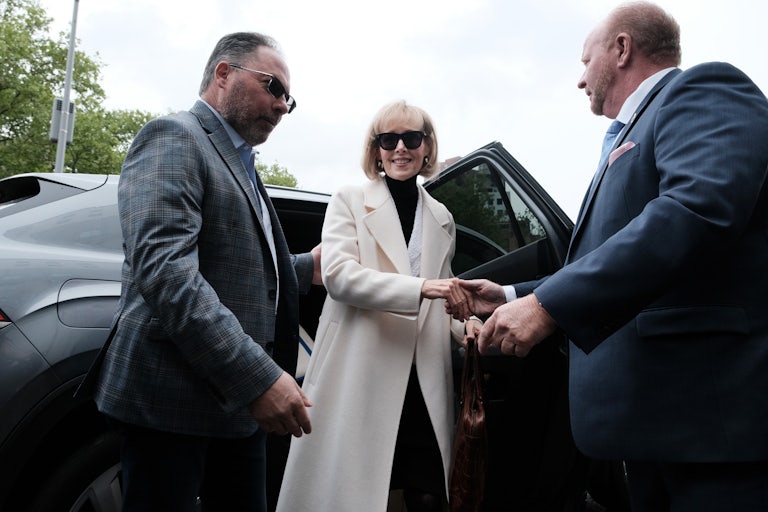
Donald Trump has lost another battle with E. Jean Carroll, and he’s handling it in a classic fashion: by completely flying off the handle.

Over the span of about 30 minutes Thursday morning, Trump made 31 posts about Carroll on Truth Social. Although he didn’t say anything himself, he shared stories from conservative outlets attacking her and comments from internet users calling her “creepy.” He also shared media interview clips and social media posts that appear to come from Carroll, all stripped of context so as to paint her as some sort of sexual deviant.

Trump’s gross little rampage is likely the result of a Wednesday court ruling rejecting his latest attempt to delay his upcoming trial for defaming Carroll. The trial is due to start on January 15.

In May, a jury unanimously found Trump liable for sexual abuse and battery against Carroll in the mid-1990s and for defaming her in 2022 while denying the assault. He was ordered to pay her $5 million in damages.

The upcoming trial is for comments Trump made in 2019, when he said Carroll made up the rape allegation to promote her memoir. Presiding Judge Lewis Kaplan ruled that since Trump has already been found liable for sexual abuse, his 2019 comments are by default defamatory. Carroll is now seeking up to $12 million in damages.

Trump has tried to argue that he has presidential immunity from the second defamation lawsuit, which Kaplan has repeatedly rejected. A main reason behind Kaplan’s decision is the fact that Trump waited three years before bringing up his immunity defense, and then another seven months before he actually moved to use that defense.

Trump appealed Kaplan’s ruling to the U.S. Court of Appeals for the Second Circuit, which ruled against him in mid-December. The three-judge panel also determined that Trump had waived his right to claim immunity by waiting for so long to bring up the potential defense.

Trump filed a motion for the entire array of the appeals court’s judges to rehear his case. The Second Circuit denied his request Wednesday, without explanation, per standard procedure. This is likely what sent Trump over the edge.

And now, thanks to his creepy Truth Social posts, Trump may have handed Carroll another chance to take him to court. Allison Gill, a former Veterans Affairs official and host of the podcast Mueller, She Wrote, pointed out that Carroll could ask for an injunction to stop Trump from continuing to make potentially defamatory statements about her.

“If an injunction is violated, jail is a remedy, as are additional fines,” Gill wrote on X (formerly Twitter).

New Poll Finds Republicans Seriously Think Trump Is the Greatest Person of Faith

More Republican voters believe Donald Trump is a person of faith than nearly any other politician.

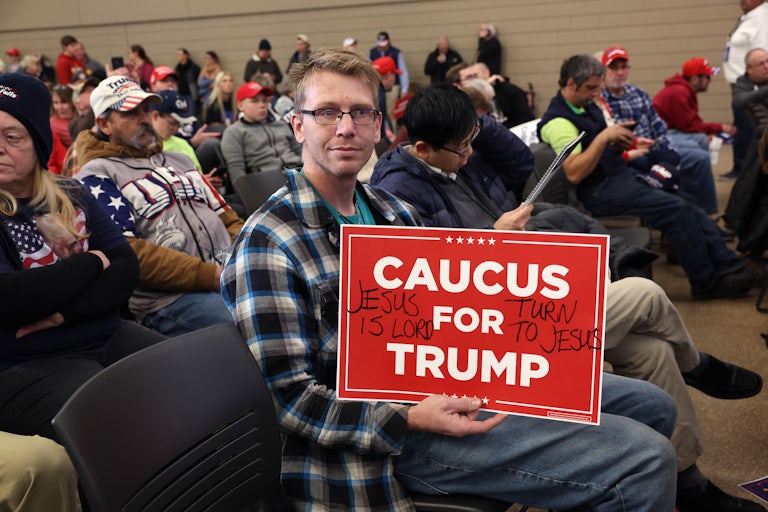
A man holds a sign that reads "Caucus for Trump." In handwritten words, it also reads "Jesus is Lord" and "Turn to Jesus."
Scott Olson/Getty Images

A new survey suggests that an increasing number of Republicans view Donald Trump as a person of faith, with Trump earning higher ratings than even some of the more vocally religious members of the Grand Old Party, including former Vice President Mike Pence and Senator Mitt Romney.

Despite Trump’s sin-filled legal tribulations, 64 percent of Republicans reported that they viewed him as a person of faith, according to a new poll conducted by HarrisX for Deseret News in November, up from 53 percent in a similar poll conducted in October.

The poll was conducted among 1,012 registered voters between November 21 and 22, 2023, with a margin of error of plus or minus 3.1 percentage points.

Trump ranked head and shoulders above his competitors in the upcoming GOP primary. Trump’s primary rival, former South Carolina Governor Nikki Haley, who converted from Sikhism to Christianity was viewed as a person of faith by 44 percent of surveyed Republicans, leaving Florida Governor Ron DeSantis once again with the short end of the stick—just 34 percent of Republicans saw the onetime potential Trump usurper as a person of faith.

Trump also topped Pence, one of the most vocal Christian evangelists in U.S. politics, by a margin of 8 percent. Even Romney couldn’t compete, with just 34 percent of Republicans viewing him as a person of faith.

However, Trump’s ranking as a person of faith differs from how Republicans view his religiosity, and that’s where Pence and Trump trade places. Sixty-two percent of Republicans said they viewed Pence as religious versus 47 percent who said the same for Trump.

Meanwhile, President Joe Biden, who attends mass every week, per his White House schedule, was only branded as a person of faith by 13 percent of Republicans—though slightly more, 26 percent, conceded that he was religious.

When prompted to explain why they felt Trump was a person of faith, few respondents pointed toward the former president’s actual religious practices. Sixty-seven percent of surveyed respondents replied that it was instead because they viewed him as someone who defends people of faith in the United States. More than half (54 percent) said that they viewed him that way because he “cares about people like me.”

People who described Biden as a person of faith, on the other hand, said so in part due to perceptions of his character, describing the president as honest and trustworthy (48 percent), ethical (47 percent), and having a strong moral compass (52 percent).

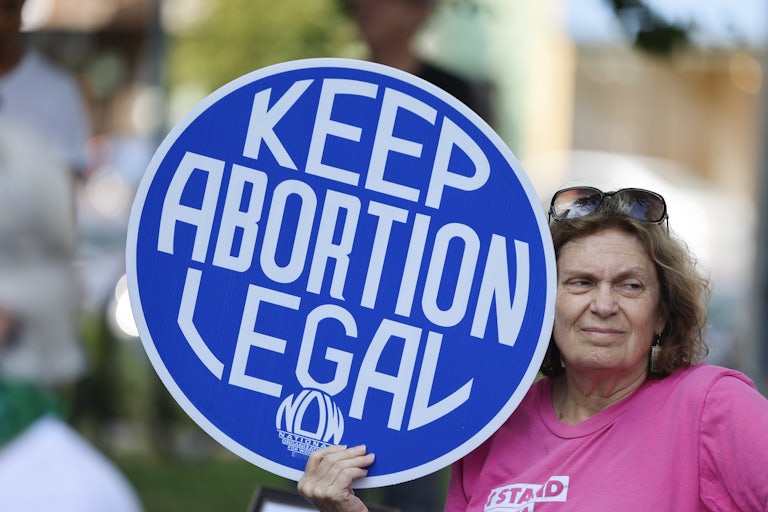
Arkansas Has a New Abortion Ballot Proposal–and It’s Not as Great as It Seems

A new ballot measure proposal in Arkansas wants to protect abortion. But it’s more complicated than you think.

Jeremy Hogan/SOPA Images/LightRocket/Getty Images

A group in Arkansas is working to get abortion protections on the state’s 2024 ballot. But experts warn that the measure would actually open the door to more government intervention in reproductive access.

The fight for abortion access is increasingly playing out through ballot measures, which have led to multiple wins even in otherwise deep-red states. But should the Arkansas ballot succeed, it would actually provide fewer protections than Roe v. Wade did, according to a Wednesday report by Slate.

The proposal—which is still awaiting a decision from the state’s attorney general—comes from a ballot committee called Arkansans for Limited Government, or AFLG, which was founded by the democracy nonprofit For AR People. The measure would only codify abortion through 18 weeks of pregnancy, far short of the generally accepted 24-week mark for viability (when a fetus can survive outside the uterus). Roe had allowed abortion up to 24 weeks.

Arkansas currently bans all abortion, with only narrow exceptions to save the life of the pregnant person. Democratic attempts to pass laws expanding abortion access have failed. AR People’s executive director, Gennie Diaz, told Slate her group created a ballot measure they believe both sides can ultimately accept as a more moderate approach.

Even though the measure clearly allows the state to continue banning abortion, just at a later point, Diaz argued the measure is “threading the needle with Arkansas voters on what they view as limited government.”

“It’s not meant to be a parlor trick,” she said, arguing that adding some restrictions would appeal to people who consider themselves “pro-life.” “Honestly, it’s not palatable to either end of the spectrum, and that’s intentional.”

But if the ballot measure was drafted with anti-abortion voters in mind, it doesn’t seem to have worked. The group Arkansas Right to Life is already slamming the measure as allowing “abortions up to the moment of birth.” Of course, that’s completely inaccurate on two counts. First, abortions do not occur up to the moment of birth. Second, a pregnancy lasts 40 weeks, whereas the measure bans abortion after only 18. Still, it’s a sign of what anti-abortion Arkansans really think of the measure.

AFLG, meanwhile, is not affiliated with Planned Parenthood, nor is it publicly supported by any abortion providers or ob-gyns. Diaz said they consulted reproductive health experts on the ballot measure, but abortion rights experts say the initiative could do more harm than good.

Erika Christensen of the group Patient Forward, which supports broad abortion protections, said limiting abortion to a specific point is “willfully ignorant.” She pointed out that a pregnancy can turn fatal for either the fetus or the patient at any point. What’s more, abortion restrictions of any kind stigmatize the procedure and allow the state to monitor and even criminalize pregnancy outcomes. And as with all abortion limitations, the “most under-resourced and over-policed” people, such as women of color, will be hit hardest.

There is also rapidly growing evidence that complete abortion access might actually stand a chance on the Arkansas ballot. Since Roe was overturned, multiple Republican-led states have put the question of abortion on the ballot—and every single time, voters choose to dramatically increase protections. Trying to roll back the 24-week abortion standard could set a dangerous precedent for other red states.

Tresa Undem, who co-founded the nonpartisan polling firm PerryUndem, has followed abortion opinions for two decades. She warned that even though AFLG said its ballot measure language had polling support, it’s possible the questions asked didn’t capture the whole picture.

What’s more, Undem conducted a national poll over the summer to see if voters were more likely to support a ballot initiative proposal that mentioned viability versus one that didn’t. She found voters preferred complete, expansive access by 15 points.

“I was kind of blown away, frankly,” she told Slate. “That’s a pretty new sentiment.”

And that’s why, “in the post-Dobbs world, I just think anyone who’s working on this issue needs to really be careful about assumptions,” Undem said. “People can die.”

Trump’s Two-Year Take From Foreign Governments While He Was President Is Staggering

A new report details how much Trump made in just half of his presidency—and which countries paid him.

Donald Trump
Scott Olson/Getty Images

If you still had any doubts as to whether Donald Trump had self-serving motivations as the nation’s forty-fifth president, then a new report detailing the millions of dollars he received from foreign governments should make it clear it definitely wasn’t America he was putting first.

Trump’s businesses received at least $7.8 million from nearly two dozen foreign governments during his presidency, according to documents released by Democrats on the House Oversight Committee. The pocket-lining funds include money Trump received from some of the “world’s most unsavory regimes,” without ever asking for congressional approval as mandated by the U.S. Constitution.

The report, titled “White House for Sale: How Princes, Prime Ministers, and Premiers Paid Off President Trump,” notes that it is likely an inconclusive analysis. It details just two years of Trump’s presidency and transactions between just four of his businesses, of which he owns more than 500, with 20 countries.

The biggest spenders included China, which gave Trump the largest sum out of all the nations—$5.5 million from entities including China’s Embassy in the United States, the Industrial and Commercial Bank of China, and the Hainan Airlines Holding Company—as well as Saudi Arabia, which gave Trump $615,000. Other nations on the list include the Democratic Republic of the Congo, Malaysia, Albania, Kosovo, the United Arab Emirates, Qatar, Kuwait, India, Afghanistan, the Philippines, Kazakhstan, Thailand, the Self-Declared Turkish Republic of Northern Cyprus, Mongolia, Lebanon, Latvia, Turkey, Hungary, and Cyprus.

“These payments were made while these governments were promoting specific foreign policy goals with the Trump Administration and even, at times, with President Trump himself, and as they were requesting specific actions from the United States to advance their own national policy objectives,” the report notes.

“That narrative is insane,” Eric Trump told The New York Times, adding that “there is no president in United States history who was tougher on China than Donald Trump.”

The junior Trump brother also explained to the Times that the Trump Organization did “not have the ability or viability to stop someone from booking through third parties” at the hotel.

Republicans have tried to wipe away the report, amplifying their own double standard by claiming that the money stemmed from legitimate business interests, all while pushing an impeachment case against President Joe Biden on the basis of the Biden family’s own business dealings, which even some Republicans have admitted is a meritless cause.

In December, Senator Chuck Grassley told reporters that he felt the caucus had failed to provide any evidence pointing to wrongdoing on the sitting president’s part.

If only they looked inward.