Newsletter
Power Mad
A weekly review of the rogues and scoundrels of American politics

So, What’s Going on With Clarence Thomas These Days?

It’s never a bad time for Democrats to talk about the possibility of a Supreme Court vacancy.

Associate US Supreme Court Justice Clarence Thomas
Olivier Douliery/Getty Images
Associate U.S. Supreme Court Justice Clarence Thomas

Next week marks the last week of oral arguments in this Supreme Court term, leaving little more than a sprint through the remaining decisions left unsettled. As of this writing, some heady matters remain unresolved. The ruling on the abortion pill has yet to be decided; there is a consequential gun rights case on the docket; and as always, the fate of the administrative state hangs in the balance. For many ordinary people, it will be another white-knuckle stretch, as they hope for narrow rulings that might limit the potentially life-altering—and precedent-shattering—damage.

For Democrats, the 6–3 split on the high court is a generational problem. At least, that’s how it’s often framed. In a recent post, my colleague Matt Ford stated the matter pretty starkly: “By some estimates, liberals may not have a chance to appoint a majority of Supreme Court justices until the 2050s. If Barrett stays on the court until she is the same age as Ginsburg, she will serve until at least 2059.” To think about this dilemma in these terms is to resign oneself to the idea that the solution won’t be arriving for several decades. But a lot can happen between now and 2059, and perhaps even sooner, because of another immutable law that holds that “shit happens.”

With that in mind, has anyone noticed that something seems to be up with Justice Clarence Thomas lately?

This past Monday, it was reported that Thomas was absent from the court and not participating remotely in the oral arguments of the day, with Chief Justice John Roberts assuring everyone that Thomas would get the full range of “briefs and transcripts” after the fact, ensuring that he’d be able to participate in the cases. Thomas doesn’t miss many days of work, and unlike a previous instance two years ago in which he missed a number of sessions during a hospital stay, no reason for his most recent absence was offered.

Into this blank space in the story, allow me to remind everyone that Thomas, 75, is the oldest of the justices, the longest-serving member of the court, and while I don’t doubt that Harlan Crow’s Garden of Dictators may be the venue for eldritch incantations of all varieties, there is no reason to believe that Thomas is immortal. In other words, he is still subject to the vagaries of the Universal Law of Shit Happening. (Fun fact: Samuel Alito is only a year younger than Thomas.)

It’s really no one’s fault that the comings and goings of sitting Supreme Court justices can be such a macabre business. Given the opportunity to amend the Founders’ work, I imagine that ending the whole “lifetime appointments for wizened, unaccountable elders in robes with the final say over American life” arrangement would be near the top of the list of improvements. But Democrats are probably too physiologically incapable of stating the potential stakes of the upcoming election to their voters in terms as stark as “Clarence Thomas might not be long for the bench; send Biden back to stem the tide of far-right jurisprudence.”

It’s not as if taking the high road hasn’t led anywhere: As The New Republic contributor Simon Lazarus has pointed out several times, a combination of consistent pressure and high-minded critique from liberals has, over the course of the past few terms, seemed to play a role in the justices taking a more tempered approach to their rulings. This strategy may yet bear more fruit this term, and forestall the kinds of extreme rulings that the conservative bloc’s two elder statesmen might hope to wrangle.

Still it’s weird to watch how some on the left are raising the salience of the justices’ mortality: by urging Democrats to bring Justice Sonia Sotomayor’s career to a premature end, the better to install a younger jurist now while Biden is still president. In that aforementioned article, Ford took a dim view of this way of thinking and suggested instead that Democrats might be better off simply winning elections. Regardless, this is a debate worth moving on from. It’s silly for Democrats to be divided in an election year over anything, let alone Sotomayor’s career, and anyway, no one’s run this plan to pull a late-in-the-day switcheroo past Senators Joe Manchin and Kyrsten Sinema, whose permission is still required for such stunts.

Nevertheless, there is definitely a ruthlessness gap between the parties in this regard. Republicans have had enormous success in dispensing with the polite traditions that govern the high court’s promotions and relegations. That the GOP went to elaborate lengths to prevent Obama from appointing Merrick Garland to the bench was, during that ongoing folderol, evidence of how far they were willing to go to consolidate power. But it is also a reminder that there was once a time when the makeup of the Supreme Court wasn’t in their favor and they were staring down the tunnel of the same kind of generational problem that Democrats now face.

But the right has benefited from the happenstances of the Shit Happens Law, as well. The misfortuned timing of Ruth Bader Ginsburg’s death created the opportunity for the 6–3 split and provided the catalyst for the Democrats’ recent agita over Sotomayor. Still, the lessons of the recent past—combined with all this recent talk of court-vacancy gamesmanship—illuminates a simple idea that Democrats should perhaps find the courage to speak aloud, regardless of the grisly implications: Elections matter, because you never know when the chance to appoint a new justice might arise. There is a clear mission at hand: Don’t let any of the court’s elder conservatives have the opportunity to make their escape through the safe harbor of a Trump presidency.
Good Riddance, No Labels!

The faux-centrist group’s attempt to mount a 2024 bid failed miserably—just like everything else they’ve ever done. Now let’s banish them from Washington.

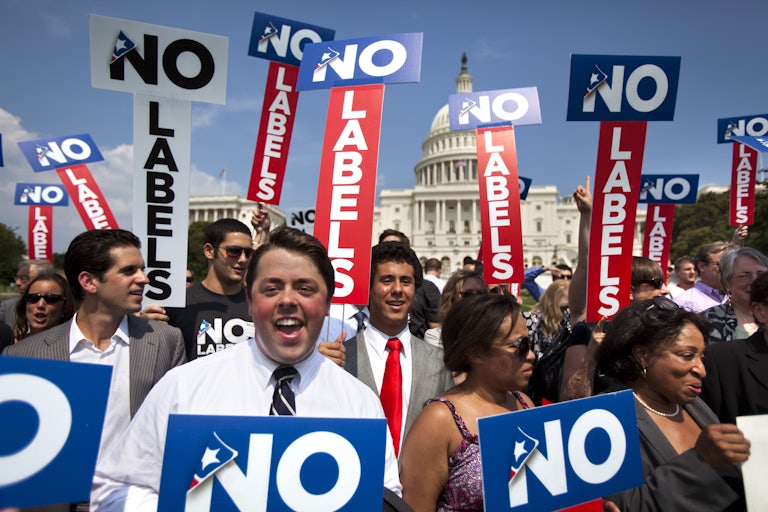
A No Labels demonstration outside the U.S. Capitol in 2011
Jim Lo Scalzo/EPA/Shutterstock
A No Labels demonstration outside the U.S. Capitol in 2011

For as long as they have existed, No Labels have wanted one thing: to matter. But these self-styled centrist “problem solvers,” who’ve yet to advance anything resembling a political solution, have always faced substantial obstacles, mainly that they’re a venal gaggle of cosseted Beltway elites with no real constituency in the broader public. That they’ve been allowed to persist with their cotton-headed paeans to bipartisanship is a testament to structural problems with our political system (which is awash in money and enables too many people who care about nothing but maintaining power to come to Washington) and the commentariat (which is packed to the brim with thunderously credulous dolts).

But after more than a decade cashing checks from the biggest fools in the donor class (and some of the biggest assholes as well), No Labels’ demise finally appears imminent. The Wall Street Journal reported on Thursday that the group has abandoned its plan to field an independent third-party presidential ticket on account of the fact that no actual candidate wanted to have anything to do with the effort. That means the fear that the group might play spoiler and hand the White House to Donald Trump—which it seemed to want—is over. In a statement, No Labels founder Nancy Jacobson said the organization “would remain engaged in promoting unity and giving voice to America’s commonsense majority.” Here’s a thought: Quit instead.

This has been a stupendously silly journey. A month ago, after prevaricating for the better part of a year, No Labels announced that they were moving “forward with the process of forming a presidential ticket to run in the 2024 election,” which everyone thought they had already been doing all this time. And yet, it made headlines. Give these terminally inside-the-Beltway toffs some credit: You can’t become a Washington lifer without mastering the art of making news out of nothing at all. If you can successfully pass activity off as achievement in This Town, more often than not the gravy train will keep on running.

But behind the scenes, matters were considerably more grim. In leaked audio that TNR’s Greg Sargent obtained, it became clear that the organization had “no idea whether it will be able to move forward” with its electoral ambitions. “No serious candidates appear interested,” Sargent reported at the time, “and there’s no sign that this is changing.” A month on, matters had not improved. In mid-March, Geoff Duncan became the latest in a long list of candidates—including GOP primary also-ran Nikki Haley, West Virginia filibuster fanboy Joe Manchin, and former Maryland Governor Larry Hogan—to decline to be the organization’s sacrificial lamb, ending any or all opportunities to finally answer the question: “Who is Geoff Duncan?” (He is apparently the former lieutenant governor of Georgia, but I invite you to double-check.)

Meanwhile, the group was considerably hampered by the recent death of founding chairman Joe Lieberman, whose stalwart defense of the organization was fully in keeping with the former Connecticut senator’s quarter-century-long conniption fit. As the Associated Press reported, Lieberman’s passing “not only mark[ed] an irreplaceable loss for No Labels, it inject[ed] a new level of uncertainty into the organization’s 2024 ambitions.” According to the AP, Mitt Romney, Chris Christie, and Brian Kemp had also turned down the chance to be the organization’s presidential candidate. So many people have rejected this group’s advances that I honestly have a hard time keeping track. (Did you turn down the chance to be the No Labels presidential candidate? Let me know!)

In an effort to prove that there is no way of taking No Labels seriously, Politico’s Alexander Burns offered some last-ditch the tongue-in-cheek advice that the organization should enlist some entertainer or outside-the-Beltway “provocateur” to be its standard-bearer instead of the “bloodless and gray” career dweebs it’s approached. As former Jesse Ventura strategist Bill Hillsman told Burns, No Labels’ efforts were “misconstrued from the beginning,” arguing that “few voters” would be inclined to see “a unity ticket forged from within the political establishment as an answer for their grievances with the system.”

I can’t stress enough that an organization led by Lieberman and Beltway donor doyenne Jacobson is physiologically incapable of imagining an outsider in its ranks. Perhaps that’s why a former Bush administration official recommended in a Hill op-ed that the group go ahead and put Lieberman on the ticket, even though he’s dead. (Come to think of it, a Weekend at Bernie’s presidency would be preferable to a second Trump term.)

At any rate, I have a better idea: No Labels should fold. This organization has a sad and decrepit legacy of timidity and corruption, and as Meredith Shiner reported in 2014, it isn’t even sincere in its core beliefs: Internal documents revealed that its leadership was “banking on more political dysfunction in an attempt to find ‘opportunity’ and relevance for itself.” And let’s face it: The day the organization handed Trump its “problem solver” endorsement during the 2016 presidential primaries should have marked the end of taking it seriously.

Alas, two presidential cycles later, these lowlifes’ grift persists. But now that their “unity ticket” plan to doom the republic has come to naught, all of the people who’ve hitherto been fleeced by them, financially or ideologically, should wise up and pull the plug. The rest of us can only be grateful that No Labels’ last hurrah—much like all of their grand designs—foundered without bringing ruin to us all. Still, it’s a searing indictment of the United States that people with such bad ideas can ascend to such great heights that they could help trigger our democracy’s demise.

This article was adapted from Power Mad, a weekly TNR newsletter authored by deputy editor Jason Linkins. Sign up here.

It’s Good That Trump’s Trials Are Delayed

Here's why Democrats should be happy that the legal system won’t save them.

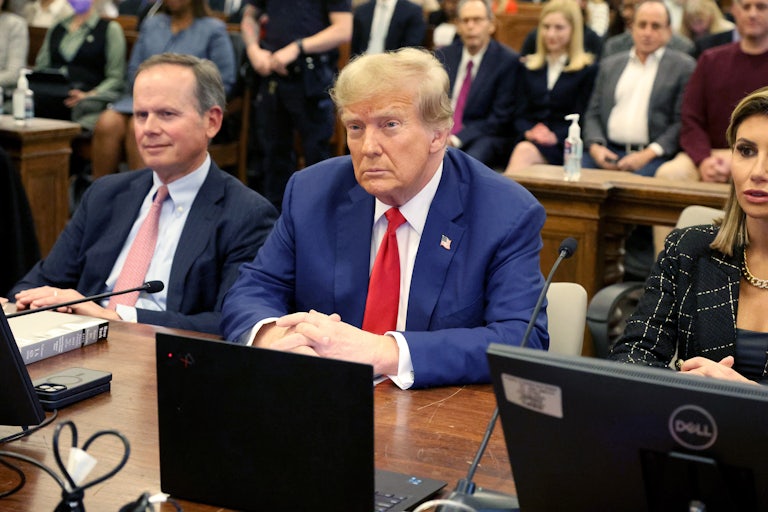
Donald Trump sits in the courtroom during his civil fraud trial at New York Supreme Court.
Jefferson Siegel/Getty Images

Last August, TNR’s Matt Ford took a look a year ahead, saw that former President Donald Trump would be competing in a Republican primary while serving as a semiprofessional defendant in no less than four trials, and declared that it was destined to “get pretty weird along the way.” A healthy dose of weirdness has, truly, been delivered. Trump now owes something in the vicinity of $500 million in legal fines, bringing us closer to the answer of an age-old question: “Does Donald Trump have $500 million?” The certainty of this burden, and the evident frustrations of the former president as he seeks out a sucker to take his bond, have stuck him in the teeth of a pay-up-or-shut-up deadline, one that may well unmoor him. I don’t think Trump minds being thought of as corrupt even one bit—but he hates being thought of as broke.

But to liberals’ considerable consternation, Trump is in a strong position both electorally and legally. While he owes E. Jean Carroll and the state of New York some mountains of money, he’s catching a lot of breaks elsewhere in the legal system, notably in the form of procedural delays that threaten to push his various criminal trials much later in the year and potentially past Election Day. For those who have been eyeing polls suggesting that President Joe Biden would benefit if Trump caught a conviction, each delay has been greeted as a damaging wound to Democrats’ hopes. But there may be an upside: Democrats will stop waiting for someone else to save them.

The Trump era revealed a certain myopia among Democratic elites, who reacted to Trump’s election as if it were an aberration, a foreign object injected into the bloodstream of the body politic—one that our democracy’s immune system would surely recognize and destroy quickly. And so liberals yassified Robert Mueller without regard for how difficult the task of convicting a sitting president of crimes truly was. They threw their back into impeachment proceedings without regard for the fact that Republican senators do, in fact, exist. Now, I fear, too many have put their hopes on Jack Smith—the dark, gritty Robert Mueller reboot who will finally finish the job. 

But with the Supreme Court’s decision to take up Trump’s presidential immunity case—and back-burnering it until April—it’s an open question as to when Smith will even get started on his January 6 insurrection case. Most observers believe there is no way to wrap things up by November. So be it. There is no deus ex machina coming to save Democrats, no miracle cure for Trump. But rather than lapse into another long sorrow session, Democrats should be glad to be unburdened of the colossal expectations that the judicial system would save them, and get up off the fainting couch to mount the nimble and powerful campaign that our democracy deserves. 

It begins with an attitude adjustment: Instead of being despondent that Trump can’t be convicted by Election Day, be damned glad that he won’t be acquitted before America casts its votes. Because Trump getting off scot-free was always a possible outcome. What was the plan, exactly, if those hoped-for judicial punishments ended up being a series of exonerations for Trump to crow about?

The good news is that Democrats don’t actually need courts to hand down a bunch of verdicts to make hay out of Trump’s legal woes. Everything that Trump is standing trial for remains a live issue, and in the absence of breaking news stories about the latest courtroom blowup or legal setback, Democrats have a free hand to feed the media beast with derogatory information related to these trials (the insurrection, the attempted Georgia election coup, his rampant fraud, the stolen documents), as well as other scandals (the foreign money he’s pocketed, his role in Roe’s demise, his plans to transform the civil service into an instrument of personal retribution). 

As Brian Beutler notes in a recent edition of Off Message, there are plenty of creative ways “for Democrats to draw attention to Trump’s corruption even if he’s able to delay official legal proceedings.” They just need to break with some old habits:

Democrats put serene faith in the power of paid advertising to convey information like this, so much so that they devote almost no strategic thought into generating free media around these disqualifying liabilities. Meanwhile, everything Trump’s doing can be viewed as an effort to dodge the free-media penalty of being a criminal, a rapist, and a fraud. 

Democrats really can’t afford to lapse into thinking that the media, the scales finally loosed from its eyes, will eventually notice the merits of their case and come out in support of it. They have to recognize that the political press prefers to be met on the proverbial low road, and get over the crass implications of participating in a politics that’s less high-minded.  

Into the vacant space left by delayed trial proceedings, Democrats need to tell the story of how Trump came to be so entangled in the first place, reminding people that this man paid hush money to an adult film star with whom he was having an affair, illegally took classified documents and stored them at Mar-a-Lago as if they were spare toilet paper (then lied about it and obstructed justice), also lied about his net worth to defraud others of countless millions, led a “criminal racketeering enterprise” to overturn the 2020 election result in Georgia, and of course directed a mob of thousands to attack the Capitol. 

And above all, they must remind voters that Trump is seeking the presidency precisely because he wants to dodge responsibility for all of these crimes. This is the bumper sticker: Joe Biden is running for office; Donald Trump is running from the law.

This article first appeared in Power Mad, a weekly TNR newsletter authored by deputy editor Jason Linkins. Sign up here.

The Supreme Court’s Savage Indictment of the Republican Party

If you read the high court’s disqualification ruling closely, you’ll see that the justices unanimously agree that the GOP is a lawless institution.

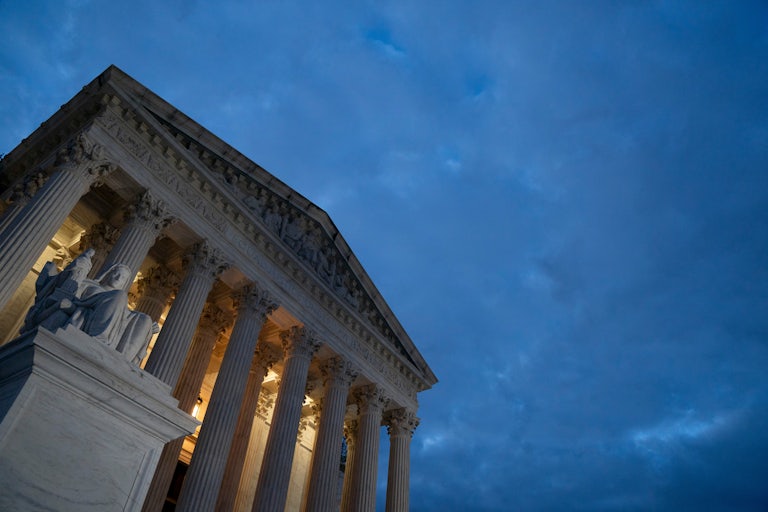
The US Supreme Court in Washington, DC
Stefani Reynolds/Getty Images
The U.S. Supreme Court in Washington, D.C.

Our little experiment in multiracial democracy rarely leaves an encounter with the Supreme Court unscathed, but Monday’s 9–0 decision in Trump v. Anderson—in which the justices ruled that Colorado could not keep Donald Trump off the ballot—has left a deeper wound than most. As The New Republic’s Matt Ford explained soon after the unanimous, unsigned per curiam decision was handed down, the ruling is an absolute cock-up that willfully misinterpreted the plain text of the Fourteenth Amendment, seemed to misunderstand how either the Constitution or most elections in the United States work, took up questions that hadn’t been brought before the court in the first place, and found terrible ways to answer them.

The American people began the day armed with a constitutional fail-safe that provided them with the means of keeping an insurrectionist off the ballot. By noon, the court had ruled that they weren’t entitled to that tool, that it would be up to the voters themselves to decide whether an insurrectionist can hold higher office, and that their decision was subject to review and reversal in the form of a subsequent insurrection. Seems like a bad way to run a country.

As far as the legal matters in play are concerned, the ruling is, for the lack of a more polite descriptor, hot garbage—a sentiment, as Ford documented, shared by many people, including those who actually believed Trump should remain on the ballot. But outside of the jurisprudential hash left steaming on the courthouse steps, there is a rather savage truth sitting there, sub rosa, in the decision: It seems the Roberts court unanimously agrees that the Republican Party is truly, and despicably, lawless.

“How could the court butcher the ruling so badly?” asked Ford. “The simplest answer appears to be fear.” Fear was especially apparent in Justice Amy Coney Barrett’s admonition of the liberal trio’s fiery concurrence. “The Court has settled a politically charged issue in the volatile season of a Presidential election,” she wrote. “Particularly in this circumstance, writings on the Court should turn the national temperature down, not up.” It’s a bit rich coming from one of the justices whose rulings, most notably on the abortion rights front, have done a great deal to elevate that “national temperature,” and sow considerable chaos along the way.

But as New Republic contributor Jess Coleman quipped, “Things definitely tend to get messy when a political party unequivocally chooses an insurrectionist as its nominee.” It’s on this precise front that the court curiously avoided taking an obvious escape hatch: disputing that Trump had, in fact, aided an insurrection. Trump’s legal team provided that off-ramp, arguing that the former president was innocent of such treachery. Still, as Ford told me, most of the constitutional arguments that Trump’s lawyers advanced in his defense “only apply if, all other things being equal, he did participate in an insurrection.” That the Supreme Court chose to try to resolve the matter along constitutional lines suggests an admission: They believe Trump to have done the very thing that the Fourteenth Amendment forbids. From there, their mission became to backfill a rationale in support of the notion that Colorado’s remedy would cause too much pandemonium if it were to be administered.

But as they put themselves to this task, the court continued to quietly snitch out the GOP for their misrule. At one point, the court warns in its unsigned opinion of an “evolving electoral map” that could “dramatically change the behavior of voters, parties, and states across the country, in different ways and at different times,” potentially leading to the nullification of the people’s will. Here, Ford said, the court was “essentially caving to threats”—chief among them the ones raised in amicus briefs from a “coalition of Republican-led states” that darkly hinted at the possibility that “some states might exclude other presidential candidates from the ballot if Trump were disqualified.”

Naturally, it’s hard to see why anyone should fear a Republican secretary of state citing the Fourteenth Amendment in an effort to remove a Democratic candidate who had participated in an insurrection. I daresay that I am 100 percent in favor of such Democrats being barred from higher office. Here, however, the justices seem to be implying that the GOP will have reckless disregard for the law, and kick off candidates who cannot be said to have contributed to the sort of crimes that the Fourteenth Amendment inveighs against.

Indeed, we can foreclose the possibility of Democrats abusing their power in this fashion. For starters, at least one Republican secretary of state, Jay Ashcroft, had already issued such a threat, the cited reason simply being that he was upset that Colorado and Maine had moved to keep Trump off the ballot. Meanwhile, there is no such behavior among Democrats: Nikki Haley, a more fearsome opponent for President Joe Biden, was left on the ballot, untroubled by Democratic secretaries of state that might have wanted to help the Democratic candidate. (Also, it wasn’t Democrats who sent amicus briefs to the court written in the spirit of “Nice democracy you’ve got here, be a shame if anything happened to it.”)

It’s understandable that the Supreme Court would be worried about a Republican Party that doubles as a criminal cartel, because we’ve seen how, in the Trump era, they have descended into that lowly state, with one of their chief exports being the fomenting of political violence. This fact happened to be on the mind of Colorado Secretary of State Jenna Griswold as she wrestled with whether or not to invoke the Fourteenth Amendment in the first place: After the Supreme Court ruling was handed down, Griswold gave an interview on cable news where she lamented how the insurrection to which she was trying to respond hasn’t actually ended, as threats to her state election officials keep pouring in.

“We have had 38 percent of our county clerks step down since 2020,” Griswold said. “We can’t allow people who would use intimidation or threats to win that battle.” From the Supreme Court came the reply: If you don’t allow those people to win, the Republican Party might very well hurt you next.

This article first appeared in Power Mad, a weekly TNR newsletter authored by deputy editor Jason Linkins. Sign up here.

A Year of Republicans Lying About Abortion

Don’t believe a single word they say in the run-up to the November election.

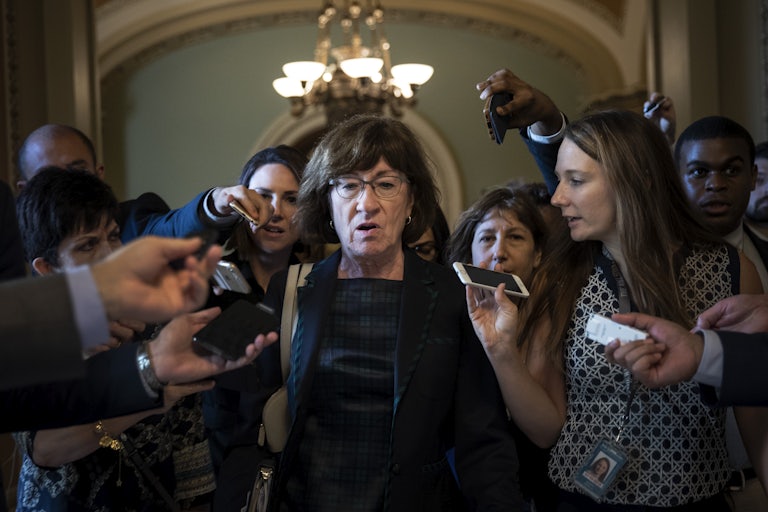
Sen. Susan Collins is surrounded by reporters following a closed-door meeting of Senate Republicans on Capitol Hill.
Drew Angerer/Getty Images
Senator Susan Collins is surrounded by reporters following a closed-door meeting of Senate Republicans on Capitol Hill.

On May 3, 2022, Maine Senator Susan Collins greeted news of the leaked draft of the Dobbs decision with her trademark rue: “If this leaked draft opinion is the final decision and this reporting is accurate, it would be completely inconsistent with what Justice Gorsuch and Justice Kavanaugh said in their hearings and in our meeting in my office.” When asked for more details, Collins demurred, offering only that her statement “speaks for itself.”

What Collins said may have been literally true, in that Neil Gorsuch and Brett Kavanaugh—like all Supreme Court nominees for decades now—didn’t explicitly show their hands on major, divisive legal questions during their hearings and congressional rounds. But it was also a breathtaking dodge by Collins, one that laid bare either her profound ignorance or her mendacity—and it’s worth recalling today because Collins and her ilk are once again being put on the spot over reproductive rights, this time with in vitro fertilization.

Justices Gorsuch and Kavanaugh, as everyone in Washington (including, surely, Collins) knew at the time of their respective nominations, were practically lab-grown to ascend to the Supreme Court to overturn Roe. That’s precisely why their names were provided to President Donald Trump by the conservative legal movement. Beyond that, Kavanaugh actually did make clear his intentions toward Roe—at least, to legal minds who were paying attention. He told Senator Ted Cruz that when it comes to rights that are unenumerated in the Constitution but considered implicit in the text, “all roads lead to the Glucksberg test.” He was referring to Washington v. Glucksberg, in which Chief Justice William Rehnquist held that such unenumerated rights need to be “deeply rooted in this Nation’s history and tradition” to be considered valid.

In Glucksberg, the specific right being challenged was the right to a physician-assisted suicide. The abortion rights wrought by Roe fall into the same category. So while Kavanaugh may have been speaking in judicial code, it wasn’t that hard to penetrate. “It doesn’t take the brains of a fourth-term United States senator from Maine to figure out what this means if Kavanaugh is confirmed,” ThinkProgress’s Ian Millhiser explained at the time. “Judge Kavanaugh will be the fifth vote to kill Roe if he joins the nation’s highest Court.” As Millhiser predicted, the “Glucksberg test” was applied in precisely this fashion in the Dobbs decision.

Why rehash this history? Mainly because Collins’s prevarication two years ago is how Republicans are going to try to run the post-Dobbs gauntlet in this election year, in an attempt to evade responsibility for the terrors they have unleashed and those they have planned for the future. They will lie, and they will play dumb.

The contours of this strategy blew into wide view after the Alabama Supreme Court ruled that frozen embryos are people, throwing the future of in vitro fertilization, or IVF, in the Yellowhammer State and beyond, into doubt. Republicans in Congress rushed out statements in support of IVF, but as The New Republic’s Ellie Quinlan Houghtaling documented, their sudden interest in preserving IVF was dramatically at odds with their support for the Life at Conception Act, which “hoped to recognize fertilized eggs as children at the federal level in an attempt to ban abortions nationwide”—a measure co-sponsored by 163 Republicans in the House.

Indeed, the Alabama ruling was nothing more than a plain reading of similar laws in state law and its constitution, which enshrines fetal personhood in a similar matter. All of these various laws and legislation are the product of the same 50-year project that took down Roe, and which is straightforwardly geared toward a nationwide abortion ban.

But the contretemps raised by the ruling has amplified a schism between Republican elites who hope to choreograph a piecemeal rollback of these and other rights, and far-right firebrands outside of Washington who want to bring about this future as instantaneously as possible. As I’ve written before, this tension has led some institutional Republicans to try to “rebrand” the pro-life movement as moderate—rather than hell-bent on banning all abortions.

This “rebranding” will, in this campaign year, essentially amount to dodging and weaving. You’re going to see various GOP elites proclaiming support for exceptions and limits, but there won’t be a valid commitment to advancing any such protections. Indeed, South Carolina Republican Nancy Mace spent the week shopping for co-sponsors for a resolution that purports to support IVF, but which, as Business Insider reporter Brian Metzger notes, “doesn’t actually do anything.”* (My colleague Adrienne Varkiani greeted this news like so: “A resolution that does nothing is peak Nancy Mace.”)

But what happens in Washington matters less than what happens in the states, where, The New Republic’s Greg Sargent says, “the true implications of GOP positions on reproductive rights will be harder to evade.” After all, it’s the states where the radicals hold levers of power, and their attempts to reassure voters that they’re not actually radical is proving even more ham-handed than Beltway Republicans’: This week, Alabama Republicans put forward a bill purportedly protecting IVF, which automatically repeals itself in 2025. In other words, it secures these rights only until the election is over, after which state lawmakers can get back down to the job of taking them away again.

This election year, Republicans will lie endlessly about their abortion positions. That much is certain. The question is whether political reporters will launder Republicans’ extreme positions by accepting at face value the benign, moderate things they say about reproductive freedoms—without adding the all-important context that the GOP is part of a half-century movement dedicated to a wholesale rollback of all abortion rights. That’s how you get an Associated Press story characterizing Donald Trump as some sort of champion for IVF when, given his Supreme Court picks, he’s played the biggest role of any politician in advancing the notion that frozen embryos are people. These GOP lies should be easy to decipher and expose, but as Susan Collins knows, they tend to work like a charm.

* This article originally misidentified Mace’s state.