Breaking News
Breaking News
from Washington and beyond

Nancy Pelosi Torches Biden After Trump’s Sweeping Victory

Nancy Pelosi has placed the blame for Kamala Harris’s loss to Donald Trump squarely on Joe Biden’s shoulders.

Nancy Pelosi stands at a podium
Jacek Boczarski/Anadolu/Getty Images

Former House Speaker Nancy Pelosi went full scorched earth on Friday, blaming Vice President Kamala Harris’s stunning loss on Joe Biden’s late exit from the presidential race.

In an interview with The New York Times, Pelosi suggested that Biden had crippled the Democratic Party’s chances at keeping Donald Trump out of the White House.

“Had the president gotten out sooner, there may have been other candidates in the race,” Pelosi said. “And as I say, Kamala may have, I think she would have done well in that and been stronger going forward. But we don’t know that. That didn’t happen. We live with what happened.”

Pelosi also blamed Biden for not making way in time for an open primary, which could have created momentum around a new candidate who would have performed better with the Democratic base.

“And because the president endorsed Kamala Harris immediately, that really made it almost impossible to have a primary at that time,” Pelosi said. “If it had been much earlier, it would have been different.”

Pelosi’s public comments about Biden’s candidacy played a critical role in his decision to step away from his presidential campaign. Pelosi had refused to combat the many calls for Biden to drop out after his disastrous debate with Trump, and cryptically said the decision to drop out was up to him (even after he’d already supposedly decided not to do it).

The California representative also suggested that the Democrats’ loss of working-class support was the result of cultural forces, not economic ones.

“Guns, God and gays—that’s the way they say it,” she said. “Guns, that’s an issue; gays, that’s an issue, and now they’re making the trans issue such an important issue in their priorities; and in certain communities, what they call God, what we call a woman’s right to choose.”

Here’s Just How Badly Democrats and Harris Pushed Muslim Voters Away

A new exit poll reveals how the Democratic Party has damaged its relationship with Muslim voters in 2024 thanks to its backing of Israel’s war on Gaza.

A group of hijabi women, non-hijabi women, and men (likely all Muslim, Arab, or brown) listen to a speaker (not pictured)..
Dominic Gwinn/Middle East Images/AFP/Getty Images
Muslim Americans attend an “Abandon Harris” campaign event in Dearborn, Michigan, endorsing Green Party candidate Jill Stein for president, on October 6.

American Muslims broadly rejected Vice President Kamala Harris in the 2024 election, according to a new exit poll.

The Council on American-Islamic Relations released the results of its national election poll of 1,575 verified American Muslim voters, and they do not reflect well on the efforts of the Harris campaign to hold onto what had been a solid Democratic constituency. The poll shows that Green Party candidate Jill Stein received 53 percent of votes, followed by Donald Trump with 21 percent, and Harris with 20 percent.

In a Michigan-specific poll of 502 registered Muslim voters, Stein got 59 percent support, followed by Trump at 22 percent, and Harris with a tiny 14 percent of the vote. The results show a significant backlash to the Biden administration’s handling of Israel’s brutal war in Gaza, which has killed at least 43,508 Palestinians, including more than 16,765 children, as well as how the Harris campaign chose to tackle the issue.

“Our final exit poll of American Muslim voters confirms that opposition to the Biden administration’s support for the war on Gaza played a crucial role,” said CAIR National Government Affairs Director Robert S. McCaw in a statement. The poll was conducted by Molitico Consulting LLC through text messages, with a margin error of 2.47 percent.

CAIR’s exit poll from 2020 was less extensive, only polling 844 registered Muslim voters, but had 69 percent of respondents saying that they voted for Joe Biden, with 17 percent choosing Trump, showing a big drop-off during this election. Another 2020 poll estimated even more Muslims backed Biden, a whopping 86 percent.

CAIR’s findings are different from the results in Dearborn, Michigan, the country’s largest majority Arab American city, where 42 percent of voters chose Trump, 36 percent went for Harris, and 18 percent went for Stein. But in CAIR’s poll as well as Dearborn’s results, the common factor was that Harris was rejected and that Stein received a much bigger portion of the vote than in the national results.

The Harris campaign refused to have an Arab or Palestinian speaker at the Democratic National Convention in August, and last week, the Democrats’ messaging to Muslims and Arab American voters included Bill Clinton saying Israel was “forced” by Hamas to kill civilians in Gaza at a rally in Michigan, which drew a large backlash.

Trump sought to capitalize on Democrats’ missteps, visiting Dearborn in the week before the election and attacking Harris for campaigning with Liz Cheney, the daughter of former Vice President Dick Cheney. Arab and Muslim voters in Michigan do not think highly of the elder Cheney’s support for the U.S. invasion of Iraq in 2003, but they also remember his daughter’s reputation for supporting torture and anti-Muslim bigotry.

Trump likely drew votes from Muslim and Arab American voters for this reason and picked up endorsements from metro Detroit Muslim and Arab politicians. Likewise, Stein’s support of an arms embargo against Israel, her support for a cease-fire in Israel’s wars in Gaza and Lebanon, and the fact that she held a campaign event in Dearborn in September helped her gain Muslim and Arab American voters in Michigan and the U.S. overall.

These survey results show that the Democratic Party will have to seriously reevaluate its policy stances in order to win back Muslim and Arab American voters. At the very least, they seem to have cost Harris valuable votes in the state of Michigan, which she needed to win. In the future, Democrats can’t neglect or ignore the issues that Arab American and Muslim voters care about like they did this year.

Harris Raised $1 Billion. Where Did it All Go?

Kamala Harris’s campaign is still sending out fundraising requests.

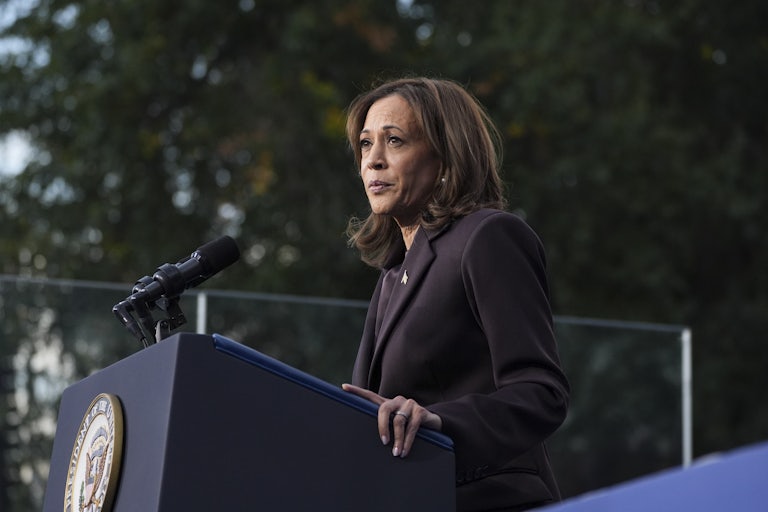
Kamala Harris stands at a podium
Demetrius Freeman/The Washington Post/Getty Images

Kamala Harris raised more than $1 billion for her presidential campaign … which ultimately failed. In the afterglow of stunning defeat, some Democrats are now asking how she could have possibly spent anywhere near that much money and still lost her shot at the White House.

The Harris campaign finished out the race with at least $20 million in debt, two sources familiar told Politico’s Christopher Cadelago, who wrote on X Wednesday night that of the $1 billion Harris had raised, only $118 million remained in cash as of October 16.

With the realization that all of that spending ultimately accomplished very little and cost the party control of the White House and Senate (and maybe even the House), Democrats are now beginning to point fingers.

“We spent money in stupid ways because we had a really bad strategy,” a former consultant to the DNC told Puck’s Tara Palmeri. He cited money sent to fund Representative Colin Allred’s failed challenge against Texas Senator Ted Cruz, as well as money directed to help in Iowa, a state Democrats never, ever win. 

“Instead of owning any mistakes, or being transparent about the voter data and strategies that were so obviously wrong, they shut off their Twitter account and are patting each other on the back,” the former consultant said. “We dug out of a deep hole but not enough.”

Inside Harris’s crumbled campaign, some feel that they were misled about her chances, and led to believe it would be a margin-of-error race. In reality, Trump blew apart Harris’s play for the blue wall states and beat her by more than four million votes.

“People are depressed and frustrated about the overconfident leadership of the campaign,” one staffer told Axios.

One Biden staffer put it more simply: “How did you spend $1 billion and not win? What the fuck?”

Harris’s campaign budget was closely guarded by campaign manager Jen O’Malley Dillon, so it’s unclear exactly how funds were allocated. An official for the DNC said that the majority of campaign spending was toward major events, paid media, and Harris’s supposedly expansive ground game—one that ultimately didn’t drum up that many votes at all.  

What’s clear is that Harris ran a very expensive campaign, one that dwarfed Donald Trump’s efforts. The campaign spent an average of $7.5 million a day in August, in comparison to the $2.7 million that Trump spent. In September, the Harris campaign spent $152 million on advertising, more than double the $63 million that Trump shelled out.

Unfortunately for Harris, dollars didn’t seem to translate into votes. And even after Harris lost, her campaign is still sending out slates of fundraising requests.

Trump Allies Prove They’re Idiots With Plan for the Federal Reserve

Elon Musk and Senator Mike Lee have ideas for how to curb the central bank’s power.

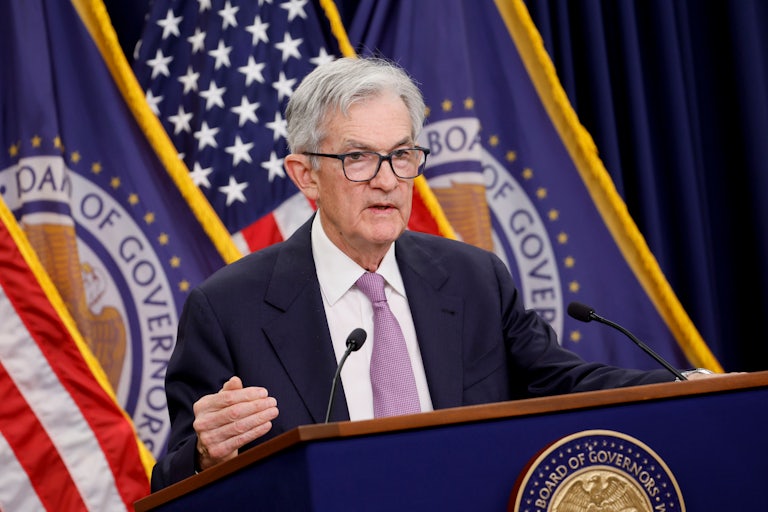
Federal Reserve Chair Jerome Powell stands at a podium and speaks to reporters
Ting Shen/Bloomberg/Getty Images
Federal Reserve Chair Jerome Powell

Conservatives are aiming high for their slash-and-burn goals during the next four years under a Republican trifecta, and next on the chopping block could be the Federal Reserve.

On Friday, incoming Department of Government Efficiency head and world’s richest man Elon Musk elevated a post on X (formerly Twitter) by Utah Senator Mike Lee, who posited that the central banking agency could be cut from the second MAGA administration.

“The Executive Branch should be under the direction of the president. That’s how the Constitution was designed,” Lee wrote Thursday night. “The Federal Reserve is one of many examples of how we’ve deviated from the Constitution in that regard. Yet another reason why we should #EndTheFed.”

During a press conference on Thursday, Federal Reserve Chair Jerome Powell addressed the mounting pressure against the financial institution by Donald Trump and his allies, telling a reporter that he would not step down from his post if Trump asked him to. Powell also noted that Trump’s election would “have no effects” on the central bank’s policymaking decisions “in the near term.”

Despite appointing Powell, Trump directed plenty of vitriol at the Fed chair during his first term in office. And the president-elect has been plenty vocal about his belief that the traditionally apolitical institution should bend the knee to his administration.

“I feel the president should have at least a say in there. Yeah, I feel that strongly,” Trump said during an August 8 press conference at Mar-a-Lago. “I think that, in my case, I made a lot of money, I was very successful, and I think I have a better instinct than, in many cases, people that would be on the Federal Reserve or the chairman.”

The Federal Reserve, which was created in 1913, has long been under attack by certain political subgroups in the United States, but Musk’s pointed attention toward the plan for control effectively brings it to the forefront of far-right thought.

In 2009, former Texas Representative Ron Paul—a flip-flopping libertarian—advocated for the demise of the central bank, arguing in his 2009 book End the Fed that in “the post-meltdown world, it is irresponsible, ineffective, and ultimately useless to have a serious economic debate without considering and challenging the role of the Federal Reserve,” which he claims prioritizes big banks in the U.S. financial system via bailouts and surreptitiously bankrolls U.S. warfare by way of inflation and devaluation.

But the Federal Reserve’s institutional predecessors, as well as the mere concept of central banking, have been contentious issues since the foundation of the country. Alexander Hamilton, the first secretary of the Treasury under the fledgling U.S. Constitution, argued in favor of a nationwide banking system to solve some of the country’s key issues in the aftermath of the Revolution.

The Democratic-Republican Party opposed the idea, perhaps most notably Thomas Jefferson, who believed that such a banking system would create a monopoly that could undermine smaller financial institutions and skew federal policy in favor of creditors over debtors, who tended to be plantation owners and farmers.

But Jefferson’s qualms would not thwart the inception of the institution, which proceeded to morph and reinvent itself over the nation’s 248-year history. Now, just about every nation in the world—especially every developed nation—has a central bank acting as the financial arm for its government. Stripping that away, which Trump’s key advisers seem to want to do, would place the United States on a short list alongside Andorra, the Isle of Man, the Marshall Islands, Micronesia, and a small handful of other nations.

The Nightmare Has Begun: Elon Musk Joined Trump’s Call With Zelenskiy

Why the hell did Elon Musk join Donald Trump’s phone call with the Ukrainian president?

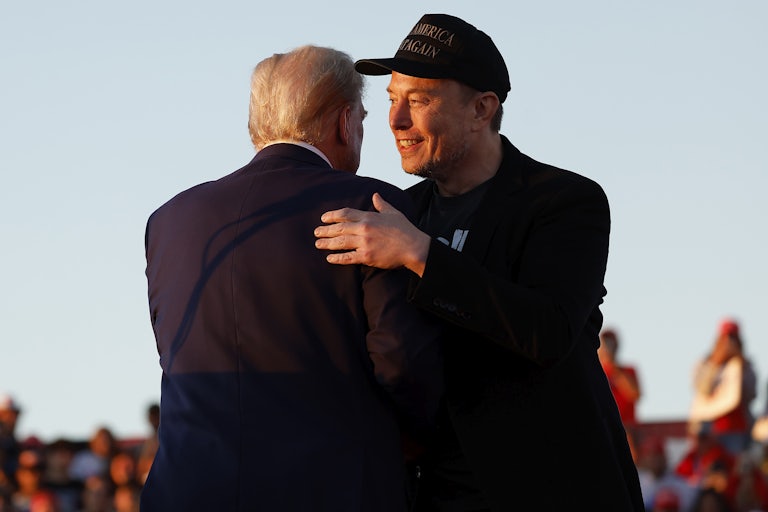
Elon Musk pulls Donald Trump in for an embrace
Anna Moneymaker/Getty Images

Just hours after Donald Trump won the election, Elon Musk was already flexing his power over the new administration, joining a phone call with the man he helped elect to office and Ukrainian President Volodymyr Zelenskiy.

Axios reported that the world’s richest man made a guest appearance on a phone call between Trump and Zelenskiy on Wednesday, even chiming in at several points during the discussion.

The call did not delve into specifics, but an Axios source noted that nothing Trump said to Zelenksiy was “alarming or made us feel that Ukraine is going to be the one who pays the price.” Musk also told the Ukrainian president that he will keep supporting Ukraine with his Starlink satellite network.

Still, Musk’s surprise addition to the call is a troubling sign, to say the least. Like Trump, the billionaire has a close relationship with Russian leader Vladimir Putin. A bombshell report last month revealed that Musk is in regular contact with Putin, and the Kremlin may have even implicitly threatened him. That could explain his past refusal to let Ukraine use his Starlink internet network to carry out a surprise attack on Russian forces, or his public ridicule of Zelenskiy’s requests for aid.

However, the 25 minute call apparently left Zelenskiy feeling upbeat and reassured. “I had an excellent call with President Trump and congratulated him on his historic landslide victory — his tremendous campaign made this result possible,” Zelenskiy wrote on X after the call on Wednesday.