Breaking News
Breaking News
from Washington and beyond

Google Snubs EU Law Over Fact-Checking YouTube Videos

Google announced it would pull out of the EU’s anti-disinformation code of practice.

The Google logo on one of its office buildings
Matthias Balk/picture alliance/Getty Images

Google announced its intention Thursday to flout European Union standards for digital fact-checking, opting not to build an internal department to moderate and verify YouTube content despite requirements from a new law.

The European Commission’s Disinformation Code of Practice has remained a voluntary policy, leaving the ball in the tech industry’s court. Companies that opted in to the code—including Meta, Microsoft, TikTok, and X—are supposed to self-regulate while submitting reports on their platform’s compliance with the code.

But a 2024 study published in the Internet Policy Review found that, by and large, companies were “only partly compliant” with the EU code, with reports data lacking detail and offering “missing, incomplete, or not robust” data. The EU has since urged companies to convert the voluntary guidelines into an official policy under the union’s newer content moderation law, the Digital Services Act of 2022.

Google has never had a fact-checking department to oversee content on YouTube, where users reportedly upload more than 500 hours of video content every minute, and on average consume a collective one billion hours of content per day, according to YouTube’s blog. The law would require Google to build fact-checking into its search function, its ranking systems, and its algorithm, as well as adding fact-checked results alongside YouTube videos.

The search engine behemoth’s global affairs president Kent Walker rejected the mandatory new standards in a letter to deputy director general Renate Nikolay, claiming that the code “simply isn’t appropriate or effective for our services,” according to Axios. Walker instead pointed to a new feature that was implemented on YouTube in 2024, allowing users to communally verify information themselves, akin to X’s “Community Notes.”

Google will “pull out of all fact-checking commitments in the Code before it becomes a DSA Code of Conduct,” Walker wrote.

But Google isn’t the only company skirting its disinformation commitments. Meta and X have heavily reduced their content moderation policies, allowing disturbing language to circulate openly on their platforms.

Earlier this month, Meta CEO Mark Zuckerberg announced that the social media company would rid itself of its third-party fact-checkers, opting instead to replace them with user-generated corrections.

“Fact-checkers have been too politically biased and have destroyed more trust than they’ve created,” Zuckerberg said in a video announcement posted to Facebook. “What started as a movement to be more inclusive has increasingly been used to shut down opinions and shut out people with different ideas, and it’s gone too far.”

In the background of their internal decisions, a cohort of Silicon Valley’s most successful figures have donated millions to Donald Trump’s inaugural fund, seemingly caving to the incoming forty-seventh president in an apparent bid to make Trump’s second term as friendly to their massive tech and AI corporations as possible.
Giuliani Will Finally Shut Up About Those Georgia Election Workers

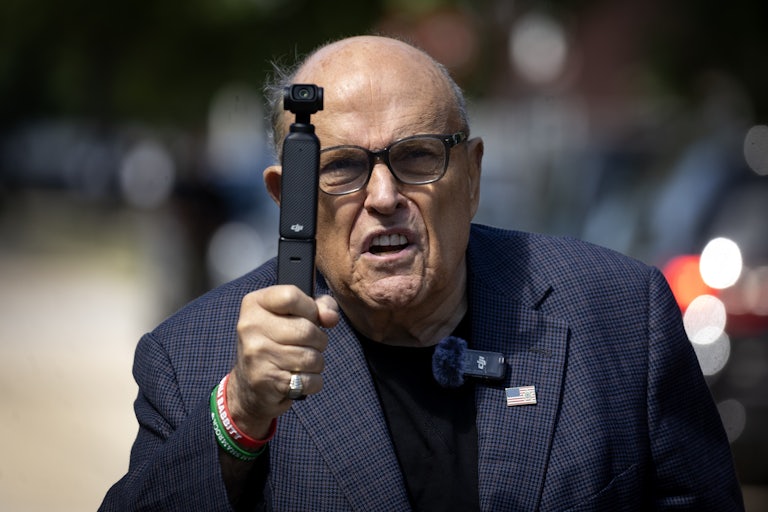
Rudy Giuliani has reached a settlement agreement with the 2020 Georgia poll workers he repeatedly lied about.

Rudy Giuliani
Scott Olson/Getty Images

Rudy Giuliani might’ve finally caught a break.

After being sued for everything he had—his watches, his diamond ring, his Mercedes-Benz, his home, and $148 million—by defamed Georgia poll workers Ruby Freeman and Shaye Moss, the former mayor has apparently come to a settlement.

“I have reached a resolution of the litigation with the Plaintiffs that will result in a satisfaction of the Plaintiffs’ judgment. This resolution does not involve an admission of liability or wrongdoing by any of the Parties,” Giuliani announced on X on Thursday. “I am satisfied with and have no grievances relating to the result we have reached. I have been able to retain my New York coop and Florida Condominium and all of my personal belongings. No one deserves to be subjected to threats, harassment, or intimidation. This litigation has taken its toll on all parties. This whole episode was unfortunate. I and the Plaintiffs have agreed not to ever talk about each other in any defamatory manner, and I urge others to do the same.”

Though the terms of the settlement are not yet public, a statement from the defamed mother-daughter duo confirmed the news.

“The past four years have been a living nightmare. We have fought to clear our names, restore our reputations, and prove that we did nothing wrong,” said Moss and Freeman in a joint statement. “We have agreed to allow Mr. Giuliani to retain his property in exchange for compensation and his promise not to ever defame us.”

The settlement comes after Giuliani failed to appear in court Thursday morning. Both parties are now asking the judge to adjourn the trial so that their settlement agreement can be executed.

Moss and Freeman testified that Guiliani’s claims that they’d engaged in election fraud in 2020 led to a wave of racist threats and hatred toward them.

Trump’s Treasury Pick Vows to Give Back to the Rich in Bleak Hearing

Scott Bessent used his confirmation hearing to make clear that he cares about the rich and the rich only.

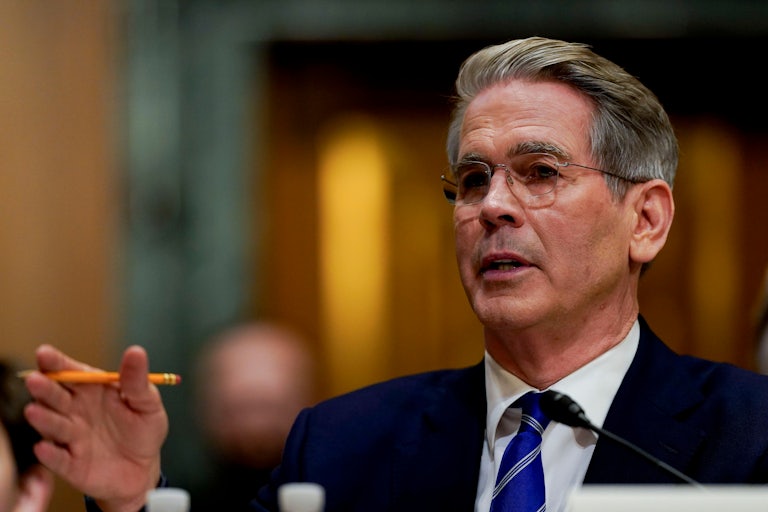
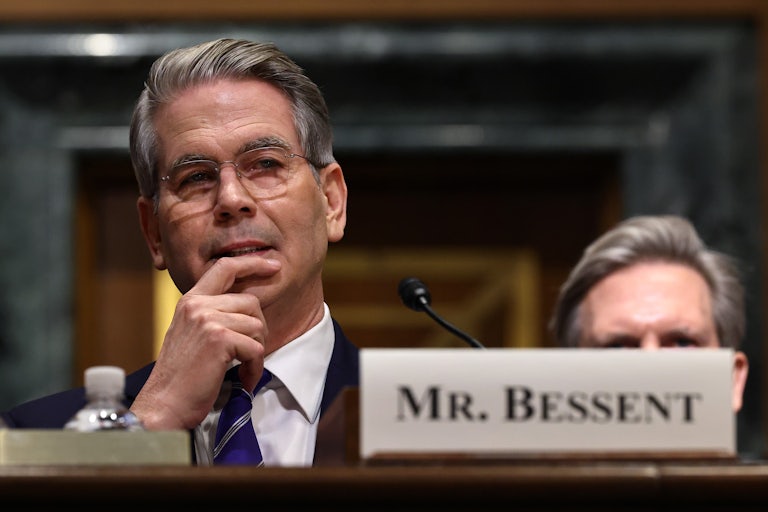
Scott Bessent puts a hand on his chin in his confirmation hearing
Chip Somodevilla/Getty Images

Scott Bessent, Donald Trump’s nominee for treasury secretary, made it clear during his confirmation hearing Thursday that he’s only interested in protecting the interests of the rich and powerful.

The hedge fund manager with a net worth of at least $500 million repeatedly spiked down questions about whether he would support working-class priorities. Vermont Senator Bernie Sanders asked Bessent about his position on raising the minimum wage.

“Shamefully, the federal minimum wage, despite the efforts of myself and other people here, [has] not been raised since 2009, and remains an unbelievable $7.25 an hour,” said Sanders. “Will you work with those of us who want to raise the federal minimum wage to a living wage, to take millions of Americans out of poverty?”

“Senator, I believe that the minimum wage is more of a statewide and regional issue,” Bessent responded.

“So you don’t think we should change the federal minimum wage of $7.25 an hour?” Sanders pressed.

“Uh, no sir,” Bessent replied. Four years ago, Trump said he would consider raising the minimum wage to $15, if it didn’t hurt small businesses. More recently, he’s dodged the question altogether.

Later, Georgia Senator Raphael Warnock asked whether Bessent would be interested in ending tax cuts for the rich to help reduce the national deficit—but the two didn’t quite see eye to eye on the policy.

“Do you agree that ending the tax cuts for those making more than $400,000 would help close the deficit and reduce our national debt?” Warnock asked.

“Senator Warnock, I do not,” Bessent said. “I believe that you would capture an inordinate amount of small-business people who largely are in that cohort of $400,000 to $1 million—”

“So you wouldn’t cut it off at $400,000,” Warnock replied. “What about $1 million?”

“Again, I believe these are small-business pass-through owners. And I believe that we, as I said before, Wall Street’s done great, it is time for Main Street to do well. And small businesses need to drive what I call the reprivatization here away from this government spending.”

Warnock kept pressing him, and Bessent quickly revealed that was hoping to keep tax rates the same as in Trump’s 2017 Tax Cuts and Jobs Act. Warnock asked about those making more than $10 million.

Bessent insisted that it was more important “that we put in incentives for them to invest.”

“What about $1 billion?” Warnock asked.

Bessent replied, “Again, I think that these are the job creators.”

“So there’s no income level for which you would support raising taxes?” Warnock said.

Bessent replied that there was “no income level” for which he would support raising taxes.

While Trump has not said that he would raise taxes, his plan to enact sweeping tariffs on imported goods from Mexico, Canada, and China will function as a sort of sales tax, driving up prices on consumer goods.

On Thursday, Bessent also refused to specify where exactly he stood on the future of Medicaid, and claimed that he would leverage negotiations to maintain the critical health care program to “empower” states.

Mike Johnson’s Caving to Trump May Have Just Cost Him in the House

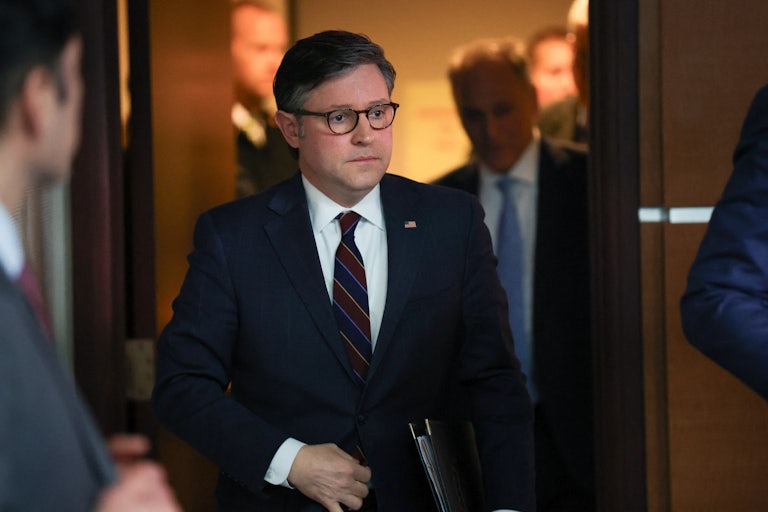
Johnson removed Mike Turner as head of the House Intelligence Committee.

Mike Johnson walks in the Capitol
Bryan Dozier/AFP/Getty Images

Representative Rick Crawford will be the next House Intelligence Committee chair, following his colleague Mike Turner’s unceremonious removal by Speaker Mike Johnson Wednesday.

Politico reported Thursday that Johnson will name Crawford to the position following Turner’s removal on Donald Trump’s orders. The move was a surprise even to the Republicans on the panel, and some in the GOP are angry at Johnson for how he handled the move.

“He dragged Mike along,” one senior House Republican said, speaking anonymously.

Another Republican warned that Johnson had just “cost himself political capital,” while a third warned that Turner was ready to go scorched earth.

“Mike’s never going to vote for another fucking thing around here again,” the third Republican said. “He’s mad.”

One Democrat, Representative Jim Himes, said Turner’s ouster “sends a shiver down my spine,” adding that Turner wasn’t a Republican who was quick to “bend the knee” to Trump and kept his “eyes on the prize” of oversight.

Trump sought Turner’s removal because he “believes that Turner is basically an intel community sycophant,” one source told The Daily Beast Wednesday. Johnson has said Trump was not involved in the decision.

Turner has warned of Russian propaganda “being uttered” on the House floor, and voted to certify Joe Biden’s win in 2020, putting himself in Trump’s and many conservatives’ crosshairs. Turner’s decision last year to back the reauthorization of Section 702 also has drawn the ire of the right, as well as the ACLU, for its potential to spy on Americans without a warrant.

Meanwhile, Crawford voted against Ukraine aid last year, in contrast to Turner’s staunch support of the country following its invasion by Russia. Turner’s departure will be seen as good news to the MAGA right who oppose any further aid to Ukraine, and Crawford’s appointment gives Trump a firm loyalist at the top of a powerful House committee, getting rid of another possible critic of his national security decisions.

Trump’s Treasury Pick Leaves Glaring Gap in Answer on Cutting Medicaid

Donald Trump and his allies have increasingly looked at cutting Medicaid.

Scott Bessent gestures while speaking during his Senate confirmation hearing
Al Drago/Bloomberg/Getty Images

Treasury secretary nominee Scott Bessent won’t commit to not cutting Medicaid.

In a heated back and forth Thursday with New Mexico Senator Ben Ray Luján, the hedge fund manager refused to specify where exactly he stood on the future of the critical health care program, claiming instead that he would leverage future negotiations on Medicaid to “empower” states.

“Yes or no: Will you recommend cutting Medicaid?” pressed Luján.

“I’m sorry, I didn’t hear if you said Medicaid or Medicare,” stuttered Bessent.

“Will you recommend cutting Medicaid?” the senator reiterated.

“Medicaid? The, um—I will—it’s the business of Congress to do the budget,” Bessent responded. “And I am in favor of empowering states, and I believe that for some states that will be an increase and for some states that will be a decrease.”

“So, Mr. Bessent, will you recommend cutting Medicaid to President Trump? And I’ll remind you that you acknowledged that one of your responsibilities as secretary of the Treasury will be to be providing this advice,” Luján said.

“I will get back to you on this,” Bessent concluded.

More than 72 million Americans, or roughly one in five citizens, were enrolled in Medicaid as of October, according to a federal Medicaid factsheet. The joint federal and state health care program provides comprehensive health care insurance to low-income Americans.

The wildly popular program has come under increased scrutiny by Donald Trump and his allies since his November win. In a Wall Street Journal op-ed published in November, Vivek Ramaswamy and Elon Musk (the potential co-chairs of the not-yet-real Department of Government Efficiency) said they intended to take a knife to “entitlement programs” such as Medicare and Medicaid, though they refused to specify how much they planned to burn from the health care programs.

That could help Trump extend his 2017 tax plan, which overwhelmingly benefits corporations and could add as much as $15 trillion to the national deficit, and which Bessent repeatedly vouched for and framed on Thursday as a salvation for America’s working class.