Breaking News
Breaking News
from Washington and beyond

Second Person With Measles Dies as Doctors Worry About RFK Jr. Effect

Robert F. Kennedy Jr. refuses to endorse widespread vaccination against the deadly disease.

Robert F. Kennedy Jr. looks to the side while standing in Congress during Donald Trump’s address to a joint session
Win McNamee/Getty Images

An unvaccinated adult in New Mexico with measles has died, local health department officials reported Thursday. The cause of death has not yet been identified, though this would be the second death so far from the (until recently) rare disease.

The individual—whose name, age, and sex were not released by local authorities—is the second person to die from the virus amid a growing outbreak along the New Mexico-Texas border, sparking widespread concern among doctors that the federal government’s response is simply not enough to halt the spread of measles.

Last week, an unvaccinated 6-year-old child in west Texas died of measles. It was the first instance in which someone has died from the viral illness in the U.S. in a decade. At least 159 infections have been reported in the Lone Star State in the current outbreak, according to data from the Texas Department of State Health Services. The vast majority of those infected—nearly 80 percent—are under the age of 17.

In response, Department of Health and Human Services Secretary Robert F. Kennedy has placed an emphasis on treating the disease with vitamin A supplements, rather than encouraging the local unvaccinated population to receive an immunization against the disease.

In an interview with Fox News on Tuesday, Kennedy claimed that local Texas doctors were “getting very, very good results” by treating their measles patients with steroids and cod liver oil.

But while health officials agree that vitamin A and other treatments can add a slight boost to one’s immune system, they stress that it’s not a replacement for a vaccine that has practically erased the highly contagious, incurable disease from public consciousness for more than a half century.

“Mentions of cod liver oil and vitamins [are] just distracting people away from what the single message should be, which is to increase the vaccination rate,” Dr. Amesh Adalja, an infectious disease physician and senior scholar with the Johns Hopkins Center for Health Security, told NPR.

Other medical professionals argued that advising children—who, again, are the bulk of those infected—to maintain high doses of vitamin A for extended periods of time isn’t just misguided but also potentially dangerous.

“Vitamin A can accumulate in the body,” Dr. Adam Ratner, a member of the infectious disease committee of the American Academy of Pediatrics, told NPR. “It can be toxic to the liver. It can have effects that you don’t want for your child.” That could include liver damage, fatigue, hair loss, and headaches.

Before last week, the last person to succumb to the disease died in 2015, during a less severe outbreak in Clallam County, Washington, in which a couple dozen people were infected. Measles was identified as the cause of death for the unidentified woman during an autopsy, which found that she had “several other health conditions and was on medications that contributed to a suppressed immune system,” the state health department said at the time.

It wouldn’t be the first measles response that Kennedy has bungled, however. Children’s Health Defense—under Kennedy’s stewardship—had its own questionable history with the disease. Preceding a deadly measles outbreak on Samoa in 2019, the nonprofit spread rampant misinformation about the efficacy of vaccines throughout the nation, sending the island’s vaccination rate plummeting from the 60–70 percent range to just 31 percent, according to Mother Jones. That year, the country reported 5,707 cases of measles as well as 83 measles-related deaths, the majority of which were children under the age of 5.

As a reminder: Since their invention, vaccines have proven to be one of the greatest accomplishments of modern medicine. The medical shots are so effective at preventing illness that they have effectively eradicated some of the worst diseases from our collective culture, from rabies to polio and smallpox—a fact that has possibly fooled some into believing that the viruses and their complications aren’t a significant threat for the average, health-conscious individual.
Trump’s Mass Deportations Collide Disastrously With His Mass Firings

One of Donald Trump’s biggest policy goals just threw a huge wrench into another.

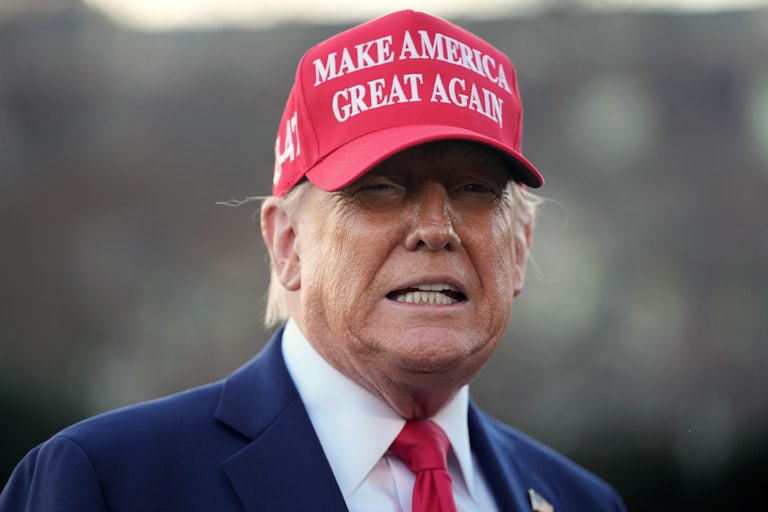
Donald Trump wears a "Make America Great Again" hat and speaks to reporters outside the White House
Andrew Harnik/Getty Images

Donald Trump’s efforts to shrink the federal workforce are getting in the way of his own agenda. 

More than 100 employees at the Executive Office of Immigration Review have either been terminated or opted into the government’s deferred resignation program, creating a new roadblock in the Trump administration’s goal to execute massive deportations, according to ABC News

For scale, the U.S. employs roughly 735 immigration judges in the country’s 71 immigration courts, charged with handling a backlog of 3.7 million cases—and the number increases every day. 

The Trump administration’s efforts to cull extraneous workers has led to the departure of 43 immigration judges, as well as 85 essential administrative staff.

Matt Biggs, the president of the International Federation of Professional and Technical Engineers, told ABC News that the Trump administration’s efforts to dismiss the immigration judges his union represents was “highly hypocritical.”

“How do you deport people without immigration judges?” Biggs said. “It’s highly hypocritical. It runs contrary to what he campaigned on. He’s making it more difficult to deport people from this country. It makes no sense at all.”

Cutting roughly six percent of the U.S. stock of judges certainly won’t prevent the Trump administration’s efforts to enact massive deportations; it will likely just make them even more slow and painful for those subjected to detainment by Immigration and Customs Enforcement, which on Thursday officially revived the policy of detaining migrant families with children. The practice had been banned under President Joe Biden.  

It’s also possible that some judges are being dismissed for political reasons. Kerry Doyle, a longtime immigration attorney, was one of 13 in a class of newly hired immigration judges who was dismissed last month. She had previously been flagged on the American Accountability Foundation’s “DHS Bureaucrat Watchlist.” 

The website described Doyle as an “immigration activist lawyer” with a “known history as a critic of DHS” and a “lifelong commitment to open borders and mass migration,” according to Mother Jones. Now, she’s out of a job. 

In a post on LinkedIn, Doyle wrote that her dismissal was “political.”

“The reality is that you’ve got a really broken system, and firing judges is not the way to fix it,” Doyle told ABC News. 

Read more about the deportations:

Trump Flirts With New Tariffs in Major Whiplash

Trump promised more tariffs are coming in an interview with Fox Business—his umpteenth 180 this week.

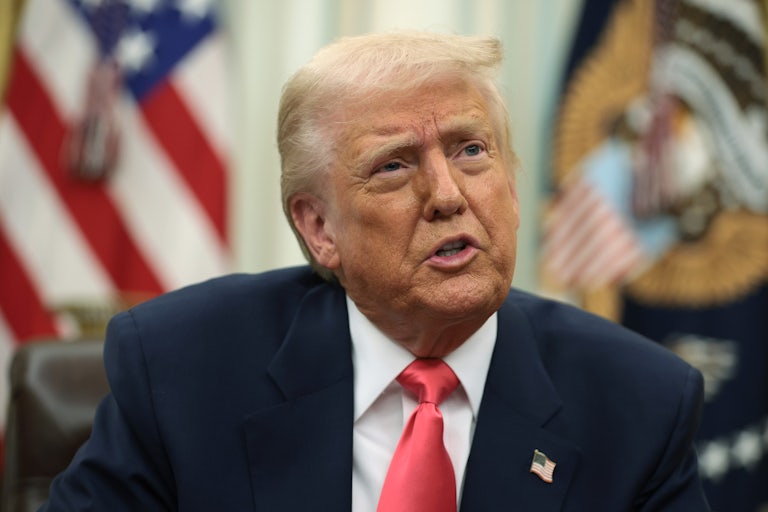
Donald Trump speaking in the Oval Office.
Alex Wong/Getty Images

Donald Trump’s tariffs plan has caused a lot of confusion with his repeated reversals, carve-outs, and threats to raise them. So, in an interview that aired Friday, Fox Business’s Maria Baritromo asked the president to clear things up.

“Can you give us a sense of whether or not we are going to get clarity for the business community?” Baritromo asked the president, noting that business leaders need predictability for planning purposes.

Trump’s answer was anything but reassuring.

“Well, I think so. But you know, the tariffs could go up as time goes by, and they may go up, and you know, I don’t know if it’s predictability—” Trump meandered before Baritromo cut him off.

“So that’s not clarity,” Baritromo said. Trump responded by casting doubt on the business leaders and whether they actually want predictability.

“You know I think that they say that. You know it sounds good to say. But, for years, the globalists, the big globalists, have been ripping off the United States, they’ve been taking money away from the United States, and all we’re doing is getting some of it back,” Trump said.

When Trump instituted his tariffs against Canada, Mexico, and China on Tuesday, the stock market plummeted, with leaders in U.S. industries ranging from automobiles to agriculture expressing fears about how they would be affected. On Wednesday, Trump announced a carve-out for U.S. automakers, and on Thursday announced Mexico and Canada would not pay tariffs on products that comply with the United States-Mexico-Canada Agreement, or USMCA, until April 2.

The real goal of the tariffs against Canada, White House press secretary Karoline Leavitt admitted Wednesday, is to decimate the country’s economy to force it to become the U.S. fifty-first state. Such an effort would further cause extreme economic confusion and ruin, and if Trump is serious, this tariff fight won’t end anytime soon.

Trump Just Made It Much, Much Harder to Sue His Administration

Donald Trump’s White House has invoked a rarely used rule to make people people pay to file lawsuits against the government.

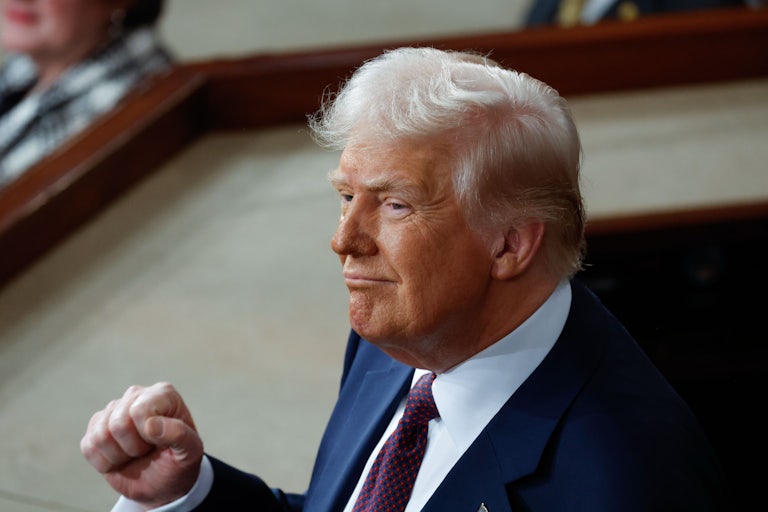
Donald Trump smiles and makes a fist emoji while addressing a joint session of Congress in the Capitol building.
Tom Brenner/The Washington Post/Getty Images

Amid a flurry of lawsuits against his administration, Trump is trying to make it a whole lot harder to sue him.

According to a memo sent to agency heads on Thursday, the White House is encouraging the use of a rarely used rule that would force anyone who sues the federal government to pay an upfront fee.

“It is the policy of the United States to demand that parties seeking injunctions against the Federal Government must cover the costs and damages incurred if the Government is ultimately found to have been wrongfully enjoined or restrained,” the memo obtained by CNN reads.

More than 100 lawsuits have been filed against the president since he took office in January. The cases range from challenging his immigration policies and funding cuts, to disputes against the Department of Government Efficiency’s attack on federal agencies. Many of the cases have been successful early on, and they are all ongoing.

In the memo, the White House framed the cases as a waste of “substantial resources to fighting frivolous suits instead of defending public safety.”

“Taxpayers are forced not only to cover the costs of their antics when funding and hiring decisions are enjoined, but must needlessly wait for Government policies they voted for,” the memo reads.

The rule the White House is attempting to invoke is rarely used in the courts, and the financial barrier could prevent individuals, organizations, unions, and agencies from taking action against the president.

It’s unclear exactly who would decide how much the plaintiff would have to pay, but the Justice Department would probably ask judges to set the amount, legal expert Mark Zaid told CNN.

That means the fee could be as little as $1, and as high as … who knows? It’s yet another sly move from Trump to dodge accountability for his relentless attack on the Constitution.

Trump Rushes to Do President Elon Musk’s Dirty Work With South Africa

Donald Trump attacked South Africa right after the country refused one of Elon Musk’s business projects.

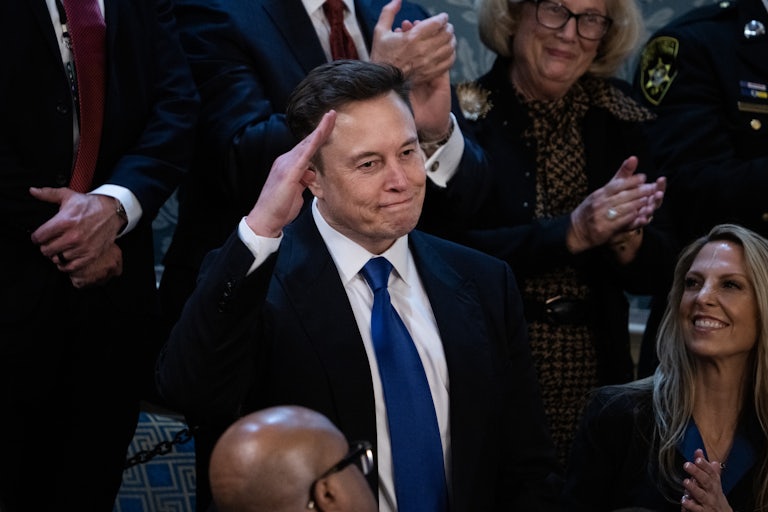
Elon Musk salutes during Donald Trump’s address to a joint session of Congress
Tom Williams/CQ-Roll Call, Inc/Getty Images

The president has decided to throw some weight behind one of his closest advisers when it comes to dealing with South Africa.

Despite tariff-induced tumult at home, Donald Trump took the time Friday morning to lambast South Africa for how it treats its farmers, threatening aggressive foreign policy toward the continent’s strongest economy by announcing that the United States would stop all federal funding to the African nation.

“South Africa is being terrible, plus, to long time Farmers in the country,” Trump posted on Truth Social. “They are confiscating their LAND and FARMS, and MUCH WORSE THAN THAT. A bad place to be right now, and we are stopping all Federal Funding. To go a step further, any Farmer (with family!) from South Africa, seeking to flee that country for reasons of safety, will be invited into the United States of America with a rapid pathway to Citizenship. This process will begin immediately!”

The missive came hand in hand with a complaint from Elon Musk, who whined on X mere hours before that South Africa would not allow his international internet project to get off the ground, due to a lack of diversity at the billionaire’s company.

“Starlink is not allowed to operate in South Africa, because I’m not black,” Musk posted on X Friday morning.

But that wasn’t exactly an accurate reflection of why Musk’s home country has refused to approve SpaceX’s Starlink service.

The South African government’s Broad-Based Black Economic Empowerment policy stipulates that all companies that do business in the nation must have at least 30 percent of their ownership or economic involvement owned by Black South Africans.

The mandate is a part of the country’s efforts to correct inequalities left in the wake of apartheid, striving to “advance economic transformation and enhance the economic participation of black people in the South African economy,” per the South African Department of Trade, Industry, and Competition.

Musk has practically made the notion of diversity his enemy as he works—via the Department of Government Efficiency—to strip and defund federal agencies whose missions make mention of inclusivity efforts.

“DEI is just another word for racism,” Musk wrote in January. “Shame on anyone who uses it.”

The world’s richest man’s affinity for Nazi salutes have also called into question his racial ideology, especially as a descendant of Nazi sympathizers. That is according to his father, Errol Musk, who told the Podcast and Chill Network in November that the billionaire’s maternal grandparents supported Adolf Hitler and were members of the German Nazi Party in Canada before moving to South Africa in support of apartheid.