Breaking News
Breaking News
from Washington and beyond

Trump Border Czar Says He’ll Ignore the Courts as Much as He Wants

Tom Homan is openly bragging about ignoring the courts on deportations.

Trump border czar Tom Homan
John Lamparski/Getty Images

Trump’s border czar proudly proclaimed that their administration could care less about what federal judges have to say about their hard-line immigration policies. 

“I wake up every morning loving my job because I work for the greatest president in the history of my life, and we’re gon’ make this country safe again. I’m proud to be a part of this administration,” Tom Homan raved on Fox News Monday morning. “We’re not stopping. I don’t care what the judges think, I don’t care what the left thinks, we’re comin.’” 

This comes after a weekend of the Trump administration ignoring court orders to deport immigrants in two high-profile cases. On Saturday, a federal judge ordered two planes of Venezuelans  being deported to El Salvador to return to the United States. The Trump administration, however, claimed the order came too late and the plane was already out of U.S. airspace, citing the time the order was filed in the court’s electronic docket instead of the verbal order, which came 45 minutes earlier. On Friday, Brown University doctor and legal visa holder Rasha Alawieh was also deported, despite a court order blocking her removal from the country.

Both cases follow the kidnapping of green card holder and pro-Palestinian activist Mahmoud Khalil and, along with Homan’s statement, finally confirm what many already knew: The “rule of law” has no power over this administration.
Elon Musk’s DOGE Guts U.S. Nuclear Agency

DOGE cuts have hit some of the country’s top nuclear scientists.

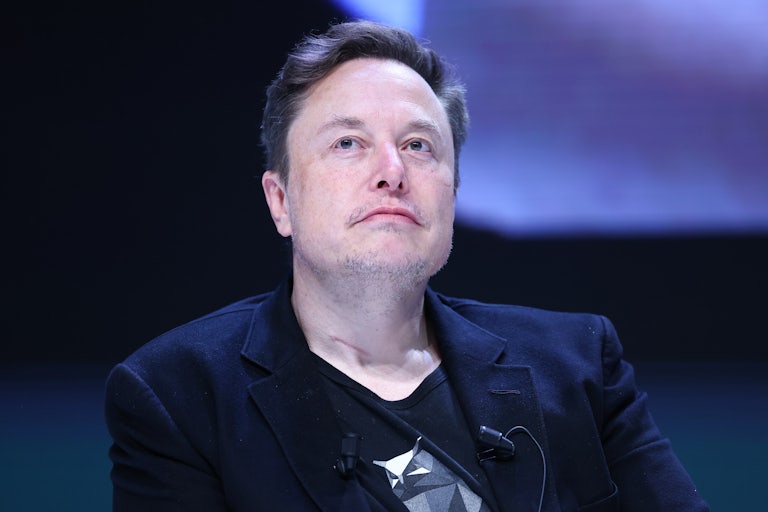
Elon Musk
Marc Piasecki/Getty Images

Several nuclear scientists, bomb engineers, and safety experts critical to national security were among the cuts made by Elon Musk’s Department of Government Efficiency.

The New York Times reports that more than 130 members of a top secret agency, the National Nuclear Security Agency, either took the Trump administration’s deferred resignation “buyout” or were fired in the past six weeks, putting an effort to upgrade the American nuclear arsenal at risk.

These cuts include at least 27 engineers, 12 program or project managers, 13 program or project analysts, five scientists or physicists, six budget analysts or accountants, as well as multiple attorneys, safety experts, and compliance officers. The job losses are coming despite the NNSA being in its busiest period since the Cold War, according to the Times.

The agency is modernizing the country’s nuclear stockpile, comprising 3,748 bombs and warheads, an effort costing $20 billion a year to arm new land-based missiles, bomber jets, and nuclear submarines. The agency had built itself up to 2,000 workers in January, still short of what it said it needed, but the new cuts undo those gains and undermine the agency’s attempt to build up its staff to handle the workload.

The NNSA is part of the Department of Energy and usually stays out of the news. But it goes to show that even those most critical agencies have been subject to the wanton, haphazard budget cuts championed by Musk and the GOP in the supposed quest to find waste, fraud, and abuse. Many people who left the agency held top-secret security clearances, and it will be tough to train replacements.

“Who’s going to teach those new people?” one anonymous senior official who took the buyout told the Times. “Who’s going to mentor them, and who’s going to bring them up to speed?”

Schumer Cancels Multiple Book Tour Stops After Shutdown Surrender

Senate Minority Leader Chuck Schumer has postponed multiple stops on his book tour as he faces backlash from the rest of the Democratic Party.

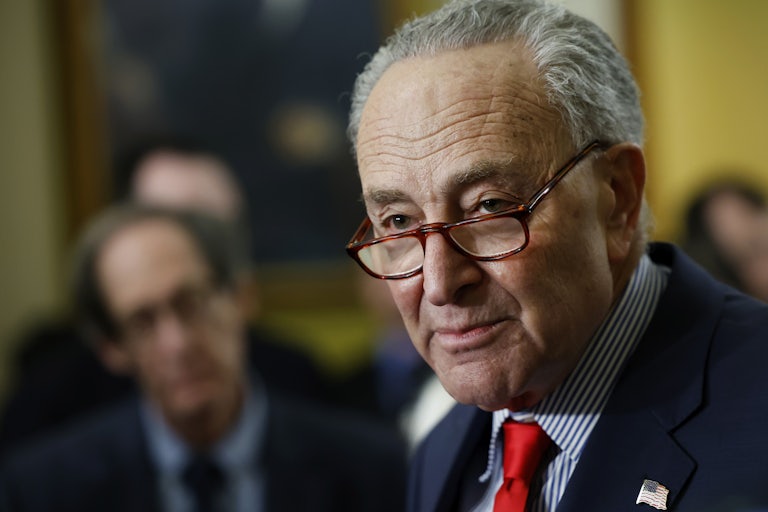
Senate Minority Leader Chuck Schumer in the Capitol
Anna Moneymaker/Getty Images

What is Chuck Schumer hiding from?

The Senate minority leader has postponed several tour appearances this week in Baltimore, Washington, D.C., New York, and Philadelphia for his upcoming book, Antisemitism in America: A Warning.

“Due to security concerns, Senator Schumer’s book events are being rescheduled,” said a spokesperson for Schumer. The new dates have not yet been announced.

The cancellations may have something to do with the intense backlash he’s facing after he voted for Republicans’ destructive budget last week, gifting them the funding and power to continue to ravage the federal government and carry out mass deportations.

There is palpable outrage throughout the Democratic establishment with Schumer’s decision. It wouldn’t be surprising if that same outrage was shown by the public. Schumer was publicly excoriated by Hakeem Jeffries and even Nancy Pelosi for the move—and there are plenty of scared, angry Democratic voters itching to show up to his town halls to do just the same.

Even still, Schumer has defended his position, insisting that a government shutdown was the worst option.

“If we go into a shutdown—and I told my caucus this—there’s no off-ramp. The total off-ramp of a shutdown, how you stop a shutdown, is totally determined by the Republican House and Senate,” he told reporters last week. “They’ve shown complete blind obeisance by Trump, DOGE, et cetera. They could keep us in a shutdown for months and months and months.”

Trump Insists He Was Being “Sarcastic” About Major Campaign Promise

Donald Trump has a new excuse for failing to uphold his promises.

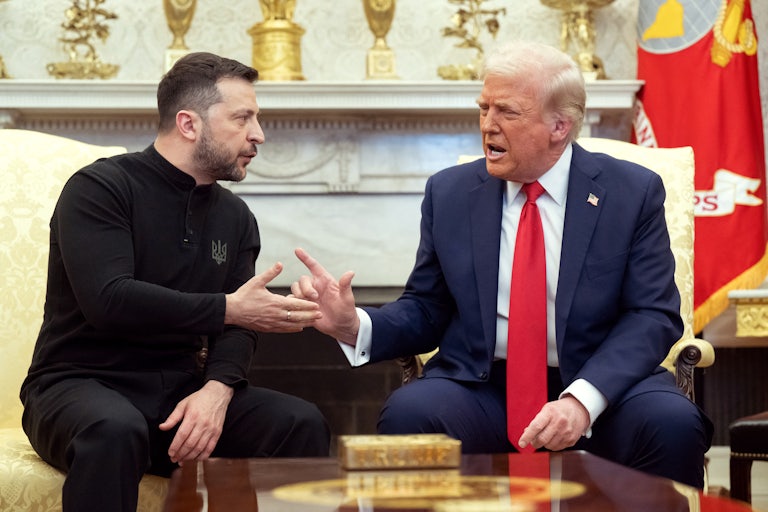
Donald Trump raises his finger and speaks as he and Ukrainian President Volodymyr Zelenskiy sit in the Oval Office
Saul Loeb/AFP/Getty Images

One month before the election, 70 percent of Americans felt that foreign affairs comprised either a “very important” or “extremely important” component of their vote. But as it turns out, Donald Trump’s repeat campaign promises to end the war in Ukraine “in 24 hours” were just gas.

In an interview with Sharyl Attkisson broadcast Sunday, the president revealed he never actually intended to follow through on that.

“Well, I was being a little bit sarcastic when I said that,” Trump told Attkisson on her show Full Measure. “What I really mean is I’d like to get it settled, and I think I’ll be successful.”

It’s one of the rare occasions where Trump has actually admitted that he was wrong. But dressing up the blatant lie as a “little bit” of sarcasm is an awfully convenient way to circumnavigate blame for failing.

Trump had harped on the vow to instantaneously end the war for more than a year before taking back the White House. While speaking about the ongoing deaths of Ukrainians and Russians at a CNN town hall in May 2023, Trump claimed that he would “have that done in 24 hours.”

He amped up the proposition the next year. While debating former Vice President Kamala Harris in September 2024, Trump claimed that he would “get it settled before I even become president.”

The Trump administration’s special envoy to the Middle East, Steve Witkoff, visited Moscow last week to advance talks on the Ukrainian-approved ceasefire terms. Negotiators in Washington and Moscow are reportedly discussing how to divvy up assets between Russia and Ukraine to bring a close to the three-year war. Russian President Vladimir Putin and his allies have insisted that they intend to keep the land they’ve carved out of Ukraine’s borders for the Kremlin. They are also expected to stipulate that Ukraine never joins NATO, the strategic Western trade and military alliance that had promised in 2008 to absorb the Eastern European nation into its fold.

Russian forces crossed the Ukrainian border on February 24, 2022, which Putin tried to justify by falsely claiming that he needed to protect civilians in eastern Ukraine. But the Trump White House has proved remarkably hostile toward Ukraine in negotiations to close the conflict.

During Ukrainian President Volodymyr Zelenskiy’s short visit to Washington late last month, Trump and Vice President JD Vance repeatedly attacked the wartime leader while verbally defending Putin. In doing so, they challenged America’s strongest alliances while ceding the world stage to America’s adversaries. In the weeks that followed, the White House ordered a pause on intelligence sharing with Kyiv and suspended military aid to the war-battered nation in defiance of the 1994 Budapest Memorandum, in which the U.S. and the U.K. agreed to defend Ukraine’s borders in exchange for Ukraine’s surrender of nuclear weapons. The aid and intelligence resumed last week after Zelenskiy publicly apologized for getting attacked.

Speaking with Attkisson on Sunday, Trump said that it would be “bad news for this world” if Putin refused the ceasefire terms.

“Bad news for this world because so many people are dying,” Trump said. “But I think, I think he’s going to agree. I really do. I think I know him pretty well, and I think he’s going to agree.”

Outgoing Commerce Official Shreds Elon Musk’s Starlink in Final Email

An official working on broadband expansion brutally condemned Musk.

Elon Musk speaks with Commerce Secretary Howard Lutnick as they walk outside the White House
Al Drago/Bloomberg/Getty Images

A top official at the Commerce Department warned in a scathing resignation letter that Elon Musk intends to get rich at the expense of rural Americans.

Evan Feinman, the former director of the Broadband Equity, Access, and Deployment Program, or BEAD, which provides grants to expand internet access across the country, condemned the efforts of the billionaire bureaucrat—who also happens to own a satellite internet constellation that might directly profit from his dismissal.

“Stranding all or part of rural America with worse internet so that we can make the world’s richest man even richer is yet another in a long line of betrayals by Washington,” Feinman wrote Sunday in a lengthy email to his colleagues, obtained by Politico.

The BEAD program, overseen by the National Telecommunications and Information Administration, which is housed within the Commerce Department, was granted $42.5 billion in 2021 by Joe Biden’s Infrastructure Investment and Jobs Act to provide fast internet connection to millions of Americans. As of yet, no internet expansion projects have actually begun, though some states are closer to the finish line than others.

In a statement earlier this month, Commerce Secretary Howard Lutnick claimed that the Biden administration’s “woke mandates, favoritism towards certain technologies, and burdensome regulations” had prevented BEAD from connecting a single person to high speed internet.

Lutnick promised an overhaul of BEAD that would include “ripping out” the “pointless requirements” imposed by the previous administration, but did not specify what steps that would include, or what regulations he intended to remove.

The potential changes could offer a bigger piece of the pie to Musk’s Starlink by adopting “technology neutral” policies that will make way for the use of satellites in addition to fiber-optic cables. Starlink was expected to haul in around $4.1 billion under the existing rules but could rake in anywhere from $10 billion to $20 billion if Lutnick’s changes are accepted.

Feinman seemed to agree that the Biden administration had inserted some language for “messaging/political purposes, and were never central to the mission of the program.” But he was concerned that Lutnick’s changes could set the program back even further, as three states, Louisiana, Delaware, and Nevada, are currently trapped in limbo as they await approval from the National Institute of Standards and Technology.

“Shovels could already be in the ground in three states, and they could be in the ground in half the country by the summer without the proposed changes to project selection,” Feinman wrote.

Feinman was concerned that the Trump administration would undermine BEAD to turn a profit, against the best interest of rural Americans, lawmakers, or even the telecommunications industry.

He urged that officials “NOT change it to benefit technology that delivers slower speeds at higher costs to the household paying the bill.”

“Reach out to your congressional delegation and reach out to the Trump Administration and tell them to strip out the needless requirements, but not to strip away from states the flexibility to get the best connections for their people,” Feinman wrote.