Breaking News
Breaking News
from Washington and beyond

Manufacturing Workers Are Beyond Pissed at Trump Over Tariffs Whiplash

Donald Trump is quickly losing support of a key voter group.

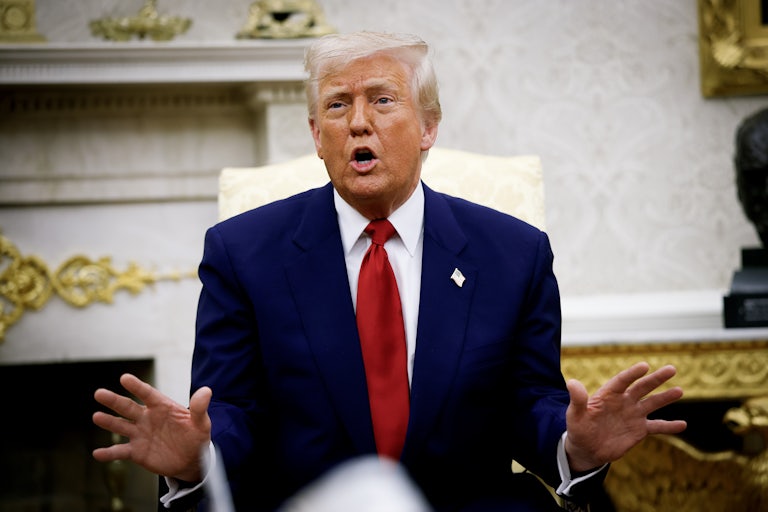
Donald Trump
Kevin Dietsch/Getty Images

It turns out that Donald Trump’s erratic tariff policy is not popular with manufacturing workers.

A new Washington Post poll of over 500 workers showed that 52 percent oppose the trade measures, believing that they are bad for their livelihoods and the country. In addition, 57 percent of them said that tariffs would hurt their jobs and careers, while 59 percent said that tariffs would hurt the companies they work for.

When broken down on partisan lines, less than half of Donald Trump voters (44 percent) said they believed tariffs would help them, while 87 percent of Harris voters said they would hurt them. A slight majority of the poll’s respondents said they favored or leaned toward the Republican Party, making the results more striking.

Trump has alternately raised and lowered tariffs, confusing markets and businesses. At the moment, there are 145 percent tariffs on China, 25 percent tariffs on Mexican and Canadian goods not covered by the USMCA trade agreement, and 10 percent on most other countries. The moves have already led to layoffs in certain American industries, such as automobiles, and a looming recession would lead to even more job losses.

But Trump doesn’t seem to have any kind of plan with his tariffs and is making it up as he goes along. Without any clarity as to where things are going, not only will industries and markets continue to slide, but Trump may start to lose support from manufacturing workers, many of whom were part of the reason for his election victory in 2024.

Trump has already created thousands of disgruntled, laid-off federal workers. If Democrats capitalize on the vast numbers of Americans worried about their jobs, the result would be big losses for the GOP in 2026, and possibly even 2028.

Trump Is Begging China to Make a Deal Over Tariffs

Donald Trump appears to be growing increasingly desperate to fix the fallout over his tariffs.

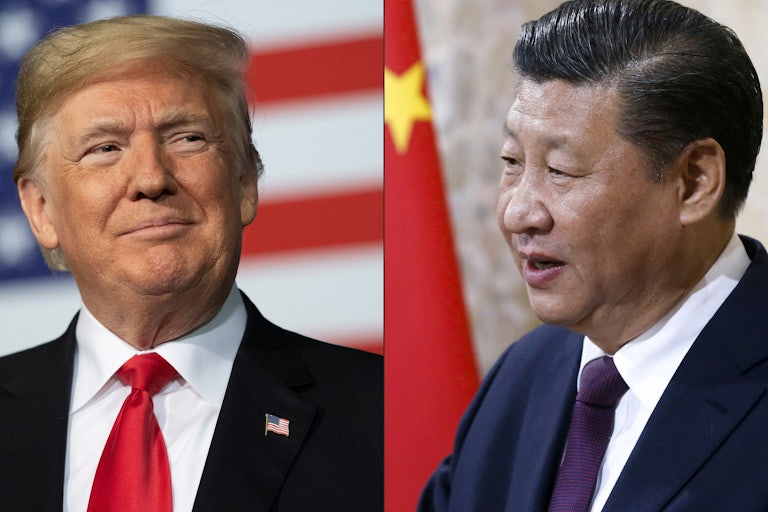
Donald Trump and Xi Jinping
Jim Watson, Peter Klaunzer/AFP/Getty Images

Donald Trump’s administration has been begging for a call from Chinese President Xi Jinping—despite Trump’s claims that his reciprocal tariff policy sent nations scrambling to cut deals with him. But instead of fostering negotiations, it seems their desperation only made things worse. 

Beijing announced Friday that it was raising tariffs on U.S. goods from 84 percent to 125 percent, following confirmation from the White House the day before that it was placing tariffs of 145 percent on Chinese goods. 

Ahead of Thursday’s announcement, the Trump administration had attempted to talk Chinese officials out of levying more retaliatory tariffs, and advised them to have their president give Trump a call, according to CNN

Instead of entreating Xi to a meeting, U.S. officials awoke Friday to even more tariffs, and no request to begin negotiations. 

U.S. Trade Representative Jamieson Greer confirmed Friday morning that the U.S. had not yet begun talks with Chinese officials to walk back the tariffs.

The White House has claimed to have started negotiations with officials from 75 countries—though it has refused to divulge which ones—in response to Trump’s reciprocal tariff policy. China has been a notable holdout, and was therefore made exempt from Trump’s 90-day pause on new rates going into effect. 

The Trump administration has been saying pretty much the same thing to China for roughly two months, insisting that Beijing must make the first move, but with no luck. Trump claimed Wednesday that “China wants to make a deal. They just don’t know how quite to go about it,” noting that the Chinese were a “proud” people.  

China’s Finance Ministry released a statement Friday saying that it wouldn’t fall for Trump’s blatant bullying. 

“Even if the U.S. continues to impose higher tariffs, it will no longer make economic sense and will become a joke in the history of world economy,” the ministry said in the statement, which CNBC translated.

“With tariff rates at the current level, there is no longer a market for U.S. goods imported into China,” the statement said, adding that “if the U.S. government continues to increase tariffs on China, Beijing will ignore.”

Here’s How Trump Plans to Take Control of Greenland

Donald Trump’s plan exposes just how clueless he is.

A sign says, "Greenland is not for sale" in English and and "Greenland is for Greenlanders" in Greenlandic
Kristian Tuxen Ladegaard Berg/SOPA Images/LightRocket/Getty Images

Donald Trump’s plan to acquire Greenland is very real, and it apparently involves convincing the country to hand itself over to U.S. control.

The White House National Security Council has met “several times” to make Trump’s desires for the arctic island a reality, reported The New York Times, which spoke to a U.S. official who said the council had sent “specific instructions to multiple arms of the government.” But those instructions apparently never specified the use of military force.

Instead, the effort is driven by a massive P.R. campaign consisting of spending federal dollars on advertising and social media campaigns with hopes of persuading Greenland’s 57,000 residents to basically annex themselves for America.

The prospect of that happening, however, is laughable. Greenland, which is a  semiautonomous territory of Denmark, has not taken kindly to Trump and his associates’ sudden interest in acquiring their land. After months of heavy pressure from the Trump family, including an embarrassing stunt in which Donald Trump Jr. reportedly convinced homeless residents to wear MAGA merchandise in exchange for food, and an effort in the U.S. Congress to rename the territory “Red, White, and Blueland,” Greenland’s various political parties set aside their differences in March to unite under a singular goal: opposing U.S. aggression.

“We don’t want to be Americans. No, we don’t want to be Danes. We want to be Greenlanders, and we want our own independence in the future,” Demokraatit Party leader Jens-Frederik Nielsen told Sky News the night his party won a decisive majority in Parliament, making him prime minister. “And we want to build our own country by ourselves.”

Other Greenland officials have been more blunt. In January, the chair of Greenland’s parliamentary Foreign and Security Policy Committee Pipaluk Lynge warned the U.S. not to “invade” the nation, which is largely composed of Indigenous tribes, in light of America’s historical treatment of Alaska’s Indigenous population.

A late January poll by pollster Verian found that 85 percent of Greenland’s residents do not want to become part of the United States. Just 6 percent were in favor of the switch, while 8 percent were undecided, according to The Guardian.

That disinterest became more apparent in late March, when second lady Usha Vance’s trip around Greenland was gutted and canceled after American representatives were spotted walking around Nuuk, the island’s capital, failing to find residents who would be interested in a visit from the vice president’s wife.

But none of that has thwarted Trump’s interest.

“We need [Greenland] for international security,” Trump said during a meeting with NATO Secretary General Mark Rutte last month. “That whole area is becoming very important, for a lot of reasons. The routes are very direct to Asia, to Russia, and you have ships all over the place. We have to have protection. 

“So, we’re going to have to make a deal on that, and Denmark is not able to do that, and you know, Denmark is very far away, and really has nothing to do. What happened? A boat landed there 200 years ago or something and they say they have rights to it, I don’t know if that’s true, I don’t think it is, actually,” the apparent anti-colonialist activist added.

In an address to Congress last month, Trump clarified his intention: “One way or the other, we’re going to get it.”

Republican Has Unbelievably Racist Theory for Measles Outbreak

Representative Ryan Mackenzie’s theory for why measles cases are spiking is the worst one yet.

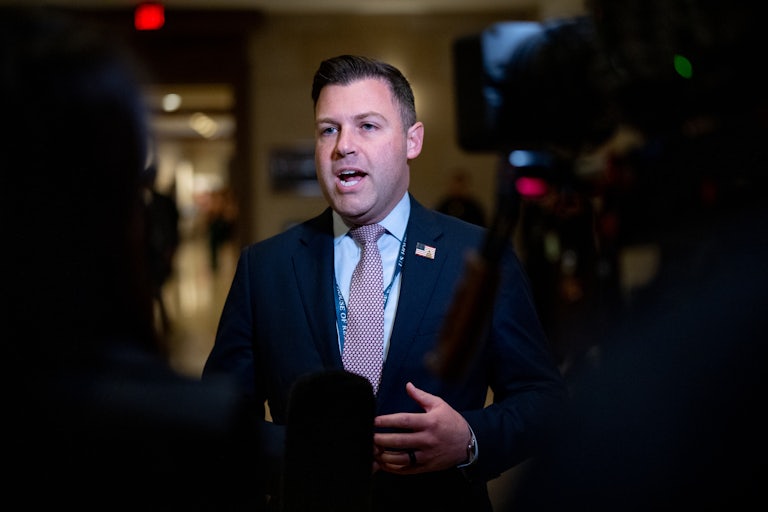
Representative Ryan Mackenzie speaks to reporters in the Capitol
Andrew Harnik/Getty Images

A Republican lawmaker has a new wildly racist explanation for the deadly measles outbreak.

During a CNN town hall Thursday, Representative Ryan Mackenzie presented his own theory about the more than 600 confirmed cases of measles.

“Many of these instances that are coming into our country are from illegal immigrants who have crossed the border with no checks, no actual health records, and they are bringing these diseases into our country. There is a reason why measles have started to spread in our country after decades of being almost eradicated,” the Pennsylvania Republican said.

Last month, Dr. Jennifer Shuford, who oversees the Texas Department of State Health Services, told lawmakers that she had no data pinpointing the origin of the outbreak. But, she warned, its rapid spread was caused by lower immunization rates and a “decreased interest or decrease in trust in vaccines.”

Mackenzie’s claim that the measles outbreak was caused by undocumented immigrants holds absolutely no water, but is par for the course for MAGA Republicans intent on blaming the country’s ills on a vulnerable population. Mackenzie spent much of his stage time praising Donald Trump and defending the president’s sweeping tariff policy.

Mackenzie was promptly lambasted for his baseless and racist attempt to blame undocumented immigrants.

“Nope, sorry, Rep. Mackenzie. People in the U.S. - not getting vaccinated - is why it’s spreading,” the House Homeland Security Committee Democrats wrote Friday on X.

Courtney Rice, the communications director for the Democratic Congressional Campaign Committee, wrote on X that Mackenzie’s comments were “despicable and, frankly, racist AF.”

“Every House Republican needs to denounce this dangerous rhetoric immediately,” she added.

Trump Gets More Bad News as Consumer Confidence Plummets

Americans across the board are quickly losing faith in Trump’s handling of the economy.

Donald Trump speaks with his hands in the White House.
Kevin Dietsch/Getty Images

As Americans navigate Donald Trump’s deranged war on global trade, consumers have never trusted him less.

Consumer sentiment has plunged for the fourth month in a row, according to new data released Friday by the University of Michigan’s consumer sentiment index, a key indicator of national economic conditions.

“Consumers report multiple warning signs that raise the risk of recession: expectations for business conditions, personal finances, incomes, inflation, and labor markets all continued to deteriorate this month,” the University of Michigan said in a statement.

Sentiment among consumers is down 11 percent from March, and the decline was “pervasive and unanimous across age, income, education, geographic region, and political affiliation,” wrote survey director Joanne Hsu. Sentiment is also down 30 percent from December, before Donald Trump took office and tanked the hopes of millions of consumers desperate for affordable groceries and sustainable livelihoods.

Since taking office, Trump has spurred economic mayhem in the United States and abroad with his relentless flip-flopping on tariffs and perverse trade policy. On his so-called “Liberation Day,” Trump used national emergency powers to enact tariffs ranging from 10 to 60 percent on more than 90 nations, including an 84 percent tariff. A week later, he announced a 90-day reduction on most of the tariffs while ramping up those on China, leading to some of the most volatile fluctuations financial markets have seen in decades—not exactly the best way to gain consumer trust.

The index also showed that inflation expectations grew from 5 percent last month to 6.7 percent, the highest recorded reading since 1981. Unemployment expectations among consumers also rose to more than double what they were last year.

The numbers were recorded and released before Trump announced the 90-day freeze on reciprocal tariffs, which may have inspired some relief among consumers. Regardless, Americans across all demographics are losing faith in the administration that promised them economic refuge.