Breaking News
Breaking News
from Washington and beyond

Trump Accidentally Admits He Hasn’t Made Any Trade Deals

Donald Trump has continually insisted that deals over his tariffs are coming.

Donald Trump gives a thumbs up while standing outside the White House
Aaron Schwartz/Bloomberg/Getty Images

President Donald Trump claimed Tuesday that the U.S. doesn’t “have to sign” any trade deals, inadvertently admitting that his administration hasn’t made any progress during the 90-day pause on his disastrous tariffs.

During a tense meeting to discuss tariffs with Canadian Prime Minister Mark Carney, the president attempted to move the goal posts on actually completing any agreements with foreign countries.

“Everyone says, ‘When, when, when, are you going to sign deals?’ We don’t have to sign deals!” Trump said.

“We don’t have to sign deals. They have to sign deals with us. They want a piece of our market, we don’t want a piece of their market. We don’t care about their market. They want a piece of our market,” Trump rambled.

The president’s unwieldy statements downplaying the importance of the trade deals seemed to be cushioning the likelihood that negotiations would ultimately fail. Trump’s remarks also revealed that his administration has yet to complete a single trade deal.

Last month, Trump claimed to have already struck 200 trade agreements with foreign countries, a remark so outlandish it sent members of his administration scrambling to make it make sense. (There are also only 195 countries in the world.)

Instead of pledging to sign deals, Trump presented his own plan Tuesday. The president claimed that “at some point over the next two weeks,” he intended to sit down with members of his Cabinet and offer individualized deals to each country seeking tariff relief.

“We’re gonna say, ‘Here’s what this country—what we want, and congratulations we have a deal!’ And they’ll either say ‘Great,’ and they’ll start shopping, or they’ll say, ‘Not good, we’re not gonna do it,’” Trump said.

Trump claimed that the offers would include “very fair numbers,” but that they might also include other requests. He also said that his administration would be open to adjusting the deals based on how the countries responded.

“And then you people will say, ‘Oh it’s so chaotic,’ no, we’re flexible,” Trump said, referring to the press.

In any case, Trump continued to emphasize that his goal wasn’t actually to make deals, just to put out offers. “In some cases we’ll sign some deals, it’s much less important than what I’m talking about,” he said. He warned that in one day, he could present 100 offers, but “they don’t have to sign.”

Still, Trump said he wanted countries to “pay for the privilege of being able to shop in the United States of America.”
Canada PM Gives Trump Middle Finger on Wild In-Person Statehood Pitch

Donald Trump pitched statehood to the man who was just elected by campaigning on rejecting statehood.

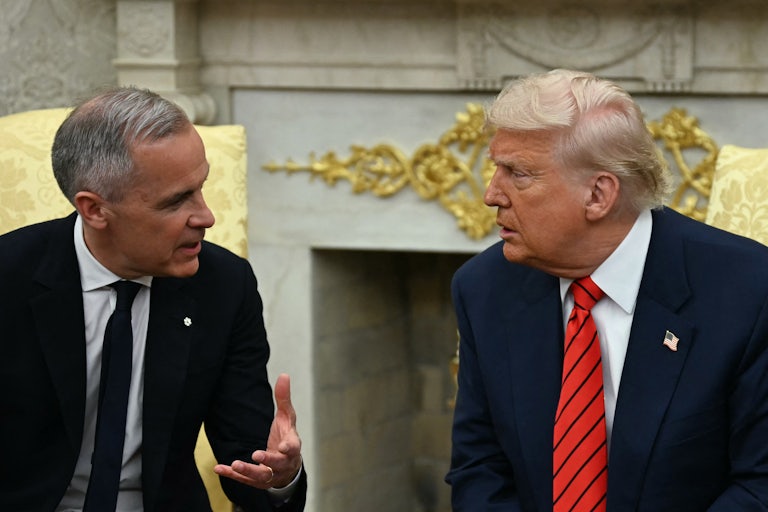
Canadian Prime Minister Mark Carney gestures while speaking to Donald Trump, as they sit next to each other in the Oval Office
Jim Watson/AFP/Getty Images

Canadian Prime Minister Mark Carney declared in the White House Tuesday that Canada would not submit to U.S. ownership. Donald Trump, however, wouldn’t back down.

“As you know from real estate, there are some places that are never for sale,” Carney said. “Having met with the owners of Canada over the course of the campaign, it’s not for sale. It won’t be for sale ever.”

“Never say never,” Trump said, telling reporters that only time would tell, while seated inches away from the Canadian leader. “I had many things that people said were not doable but ended up being doable.”

Carney won Canada’s top leadership post in April in large part due to his staunch position against Trump’s growing threats to annex the country.

In the months leading up to the election, Canada’s Liberal Party was believed to be on its deathbed. But that all changed with Trump’s tariff talk, which radically ramped up anti-American sentiment amongst Canadian voters, alongside Trump’s bizarre and public ambitions to occupy Canada.

Trump has actively aggressed U.S. relations with Canada since his first term. Recent rhetoric about annexing Canada to become America’s “fifty-first state” has not played well with the Canadian people or its leaders, causing some residents of the country to candidly dub Trump an “asshole.”

Responding to reporters Tuesday, Trump said there was nothing that Carney could say or do to lift his tariffs on Canada. “It’s just the way it is,” Trump said, when asked why he wouldn’t budge.

Carney appeared disturbed by the admission, interjecting to respond to several of Trump’s prior points.

“Respectfully, Canadians’ view on this is not going to change, on the fifty-first state,” Carney said as Trump grimaced beside him. “Secondly, we are the largest client of the United States. In the totality of all the goods, we are the largest state. We have a tremendous auto sector between the two of us.

“You know, 50 percent of the cars that come from Canada is American, that’s unlike anywhere else in the world,” the prime minister continued, gesturing to the reporter who inquired about tariffs. “This will take some time and some discussions, and that’s why we’re here, to have those discussions, and that’s represented by who’s sitting around the table.”

Trump was quick to respond. “See, the conflict this—and this is very friendly; this is not going to be like, ‘We had another little blow up with somebody else,’ that was a much different—this is a very friendly conversation,” he said. “We want to make our own cars, we don’t really want cars from Canada.

“At some point, it won’t make economic sense for Canada to make those cars,” Trump continued, claiming that the U.S. would make its own steel. “We really don’t want Canadian steel, and we don’t want Canadian aluminium and various other things because we want to be able to do it ourself.”

Trump then continued to lie about the two country’s trade situation, equating Canada’s trade deficits with the U.S. with “subsidies.” Trade deficits are indicators that America’s neighbors are purchasing more of its goods than they sell in return. In 2023, that differential—or deficit—was nearly $41 billion with Canada, according to the U.S. Census Bureau.

Shortly afterward, Trump abruptly ended the meeting, refusing to allow Carney another opportunity to respond to the American press.

This story has been updated.

Trump Trashes Canada Just Minutes Before Prime Minister Visits

Donald Trump continues to insist that Canada needs the United States.

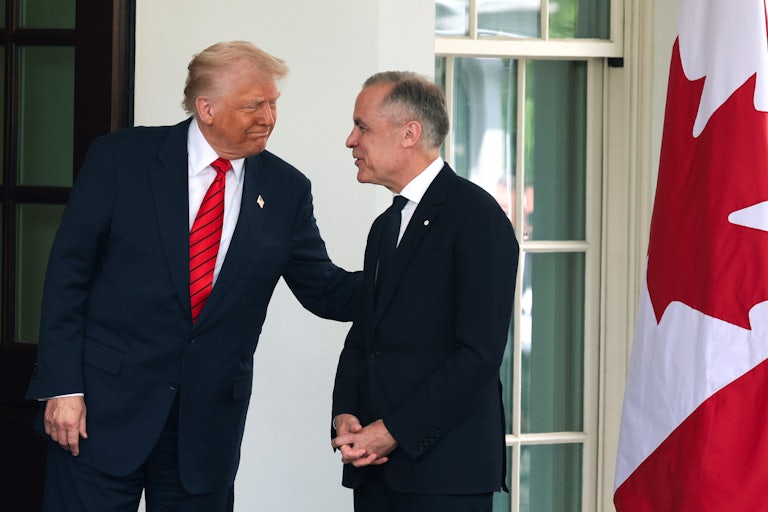
Donald Trump puts his hand on Canadian Prime Minister Mark Carney’s arm while they stand outside the White House
Alex Wong/Getty Images

Donald Trump made a wild post Tuesday slamming Canada, just moments before Canadian Prime Minister Mark Carney arrived at the White House for a tense meeting to discuss tariffs.

“I look forward to meeting the new Prime Minister of Canada, Mark Carney. I very much want to work with him, but cannot understand one simple TRUTH—Why is America subsidizing Canada by $200 Billion Dollars [sic] a year, in addition to giving them FREE Military Protection, and many other things?” Trump wrote in a post at 11:23 a.m. on Truth Social.

“We don’t need their Cars, we don’t need their Energy, we don’t need their Lumber, we don’t need ANYTHING they have, other than their friendship, which hopefully we will always maintain. They, on the other hand, need EVERYTHING from us! The Prime Minister will be arriving shortly and that will be, most likely, my only question of consequence.”

Carney arrived at the White House at noon, according to NBC News.

Trump’s meeting with Carney will be their first in-person interaction since Trump announced he would impose 25 percent tariffs on U.S. exports to Canada. The U.S. president has facilitated a rapid breakdown in relations between the neighboring countries, continually criticizing Canada’s dependence on the U.S. and repeatedly joking that it should become the fifty-first state.

Carney responded to Trump’s aggression in April, proclaiming that Canada’s old relationship with the U.S. was “over” and that the country would begin seeking new trading partners.

After Carney’s Liberal Party won Canada’s national election late last month, he started out his new term by dissing Trump.

“As I have been warning for months, America wants our land, our resources, our water, our country. But these are not idle threats. President Trump is trying to break us so that America can own us,” Carney said. “That will never ever happen.”

Trump’s Law Firm Deals Aren’t Working Out How He Hoped

Law firms that caved to Donald Trump are revealing they have ways to wriggle out of the deals.

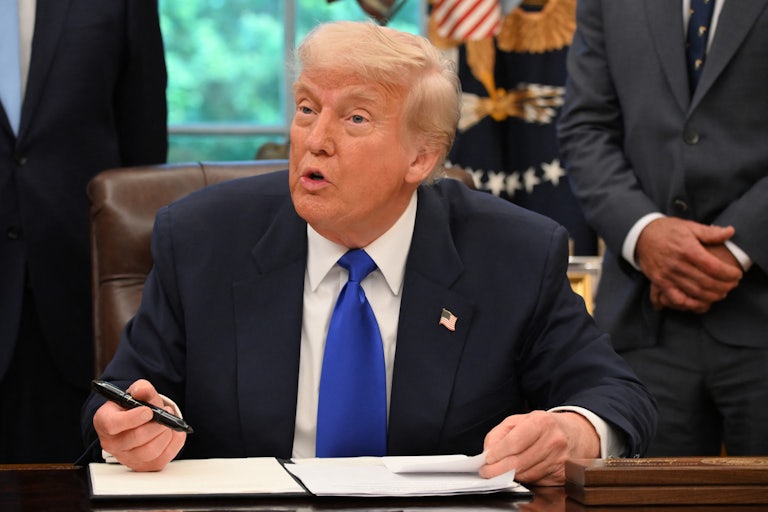
Donald Trump looks up while signing an executive order in the White House
Alex Wroblewski/AFP/Getty Images

President Donald Trump may have thought he was getting a legal war chest by threatening several major law firms—but it seems the famed dealmaker didn’t know exactly what he was signing on to.

In a series of letters to Representative Jamie Raskin and Senator Richard Blumenthal obtained by The Bulwark, several major law firms that cut deals with the Trump administration provided details on the terms of their agreements—and it’s looking like the president may have gotten the short end of the stick.

While the firms had reportedly agreed to provide millions of dollars of pro bono work for specific causes, many asserted that they had total authority over the selection of their clients.

Allen Overy Shearman Sterling LLP wrote that its agreement to provide $125 million in pro bono work “does not call for, or permit, the administration or any other person or entity to determine what clients and matters the Firm takes on, whether they be pro bono matters or otherwise.” The firm said it had simply agreed to provide free legal services across “three specified areas,” including assisting veterans, ensuring fairness in the justice system, and combating antisemitism.

The Bulwark reported that other firms’ deals had similar stakes. Latham & Watkins wrote that it “maintains its complete independence as to the clients and matters the firm takes on,” while Simpson Thacher & Bartlett wrote that their agreement with the government did not “dictate or restrict what pro bono matters we will take on moving forward.” Cadwalader, Wickersham & Taft wrote that they “have not and will not restrict our pro bono activities or the positions we take on behalf of those clients.”

Nine law firms have signed deals with the president, promising nearly $1 billion in pro bono work.

Meanwhile, Trump has projected a far grander view of what he could call on firms to do for him. The president claimed that the major law firms who struck deals stood at the ready to help him make deals with foreign countries to alleviate the weight of his sweeping reciprocal tariffs. He also floated the idea of using his battalion of attorneys to help the coal industry. In the White House, discussions had begun about deploying lawyers at DOGE and the DOJ, The New York Times reported last month.

Other firms seem to be using a different legalese to prevent themselves from being strong-armed by Trump. Skadden, Arps, Slate, Meagher & Flom LLP executive partner Jeremy London said that the firm had agreed to provide $100 million in pro bono work that “the president and Skadden both support,” which could potentially provide an out should the firm be remanded to work on a specific cause.

Last month, Raskin and Blumenthal penned letters to five major law firms they accused of being “complicit in efforts to undermine the rule of law” and demanded information on the deals.

A group of Democratic lawmakers sent another series of letters to law firms last month, warning that the Trump administration’s scheme to use “coercive and illegal measures” to blackmail firms could potentially violate federal laws against bribery, defrauding the public, and even racketeering.

If the firms have truly maintained authority over selecting which clients they represent, and which matters they take up, then some of these concerns may be moot. However, the lawmakers raised the possibility that by signing a deal with Trump, the firms were opening themselves up to extortion, asking what each firm planned to do to “ensure that the administration will not be able to require more from the firm beyond the provisions currently in place?”

Read more about Trump’s attacks on law firms:

Trump Treasury Secretary Crashes When Asked Easy Question on Tariffs

Scott Bessent glitched as he tried to answer a question about the real costs of tariffs.

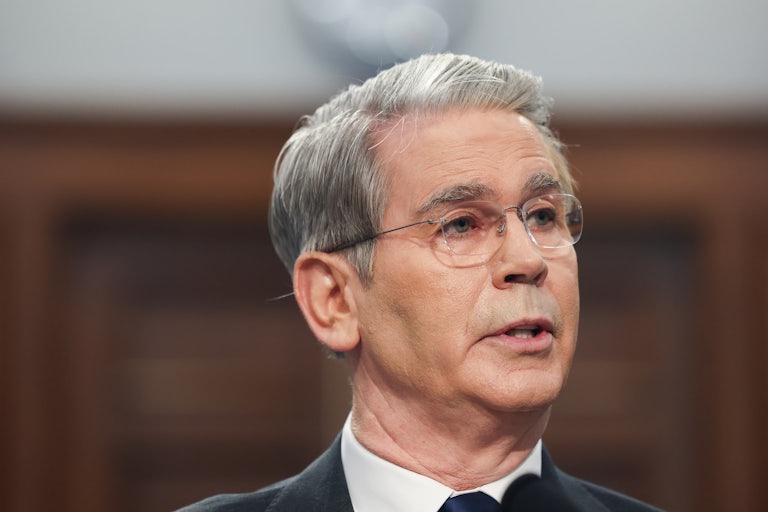
Treasury Secretary Scott Bessent testifies before Congress.
Tierney L. Cross/Bloomberg/Getty Images

U.S. Treasury Secretary Scott Bessent stumbled and deflected when asked a simple, direct question about tariffs at a congressional hearing on Tuesday.

“Who pays tariffs, Mr. Secretary?” asked Representative Mark Pocan.

Bessent began to ramble on indirectly, frustrating Pocan. “Who pays tariffs? Mr. Secretary, please, the question is very simply, Who pays tariffs? Mr. Chairman, I’d like him to answer that question; he wants to answer other questions.”

Bessent replied shakily. “Well, Congressman, if the congressman, if the exporters, the … uh, dislike tariffs so much, why wouldn’t they? If, I think what you’re trying to get me to say—”

“Did you remember the question? I’m not sure you did,” Pocan said. “Who pays tariffs?”

“It’s a very complicated question.”

“Reclaiming my time. People pay tariffs, right?”

“No, no, no,” Bessent muttered, while Pocan reclaimed his time.

“You clearly aren’t gonna answer, I’m not gonna waste my time having you go ‘uh uh uh uh.’”

The Trump administration is doing everything in its power to gaslight Americans into thinking that the tariffs will be positive; that we’ll just have some short-term discomfort before everything is cheap and made in America again. That couldn’t be further from the truth.

Meanwhile, what Republicans are up to: