Breaking News
Breaking News
from Washington and beyond

Republicans Are Already in Revolt Over Medicaid Cuts

Some Republican lawmakers are ready to kill the upcoming budget bill for not being cruel enough.

Representative Chip Roy speaks into a microphone during a House hearing
Kayla Bartkowski/Getty Images

House Republicans are already opposing House Speaker Mike Johnson’s budget proposal stripping health care coverage from millions of Americans—but not for the reason you think.

Texas Representative Chip Roy was outraged Monday by the House Republicans’ new budget proposal, which included $880 million in cuts largely to Medicaid, not because they were too big but because they weren’t big enough.

“I sure hope House & Senate leadership are coming up with a backup plan …. because I’m not here to rack up an additional $20 trillion in debt over 10 years or to subsidize healthy, able-bodied adults, corrupt blue states, and monopoly hospital ceos …” he wrote on X. Roy is policy chair of the House Freedom Caucus, which has been vocal in advocating massive cuts.

Utah Senator Mike Lee replied to Roy in agreement:. “🎯” he wrote.

The budget proposal would strip Medicaid from an estimated 8.6 million people over the next decade, according to estimates from the nonpartisan Congressional Budget Office. The cuts would come primarily due to work requirements—a minimum of 80 hours per month for able-bodied adults—as well as a requirement to verify eligibility twice a year, rather than once.

But not every Republican is pushing for more significant cuts to Medicaid. Earlier this month, 12 GOP lawmakers wrote a letter to Johnson writing that they would “not support a final reconciliation bill that includes any reduction in Medicaid coverage for vulnerable populations,” according to Axios.

Roy had pushed for large cuts to Medicaid while supporting the White House budget proposal released earlier this month, which would cut a whopping $163 billion in federal spending next fiscal year by eliminating programs on climate, education, health, and housing.

“Combined with our joint efforts to rescind additional wasteful spending, and deliver a reconciliation bill that will extend and expand the Trump tax cuts while reforming Medicaid and other programs to reduce deficits, we are poised to deliver prosperity, freedom, and strength to the American people,” Roy said in a statement at the time.

Crucially, it may not actually matter if Republicans approve of Donald Trump’s proposed budget. The administration isn’t ruling out using impoundment to override Congress’s decision, one official in the Office of Management and Budget told Politico. If the administration goes the route of impoundment, the president will be intruding on Congress’s power of the purse, in violation of the Impoundment Control Act of 1974. While Trump and his allies may claim the rule is unconstitutional, it’s not clear that the courts will agree.
Here’s How Much Trump Spent to Deport 32 Immigrants to Guantánamo

This makes zero financial sense—to say nothing of the plethora of human rights concerns.

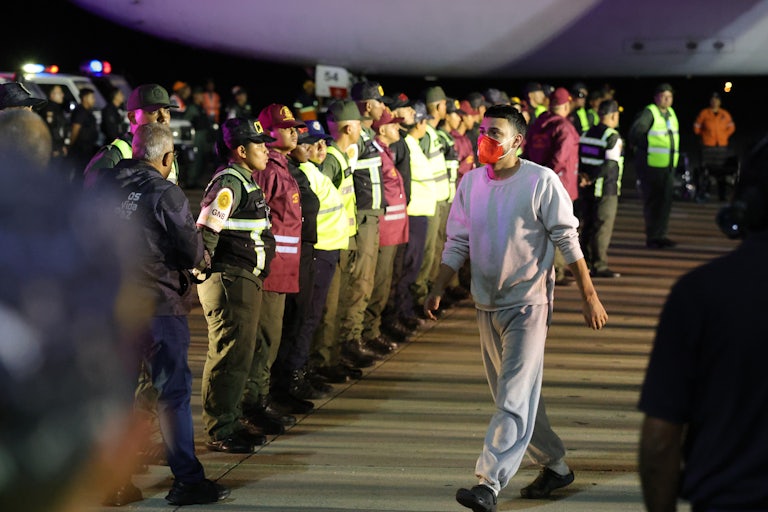
A man wears a gray sweatshirt, gray sweatpants, and a red face mask. He walks away from the plane as a line of airport workers and police officers watch him.
Javier Campos/Getty Images
A Venezuelan deported immigrant disembarks off the repatriation flight from Guantánamo to Simon Bolivar International Airport in La Guaira, Venezuela, on February 20.

The Trump administration’s decision to deport immigrants to the U.S. base on Guantánamo Bay, Cuba, cost taxpayers at least $21 million between January 20 and April 8.

Right now, the base only holds 32 immigrants, making the whole effort look like a massive waste. Close to 500 people in total have been held there since January, with no more than 200 at a time. Many immigrants held there have been returned back to the United States, as was the case with 40 people briefly held at the prison in March.

Flying immigrants to Cuba also carries a steep price: $26,277 is the average cost per flight hour for the military aircraft the Trump administration used. The drain of taxpayer dollars has drawn criticism from Democrats in Congress.

“Every American should be outraged by Donald Trump wasting military resources to pay for his political stunts that do not make us safer,” said Senator Elizabeth Warren, a member of the Senate Armed Services Committee. “U.S. service members did not sign up for this abuse of power.”

The military flew 46 flights this year between Trump’s inauguration and the beginning of April, lasting 802.5 hours and costing $21,087,300, according to Department of Defense data shared with Warren. So far, though, the total effort is far below Trump’s January promise to hold 30,000 immigrants at the Cuba facility.

But even if the Guantánamo Bay base was holding as many immigrants as Trump promised, it would still be a bad idea to use the detention center in this way, or even at all. A relic of the Cold War days when Cuba’s Communist regime was aligned with the Soviet Union, Guantánamo Bay became notorious after the September 11 attacks for holding terrorism suspects under the questionable legal designation of “enemy combatants.”

And Trump wants more immigrants held there: U.S. Transportation Command has ordered that a new additional weekly flight to Guantánamo begin. It’s part of a mission named Operation Southern Guard and involves the Department of Homeland Security, Immigration and Customs Enforcement, and the military. The base should have been closed years ago, but thanks to the inaction of previous Congresses and presidents, it continues serving a dubious purpose.

Gavin Newsom Escalates His War on the Homeless in Lead-up to 2028

The California governor thinks a ban on homeless encampments should be the priority right now.

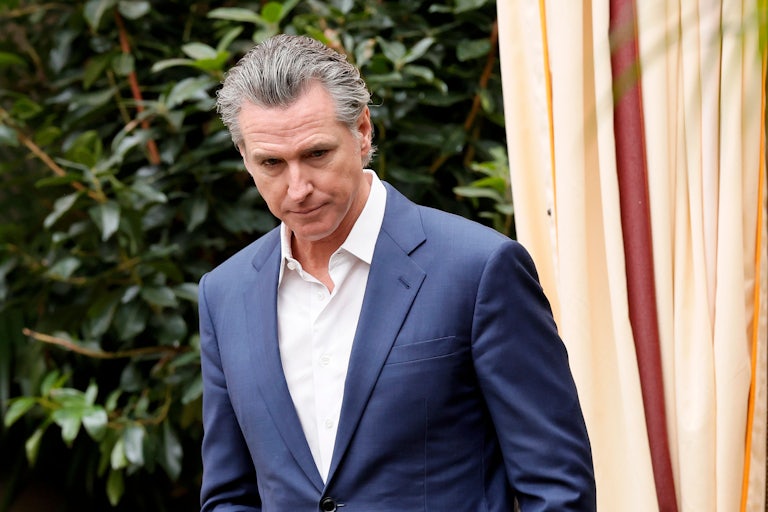
California Governor Gavin Newsom walks ouside while looking downward.
Frazer Harrison/WireImage

California Governor Gavin Newsom, an early contender for the Democratic presidential nomination in 2028, is doubling down on his war against his state’s homeless population.

Newsom on Monday called on cities across California—which accounts for a third of the country’s entire homeless population—to clear out and ban homeless encampments. There are 187,000 homeless people in California.

His administration has penned legislation that allows towns, cities, and counties to adopt their own spin on his order. He has also made $3.3 billion in funds available for expanded housing and treatment.

Newsom has cracked down on homelessness since he took office in 2019, but his strategy has yielded little aside from taking homeless people and moving them to different areas in the state, which is not a permanent solution. An audit from 2024 found that the state spent $24 billion over five years with not much to show for it.

This is another notable rightward shift for a man who is seen as a legitimate front-runner for the presidency in 2028.

“Gavin Newsom isn’t fighting homelessness, he’s fighting homeless people,” Current Affairs wrote on X. “Banning encampments won’t fix the housing crisis, but it will make life more miserable for those with nowhere to go.”

This move also comes as Los Angeles prepares to host the Summer Olympics in 2028.

Trump’s Transportation Sec Warns More Airport Outages Are Coming

Flying is about to get a whole lot worse, according to Sean Duffy.

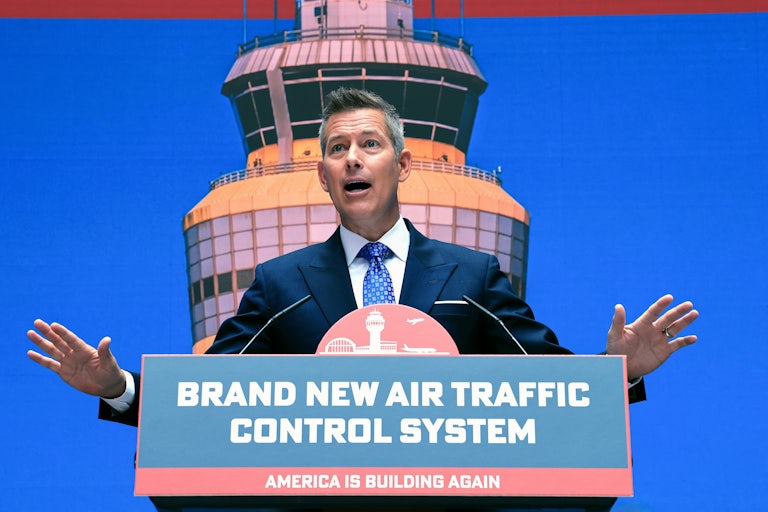
Transportation Secretary Sean Duffy gestures while speaking at a podium labeled "Brand New Air Traffic Control System"
Win McNamee/Getty Images

Rolling blackouts at Newark International Airport have continued to erode confidence in America’s airports, and while the Trump administration is promising that New Jersey’s flight problems will soon be a thing of the past, the problems are just beginning for the rest of the nation.

In an interview with MSNBC’s Meet the Press Sunday, Transportation Secretary Sean Duffy had only more warnings for the future of America’s commercial aviation industry.

“The lights are blinking, the sirens are turning.… What you see in Newark is gonna happen in other places across the country,” Duffy said, pointing to telecom and software issues at air traffic towers across the country. “It has to be fixed.”

He noted that, at least at Newark, “we believe we can have it up and running in short order.”

“We’re going to be able to fix that glitch, and we feel a little more comfortable about our primary line that gets the data in on radar,” Duffy said.

Duffy also mentioned that America’s airports are operating on equipment so outdated that the parts are no longer manufactured for replacements, telling host Kristen Welker that the government has to search online for alternatives.

“I’m concerned about the whole airspace. The equipment that we use, much of it we can’t buy parts for new, we have to go on eBay and buy parts if one part goes down. You’re dealing with really old equipment,” he said.

Duffy further acknowledged that while U.S. airspace is safe, a major outage could pose a “risk to life.”

Newark has experienced several significant disruptions since late April, causing hundreds of cancellations and delays, which officials have blamed on aging infrastructure and a shortage of air traffic controllers.

The shortage of air traffic controllers is nothing new, however: It’s been a problem decades in the making. A large bulk of controllers retired over the last 10 years—a coincidence made possible due to the fact that the majority of the staff onboarded simultaneously as replacements for the 11,350 controllers fired by President Ronald Reagan in 1982.

In 2015, the National Air Traffic Controllers Association told Congress that the situation had reached a “crisis” level and that, at the time, the Federal Aviation Administration had missed hiring targets five years in a row. For years, the federal government has failed to properly incentivize younger generations to view the famously high-stress, high-education, and relatively antisocial job as desirable—and similar to other industries, that lapse between the aging workforce and the stalling youth is contributing to a brain drain. (To address this, Duffy also said he’d told the union that air traffic controllers will be allowed to work past the age of 56.)

On top of that, the massive worker shortages have forced controllers to do double duty, for instance at Reagan International Airport, where controllers were reportedly tasked with handling both the flight paths of commercial airplanes and helicopters—work typically done by two separate controllers.

“The Congress and the country haven’t paid attention to it, and they expect it to work,” Duffy told MSNBC.

In February, the administration erased 400 FAA roles, including positions that supported air safety. Duffy confirmed the cuts that time, though he attempted to minimize them by highlighting the overall staffing of the agency, which he claimed employs some 45,000 workers.

At the time, Duffy said he would “supercharge” air traffic controller hiring, hoping to shave four months off the typically arduous onboarding process. But that likely wouldn’t make a dent in America’s air traffic staff anytime soon: It currently takes about four years to become a certified air traffic controller.

Questions have emerged as to whether Elon Musk and the Department of Government Efficiency directed the FAA cuts. But when asked directly about the issue, Duffy skirted the question.

“We were having a conversation about ‘Who do we preserve’,” Duffy said Sunday. “We went back and forth, and Elon agreed; the president agreed, ‘Of course you want to keep air traffic controllers.’ We’re trying to hire more of them. But I think the key is: Can your government be more efficient?”

“You can actually be more efficient and still accomplish the mission of safety,” Duffy told MSNBC.

On Thursday, Duffy released an eight-page framework to replace America’s antiquated aviation infrastructure, revealing at a press conference that the Trump administration would be investing in a “brand new, state-of-the-art air traffic control system that will be the envy of the world.” Unfortunately, the pitch did not mention how the agency would fund the massive technological overhaul.

Read about how air travel is going on Sean Duffy’s watch:

Trump Fails Basic Math Problem in His Own Drug Prices Executive Order

Donald Trump made some wild claims about how much he’s about to bring down drug costs.

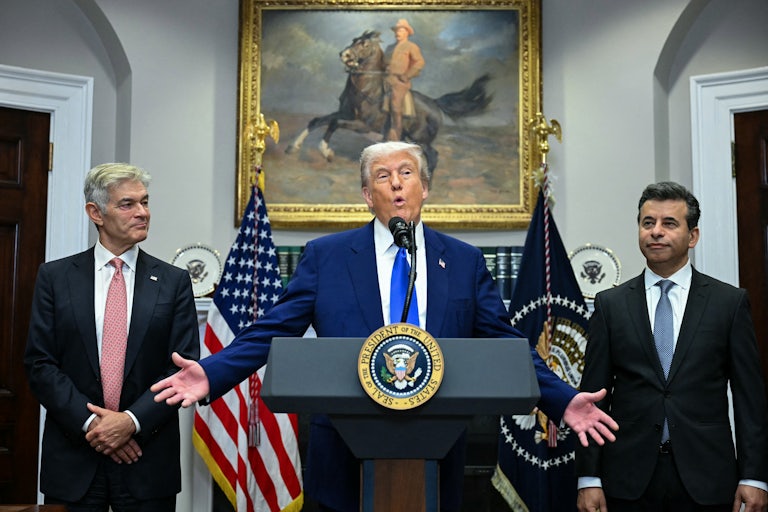
Donald Trump holds his arms out to the side while speaking at a podium in the Oval Office. He is flanked by Mehmet Oz and Marty Makary.
Jim Watson/AFP/Getty Images

Does Donald Trump know the details of his own executive order to reduce the price of pharmaceuticals?

During an address from the White House Monday morning, the president stumbled over the terms of his latest executive order, which set a 30-day deadline for drugmakers to negotiate lower prices in the U.S.

“Drug prices will come down by, much more really if you think—59, if you think of sometimes a drug that is 10 times more expensive, it’s much more than the 59 percent. You know, it depends on the way you want to analyze it, but in one way you could analyze it that way,” Trump said. “But between 59 and 80, and I guess even 90 percent.”

Trump insisted that the prices would be slashed by a far more significant rate than the cut he pushed in his first term. “Well, we’re getting them down 60, 70, 80, 90 percent—but actually more than that if you think about it in a way, mathematically,” he added.

Trump got one thing right: It’s entirely unclear how much prices will be reduced. If pharmaceutical companies fail to strike a deal to lower prices, then the U.S. will tie its drug prices to those paid by other countries. But as of now, nothing has changed.

This is far from the first time the president has struggled trying to explain a policy idea. Last week, the president rambled incoherently when asked to explain why he wanted to reopen Alcatraz.