Breaking News
Breaking News
from Washington and beyond

MAGA and Silicon Valley Are Battling for Influence in the White House

A new report lays out the tensions at play behind Trump’s executive order on AI.

Donald Trump signs an executive order in the Oval Office.
Alex Wong/Getty Images

President Donald Trump signed an executive order Thursday intended to stop states from regulating AI—an idea that had received a lot of pushback from members of his base.

The order didn’t emerge out of a vacuum, of course. MAGA Republicans and Silicon Valley leaders have been locked in a battle for influence over the White House on tech policy for some time, The Washington Post reported on Sunday.

Trump’s tech advisers seem to be winning.

Let’s back up a few months: over the summer, the Senate killed a bill that would have imposed a 10-year moratorium on AI laws from states. Then, when a draft version of the just-signed executive order leaked last month, many Republicans, who traditionally support states’ rights, tried to stop the president from going forward with it.

GOP members including Georgia Representative Marjorie Taylor Greene decried the idea, writing on X that “states must retain the right to regulate and make laws on AI and anything else for the benefit of their state. Federalism must be preserved.”

Conservative groups, members of Congress, and governors all reportedly reached out to the White House to raise the alarm about the draft as well.

The Post spoke to more than a dozen people familiar with the administration’s AI policies and White House officials and concluded that this moment was emblematic of a wider struggle between Trump’s base and his tech advisers and industry leaders who used their money and sway to help put him in office.

“It feels like millions of votes across the country just got traded for thousands of [venture capitalist] and tech rich votes in regions Republicans will never win,” one source said.

Compromises were made to the draft to bring Republicans on board, and silence critics, the Post reported, and Trump ended up signing the order this week.

The tension between what Big Tech and the president’s populist supporters want isn’t likely to disappear overnight, though. And as the midterm elections loom, more and more cracks are appearing among Trump’s MAGA base.

Trump’s Support Is Declining Among MAGA Base: Poll

More Americans are suffering from economic woes, and Donald Trump is losing support.

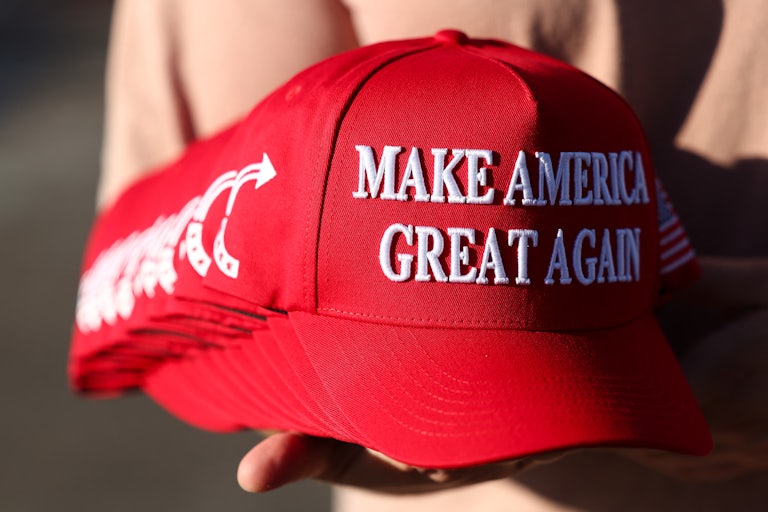
A person holds a stack of Make America Great Again hats.
Charly Triballeau/AFP/Getty Images

President Donald Trump’s support is starting to waver, even among his staunchest supporters, a new poll shows.

Don’t get it twisted—Trump’s approval rating among adults has been in the red for months, and is still falling, with now close to 60 percent of Americans saying they disapprove of the president. But according to an NBC News Decision Desk poll that surveyed 20,252 adults online, the two groups that show the largest drop in support for the president since April are Republicans and MAGA Republicans.

For people who identified themselves as Republicans rather than part of MAGA, the percentage who “strongly approve” of the president has dropped to 35 percent, from 38 percent in April.

Among MAGA Republicans, there’s a much higher percentage of people who strongly approve of Trump: 70 percent. But that’s down eight percentage points since April.

Plus, fewer Republicans report being part of MAGA today than did earlier this year. In April, 57 percent of Republicans identified as MAGA, but today the two sides of the party are equally split at 50–50.

These are small shifts, but they belie Trump’s fracturing base of support. From Marjorie Taylor Greene’s split from the president and abrupt resignation to the botched rollout of the Epstein files, to Trump’s tariffs and inability to bring down prices, there are some issues that even die-hard MAGA adherents can’t overlook.

Read more about Trump’s declining popularity:

Climate Change Is Coming for Your Favorite Holiday Foods

Consider yourself forewarned.

A tray of holiday cookies.
Justin Tsucalas/The Washington Post/Getty Images

Chocolate, vanilla, coffee, cinnamon: The ingredients for your favorite holiday foods are becoming increasingly harder to grow because of climate change.

For example, cocoa beans are grown in West Africa, which has been facing more days of extreme heat and drought, according to a recent report from the Weather Channel. “The crop doesn’t like it,” meteorologist Jennifer Gray explained.

And when cocoa production falls, consumers also feel the heat: Prices for chocolate have shot up over the last year and were four times as high at the end of 2024 as they were in 2022.

Vanilla and cinnamon, key ingredients for holiday baking that are largely grown in Southeast Asia and Indonesia, are also under threat. “Because we rely on just a handful of islands to produce basically our world’s cinnamon, it is extremely vulnerable. These are also places that are facing climate extremes,” Gray said.

And for something like coffee, climate change is drastically shrinking the land where it can grow. Suitable locations could decrease by 50 percent by 2050, according to a 2014 study. Plus, the Trump administration’s on-again-off-again tariffs have shocked the coffee market, one that’s already reeling from landslides and floods in Vietnam.

That festive mocha latte looks like it’ll be getting a lot more expensive. Luckily, we’ll have a lot more heat waves, fires, and floods to deal with to distract us.

Read more about climate change:

Trump Scraps Abolition Coins, Features Himself Instead

The Trump administration nixed commemorative coins meant to honor abolitionists and women in favor of honoring more old white men.

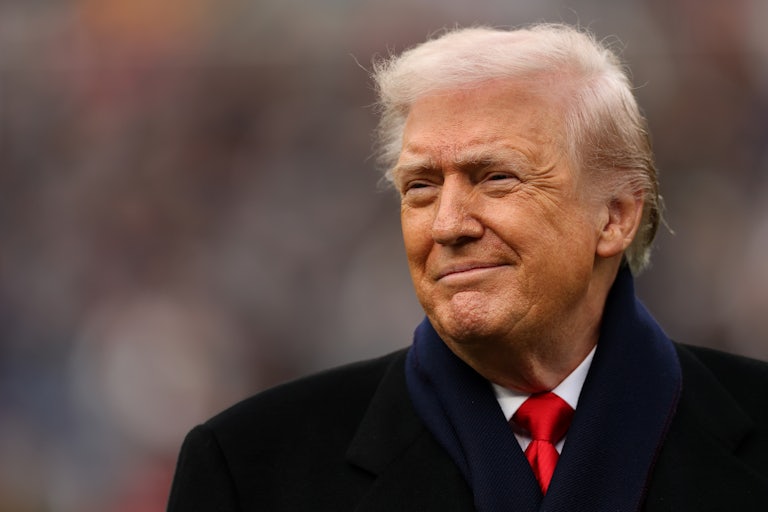
Donald Trump smiles at the camera at a sports event.
Patrick Smith/Getty Images

To celebrate America’s 250th birthday, President Donald Trump is commemorating the most important person in the country’s history: himself.

Back in 2021—days after the January 6 riots—Trump signed an act to authorize the creation of new coins to celebrate the country’s 250th anniversary. The act specified that one coin be focused on women’s contribution to U.S. history.

In response, a bipartisan committee came up with some recommendations: a coin featuring Frederick Douglass to represent abolition, one with a “Votes for Women” flag to honor women’s suffrage, and a coin featuring 6-year-old Ruby Bridges, who helped desegregate her school in 1960.

But Treasury Secretary Scott Bessent, who has ultimate say, did not follow these recommendations, reported The New York Times.

Instead, the new coins will feature a Pilgrim couple on the Mayflower, George Washington, Thomas Jefferson, James Madison, and Abraham Lincoln. (The Trump administration, apparently, was not satisfied with the already significant coin representation of three out of four of these historic American men.)

And then, the collection’s pièce de résistance: a Trump dollar coin, featuring the president’s likeness on both sides.

It’s worth pointing out that it is incredibly abnormal—and some would argue, anti-American—to have a sitting president on a coin. Washington refused to have his likeness on a coin while he was president, as it felt too king-like for the leader of the newly free United States, according to the Times. Trump, apparently, has no such qualms.

Read more about Trump’s obsession with rewriting U.S. history:

Dem Senator Slams Trump for Making U.S. More Prone to Gun Violence

After a deadly attack at Brown University, Senator Chris Murphy called out the president for weakening programs and laws that would prevent gun violence and mass shootings.

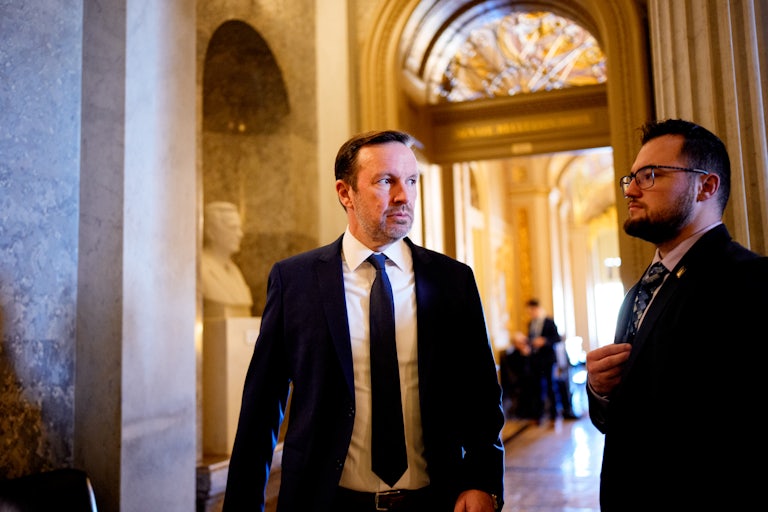
Democratic Senator Chris Murphy walks to a meeting.
Andrew Harnik/Getty Images

After a deadly shooting at Brown University which left two people dead and injured nine others, people across the country struggled Sunday to make sense of the event and the needless loss of life.

But while Americans tend to agree that mass shootings such as this one are a tragedy, much of the GOP, predictably, continues to engage in magical thinking—by pretending gun violence is not at all connected to being able to easily procure guns.

Democratic Senator Chris Murphy pointed out during an interview on CNN on Sunday that the president himself was making the problem much, much worse.  

“Over the last year, President Trump has been engaged in a dizzying campaign to increase violence in this country,” Murphy said. “He is restoring gun rights to felons and people who have lost their ability to buy guns, he eliminated the White House office of gun violence protection, and he has stopped funding mental health grants and community anti–gun violence grants that Republicans and Democrats supported... He’s been engaged in a pretty deliberate campaign to try to make violence more likely in this country, and I think you’re unfortunately going to see the results of that on the streets of America.”

“That’s a pretty big statement. He’s in a campaign to make violence more likely?” the CNN anchor said.

“Of course,” Murphy said. Later, he continued: “The evidence tells you that when you stop funding mental health, you stop funding community anti–gun violence programs, when you give gun rights back to dangerous people, you’re going to have an increase in violence, that is knowable and that is foreseeable.”

While authorities have reported that a person of interest in the shooting has been detained, details about the deadly attack at Brown University are still emerging. President Trump, for his part, weighed in on the situation Saturday night, saying, “All we can do right now is pray.”