Breaking News
Breaking News
from Washington and beyond

Wisconsin Democrats Save Governor Evers’s Veto Power

Evers has vetoed Republican bills nearly 150 times in the past. Republicans weren’t able to get a supermajority in the legislature to override him.

Jim Vondruska/Getty Images

Wisconsin Governor Tony Evers has been reelected—and thanks to Democratic victories in the state legislature, he’ll have some power against Republicans’ agenda.

Evers beat Republican Trump-backed challenger Tim Michels 51.2 percent to 47.8 percent, with 99 percent reporting. Michels, a millionaire construction executive backed by former President Donald Trump, supported a state-level abortion ban only with exceptions for cases of rape or incest. Opposed to same-sex marriage, Michels also questioned the integrity of the 2020 election.

At the same time, state Democrats were able to stave off Republican supermajorities in the state legislature. Republicans are still projected to win control of the legislature, but the news means that they won’t have a veto-proof majority.

Since coming into office, Evers has vetoed a whopping 146 bills sent to his desk by the Republican-controlled state legislature. A majority of these, 126 vetoes to be precise, took place since January 2021. These included bills that sought to restrict voting access, ban vaccine mandates, limit schools’ ability to teach students about racism and sexism, cut unemployment and Medicaid benefits, and much more.

Had state Republicans secured two-thirds supermajorities in both the state Senate and Assembly, Evers would have had far less power to stop such bills, many of which may resurface in the coming year. As it stands, state Republicans, who benefit from one of the nation’s most heavily gerrymandered maps, will fall short.

The state GOP had drawn these gerrymandered maps in 2011—once they regained trifecta control in the state. And Republicans have never looked back, holding their grip on a state that just re-elected a Democratic governor, and elected Biden in 2020 and Obama in 2012.

For now, Democrats still have an able defender in Evers, who can stave off Republican attacks on the government’s ability to do anything for its people.

More on the Election

Four States Vote to Ban Prison Labor and the “Slavery Loophole”

Alabama, Oregon, Tennessee, and Vermont will all change their state constitution.

J. Conrad Williams Jr./Newsday/Getty Images

Four states voted to ban slavery on Election Day, closing a loophole in the Thirteenth Amendment that allows for draconian prison labor practices.

The Thirteenth Amendment bans slavery or involuntary servitude, except when used as punishment for a crime. About 800,000 prisoners across the United States are forced to work, often in cruel conditions and for little or no pay.

Tennessee, Vermont, and Oregon all passed amendments to their state constitutions Tuesday eliminating language that allows slavery as punishment in prisons, by 79.7 percent, 89.2 percent, and 54.3 percent of the vote in each state, respectively, according to The New York Times.

In Alabama, 76.6 percent of residents voted to recompile the state constitution, which will remove racist language and legally irrelevant provisions, including prison labor. The referendums do not automatically change the state of prison labor, but they do make it easier for legal challenges over the treatment of prisoners.

Unfortunately, in Louisiana, 60.9 percent of state residents voted to keep the language allowing slavery as punishment for inmates.

The U.S. prison system has the highest incarceration rate in the world, and Black people are disproportionately imprisoned, according to the ACLU.

Prison workers produce about $2 billion worth of goods per year, and more than $9 billion in services annually, the ACLU found in a report. California has long used inmates as firefighters, some of whom are sent out with insufficient equipment.

These workers are paid an average of 52 cents per hour nationally—seven states pay them nothing at all—but they don’t get to keep all of the money they do make.

They end up pocketing less than half of what they earn after deductions are made for taxes, room and board fees for the prison where they are locked up, and other costs.

Any inmates who refuse to work are often punished, University of California, Los Angeles law professor Sharon Dolovitch and Stony Brook University associate history professor Robert Chase told The Washington Post, such as with solitary confinement or the removal of sentence reductions for good behavior.

Colorado was the first state to close the loophole in 2018, followed by Nebraska and Utah in 2020.

More Ballot Initiatives This Election:

A Running List of Every Major Trump-Endorsed Candidate Who Lost The Election

Former President Donald Trump supported a lot of candidates who lost, often in races Republicans were expected to win.

Joe Raedle/Getty Images

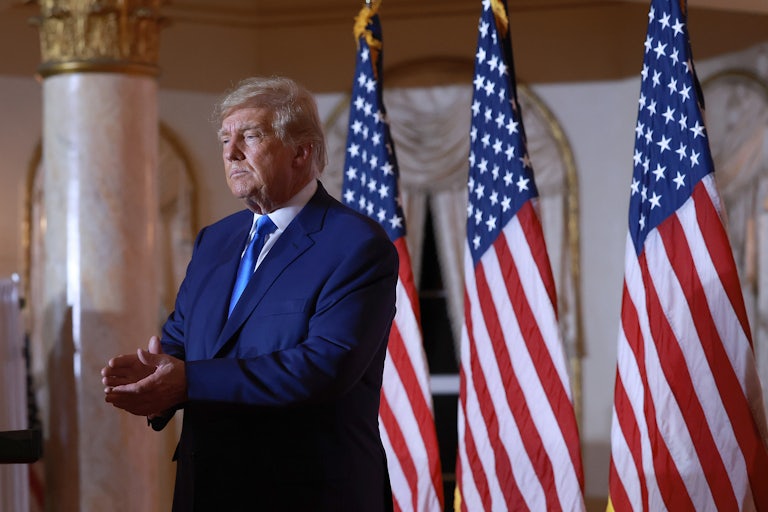
Hours before the midterm election polls were set to close, former President Donald Trump said that if Republicans do well, he should “get all the credit”—but if they lose, he “should not be blamed at all.”

Maybe Trump knew what was coming. Because what some saw as a forthcoming red wave turned out to be a ripple, at best. And many of the candidates Trump personally endorsed lost the election, a lot of them in races Republicans were expecting to win.

Here is a running list of every major Trump-endorsed candidate who lost the election:

Senate

  • Kelly Tshibaka, Alaska
  • Blake Masters, Arizona
  • Leora Levy, Connecticut
  • Herschel Walker, Georgia
  • Adam Laxalt, Nevada
  • Don Bolduc, New Hampshire
  • Mehmet Oz, Pennsylvania
  • Gerald Malloy, Vermont

House

  • Sarah Palin, Alaska’s At-large District
  • Kelly Cooper, Arizona’s 4th district
  • John Gibbs, Michigan’s 3rd district
  • Karoline Leavitt, New Hampshire’s 1st district
  • Robert Burns, New Hampshire’s 2nd district
  • Sandy Smith, North Carolina’s 1st district
  • Bo Hines, North Carolina’s 13th district
  • Jim Bognet, Pennsylvania’s 8th district
  • Steve Chabot, Ohio’s 1st district
  • J.R. Majewski, Ohio’s 9th district
  • Madison Gesiotto Gilbert, Ohio’s 13th district
  • Yesli Vega, Virginia’s 7th district
  • Joe Kent, Washington’s 3rd District

Governor

  • Kari Lake, Arizona
  • Darren Bailey, Illinois
  • Derek Schmidt, Kansas
  • Dan Cox, Maryland
  • Geoff Diehl, Massachusetts
  • Tudor Dixon, Michigan
  • Scott Jensen, Minnesota
  • Mark Ronchetti, New Mexico
  • Lee Zeldin, New York
  • Doug Mastriano, Pennsylvania
  • Tim Michels, Wisconsin

Secretary of State

  • Mark Finchem, Arizona
  • Kristina Karamo, Michigan
  • Kim Crockett, Minnesota
  • Jim Marchant, Nevada

Attorney General

  • Matthew DePerno, Michigan

This piece was last updated on December 7.

Ron Johnson, One of the Most Corrupt Republican Senators, Wins Wisconsin Senate Race

Johnson managed to survive a challenge from Democrat Mandela Barnes and hold onto his seat.

Scott Olson/Getty Images

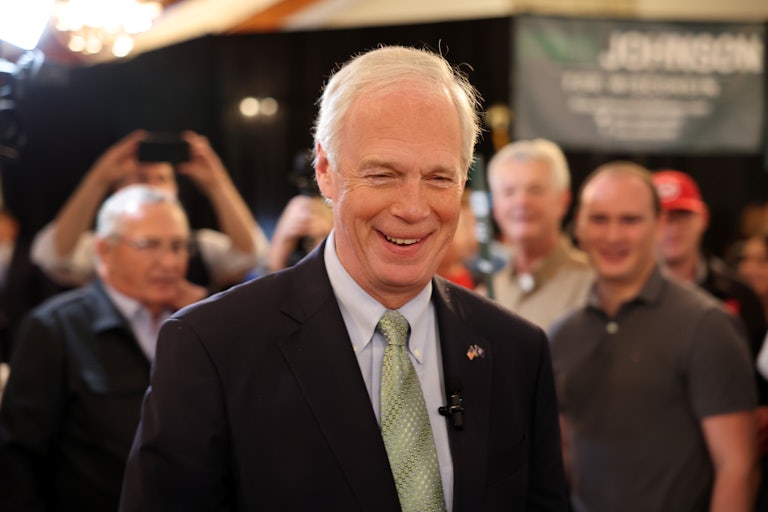
Senator Ron Johnson has been reelected, besting Democratic challenger Mandela Barnes, NBC News projects.

Johnson leads Barnes 50.5 percent to 49.5 percent on Wednesday morning, with 100 percent reporting.

Johnson came to the Senate on the coattails of the Tea Party movement, positioning himself as a classic fiscal hawk. But as with many fiscal conservatives, for Johnson, belt tightening seemed to boil down to “rules for me and not for thee.”

Before being elected, Johnson evaded up to $3.5 million in federal taxes by loaning himself millions from his own company. He only had to pay interest on the loans, that was then paid back to his company—avoiding any taxes from the money he received from the company.

After Johnson had spent nearly $9 million of his own money to win his seat in 2010, his plastics company (inherited from his wife’s brother) paid him a curious $10 million in “deferred compensation” shortly before he was sworn into office. “It’s a private business,” Johnson told the Milwaukee Journal Sentinel. “I’ve complied with the disclosure laws, and I don’t have to explain it any further to someone like you.”

Once elected, Johnson’s trust fund (used to buy a million-dollar house) helped him avoid hundreds of thousands in taxes by exploiting the state’s “Manufacturing and Agriculture Tax Credit.” Later, Johnson pushed to ensure Trump’s 2017 Tax Cuts and Jobs Act included a tax break that benefited him, and two of his biggest donors—garnering the pair $215 million in tax deductions just in 2018.

Johnson has metastasized into the kind of Republican who revels not only in rigging the system for his and his allies’ benefit, but also in fomenting conspiracy—perhaps to try distracting from his corrupt mal-governance, or simply to maintain appeal with the most extreme wing of his party. He helped spread misinformation about the coronavirus, pushed conspiracy surrounding the 2020 election’s integrity, and called climate change “bullshit.”

And now, Ron Johnson continues the mantle that he (and at one point Scott Walker) proudly owns: being a particularly vile Republican unfortunately representing the state of Wisconsin.

Warnock, Walker Officially Head to Runoff in Georgia Senate Race

The Georgia Senate race was too close to all, the secretary of state announced.

Anna Moneymaker/Getty Images

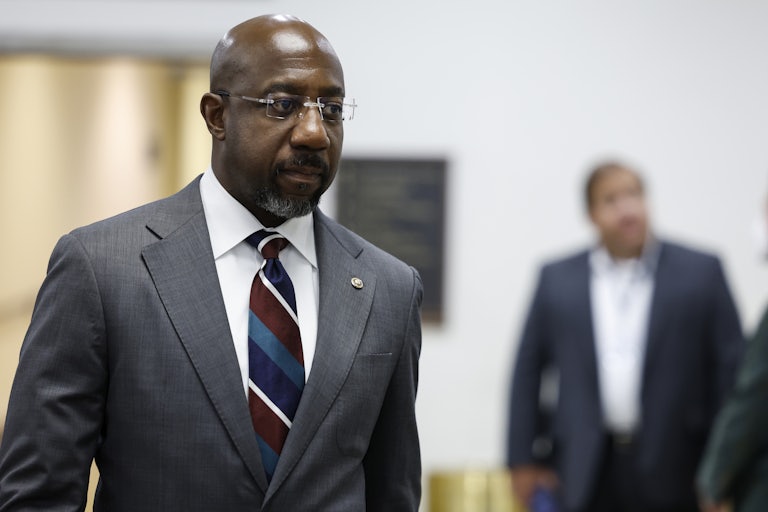
Raphael Warnock, Georgia’s first Black senator, and ultra-conservative opponent Herschel Walker will head to a runoff vote on December 6 to determine who will be elected senator, the secretary of state announced Wednesday.

As of Wednesday morning, incumbent Warnock had 49.4 percent of the vote, while Walker stood at 49.5 percent, according to The New York Times. Neither candidate will win 50 percent of the state, the minimum requirement for avoiding a runoff.

The pair will now enter a four-week campaigning blitz ahead of the second vote.

Warnock was elected to Congress alongside fellow Democrat Jon Ossoff in January 2021 runoff elections, a major victory for Democrats in the historically red state. Georgia also went for President Joe Biden in the 2020 presidential election.

But despite the state’s recent history of leaning Democratic, Walker and Warnock were locked in a dead heat for almost the entire race.

A pastor, Warnock describes himself as “Christian progressive,” similar to Dr. Martin Luther King, Jr., who presided at the same church in Atlanta where the senator now leads the congregation.

Warnock is pro-choice and campaigned on the belief that the United States can overcome its racist roots and enact social change.

Walker, meanwhile, ran on an ultra-right-wing platform, saying he is pro-life, supports traditional (heteronormative) family values, and would back another run by former President Donald Trump.

He complained about “wokeness” and says he does not believe racism exists.

He also lied about his academic record and was accused by two women of pressuring and paying for them to get abortions.

But Walker enjoyed the widespread support of the Republican Party, who insist that electing a Black senator proves their party is not racist.

But several reports, citing anonymous GOP sources, said that the party really hoped Walker would be both a puppet and a good buffer against accusations of racism. According to The Washington Post, “Many Republican operatives admit privately that Walker was backed by the party’s leaders at least in part because the GOP wanted a Black candidate to face Warnock.”

This piece has been updated.