Breaking News
Breaking News
from Washington and beyond

Trump Is Having a Meltdown After So Many of His Candidates Lost the Election

The former president is reportedly “screaming at everyone” as the election results come in.

Drew Angerer/Getty Images

Donald Trump is not having a good morning.

Out of 37 candidates in competitive races that the former president endorsed ahead of Election Day, only 10 have won so far. Nine lost, and 20 of those races are still undecided. And the full list of Trump-endorsed candidates that lost is much, much longer.

Trump has tried to play it down, posting on Truth Social that Tuesday night was a “GREAT EVENING” with an “amazing job by some really fantastic candidates,” but multiple reports indicate that a very different scene is playing out behind closed doors.

New York Times reporter Maggie Haberman tweeted that Trump was “furious” Wednesday morning.

CNN had a similar report, citing a Trump adviser as saying the original MAGA Republican has been “livid” and “screaming at everyone” as the results come out.

The Republican Party, however, seems ready to move on.

Fox News, once a stalwart of Trump support, published a story Wednesday morning announcing, “Ron DeSantis is the new Republican Party Leader.” The Florida governor was reelected Tuesday by nearly 20 points.

Trump and DeSantis have repeatedly butted heads as they vie for who will lead the GOP next. DeSantis has said that if Trump runs, he will stand aside, while Trump has threatened to “reveal things about [DeSantis] that won’t be very flattering” should the Florida governor oppose him for the presidency.

Meanwhile, former Trump communications director Alyssa Farah Griffin called her old boss a “loser” on Fox News during election commentary.

“If you want the Republican Party to thrive, we’ve got to just finally speak out and say, ‘This man is a loser. He lost 2020 … he’s losing us seats that were winnable this time,” she said.
Latino Voters Did Not Abandon Democrats This Election

Despite what the media narrative is saying, Latino voters still showed up for Democrats. (But their support is slipping.)

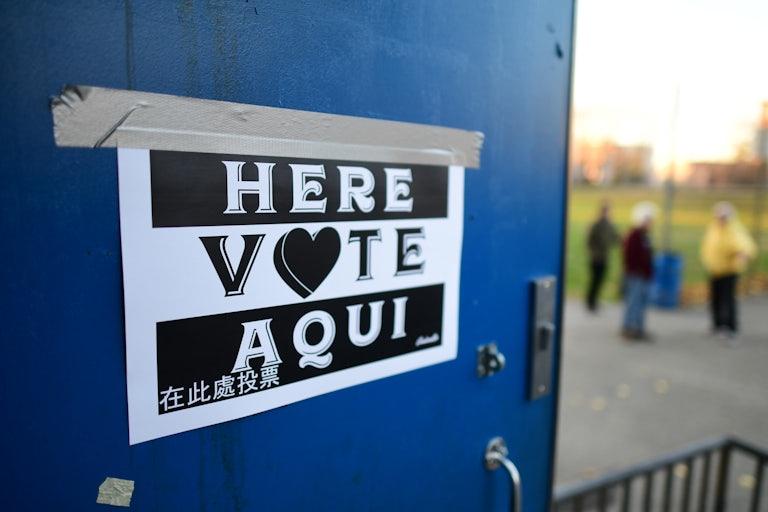
A sign says "Here VOTE Aqui." The "o" in Vote is a heart.
Mark Makela/Getty Images

Latino voters did not abandon the Democrats on Election Day, but the demographic’s unquestioned support is starting to wane.

Despite widespread analyst predictions that Latino voters would swing Republican during the midterms, network exit polls and the AP found Wednesday morning that about 60 percent of Hispanic and Latino voters went Democratic.

That is lower than the previous midterm cycle, though, when about 70 percent of Hispanic and Latino Americans voted Democratic.

In the weeks leading up to the election, multiple reports indicated that Democrats had taken the Latino community’s support for granted and had not done enough to address the group’s top issues.

Recent polls by the Pew Research Center, however, found that Latino Americans tend to have a generally positive view of the Democratic Party. About 63 percent of Latinos said in September that the party “really cares” about their community, and 60 percent said the party represents their interests.

Latino voters were also crucial in sending President Joe Biden to the White House in 2020, supporting the Democrat 2-1 over Donald Trump.

But Trump over-performed among Latinos in Florida and Texas during that presidential election, shaking the belief that the Hispanic vote is a solidly Democratic monolith.

Instead, Latino Americans are proving to be the new swing voter demographic. Democrats such as Nevada Senator Catherine Cortez Masto sought to reach out to Latino small business owners, to ensure they did not feel forgotten by Washington lawmakers.

It remains to be seen whether that paid off for her.

Maryland and Missouri Vote to Legalize Marijuana

After this election, recreational marijuana use will soon be legal in 21 states and D.C.

Michael M. Santiago/Getty Images

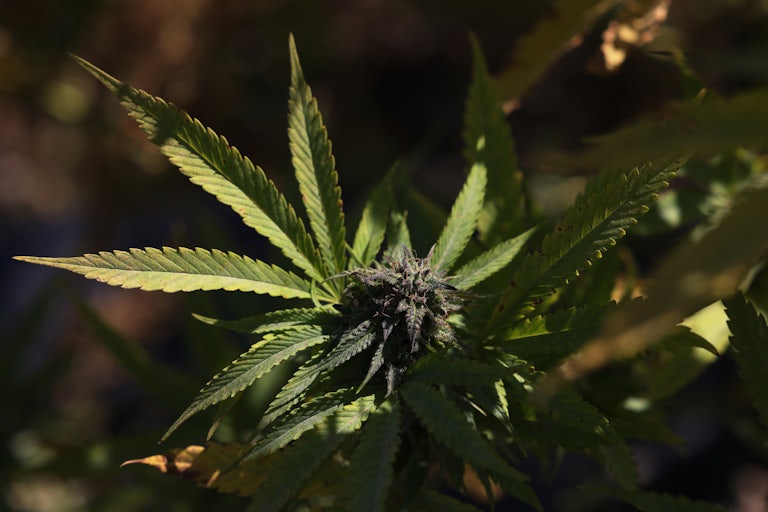
Maryland and Missouri have voted to legalize recreational use of marijuana.

In Maryland, voters passed a measure legalizing recreational use for adults age 21 and older and allowing the Maryland General Assembly to regulate and tax cannabis. Adults in Maryland will be allowed to smoke marijuana, grow up to two cannabis plants, and possess up to 1.5 ounces of marijuana beginning July 1, 2023.

The measure passed 65.54 percent to 34.46 percent, with 82 percent reporting.

Legislation paired with the passage modifies penalties for people under the age of 21 found to be using cannabis. The bill would also automatically expunge convictions for any conduct now legal under the new law—and people serving time for any offenses would be allowed to file for resentencing.

In Missouri, voters passed a similar measure, 53.14 percent to 46.86 percent, with 96 percent reporting. Adults over the age of 21 will be able to possess up to three ounces of marijuana, and grow up to six cannabis plants, come December.

The measure also enacts a six percent tax on the retail price of recreational marijuana and—unlike Maryland where this will be done automatically—allows people with marijuana-related offenses to petition to be released from incarceration and have their records expunged.

The results display the ever-increasing popularity of marijuana legalization. While Maryland is a reliably blue state, Missouri is not. Former President Donald Trump won Missouri by 15 points in 2020.

Even in states where marijuana legalization initiatives did not pass, the measures overperformed relative to Democratic results. In North Dakota, the measure failed by just under 10 points, while in South Dakota it fell short by about six. In Arkansas the measure failed by about 13 points. Trump had won by over 25 points in all three of those states in 2020.

With Maryland and Missouri’s passage of the measures, recreational marijuana use is now legal in 21 states and Washington, D.C.

All Five States With Abortion on the Ballot Voted to Increase Access

Voters in California, Michigan, Vermont, Kentucky, and Montana all showed up to protect abortion.

Jon Cherry/Getty Images
Abortion rights protesters in Louisville, Kentucky.

Five states voted to increase abortion access on Election Day, in a massive victory for women and gender minorities.

California, Michigan, and Vermont all passed constitutional amendments codifying the right to abortion Tuesday, with 65.2 percent, 55.5 percent, and 77.4 percent of the vote in each state, respectively, according to The New York Times.

Kentucky and Montana both voted against anti-abortion ballot initiatives. In Kentucky, 52.6 percent of people voted against an amendment that would have said abortion is not a protected right in the state. In Montana, 52.6 percent of state residents voted to reject a measure that would have deemed any infant “born alive” a legal person, the Times reported.

Abortion became a hotly contested issue after the Supreme Court overturned the nationwide right to the procedure in June. States rushed after the ruling to either enshrine or scale back abortion access. Health experts warn that banning the procedure will result in a massive uptick in the national maternal mortality rate.

In August, residents of Kansas, a typically conservative state, voted to keep abortion protections in the state constitution, a major twist that had many activists hopeful for future reproductive rights referendums—and, it would seem, with good reason.

In California, people voted by 1,617,876 points Tuesday to add an amendment to the state constitution enshrining the right to “reproductive freedom,” which includes both abortions and contraception. The state had passed a law legalizing abortion after the Supreme Court ruling, but an amendment cannot be challenged in court and therefore holds more power.

Vermont also already has a law protecting abortion, but residents voted by 91,155 points to enshrine the right to “reproductive autonomy” in the constitution, as well.

In Michigan, the Supreme Court ruling triggered a 1931 law banning abortion, but a state court temporarily blocked that law going into effect. Michigan residents passed a constitutional amendment by 443,940 points protecting abortion rights. As a result, the old law can no longer be implemented.

In a surprise similar to Kansas, voters in conservative Kentucky rejected an amendment that would have specified their constitution does not protect abortion access. The decision to keep abortion access passed by 67,953 points.

Montana abortion rights are protected under a 1999 state Supreme Court ruling, but residents voted Tuesday on a measure about fetal personhood. The law, which people rejected by 20,581 points, would have required medical care be given to “infants born alive after an induced labor, cesarean section, attempted abortion, or another method.”

The measure said “born alive” meant anything that “breathes, has a beating heart, or has definite movement of voluntary muscles.”

However, fetuses are rarely “born alive” after an abortion, according to the CDC. Montana state health experts had slammed the measure, warning it could have negatively affected care for babies born prematurely or with fatal abnormalities by preventing doctors from helping relieve any pain those babies might be in, or punishing medical professionals that let families hold such newborns before they die.

Reports That Ron Klain May Soon Leave the White House Are Concerning

Please don’t go, Ron Klain!

Al Drago/Getty Images
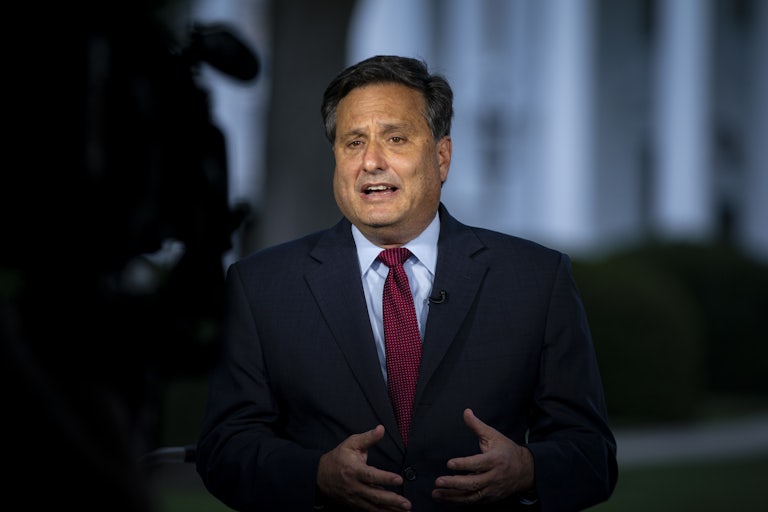
White House Chief of Staff Ron Klain

As if awaiting the midterm results weren’t enough to put Democrats on edge, Politico’s Eli Stokols and Alex Thompson reported Tuesday afternoon that White House chief of staff Ron Klain may soon depart the White House.

That would be very bad. Klain has been the Biden administration’s indispensable man. Indeed, some would argue he’s more indispensable than Joe Biden. Klain (whom I know slightly) is a decent, fiercely intelligent, highly experienced political operator whom Stokols and Thompson describe as:

... a chief of staff intent on managing the flow of information to the president and keeping a tight grip on power, advising everyone on everything and being involved in even the smallest policy and planning details. Whenever Biden is set to deliver a speech, one official explained, “Ron often has to see the [camera] shot beforehand.”

Inevitably, Klain has committed a few blunders, including, according to Politico, encouraging Biden to declare victory over Covid on July 4. Two months later, Biden said, “the pandemic is over.” One month after that your faithful correspondent flung his mask to the side, contracted Covid, and transmitted it to 13 other people, including two nonagenarians. (All recovered, but still, jeez.)

But easily more striking are Klain’s (and Biden’s) victories. As Klain himself said in August, Biden “has delivered the largest economic recovery plan since Roosevelt, the largest infrastructure plan since Eisenhower, the most judges confirmed since Kennedy, the second-largest healthcare bill since Johnson, and the largest climate change bill in history.” That doesn’t happen unless you have a highly competent chief of staff working alongside you. “He’s not just experienced, he’s strategic,” John Podesta, a former chief of staff for Bill Clinton, told my colleague Daniel Strauss in January. “He’s someone who can say ‘no’ to Biden.”

I know it’s a punishing job, but if Republicans take back the House (and, possibly the Senate), the boss’s job is going to get more difficult. Biden will need Klain more than ever, and there isn’t anyone else around who can do that job half so well.