Breaking News
Breaking News
from Washington and beyond

This Has Been a Very Bad Week for the Supreme Court

Leaving 43 million people in debt and legalizing anti-gay discrimination apparently wasn’t nearly enough.

Photo by Chip Somodevilla/Getty Images

The Supreme Court had a banner week: overturning affirmative action, ruling that it’s OK to discriminate against gay people, and blocking President Biden’s plan to relieve up to 43 million Americans from crippling debt.

But that apparently wasn’t enough: The Supreme Court made a number of smaller, but still abhorrent, decisions as well.

The court also spent the week deciding several cases to hear next term. One, US v. Rahimi, involves the question of whether a law barring people subject to domestic violence restraining orders from accessing guns violates the Second Amendment, a case that could allow domestic abusers to acquire and carry weapons. Women are five times more likely to die at the hands of a domestic abuser if the abuser has access to a gun. And the threats are all the more relevant in a country plagued with mass shootings. In almost half of shootings in which four or more people were killed, the shooter had shot an intimate partner or family member.

While the court decided to take up the question of whether to arm domestic abusers with these numbers, it also chose to deny hearing the appeal of a Black Mississippi man on death row who alleges that his conviction was the result of racist jury selection. In 2019, the court heard a similar case involving another Mississippi man, Curtis Flowers, who has since been exonerated. Flowers was on death row himself for almost 23 years, until the Supreme Court itself vacated the murder conviction he faced.

“The State’s relentless, determined effort to rid the jury of black individuals strongly suggests that the State wanted to try Flowers before a jury with as few black jurors as possible, and ideally before an all-white jury,” wrote Justice Brett Kavanaugh. Now the court isn’t interesting in hearing another potential case of Mississippi racial jury stacking.

“Because this Court refuses to intervene, a Black man will be put to death in the State of Mississippi based on the decision of a jury that was plausibly selected based on race,” Sotomayor wrote, alongside Justices Elena Kagan and Ketanji Brown Jackson. “The result is that Flowers will be toothless in the very State where it appears to be still so needed,” she added.

Finally, the court also refused to hear a pair of cases surrounding qualified immunity, which protects police officers from liability when they kill someone. In one, Lombardo v. City of St. Louis, the court would have ruled on whether police officers who held a hand- and leg-cuffed homeless man face down on the floor of a small holding cell and pushed into his back, killing him, would be entitled to qualified immunity. The preceding court, the Eight Circuit Court of Appeals, ruled the city and police department weren’t liable because the victim, Nicholas Gilbert, apparently did not have the right “to be free of such force.”

Officers say Gilbert was resisting arrest. Justice Sonia Sotomayor, in her dissent, said she would have vacated the Eighth Circuit’s ruling and asked the lower court to address the question “without assuming that Gilbert’s final movements were those of a dangerously noncompliant person posing a threat, rather than of a dying man struggling to breathe while adequately restrained by handcuffs and leg shackles and surrounded by six officers in a secure cell.”

In the other case, N.S. vs. Kansas City Board of Police Commissioners, the same Eighth Circuit court ruled that a Kansas City police officer who shot in the back of the head and killed an allegedly unarmed, nonviolent Black man, who was peacefully surrendering, was shielded by qualified immunity.

That’s where things stand as the Supreme Court term ends: 43 million people forced into crippling debt; at least 24 million LGBTQ people now vulnerable to even more discrimination; wealthy, well-connected families still free to buy their kids into college; and a loud affirmation that so-called “bad apple” cops are free to be kings of the crop.
Abortion Will Be Almost Entirely Illegal in Indiana

Friday has not been a good day in America’s courts.

Photo by Jon Cherry/Getty Images
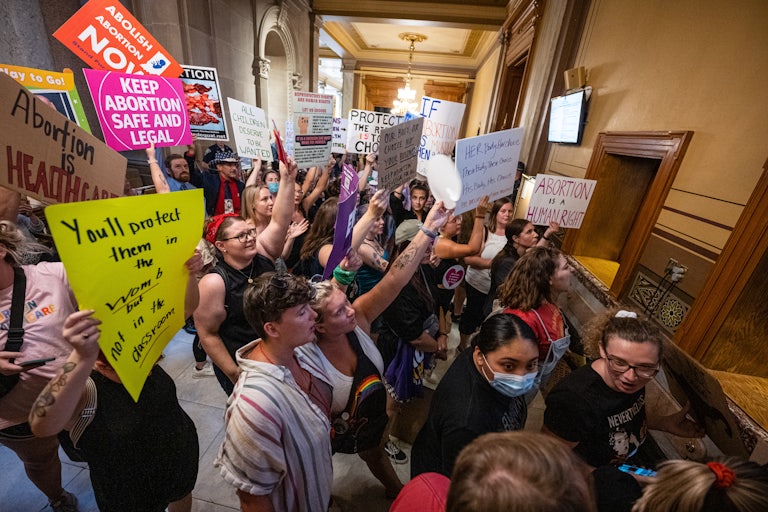
Abortion-rights protesters in Indiana’s state Capitol last year

On Friday, the Indiana Supreme Court ruled that the state’s abortion ban is constitutional, clearing the way for a ban passed by Republicans last year to take effect. The ban was the first in the nation to be passed in the aftermath of the United States Supreme Court overturning Roe v. Wade.

Indiana’s highest court superseded a county judge who ruled that the ban likely violates the Indiana Constitution. The previous ruling had stopped the ban, and left residents able to obtain abortions up to 20 weeks.

But with the state court’s ruling, that injunction is now gone.

The court wrote that while the state constitution “protects a woman’s right to an abortion that is necessary to protect her life or to protect her from a serious health risk,” the “General Assembly otherwise retains broad legislative discretion for determining whether and the extent to which to prohibit abortions.”

If the ban proceeds as planned, it will shut down all seven abortion clinics in the state and outlaw virtually all abortions. The ban only includes exceptions for abortions in cases of rape or incest before 10 weeks post-fertilization, to protect the life of the mother, or if a fetus is diagnosed with a lethal condition.

Any doctor who performs an abortion outside of those restrictive provisions would lose their medical license. Some Republicans like State Senator Mike Young have complained the bill’s enforcement provisions against doctors are not strict enough.

The abortion ban still faces another legal challenge on grounds that it violates people’s religious beliefs; the Supreme Court has left the argument to be considered by the state’s Court of Appeals for now. While a county judge has granted an injunction vis-à-vis that case, it reportedly only applies to the specific plaintiffs in the case.

The ban’s upholding comes after a 10-year-old Ohio rape victim traveled to Indiana for an abortion after Ohio banned abortions at the first detectable “fetal heartbeat.”

Has Ron DeSantis Eaten Pizza Before?

The Florida governor’s Fox News interview was predictably awkward.

Photo by Ronda Churchill/Getty Images

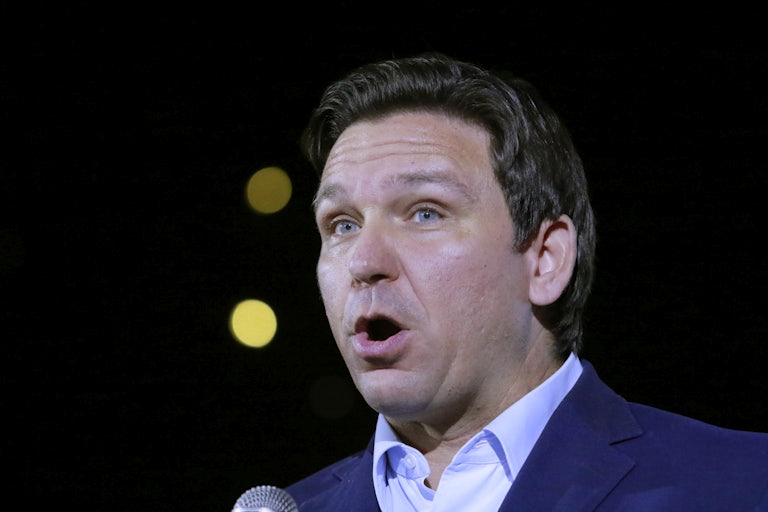
On Thursday, Ron DeSantis joined Fox News for a slice of pizza in New York City.

The Florida governor and 2024 presidential candidate joined Fox’s ladder-climbing wonder boy Jesse Watters to shoot a segment in response to the city considering a rule that would encourage pizza shops to cut emissions from outdated coal-fired ovens.

Of course, analogous to the whipped-up backlash to the Consumer Product Safety Commission expressing concern for the health effects of gas stoves, the right has turned this into a cultural panic: The left wants to ban pizza. Enter Ron DeSantis, who has tried to make himself the poster boy of every ginned-up moral panic on the right.

Some quipped that it looked like the first time the 2024 candidate has eaten a slice of pizza.

“[The left] just wanna control.… They just don’t want people to be happy and be able to make their own decisions” DeSantis said, as if he hasn’t launched an all-out crusade against students and teachers, LGBTQ people’s civil rights, or people’s freedom to choose after signing one of the strictest abortion bans in the country.

“They were going after gas stoves. In Florida we made them tax-free, we may have to do some incentives for coal-fired pizza, because you know what, we’ll take it,” he continued before taking another face-scrunching bite.

The segment appeared as millions across the country were re-enveloped in wildfire-induced smog worsened by climate change. It also came months after twice-impeached and twice-indicted former President Donald Trump said DeSantis would have been working in a “pizza parlor” or “law firm” without his help.

Joe Biden’s Student Loan Forgiveness Plan Is Dead

The Supreme Court just blocked a debt forgiveness policy that helped tens of millions of Americans.

Photo by David McNew/Getty Images

The Supreme Court voted to overturn President Joe Biden’s student debt relief plan 6–3.

The pause on student loan payments was already set to expire at the end of August, and Biden’s ability to extend the pause was foreclosed through debt ceiling negotiations. But the court’s decision on Friday hurts about 43 million people who were expected to see some relief from the burden of America’s crippling student debt regime.

On Thursday, the court ruled that affirmative action was a discriminatory mechanism. A day later, it ruled that people can openly discriminate against gay people, or anyone they see as “illegitimate” (in a case that didn’t even involve any gay people). And now the court has ruled against debt forgiveness, in a case based on harm toward a loan servicer that actually didn’t want to be involved in the case at all.

Justice Elena Kagan captured the madness in her dissent. “Wielding its judicially manufactured heightened-specificity requirement, the Court … does not let the political system, with its mechanisms of accountability, operate as normal. It makes itself the decisionmaker on, of all things, federal student-loan policy. And then, perchance, it wonders why it has only compounded the ‘sharp debates’ in the country?”

Estimates show that 87 percent of the relief from Biden’s plan was to go to individuals earning less than $75,000 a year, while none would have gone to those earning more than $125,000. Ninety-five percent of the total benefits were set for households making less than $150,000.

It remains unclear what the administration now plans to do to remain committed to its promises to these millions of people, but there still are options. One potential pathway proposed by the People’s Policy Project involves using the Higher Education Act to instate already authorized income-driven repayment programs that could potentially have debtors save even more than in Biden’s original plan.

The Supreme Court Just Used a Fake Case to Make It Easier to Discriminate Against Gay People

In America, Neil Gorsuch writes, people are “free to think” that gay people are “illegitimate.”

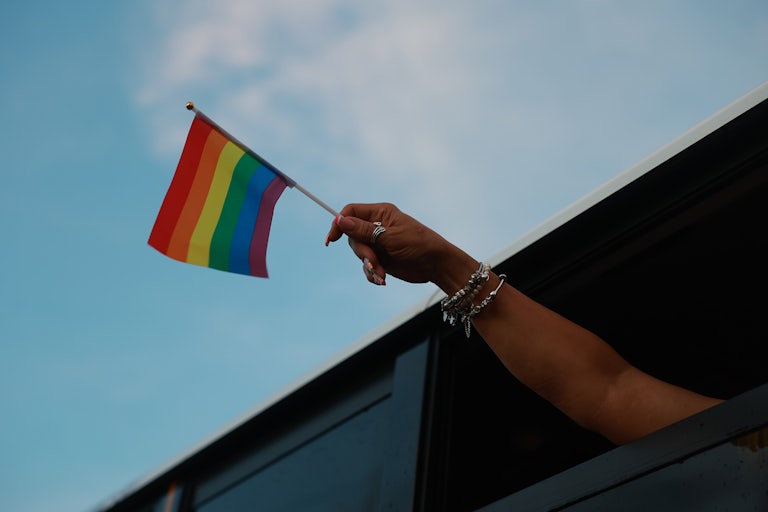
A hand outside a inwdow hold a pride flag in the wind
Joe Raedle/Getty Images

The Supreme Court ruled 6–3 in favor of a Colorado web designer’s crusade to make exemptions from anti-discrimination laws so she can refuse to provide services for same-sex weddings.

Consistent with the First Amendment, the Nation’s answer is tolerance, not coercion. The First Amendment envisions the United States as a rich and complex place where all persons are free to think and speak as they wish, not as the government demands,” the court wrote in an opinion led by Justice Neil Gorsuch.

303 Creative LLC v. Elenis is among the most peculiar cases to reach the highest court of the land. Since 2016, web designer Lorie Smith had been appealing courts to outright make exceptions to Colorado anti-discrimination laws, so she could provide wedding website design services to straight couples only. Smith’s initial suit with a Colorado district court failed in 2019, and her subsequent appeal to the Tenth Circuit Court of Appeals failed as well. The Supreme Court took up her case in February 2022.

Puzzlingly, before she actually filed the first suit in 2016, Smith had apparently never designed a wedding website. Even weirder: She had never apparently been asked to provide services to a same-sex couple up to that point either.

Enter supposed couple “Stewart and Mike,” who apparently submitted a request to Smith for her services one day after she filed her case in Colorado’s U.S district court in 2016. Stewart apparently wanted to plan some design work for his wedding with Mike “early next year.”

But after The New Republic reached out to Stewart directly—his contact information was readily accessible in court documents—the story fell apart: He said he had never submitted the form; he said TNR’s call was “the very first time I’ve heard of it.”

“It looks like Smith and her attorneys have, perhaps unwittingly, invented a gay couple in need of a wedding website in a case in which they argue that same-sex marriages are ‘false,’” TNR’s Melissa Gira Grant writes.

This flimsy story befits a complaint with little to no substance. No one has caused actual, material harm to Smith that may prompt legal action at all. Colorado’s anti-discrimination law is the supposed villain here, according to Smith’s legal team. Such a law apparently prevents Smith from being able “to bring glory to God by creating unique expression that shares her religious beliefs of creating wedding websites,” her lawyers argue. “She only wants to make websites that comport with her values that same-sex marriage is illegitimate.”

And now, with the Supreme Court’s blessing, people like Smith can openly discriminate against anyone they see as “illegitimate.”