Breaking News
Breaking News
from Washington and beyond

Affirmative Action is Over, Thanks to the Supreme Court

The rulings seriously curtail race-conscious college admissions, effectively ending a decades-old policy.

Photo by Chip Somodevilla/Getty Images

The Supreme Court has voted to end affirmative action in higher education, overturning decades-old policy originating from the presidencies of John F. Kennedy, Lyndon B. Johnson, and Richard Nixon.

“Harvard’s and UNC’s admissions programs violate the Equal Protection Clause of the Fourteenth Amendment,” the court’s majority opinion ruled.

The suits were brought by the anti–affirmative action group Students for Fair Admissions; one was against Harvard University, another against the University of North Carolina.

In the former, the court voted 6–2, with Justice Ketanji Brown Jackson recusing herself due to having served on Harvard’s Board of Overseers. In the latter, the court voted 6–3.

Affirmative action has been a point of legal contention for decades, but most cases regarding it have arrived at one general conclusion: Schools can consider a student’s race when making admissions decisions, but only as part of a broader comprehensive and holistic process. This was the finding in the landmark 2003 cases Grutter v. Bollinger and Gratz v. Bollinger, in which the court ruled that affirmative action in school admissions is constitutional if race is treated as one factor among many, if the purpose is to achieve more diverse classes, and if it doesn’t replace more individualized review of applicants.

In ruling affirmative action unconstitutional, the court overturns this focus on holistic balance.

Now schools across the country will need to overhaul their admissions processes to the new regime. Many schools have already begun to de-emphasize the need for standardizing testing; others are taking the stronger step to get rid of legacy admissions, which favor the children of alumni.

What’s clear is that unless schools take positive steps to ensure their student bodies grow more and not less diverse in the aftermath of this decision, the Supreme Court will leave yet another shameful legacy in its wake: this time, hamstringing our need to foster a strong diversity of thought in this country.

“In so holding, the Court cements a superficial rule of colorblindness as a constitutional principle in an endemically segregated society where race has always mattered and continues to matter. The Court subverts the constitutional guarantee of equal protection by further entrenching racial inequality in education, the very foundation of our democratic government and pluralistic society,” Justice Sonia Sotomayor wrote in her dissenting opinion.
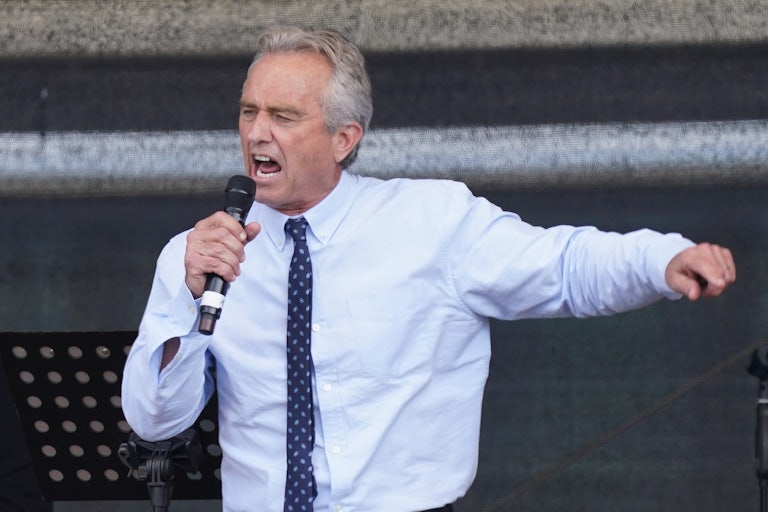

What Is Robert F. Kennedy Doing in the Democratic Primary?

Republicans love him. Democrats? Not so much.

Photo by Sean Gallup/Getty Images

Robert F. Kennedy Jr. theoretically has one big thing going for him in the Democratic presidential primary: He is a Kennedy. Possessing one of the most famous names in Democratic politics is a clear boon, even if Kennedy Jr.’s bid for the party’s nomination is a long shot given that the current occupant of the White House, Joe Biden, is a Democrat. Still, Kennedy Jr.’s name has given him a boost in this early stage of the Democratic primary: With many voters looking for alternatives to the octogenarian Biden, Kennedy Jr. surged in the polls, hitting the high teens in some cases.

The big problem with Kennedy Jr.’s candidacy, however, isn’t just that he’s running against a president most Democratic voters like. It’s that he’s basing much of his candidacy around fringe issues that are directly opposed to the views of most of the Democratic electorate. For decades, Kennedy Jr. has pushed a number of dangerous and unfounded conspiracy theories about the safety of vaccines and the Covid-19 vaccine in particular. Democratic voters like the vaccine—and vaccines more broadly—a lot. Kennedy Jr. has similarly campaigned aggressively against continued support for Ukraine, while arguing to end the war on terms that would be highly favorable to Russia—yet another viewpoint that is wildly out of step with his ostensible party. He has meanwhile appeared with a number of fringe figures, like Joe Rogan, and accepted kudos from Tucker Carlson, among other right-wingers. Donald Trump recently gave him a pat on the back, calling him a “commonsense guy.”

On the right, particularly on Fox News, Kennedy Jr. has been presented as an insurgent and a threat to Biden’s renomination. But that simply isn’t the case. Kennedy Jr.’s popularity has actually fallen as he’s received more media coverage. And it’s easy to see why: Much of the hype is coming from the right. And much of the coverage is focusing on the many, many ideas Kennedy Jr. has that are not shared by his party. In recent weeks, the percentage of Democrats holding strongly favorable opinions of RFK Jr. fell from 20 percent to 14, while those with strongly unfavorable opinions rose to 22 percent, per YouGov polling. Biden currently leads him by 63 points among Democratic voters, though he only bests him by 44 among independents.

Robert F. Kennedy Jr. is a conspiracy theorist and an anti-vaxxer running on ending the war in Ukraine on pro-Putin terms. Still, he could make a dent in an election next year—provided he switches parties. He’s running a decent campaign to become the Republican presidential nominee. He’s running a terrible one to replace Biden at the top of the ticket.

Newly Unearthed Photos of Ron DeSantis Prove He’s Just a Normal Human Person, OK?

The internet has discovered a 2015 campaign photo shoot in which Florida’s future governor pretends to look like an approachable guy (and definitely not a robot).

DeSantis for Senate/Flickr

Ron DeSantis is in a bit of a pickle: He is quite unpleasant personally (as can be seen by interrogations into his physical humanity, let alone his spiritual humanity; or in watching how many Republicans immediately endorse Trump after meeting with DeSantis). He is not necessarily more unpleasant than a lot of other politicians. But his particular brand of unpleasantness has made it so that we as observers are much more primed to pick up on his specific oddities or downright distastefulness.

Enter DeSantis’s photo shoot from 2015, when he was briefly running for Senate after Marco Rubio initially said he would not run for reelection while running for president. An old Flickr account shows DeSantis glad-handing with the same charisma that has recently left him with a net approval rating of negative 19 points—results coming as more and more people across the country have learned more and more about the presidential hopeless.

Take a look here:

DeSantis for Senate/Flickr

Even eight years ago, DeSantis displayed the same level of attentive presence as he has maintained while encountering voters on the campaign trail this year:

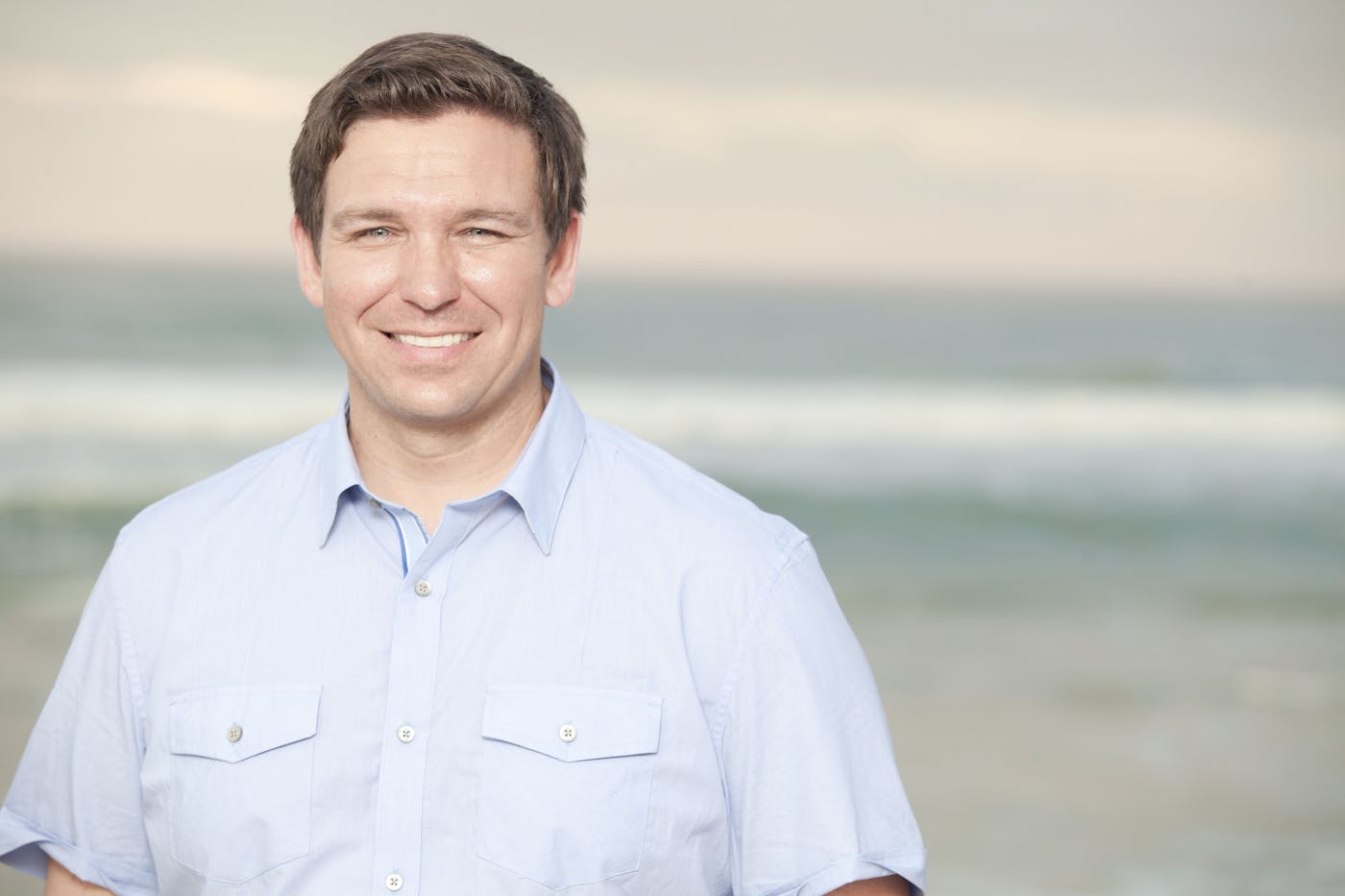
Meanwhile, the Florida native known for attacking LGTBQ people and local schools also snapped some headshots in peak high school graduation photo-shoot form. Here, he smiles at the beach.

DeSantis for Senate/Flickr

The photo presents a genial homage to Florida—especially in light of the governor’s strained efforts to contrast being “geographically raised” in Tampa Bay to being “culturally” brought up in Pennsylvania and Ohio. In the latter, he learned how to be “God-fearing, hard-working, and America-loving,” while, apparently in the former, he learned how to deregulate guns while most of America fears increased gun violence, or how to roll back regulations that could have stopped the collapse of Silicon Valley Bank.

DeSantis, like America: a complicated body of contrasts.

But perhaps the landmark photo of the collection is one of the Florida governor and his wife, Casey, sharing a warm stroll on the beach.

DeSantis for Senate/Flickr

The image evokes memories of how the duo aspiring to be America’s couple first tied the knot: at Walt Disney World in the fall of 2009. The place where dreams come true, after all. One may be prompted to wonder whether a planned Mickey Mouse meet-and-greet or princess-themed performance went awry at the wedding, given DeSantis’s relentless war on one of the most recognizable names in America.

Disney aside, DeSantis of 2015 seemed to have forgotten one of the golden rules of online photography: no free feet! Perhaps his open exposure of the dogs just goes to show how charitable the Florida governor really is.

TNR reached out to the account to ask for more details about what the creative direction was behind the photos but did not hear back by publishing time.

DeSantis Vows to Eliminate Department of Education or Use It to Wage War on Woke

The Florida governor is taking his “war on woke” to dangerous new levels.

CHENEY ORR/AFP/Getty Images

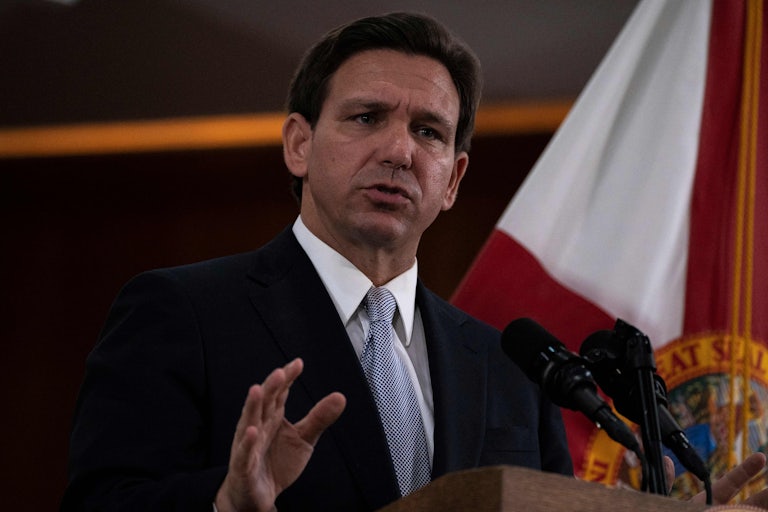
Ron DeSantis is taking his idiotic “war on woke” to new, extremist levels.

On Wednesday, the Florida governor and Republican presidential candidate went on Fox News and vowed to eliminate the U.S. Department of Education—or if he can’t, use it to go after “woke ideology.”

DeSantis also vowed to eliminate the Department of Commerce, the Department of Energy, and the IRS in order “to reduce the size and scope of government.”

DeSantis said that if Congress doesn’t help him abolish the agencies, then he would use them to “push back against woke ideology and against the leftism that we see creeping into all institutions of American life.”

“So for example, with the Department of Education, we reverse all the transgender sports stuff,” he continued. “We reverse policies trying to inject the curriculum into our schools. That will all be gone. We will make sure we have an accreditation system for higher ed, which is now trying to foment more things like DEI and CRT. So we’ll be prepared to do both. Either way, it will be a win for conservatives.”

DeSantis has been using Florida as a testing ground for his war on wokeness, a manufactured culture war he thinks will propel him to the White House. Meanwhile, he is ignoring the harm his policies have caused his own constituents.

On education, he has fought the College Board, convincing it to cave and water down its new African American Studies course curriculum. He has replaced members on the Florida Board of Medicine and New College Board of Trustees with his own campaign donors and friends. He has banned diversity, education, and inclusion programs in higher education, banned degrees in gender and race studies, limited what college professions can actually teach on race and gender, and made it a requirement for all students to take a course in “Western civilization.”

Teachers across the state are covering up books in their classrooms to avoid being charged with felonies under the new regime. Last month, an entire district banned a children’s book on segregation after only one parent complained.

If that all wasn’t enough, remember too that the “Don’t Say Gay” law, banning any classroom discussion of race and sexuality, now applies to every single grade in the state.

DeSantis has been using Florida as his own personal laboratory, testing all manner of extreme policies targeting the most marginalized in his state. And now he’s making it clear: If he becomes president, he’ll take his fanatical vision nationwide.

After a Week in Limbo, Turner Classic Movies Seems Safe

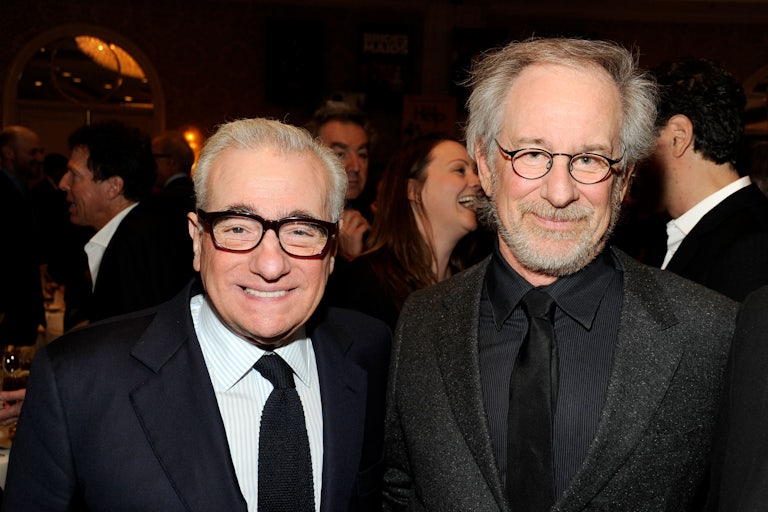
Martin Scorsese, Steven Spielberg, and Paul Thomas Anderson will help curate content for the network.

Photo by Frazer Harrison/Getty Images for AFI

A week ago, the future of Turner Classic Movies, the iconic network that has played a crucial role in preserving America’s film history, seemed bleak. Warner Bros. Discovery, its parent company, was slashing costs as a result of costly acquisitions, cord cutting, and the uncertain future of streaming entertainment. TCM appeared to be on the chopping block: Much of the network’s senior leadership was let go last week, leading to widespread concern that it would be diminished, or disappear altogether. 

On Wednesday, Warner Bros. Discovery made a series of announcements that appear to secure the network’s future, at least for now. Martin Scorsese, Steven Spielberg, and Paul Thomas Anderson will help curate content for the network, giving it an important boost in an uncertain time. “We have already begun working on ideas with [Warner Bros. film chiefs] Mike [De Luca] and Pam [Abdy], both true film enthusiasts who share a passion and reverence for classic cinema that is the hallmark of the TCM community,” the filmmakers said in a statement provided to The New Republic. “This unique arrangement, initiated by [Warner Bros. Discovery CEO] David Zaslav, reflects his commitment to honoring the TCM legacy while also involving us on curation and programming.  We are thrilled that longtime programmer Charlie Tabesh will be staying with TCM and gratified to know that the team is focused on preserving TCM’s mission of celebrating our rich movie history while at the same time ensuring that future generations of filmmakers and film lovers have TCM as a valuable resource.”  

The most important announcement is less eye-catching. Tabesh, the network’s lead programmerwho was among those let go last weekwill return to his position and report to De Luca and Abdy. Tabash’s retention is an important commitment to the network and it provides continuity as TCM enters its next phase. 

“TCM is a cultural treasure which WBD is fully committed to safeguarding, supporting, and investing in for the future,” a WarnerBros Discovery spokesperson said in a statement. “This year, TCM’s content investment has grown by 30% and we plan to build on that in future years. That said, TCM is not immune to the very real pressure on the entire linear ecosystem, but we have taken steps to ensure that we stay true to the mission of the network—bringing more titles to the air, driving content investment, and preserving and protecting the culture of cinema. Part of this is the creation of a more sustainable structure behind the screen, one that benefits from the vast resources and promotional engine of WBD’s formidable networks group, so TCM is set up for long term success.” 

TCM will be different, no doubt. Tabash’s return is a major step toward stability—and some other members of the team are expected to return—but it’s unlikely that the group running TCM will have the resources it did only a few years ago. Zaslav, per a definitive Hollywood Reporter piece about recent changes at the network, wants more “celebrity guests” on the network, suggesting further changes and compromises. The financial pressures that led to the draconian cuts are not going away. Still, while there may be further turbulence in the future, after a week of uncertainty—and a ferocious backlash—TCM has some stability.