Breaking News
Breaking News
from Washington and beyond

Did Trump Just Publicly Admit He May Be Guilty of Crossing the Line?

Donald Trump has a new interpretation of “total immunity”—and it may land him in trouble.

Adam Glanzman/Bloomberg/Getty Images

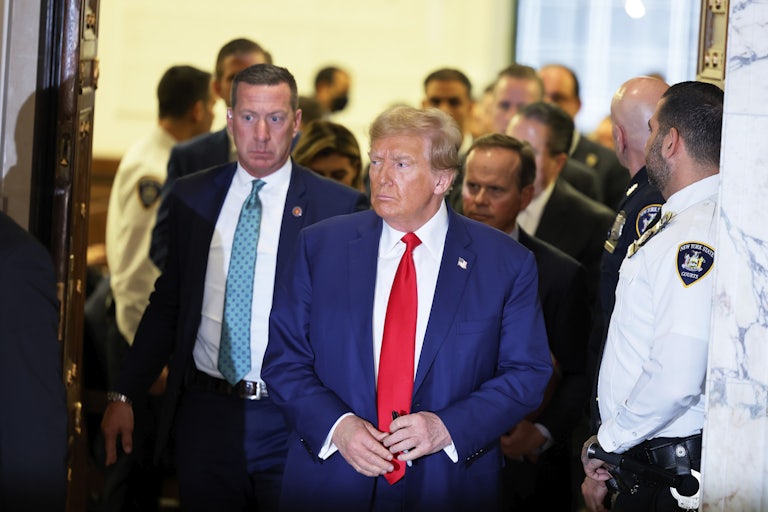
Donald Trump appeared to admit Thursday that some of his actions “cross the line” of legality, but claimed he should be shielded from repercussions because of presidential immunity.

Trump has repeatedly insisted that he cannot be prosecuted for trying to overturn the 2020 election—or for anything else for that matter—because presidential immunity protects him against criminal proceedings.

He presented his own case for immunity on Truth Social in the early morning hours. “A PRESIDENT OF THE UNITED STATES MUST HAVE FULL IMMUNITY, WITHOUT WHICH IT WOULD BE IMPOSSIBLE FOR HIM/HER TO PROPERLY FUNCTION. ANY MISTAKE, EVEN IF WELL INTENDED, WOULD BE MET WITH ALMOST CERTAIN INDICTMENT BY THE OPPOSING PARTY AT TERM END,” he wrote. “EVEN EVENTS THAT ‘CROSS THE LINE’ MUST FALL UNDER TOTAL IMMUNITY, OR IT WILL BE YEARS OF TRAUMA TRYING TO DETERMINE GOOD FROM BAD.”

“YOU CAN’T STOP POLICE FROM DOING THE JOB OF STRONG & EFFECTIVE CRIME PREVENTION BECAUSE YOU WANT TO GUARD AGAINST THE OCCASIONAL ‘ROGUE COP’ OR ‘BAD APPLE.’ SOMETIMES YOU JUST HAVE TO LIVE WITH ‘GREAT BUT SLIGHTLY IMPERFECT.’”

This is far from the first time that Trump and his legal team have appeared to insist that the former president should be allowed to get away with breaking the law. While trying to appeal the charges in Trump’s January 6 insurrection case, lawyer John Sauro said that even if a president ordered the assassination of a political opponent, he could only be criminally prosecuted if he was impeached first.

If the president was acquitted during the impeachment, Sauro argued, then he should not have to face criminal proceedings.

And in early January, Trump lawyer Christina Bobb argued that anyone can be president, “whether they are guilty of insurrection or not,” so long as they were elected.
What the Hell Was That Stuff on Donald Trump’s Hands?

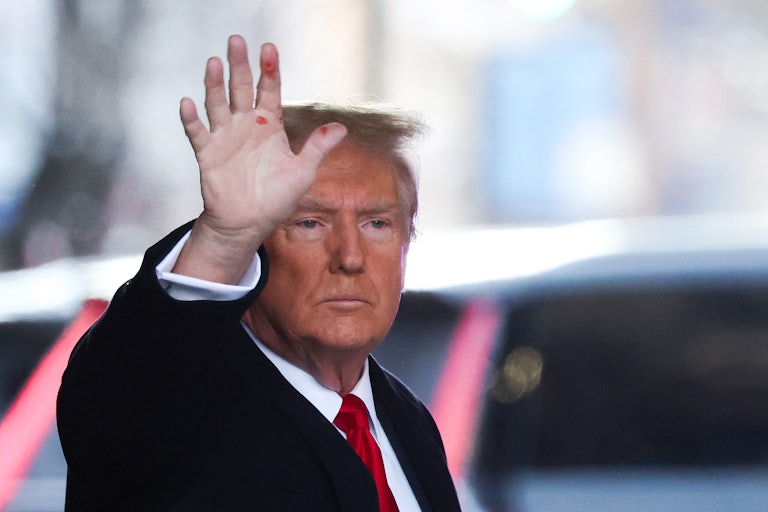
The entire internet is speculating about the mysterious red marks on Trump’s hands.

CHARLY TRIBALLEAU/AFP/Getty Images

Donald Trump’s hands didn’t look too good on Wednesday, leading to a flurry of theories about the current state of the GOP front-runner’s mental and physical health.

Political advisers and voters alike speculated across the spectrum as to the origin of the dark, red spots on Trump’s hand, arguing that the marks’ origin could be anything from syphilis to ink splotches.

“They don’t look like cuts to me, they look like sores,” said Bill Clinton’s former presidential campaign strategist James Carville, during a livestream. “I’ve asked a number of M.D.s what medical condition manifests itself through hand sores, and the answer is immediate and unanimous: secondary syphilis.”

Earlier on Wednesday, syphilis was trending on X, the social media platform formerly known as Twitter.

Others pondered whether the mysterious condition emerged due to a rash, dry skin, or even as the result of some emotionally charged tantrum.

“Is it magic marker? Because it looks like he has a sore on his index finger there,” said Joe Scarborough on MSNBC’s Morning Joe.

“There was a point in time during the day where Trump, very frustrated with Judge Kaplan, banged his hands down on the table. I doubt that the blisters or marks that were seen there come from that. But could they be exacerbated by that? Perhaps,” speculated MSNBC’s Lisa Rubin.

“Like a toddler having a tantrum, perhaps, and causing bleeding into his hand?” responded Willie Geist.

Some online posters noticed that the emergence of Trump’s mysterious hand condition coincided with a bizarre speech Wednesday night, theorizing that Trump’s cluttered and nonsensical speech could be a symptom of late-stage syphilis. 

“We’re also going to place strong protections to stop banks and regulators from trying to debank you from your—you know, your political beliefs what they do. They want to debank you, and we’re going to debank—think of this. They want to take away your rights, they want to take away your country, the things you’re doing,” Trump said during a New Hampshire campaign rally, immediately before diving into a rant about electric cars.

Florida Republicans Want to Ban More Than Just the Pride Flag

Florida Republicans are advancing a bill that would ban a sweeping array of flags in classrooms. One critic calls it “fascism at its best.”

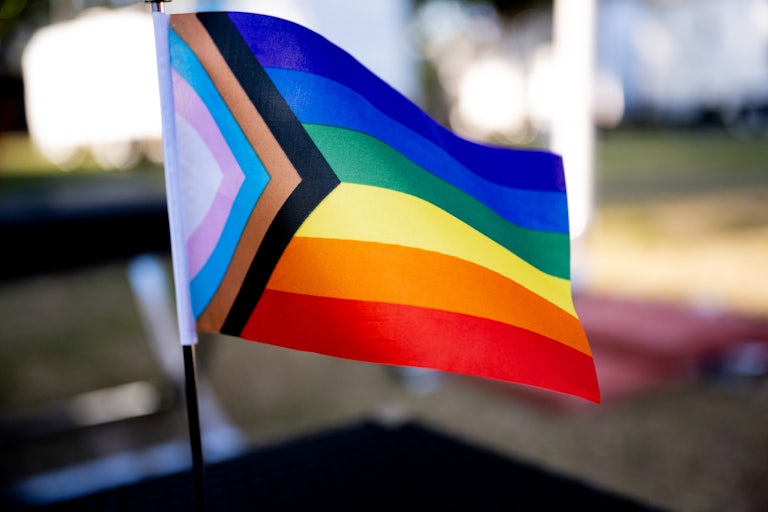
Pride flag
Scott Dudelson/Getty Images

Florida state Republicans have advanced a bill that would ban schools and government buildings from displaying Pride flags, Black Lives Matter flags, and the Palestinian flag.

House Bill 901 passed the state House Constitutional Rights, Rule of Law & Government Operations Subcommittee on Wednesday by a vote of 9–5, along party lines. The bill must pass one more committee before going before the full chamber.

The measure bans all government entities from displaying flags that represent “a political viewpoint, including, but not limited to, a politically partisan, racial, sexual orientation and gender, or political ideology viewpoint.” Government employees would be banned from wearing lapel pins that express these ideologies.

Bill sponsor David Borrero said this would also prohibit flags of countries that the United States does not recognize as sovereign nations, such as Palestine.

“Public classrooms should not be the place where our kids go to be radicalized and evangelized into accepting these partisan, radical ideologies,” Borrero said. “It’s wholly inappropriate to be putting those types of flags in front of public school students and in government buildings.”

The bill applies to state and local government buildings, and all schools in the Florida public school system. This includes state colleges and universities, which detracts significantly from Borrero’s main argument. College and university students are legally adults, so this bill isn’t really about protecting children.

The bill is “not about indoctrination,” Democratic Representative Johanna Lopez said. “It’s about discrimination.”

Several Democratic state lawmakers fly Pride or Black Lives Matter flags in their offices. If the bill becomes law, they would be required to take those banners down—although they are already saying they won’t.

Democratic Representative Michele Rayner, who is Black and lesbian, lamented the fact that “once again we’re focusing on things nobody has asked us to focus on.”

Rayner has rainbow “Protect LGBTQ+ Students” flyers in her office and a “Black Voters Matter” sign hanging outside. “It will remain outside my office regardless of what bill they pass because there’s a thing called the First Amendment,” she said.

Democratic Senator Shevrin Jones slammed the bill as “authoritarianism” and “fascism at its best.” Jones is Black and gay, and he has multiple Pride symbols in his office, including a rainbow “Pride at the Capitol” poster.

“How I was raised, the rainbow meant hope … I can promise you it wasn’t that that made me gay,” Jones said. “I’m not taking a damn thing down. I want everybody to see it.”

Here’s What Alarms Legal Experts Most About Trump’s Upcoming Cases

Pay closer attention to what’s happening to the jurors.

Donald Trump in the courtroom. Others stand around him, including his legal team and a security guard.
Michael M. Santiago/Getty Images

One prominent legal expert is sounding the alarm bells over impending damage in Donald Trump’s upcoming criminal trials, likening Trump’s behavior on the stand and his relentless bullying of judges and court staff to that of a mob boss.

While Trump and his political allies have so far been successful at hounding judges and defendants—like Judge Arthur Engoron in Trump’s Manhattan bank fraud trial—there could be members of even more vulnerable demographics in the courtroom who could be legitimately compromised by Trump’s harassment.

Andrew Weissman, a New York University law professor and former lead prosecutor in Robert Mueller’s special counsel investigation, raised the issue during The New Republic’s “America in Crisis” event on Wednesday evening.

“Obviously the investigation and prosecution is important, and as serious of a problem as it is with respect to judges and prosecutors and journalists, I’m particularly concerned with what is going to happen with respect to witnesses and jurors,” said Weissman.

Weissman likened Trump’s conduct in the courtroom to the “organized crime cases” that he prosecuted as a young attorney, pointing to the “extraordinary” measures taken thus far—like keeping jurors fully anonymous and partially sequestered in E. Jean Carroll’s defamation case.

“The jurors go by number, and they were instructed to not use their names, even with each other … and that is an extraordinary step, even in a criminal case—but that is the kind of measure that I think you’re going to see, whether it’s the Manhattan district attorney’s criminal case against Donald Trump or the Jack Smith case before Judge [Tanya] Chutkan,” Weissman continued, noting that for witnesses it will be “a lot more difficult.”

In the Carroll defamation case, Judge Lewis Kaplan cited Trump’s behavior as a reason for the extreme measures to protect the jury.

Trump is on the line for 91 charges across four separate criminal cases, for his behavior related to the January 6 insurrection, his attempt to undermine the election results in Georgia, his alleged theft of thousands of classified documents, and the Stormy Daniels hush-money case, in the last of which Trump is accused of using his former fixer Michael Cohen to sweep an affair with the porn actress under the rug ahead of the 2016 presidential election.

The outcome of Trump’s criminal trials has proven to be one of the few issues that sways some of his raucous supporters. More than a quarter of Republicans said that the real estate mogul should not be a presidential candidate if he’s convicted of a crime, according to a December New York Times/Siena College poll—enough to swing the general election in a matchup against President Joe Biden.

But that would require Trump’s numerous trials to come to fruition before November. According to Weissman, just two are due to be resolved by then: the D.C. January 6 case and the Stormy Daniels hush-money case.

And that’s significant, since Trump’s race to the White House will likely only be impeded by America’s electorate. In fact, nearly every legal expert at The New Republic’s event—including Wendy Weiser of the Brennan Center for Justice and Michael Pollack of the Cardozo Law School—agreed that the Supreme Court is unlikely to affirm Colorado’s and Maine’s decisions to push Trump off their primary ballots.

“It will be up to voters as to whether they want an insurrectionist in the White House,” Weissman added.

Republican Lawmaker Says It’s Time to Bring Back Family Separation

Representative Anna Paulina Luna is saying the quiet part out loud.

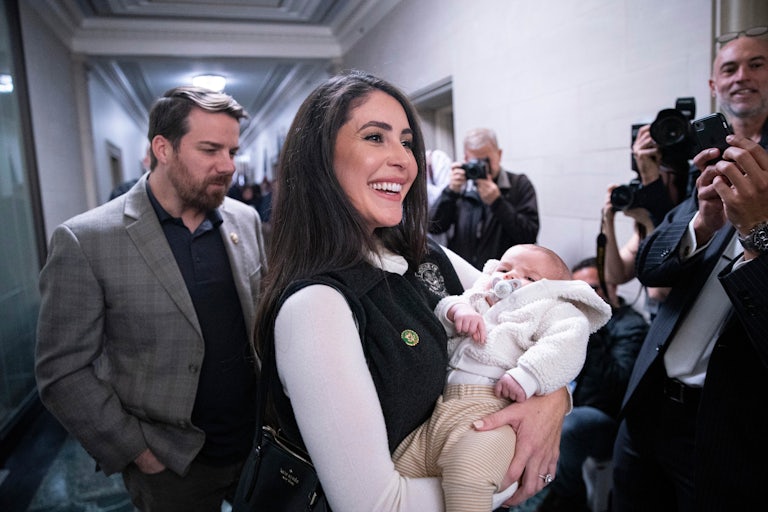
Representative Anna Paulina Luna holds a newborn baby
Al Drago/Bloomberg/Getty Images

A Republican representative on Wednesday made a shocking confession: “We want family separation.”

Representative Anna Paulina Luna, a freshman congresswoman from Florida, made the startling claim during a House hearing on immigration, in which she tried defending former President Donald Trump’s horrific family separation policy.

She questioned whether any real trauma took place when children were separated from their “quote unquote parents” under the program.

Cato Institute immigration expert David Bier, a witness in the hearing, apparently began laughing at her use of the phrase—which was enough to set off Luna.

“Why are you laughing?” she angrily yelled at Bier.

“Because you said ‘quote unquote parents,’ as if they weren’t really their parents,” he responded.

“You have no idea,” she immediately responded.

“I do have an idea. I’ve met with—”

“You have no idea if these people are their intentional parents or not. Really? Are you psychic? Have you won the lotto, Mr. Bier?”

It’s at this point that Luna revealed what she really thinks.

“The reason why we want family separation until we can confirm if they are their actual biological parents—”

“You want family separation?” Bier asked, stunned by her admission.

To be clear, Trump’s family separation caused lasting trauma to entire families. Under the 2018 “zero tolerance” policy, at least 2,000 children were separated from their parents at the border. Those children were placed in Health and Human Services custody, while their parents were placed in detention and then prosecuted in federal court. Years later, hundreds of families still remain separated.

In 2019, a watchdog report documented some of the trauma experienced by the children. “The little ones don’t know how to express what they are feeling, what has happened,” one program report told investigators. “Communication is limited and difficult. They need more attention.”

“According to program directors and mental health clinicians, separated children exhibited more fear, feelings of abandonment, and post-traumatic stress than did children who were not separated,” the report found, noting that many children cried inconsolably or experienced other physical symptoms of trauma. One child said that “every heartbeat hurts.”

Luna, by the way, is best known for likely fabricating her Jewish heritage. In a Washington Post report last year, many of her family members disputed her claim that she was raised Jewish. In fact, they noted, her grandfather served in the Nazi army.