Breaking News
Breaking News
from Washington and beyond

Florida GOP Just Can’t Stop: New Bill Would Ban Virtually All Abortions

A Republican representative in Florida has filed an extreme bill that would ban nearly all abortions in the state.

John Parra/Getty Images/MoveOn
An abortion rights protest in Fort Lauderdale, Florida, on July 13, 2022

A Florida Republican lawmaker has introduced a bill that would essentially ban abortions altogether, going even further than the already draconian restrictions on the procedure in the Sunshine State.

State Representative David Borrero filed a bill Monday that would ban anyone from performing an abortion except to save the patient’s life. There are no exceptions for rape, incest, or if the patient is a minor. The bill would establish that personhood exists from the moment of fertilization.

The measure (H.B. 1519) states that a qualifying medical emergency would be “an emergent physical condition in which an abortion is necessary to preserve the life of a pregnant woman whose life is endangered by a physical disorder, physical illness, or physical injury, including a life-endangering physical condition caused by or arising from the pregnancy itself.” The bill makes no mention of what a patient should do if they miscarry and need to have the fetus removed, or if the fetus develops a fatal anomaly.

Under the bill, “performing or attempting to perform an abortion” is classified as a third-degree felony. Doctors who conduct abortions for reasons other than those allowed by the measure could face up to 10 years in jail, up to $100,000 in fines, or both.

The Florida Senate minority leader, Democrat Lauren Book, slammed the bill as a “desperate attempt at relevancy by the bill sponsor.”

“We are in arm’s reach of getting abortion on the ballot and restoring the rights they stole,” she told the Sun Sentinel. “Republican leadership knows this is no longer a winning issue for their party. Voters of all political leanings have shown and will continue to show their overwhelming support for women’s right to healthcare privacy and reproductive freedom.”

Florida currently bans abortion after 15 weeks. That law went before the state Supreme Court in September. If the court upholds the law, then an even more restrictive measure banning abortion at six weeks—before most people know they are pregnant—will go into effect. Florida Governor Ron DeSantis signed the hugely unpopular bill in April.

If Borrero’s bill becomes law—a possibility, with Republicans controlling both chambers of the state legislature and the governor’s office—then it would supersede the six-week ban.

But there’s a chance that all of these laws will be defeated. Florida abortion advocates have collected enough signatures to put access to the procedure on the state’s 2024 ballot. The amendment would allow abortion access up until viability, or when the fetus can survive outside the uterus. This is generally estimated to happen at around 24 weeks.

The ballot initiative faces a major Republican challenge, though. State Attorney General Ashley Moody, a DeSantis ally, has asked the Florida Supreme Court to disqualify the amendment. She argues the language is misleading, claiming that the use of the word “viability” could have multiple meanings. The state’s high court will hear arguments on February 7.
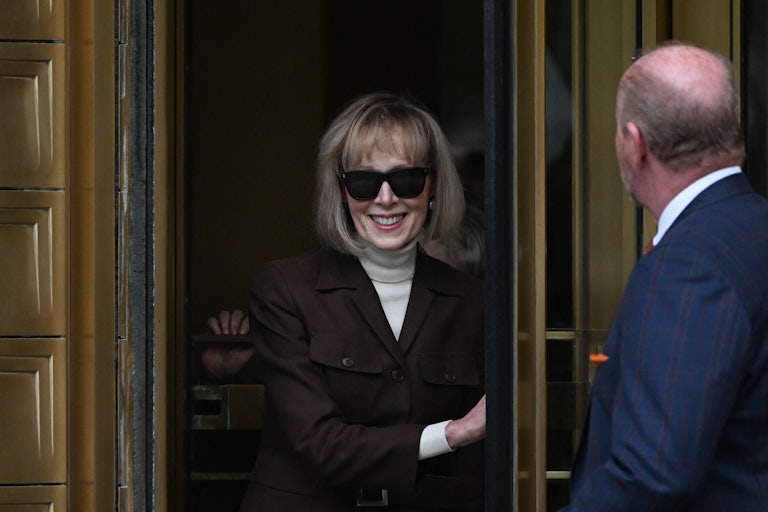
Here’s the List of Things Trump Can’t Say at the Next E. Jean Carroll Trial

A federal judge has given Donald Trump and his legal team a long list of restrictions.

ED JONES/AFP/Getty Images

A federal judge on Tuesday set strict limitations on what Donald Trump and his attorneys can say during the former president’s upcoming trial for defaming the writer E. Jean Carroll.

Trump will go on trial starting next Tuesday for comments he made in 2019, when he said Carroll accused him of raping her just to promote her memoir. Presiding Judge Lewis Kaplan has already determined that Trump is liable for defamation, so the trial is primarily to set damages.

Kaplan issued an order Tuesday barring Trump and his lawyers from discussing Carroll’s choice of lawyer or who might be paying her legal fees. They are prohibited from making comments “concerning Ms. Carroll’s past romantic relationships, sexual disposition, and prior sexual experiences,” and they cannot argue that Trump did not sexually abuse Carroll or act with actual malice when making his comments about her.

Trump’s legal team has argued that Carroll’s lawsuits are just another witch hunt against the former president. They claim her lawyer Roberta Kaplan (no relation to the judge) is biased because she has represented prominent Democrats, and that the whole lawsuit is being funded by a left-leaning billionaire.

Judge Kaplan had already ruled over the weekend that Trump can’t argue he didn’t rape Carroll. Although Trump was found liable for sexual abuse, Kaplan has repeatedly stated that Trump “‘raped’ her as many people commonly understand the word ‘rape.’”

In May, a jury unanimously found Trump liable for sexual abuse and battery against Carroll in the mid-1990s and for defaming her in 2022 while denying the assault. He was ordered to pay her $5 million in damages.

Kaplan ruled in September that since Trump has already been found liable for sexual abuse, his 2019 comments are by default defamatory. Carroll is now seeking up to $12 million in damages.

Legal analyst Lisa Rubin noted Tuesday that Kaplan’s latest ruling might convince Trump not to testify in next week’s trial. Rubin explained that Trump’s testimony could result in higher punitive damages, and he might violate the order while on the stand.

Trump has already shown it will be difficult for him not to bring up Carroll’s past sexual experiences. Carroll wrote a popular sexual advice column in Elle magazine for nearly three decades. Just last week, over the span of about 30 minutes, Trump made 31 posts about Carroll on Truth Social. Among the many things he shared were media interview clips and social media posts that appear to come from Carroll, all stripped of context so as to paint her as some sort of sexual deviant.

It Never Ends With the Freedom Caucus: Mike Johnson Ouster Countdown Begins

Republicans are privately—and publicly—considering dumping their own House speaker over the spending deal.

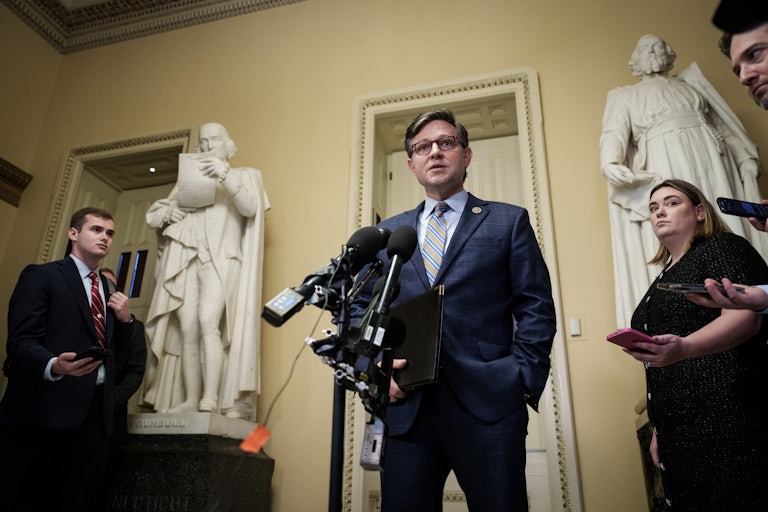
Mike Johnson gives a press conference in the Capitol
Drew Angerer/Getty Images

Less than three months into Mike Johnson’s tenure as speaker of the House, some House Republicans are already experiencing buyer’s remorse.

Texas Representative and Freedom Caucus member Chip Roy on Monday publicly raised the possibility of dumping Johnson as speaker.

Questioned by CNN’s Kaitlan Collins, Roy mentioned “colleagues that are really frustrated” with Johnson and alluded to “real conversations this week about what [House Republicans] need to do going forward,” calling the situation “[not] good.”

And Roy is not alone. As Punchbowl News reports, some House Republicans have “significant concerns” about whether Johnson—the least experienced speaker in 140 years—is “in over his head.” At least one Republican claimed Johnson is “getting rolled even more than [ousted former Speaker Kevin] McCarthy did.”

Conservative dissatisfaction with Johnson stems from what some see as his acquiescence to President Biden and House Democrats on spending. Johnson over the weekend agreed to a $1.59 trillion spending deal for 2024. Under the deal, fiscal spending will be limited to what was mostly laid out in June’s Fiscal Responsibility Act, which averted a government shutdown at the time but also angered the Freedom Caucus and in part led to McCarthy’s ouster.

In the green but hard-line Johnson, Republicans like Roy saw a figure more amenable to their brand of austerity and obstructionism. Facing his first real test, however, Johnson seems to have failed in the eyes of some of his colleagues.

Now concerns over Johnson’s ability to lead are trickling out via anonymous quotes from “VERY well connected” House members.

Johnson’s rise from little-known Louisiana congressman to speaker of the House in the 23 days following McCarthy’s removal was seen as a win for the party’s right wing; Johnson’s 2020 election denial and social conservatism (he opposes abortion rights and same-sex marriage and sees his election as divinely ordained) allowed anti-McCarthy holdouts to coalesce around his candidacy.

But the one-member threshold for vacating a House speaker, which McCarthy implemented and which led to his own ousting, is still in place.

And now, it seems Johnson’s days as speaker may be numbered.

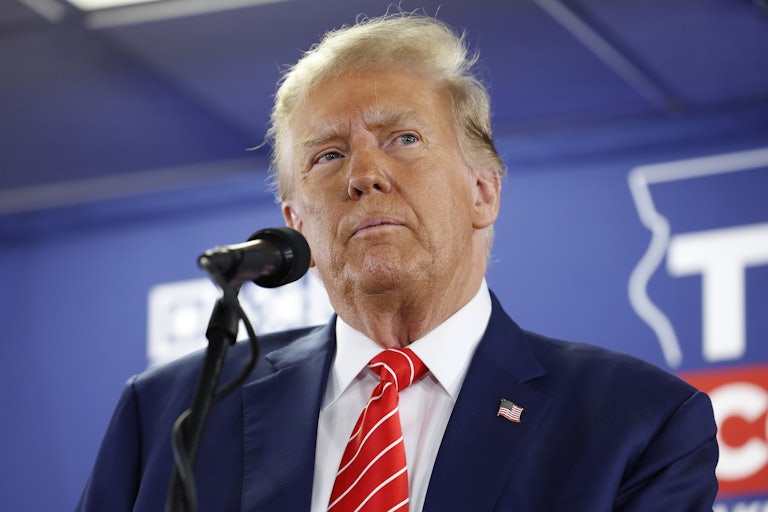
Trump’s Idiot Lawyer Just Blew Up His Own Absolute Immunity Argument

Donald Trump’s lawyer tried to argue that his client is immune from charges—and instead undermined his whole defense.

Anna Moneymaker/Getty Images

One of Donald Trump’s lawyers on Tuesday made a shocking new defense of “presidential immunity”—and in the process accidentally destroyed one of the former president’s arguments for why he shouldn’t be charged for his role in the January 6 insurrection.

Trump has repeatedly insisted that he cannot be prosecuted for trying to overturn the 2020 election, because he has presidential immunity from criminal proceedings. His lawyers presented his case to a panel of three appellate judges in Washington, D.C., on Tuesday.

At one point, Judge Florence Pan asked if a president would be immune from criminal prosecution if he had ordered Seal Team 6 to assassinate a political rival. She noted that an order to Seal Team 6 would be an official act.

Trump’s lawyer John Sauer said the president could be prosecuted, but only if he had been impeached and convicted first.

That’s a terrifying interpretation on its own, but Pan took it one step further. She pointed out that this would mean presidents can be criminally prosecuted under certain circumstances. In other words, Trump does not have absolute immunity.

“Doesn’t that narrow the issues before us to…‘can a president be prosecuted without first being impeached and convicted?’” Pan said. “All of your other arguments seem to fall away.”

“Once you concede that there’s not this absolute immunity, that the judiciary can hear criminal prosecutions under any circumstances—you’re saying there’s one specific circumstance—then that means that there isn’t this absolute immunity that you claim.”

Pan also noted that Trump appeared to be trying to have it both ways. During his second impeachment trial, Trump and some of his Republican allies argued that the Senate shouldn’t convict him because he would face criminal prosecution later. But now, he claims he shouldn’t have to face prosecution, either.

If the appellate judges rule against Trump, then the case will likely head to the Supreme Court. This could delay Trump’s trial, which is currently set to begin on March 4, the day before Super Tuesday.

Trump was indicted in August for his role in the January 6, 2021, insurrection and other attempts to overturn the 2020 presidential election. He faces one count each of conspiracy to defraud the United States, conspiracy to corruptly obstruct an official proceeding, obstruction of and attempt to obstruct an official proceeding, and conspiracy against the right to vote.

Trump has pleaded not guilty to all of the charges and has insisted the case should be dismissed altogether. He argues that former presidents can’t be criminally charged for actions related to their official responsibilities. He did not explain how overturning an election was related to official presidential duties.

While many critics say Trump’s immunity claim is a desperate attempt to avoid accountability, it could also be an attempt to ease his path towards increased power. As Greg Sargent writes for The New Republic, “If he wins on this front, he’d be largely unshackled in a second presidential term, free to pursue all manner of corrupt designs with little fear of legal consequences after leaving office again.”

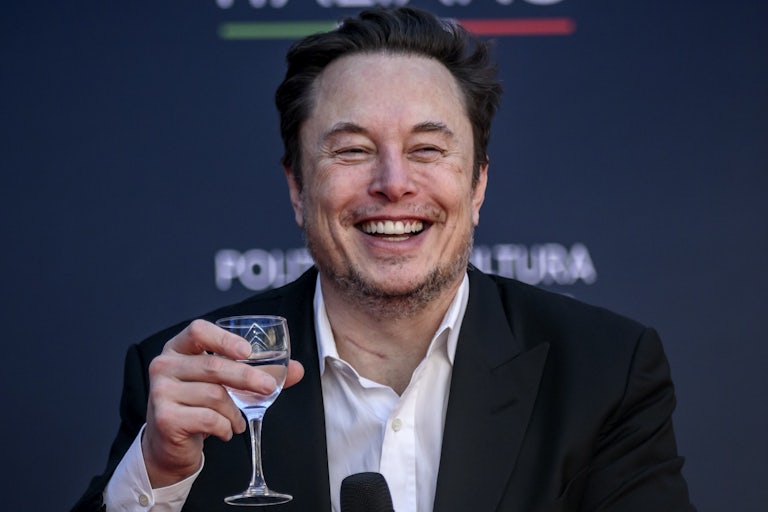
Gee, Guess What Twitter Just Did to Accounts Critical of Elon Musk?

Elon Musk is at it again.

Antonio Masiello/Getty Images

X, formerly known as Twitter, on Tuesday temporarily suspended the accounts of multiple prominent journalists and left-leaning commentators and comedians, many of whom were critical of X owner Elon Musk.

The social media platform gave no explanation for the sudden purge, saying only that the accounts “violate the X rules.” The X rules prohibit violent or hateful speech, child exploitation, private information sharing, and fake information.

But the accounts in question do not post that kind of content. The reporters who were banned include Steven Monacelli, a journalist at the Texas Observer who covers extremism, and Ken Klippenstein, who covers national security for The Intercept. Last year, Klippenstein published a piece on the errors with Tesla’s self-driving feature, and Monacelli noted that X shadow-banned the Intercept author since then.

MintPress News reporter Alan MacLeod, who recently has extensively covered Israel’s approach to the war in Gaza, and leftist podcaster Rob Rousseau were also suspended Tuesday.

The accounts for @liamnissan, @zei_squirrel, and the TrueAnon podcast were suspended, as well. The @liamnissan account posts mostly comedic commentary, including criticisms of Musk. The TrueAnon podcast provides left-wing analysis of current political events and conspiracy theories.

The @zei_squirrel account is another left-leaning commentator who has been critical of Musk in the past. In a post on their Substack Tuesday, the @zei_squirrel writer noted that they had recently begun to criticize Bill Ackman, a hedge fund billionaire and friend of Musk’s who helped lead the campaign against former Harvard University President Claudine Gay. Ackman’s wife was recently accused of plagiarism, the same charge that brought down Gay.

All of the suspended accounts were reinstated a few hours later, but initially with significantly lower follower counts than before.

This is at least the fifth time that X, under Musk, has purged accounts that are the slightest bit critical of him, his friends, or causes he supports. Shortly after taking the social network’s reins in October 2022, the self-proclaimed “free speech absolutist” banned the accounts of multiple actors and comedians who made fun of him.

Just a month later, accounts for people including Dean Baker, the senior economist at the Center for Economic and Policy Research, and Andrew Lawrence, deputy director of rapid response at the left-wing watchdog Media Matters, were temporarily suspended. Both men have been critical of Musk. Also that month, the accounts for several high-profile journalists including Keith Olbermann, Aaron Rupar, Ryan Mac, and Drew Harwell were temporarily suspended.

Dell Cameron, a reporter for Wired, was banned in April last year for reporting on the hacker who targeted far-right commentator Matt Walsh.

Ironically, if X wants to ban an account that violates platform rules, the company need look no further than its owner. Musk’s personal account is a major source of hate speech and disinformation. In addition to aggressively antisemitic posts, Musk also regularly lets Nazis back on X, shares transphobic content, and spreads conspiracy theories.

This article has been updated.