Breaking News
Breaking News
from Washington and beyond

Vladimir Putin Dumps Cold Water on Trump’s Bragging About Ukraine

Despite Donald Trump’s boasting about peace talks, the Russian president just showed who’s really in control.

Russian President Vladimir Putin touches his chin while sitting onstage at an event
Contributor/Getty Images

Donald Trump and Russian President Vladimir Putin need to get their story straight, because they’re both telling different tales about negotiations to end Russia’s violent incursion into Ukraine.

Trump bragged Monday about working with Putin while recapping his meeting with French President Emmanuel Macron and other G7 leaders about next steps to deescalate the war in Ukraine.

“I am in serious discussions with President Vladimir Putin of Russia concerning the ending of the War, and also major Economic Development transactions which will take place between the United States and Russia,” Trump wrote in a post on Truth Social. “Talks are proceeding very well!”

But, surprise, surprise, it seems Putin is on an entirely different page.

During remarks on Russian state television Monday, Putin said he had yet to have any detailed talks with Trump about ending the conflict in Ukraine, according to the Associated Press.

The autocrat added that Russian and American negotiating teams hadn’t discussed ending the war, either, during a meeting in Saudi Arabia last week.

So which is it, “serious discussions” or conversations lacking in details? The muddled answers could suggest something is awry in negotiations, if one can even call Trump’s endless capacity for caving to Putin’s every demand a negotiation.

There’s reason to believe that Trump’s supposed statesmanship might be falling apart. Last week, Trump accused Ukrainian President Volodymyr Zelenskiy of being responsible for Russia’s invasion, enjoying a “gravy train” from the United States, and even calling him a “Dictator Without Elections.”

During their joint press conference Monday, Macron was forced to fact-check Trump, after the president misrepresented the agreement they had just made.
Try to Make Any Sense of What Trump Says When Asked About Elon’s Email

Donald Trump was asked about Elon Musk’s email telling federal workers to list what they did last week or be fired.

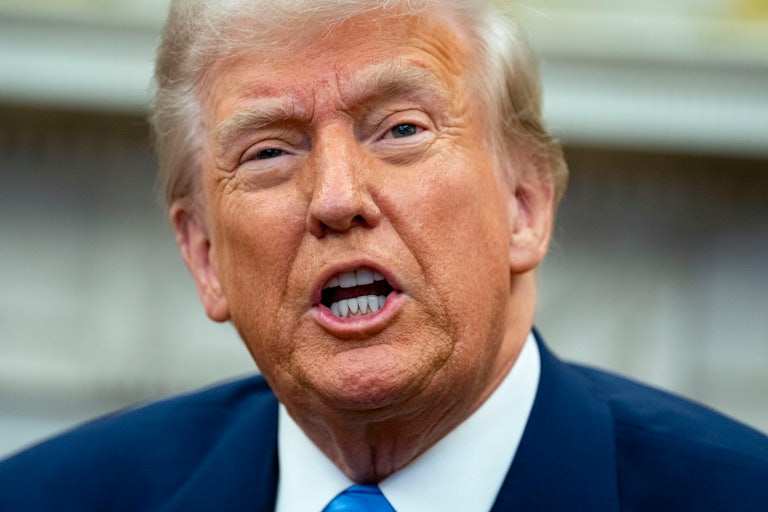
Donald Trump speaks during a joint press conference with French President Emmanuel Macron
Bonnie Cash/UPI/Bloomberg/Getty Images

Donald Trump ramped up his outlandish claims of widespread fraud on Monday, claiming that the government was paying fake people not to work.

During a press conference, Trump cobbled together an explanation for Elon Musk’s contentious email to federal workers from the Office of Personnel Management Friday asking them to explain five things they accomplished last week. On X, Musk later claimed that failing to respond would be tantamount to a resignation.

Federal workers have alleged the threat was illegal; meanwhile, Trump said that there was “a lot of genius in sending it,” because it would help root out what he described as nonexistent government workers.

“You know why he wanted that, by the way? I thought it was great, because we have people who don’t show up to work, and nobody even knows if they work for the government,” Trump said. “So, by asking the question, ‘Tell us what you did this week,’ what he’s doing is saying, ‘Are you actually working?’ And then, if you don’t answer, like, you’re sort of semi-fired or you’re fired, because a lot of people are not answering because they don’t even exist.

“That’s how badly various parts of our government were run by, and especially by this last group. So, what they’re doing is trying to find out who’s working for the government, are we paying other people that aren’t working, and where is all this—where has the money gone?”

Trump claimed that his administration had already uncovered “hundreds of billions of dollars of fraud,” but of course, to Trump, fraud isn’t actually fraud, it’s just any federal spending he does not agree with—any cuts can be justified post hoc by claiming “fraud.”

There is no evidence supporting Trump’s claim that there are fictional people on the government payroll, but then again, his administration has provided no evidence for any of its supposedly mounting claims of fraud in the past two months.

Musk’s email is simply the latest plot to arbitrarily slash the federal workforce, after the administration’s sketchy buyout scheme and mass firings recommended by the Department of Government Efficiency. Now it seems that Musk and Trump are hoping to create a context to justify the mass firing of federal workers.

In that same vein, Musk announced in a post on X Monday that any federal worker who did not return to in-person work this week would be placed on administrative leave. Last month, Trump signed an executive order telling federal workers that they needed to return to work onsite, or be terminated.

Meanwhile, OPM told agency heads Monday that responding to Musk’s email was “voluntary,” and that employees would not be fired if they did not respond.

Trump Administration Suddenly Backtracks on Elon Musk’s Weird Email

The Office of Personnel Management has stunningly split from Elon Musk.

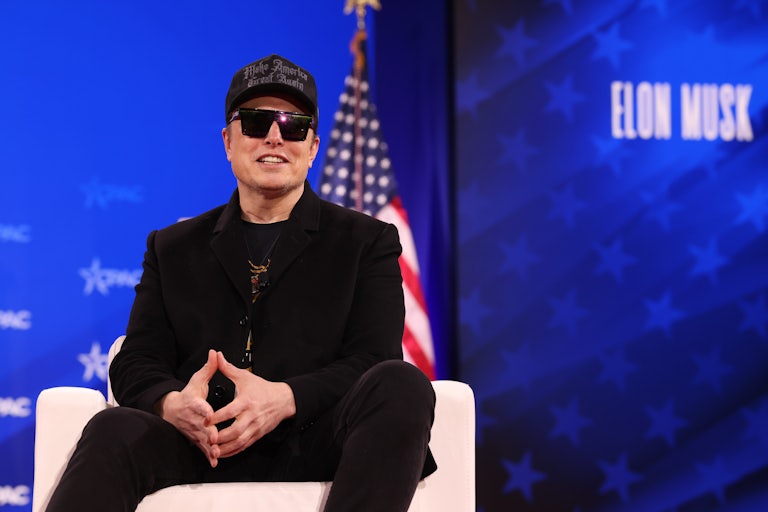
Elon Musk sits onstage during CPAC
Valerie Plesch/The Washington Post/Getty Images

The nation’s H.R. leaders suddenly don’t seem keen to obey Elon Musk’s weekend threat.

Responding to the president’s request that he become “more aggressive” in sizing down the federal government, Musk wrote in a social media post Saturday that all federal employees must self-report five things that they achieved in the previous week before midnight on Monday or face immediate termination.

Federal workers reportedly received an email from the Office of Personnel Management shortly afterward that echoed Musk’s post. But by Monday, many federal agencies fronted by Donald Trump’s own appointees had simply told their staffers not to respond. Those included the Department of Defense, the FBI, the State Department, the Department of Homeland Security, and most recently, curiously, the Office of Personnel Management.

“This afternoon, OPM during a Chief Human Capital Officers Council meeting, informed agencies that employee responses to the OPM email is voluntarily,” the agency said in an internal email obtained by The Hill.

“OPM also clarified that a non-response to the email does not equate to a resignation,” the email continued.

The stance is a stunning about-face for an agency that has otherwise seemed thoroughly under Musk’s control.

Newly confirmed FBI Director Kash Patel similarly instructed the bureau not to follow Musk’s demands, telling agents that “when and if further information is required, we will coordinate the responses. For now, please pause any responses.”

“The FBI, through the Office of the Director, is in charge of our review processes and will conduct reviews,” Patel said.

Meanwhile, the State Department wrote in a statement that “no employee is obligated to report their activities outside of their Department chain of command.”

Musk has acknowledged the similarities between the threat to federal employees and his treatment of Twitter staffers during his takeover of the company in 2022, when he fired the social media company’s former chief executive, Parag Agrawal, after publicly accusing him of failing to accomplish his weekly goals.

“Parag got nothing done. Parag was fired,” Musk wrote on X Saturday.

Trump’s Funding Freeze Creates Narco Dream at Mexico Border

Donald Trump has already broken a key campaign promise with his funding freeze.

Donald Trump claps while standing in the White House
Win McNamee/Getty Images

Donald Trump’s freeze on foreign aid is hurting one of his major campaign promises: taking on fentanyl and ending overdose deaths from the drug in the U.S.

Reuters reports that a United Nations counternarcotics program that seeks to stop fentanyl chemicals from reaching Mexico’s drug cartels has been held up by Trump’s aid freeze, citing eight unnamed sources. The effort gave the Mexican navy training and equipment to boost screening at Mexico’s busiest container port, the Port of Manzanillo. Two more Mexican ports were supposed to be added to the initiative this month until funding was cut off.

The U.S. provided $800,000 in funding to launch the project in 2023 at the Port of Manzanillo, which is used heavily by Mexican drug cartels to sneak in Chinese chemicals used to help manufacture opioids and methamphetamine. Drug traffickers have also used cargo ships leaving the port to stash finished drugs headed overseas. More cargo scanners and drug-testing equipment were supposed to arrive at the Port of Manzanillo before the freeze as well.

Trump’s interruption of foreign aid has also hurt other U.S. anti-drug efforts in Mexico, including a program to train Mexican law enforcement to find and take down hidden fentanyl labs as well as donations of drug-sniffing dogs to the country.

While the Trump administration has scrambled to resume other anti-fentanyl programs with Mexico, including $7.8 million in funding for the State Department’s Bureau of International Narcotics and Law Enforcement Affairs “to counter production and trafficking of fentanyl and to dismantle terrorist criminal organizations,” the rest of the bureau’s $50 million in funding is frozen.

Last week, the Trump administration labeled 8 Latin American drug cartels as “foreign terrorist organizations” as part of its efforts to combat drug trafficking and migrant smuggling, stepping up its military actions in Mexico as well. But Trump may soon find that counterterrorism mixed with tariffs threats is no replacement for badly needed aid.

“Stopping all these programs at this moment, I just don’t see how this is going to have a positive impact on reducing the numbers of fentanyl deaths in the U.S.,” a former State Department official, Enrique Roig, told Reuters.

Trump Makes Wild Announcement About Future Relationship With Russia

Donald Trump has made it clear where his loyalty lies.

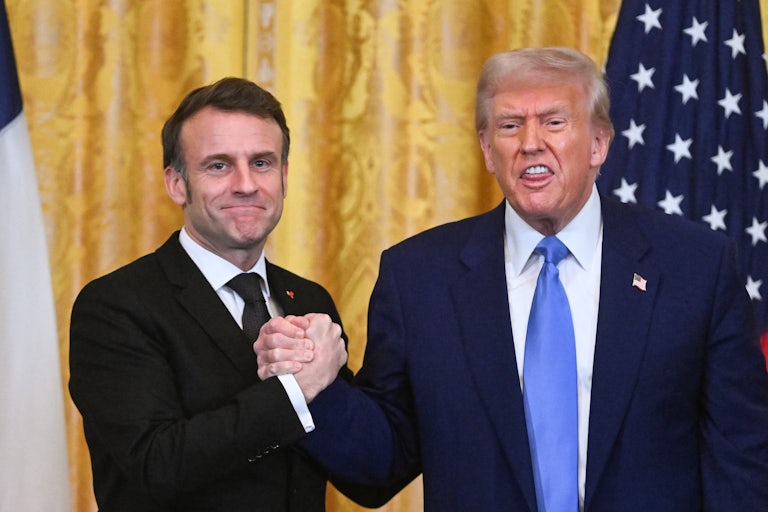
French President Emmanuel Macron and Donald Trump clasp hands during a joint press conference
Roberto Schmidt/AFP/Getty Images

President Donald Trump capped a meeting with French President Emmanuel Macron Monday by writing a lengthy post on his social media platform—though details regarding a potential Ukraine-Russia peace deal didn’t just appear to favor Russia but also hinted at larger economic goals with America’s longtime adversary.

“Today, President Emmanuel Macron of France joined me in the Oval Office to speak to the G7 Summit,” Trump posted on Truth Social. “The meeting was convened by Governor Justin Trudeau of Canada, the current chair of G7, to acknowledge the Third Anniversary of the Russia-Ukraine War—Which would have never started if I was President.”

Trump then went on to write that everyone in attendance at the meeting wanted to see an end to the war in Ukraine. Trump also noted that he “emphasized the importance” of the proposed “Critical Minerals and Rare-Earths Deal” between the United States and Ukraine, which would funnel half of the Eastern European nation’s rare earth minerals—hundreds of billions of dollars’ worth of materials used in tech and electronic products—into the American market.

Trump has pitched the deal as a way for the U.S. to recoup financial and military assistance it provided to Ukraine, while Ukrainian officials see the trade arrangement as a way to solidify a long-term relationship with an increasingly Russian-friendly U.S. president.

Trump has previously and incorrectly claimed that the U.S. provided some $350 billion to Ukraine. In actuality, the U.S. has allocated $119 billion in Ukraine aid, according to the Kiel Institute, which has been tracking international financial assistance for Ukraine.

Still, Trump made it perfectly clear who the priority would be in the ongoing peace talks.

“At the same time, I am in serious discussions with President Vladimir Putin of Russia concerning the ending of the War, and also major Economic Development transactions which will take place between the United States and Russia,” Trump said. “Talks are proceeding very well!”

Real estate developer turned U.S. special envoy to the Middle East Steve Witkoff spoke with Russian officials last week regarding a potential peace deal. While speaking about the meeting with CNN’s State of the Union on Sunday, Trump’s longtime friend couldn’t detail one thing that Russia would actually have to compromise on in the arrangement.

Russian forces crossed the Ukrainian border on February 24, 2022, which Putin tried to justify by falsely claiming that he needed to protect civilians in eastern Ukraine.

The U.S. and Russia opened discussions at a meeting in Saudi Arabia last week, seeking a conclusion to the three-year war, but the assembly conspicuously excluded Ukrainian leadership.

While speaking at a NATO summit earlier this month, Defense Secretary Pete Hegseth explicitly outlined that the Trump administration’s peace talks with Russia had taken several bargaining chips “off the table.”

Those included Ukraine’s possible NATO membership (something the military alliance had promised in 2008), the possibility of a U.S. military presence in Ukraine to enforce postwar security guarantees, and the end of NATO missions to Ukraine. Hegseth also added that it would be “unrealistic” for Ukraine to return to its prewar borders, effectively ceding land to Moscow.

The announcement came as a complete 180 on American and NATO policy regarding the Eastern European country, and left U.S. allies and defense experts reeling. The deal, per Trump’s former national security adviser John Bolton, amounted to Russian propaganda and was practically “written in the Kremlin.”