Breaking News
Breaking News
from Washington and beyond

Karoline Leavitt Says You’ll Never Know Who’s at Trump’s Crypto Dinner

Trump’s press secretary made a shocking defense of the obvious pay-to-play dinner with Trump.

Karoline Leavitt smiles at the podium in the White House Press Briefing Room.
Samuel Corum/Bloomberg/Getty Images

President Trump is refusing to release the guest list of his pay-to-pay crypto dinner, as his press secretary Karoline Leavitt argues that the dinner is in his “personal time.”

“On the president’s dinner tonight, will the White House commit to making the list of the attendees public so people can see who’s paying for that kind of access to the president?” a reporter asked Leavitt at the White House press briefing on Thursday.

“Well as you know, Garret, this question has been raised with the president. I have also addressed the dinner tonight; the president is attending it in his personal time, it is not a White House dinner, it is not taking place here at the White House,” Leavitt responded, ignoring the specific question about who was going to be at this dinner. “Certainly I can raise that question and try to get you an answer for it.”

The dinner will be held at Trump’s private golf club in northern Virginia on Thursday evening for the top 220 holders of the president’s cryptocurrency—after an auction that brought in $147,586,796.41. The event is being promoted as the “most EXCLUSIVE INVITATION in the world,” according to an email about the event. The top 25 buyers will get an “ultra-exclusive private VIP reception” and “Special VIP Tour” with the president.

All of the donors/guests of this event will be completely anonymous, leading to legitimate questions about corruption and foreign influence, like the one Leavitt refused to answer. Many of the buyers are foreign, as well, based in countries like Singapore and Hong Kong—directly contradicting the “America First” narrative that Trump has built his brand on.

The top spender, holding close to $18.5 million of Trump’s coin, is called “SUN” and is held by a Seychelles-based crypto exchange known as HTX. Justin Sun, a Chinese national accused of fraud, known for spending $6.2 million on a banana and then eating it, is on HTX’s board and already has a financial relationship with Trump.

The president is having a private dinner for anonymous foreigners who bought his cryptocurrency—a scam in and of itself—and is acting as if he’s just taking a personal day that will have no impact on American politics.

“The sitting president appears to be selling personal cryptocurrency while in office, granting access to people who buy it, and thereby enriching his business and his family. It’s gobsmacking,” Senator Jon Ossoff said to Politico earlier this month. “I’d like to hear one Republican senator defend it. Any self-respecting Congress would demand an accounting of everyone trading this coin who has any business before the government.”

Trump Bans International Students at Harvard in Horrifying Move

This will hurt so many students—and destroy Harvard.

Students walk on Harvard University’s campus.
Mel Musto/Bloomberg/Getty Images

The Trump administration has escalated its attacks on academic freedom by barring Harvard University from enrolling international students.

The New York Times reports, citing three unnamed sources, that the White House told the university of the ban after back-and-forth discussions between White House officials and the university about whether a records request from the government was legal.

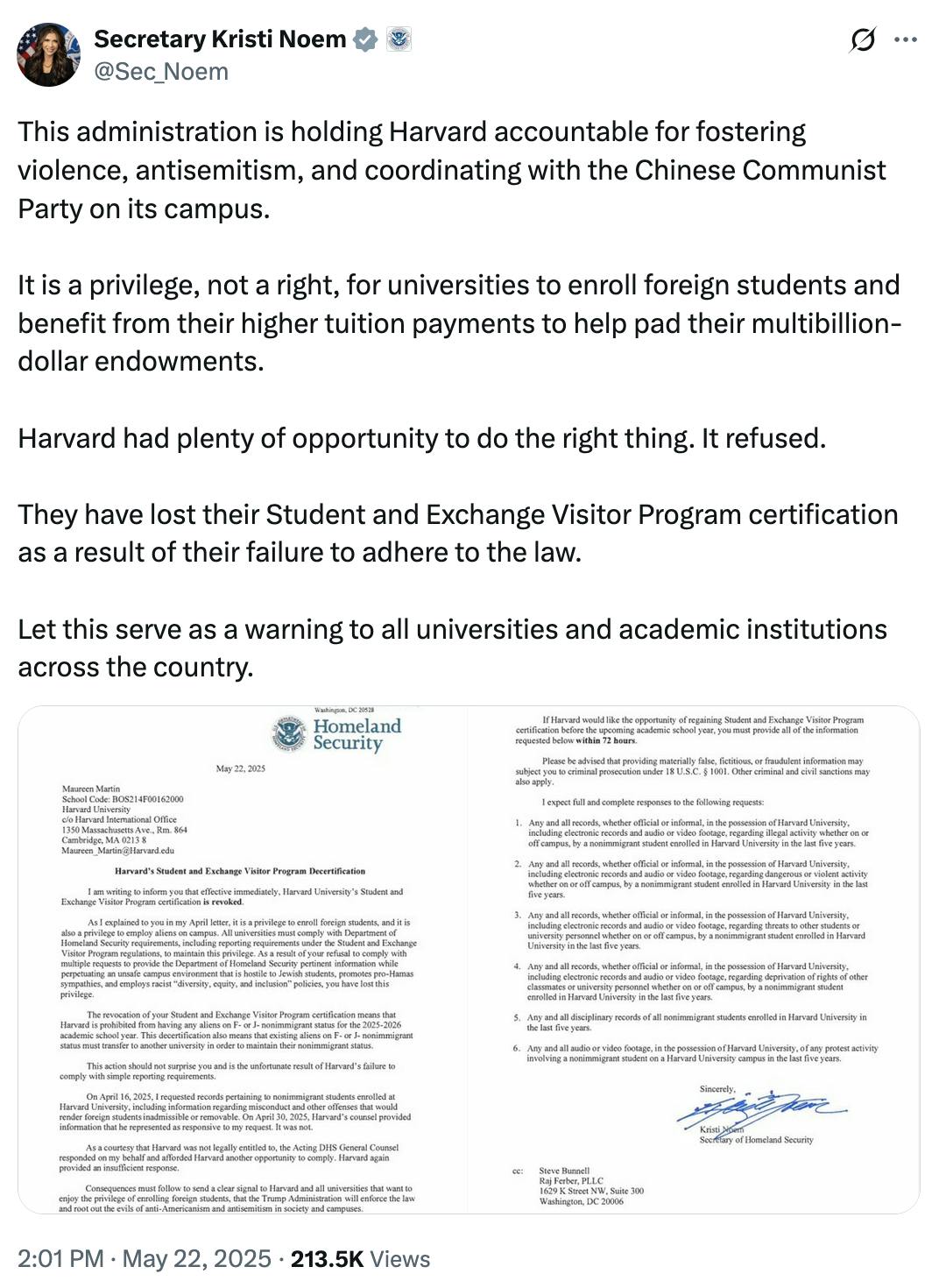
“I am writing to inform you that effective immediately, Harvard University’s Student and Exchange Visitor Program certification is revoked,” Secretary of Homeland Security Kristi Noem wrote in a letter to the institution.

X screenshot Secretary Kristi Noem @Sec_Noem This administration is holding Harvard accountable for fostering violence, antisemitism, and coordinating with the Chinese Communist Party on its campus. It is a privilege, not a right, for universities to enroll foreign students and benefit from their higher tuition payments to help pad their multibillion-dollar endowments. Harvard had plenty of opportunity to do the right thing. It refused. They have lost their Student and Exchange Visitor Program certification as a result of their failure to adhere to the law. Let this serve as a warning to all universities and academic institutions across the country. (photos of letter sent to Harvard)

The decision means that the university will not be able to enroll students on F- or J- nonimmigrant visas for the 2025–2026 academic year. Harvard currently has nearly 7,000 international students, making up 27 percent of the school’s student body. In a press release, Noem said that these students must transfer or lose their legal status.

Earlier this month, President Trump threatened Harvard with the loss of its tax-exempt status, and in April, Noem demanded the university turn over records on the “illegal and violent” activities of its foreign student visa holders, threatening that if the university didn’t comply, its “privilege of enrolling foreign students” would end.

The university ended up sending some student information to the Department of Homeland Security but did not specify which records were turned over. Noem’s letter called the submitted records “insufficient” and said that they didn’t follow “simple reporting requirements.”

“This administration is holding Harvard accountable for fostering violence, antisemitism, and coordinating with the Chinese Communist Party on its campus,” Noem said in the press release. “It is a privilege, not a right, for universities to enroll foreign students and benefit from their higher tuition payments to help pad their multibillion-dollar endowments. Harvard had plenty of opportunity to do the right thing. It refused.”

“They have lost their Student and Exchange Visitor Program certification as a result of their failure to adhere to the law. Let this serve as a warning to all universities and academic institutions across the country,” Noem added.

The university continues to lose more federal grants each day, the latest $60 million in cuts coming Monday. The new ban will be well received by conservatives, who have long accused higher education in the U.S. of being a bastion of liberal thought. Many on the right continue to accuse universities of stoking criticism of Israel by allowing protests against Israel’s war in Gaza over the past year. Those grievances have culminated in threatening Harvard’s very existence.

This story has been updated.

Trump Suffers Massive Blow in War on Education Department

A federal judge has blocked the Trump administration from dismantling the Education Department, slamming the move as an attempt to take over the power of Congress.

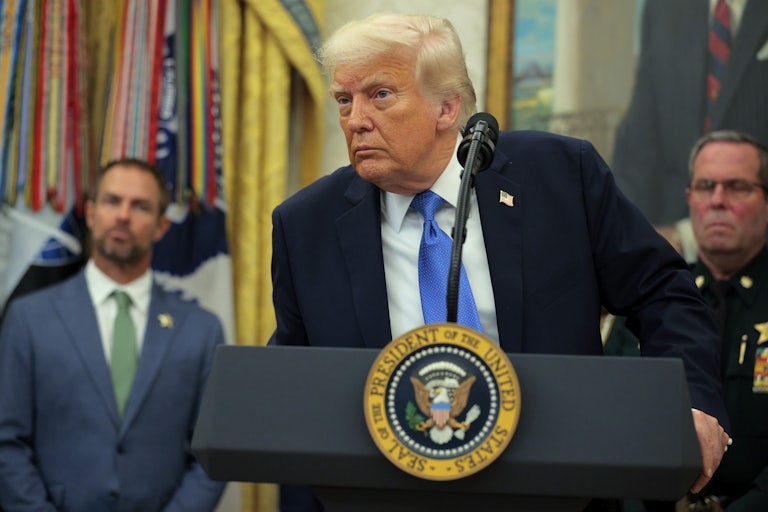
Donald Trump leans forward while standing at the presidential podium in the White House.
Chip Somodevilla/Getty Images

A federal judge has blocked President Trump and Education Secretary Linda McMahon from carrying out an executive order to eliminate the Department of Education.

On Thursday, U.S. District Judge Myong Joun in Boston issued a preliminary injunction stopping the Trump administration from carrying out the president’s March executive order to dismantle the agency.

“Today we take a very historic action that was 45 years in the making,” Trump said at the time. “Everybody knows it’s right. The Democrats know it’s right, and I hope they’re going to vote for it because ultimately it may come before them.”

Joun disagreed, stating that the executive order painted a “stark picture of the irreparable harm that will result from financial uncertainty and delay, impeded access to vital knowledge on which students and educators rely, and loss of essential services for America’s most vulnerable student populations.”

“The record abundantly reveals that defendants’ true intention is to effectively dismantle the department without an authorizing statute,” Joun wrote, condemning the administration for trying to abolish a department without approval from Congress.

Joun also called for the reinstatement of employees who were fired from the department by the Department of Government Efficiency. “Restore the department to the status quo,” he wrote in his ruling.

Trump has yet to comment on the decision.

Trump’s Social Security Head Bragged About Having to Google Own Job

Frank Bisignano is clueless and proud of it.

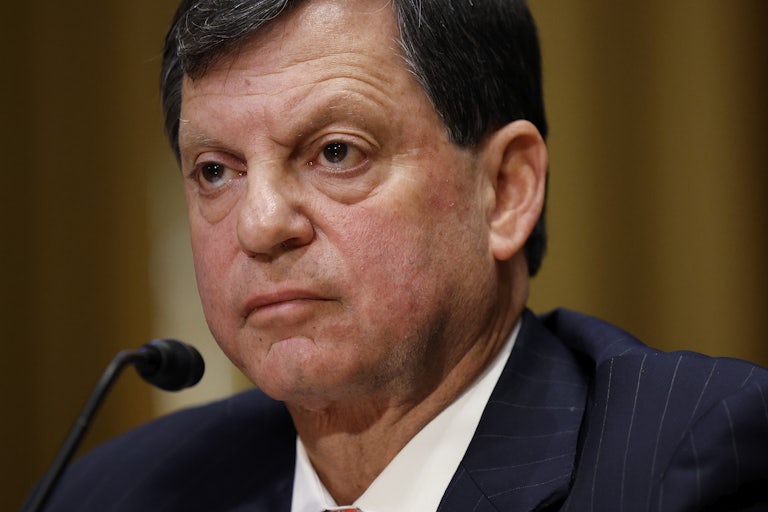
Frank Bisignano sits in his Senate Finance Committee hearing
Kevin Dietsch/Getty Images

It looks like Donald Trump’s streak of hiring wildly unqualified people remains undefeated.

Frank Bisignano, the new Social Security Administration commissioner, revealed Wednesday that he’d needed to google what the position actually entailed after being tapped to lead the benefits agency servicing more than 70 million Americans, according to the Federal News Network.

In a largely unscripted address Wednesday, the former chairman and CEO of banking technology company Fiserv remarked that he wasn’t totally familiar with his new presidentially appointed role.

“I don’t think the commissioner of Social Security is like a globally known title. It is to you, right? But, like, it wasn’t to me,” Bisignano said. “I’m like, ‘Well, what am I gonna do?’ So I’m googling ‘Social Security.’ That’s one of my great skills, I’m one of the great googlers on the East Coast.”

“I’m like, ‘What the heck’s the commissioner of Social Security?’”

The best “googler on the East Coast” said that he hoped to oversee a “digital-first” agency.

“We’re never going to be client-first if we’re not digital-first in this era,” Bisignano said. “That’s the only way we’re going to win. You’re competing with experiences that people have with Amazon. If I can get something done at Amazon, why can’t I get something done the same way with Social Security? That’s how people think.”

Bisignano has no experience working in government, serving as a staunch defender of corporate interests, and was previously one of the highest-paid CEOs in the country.

In agreeing to serve as SSA commissioner, Bisignano also agreed to sell his shares in Fiserv, which were worth roughly $484 million. But because of a loophole in the tax code for government officials that defers his capital gains tax on divestment, he won’t be forced to pay tens of millions of dollars in potential taxes on the massive windfall.

The Trump administration is in the process of a massive overhaul at the SSA, after announcing that it plans to reduce the workforce by 7,000 federal workers, offering buyouts, and reassigning many employees from regional offices to field offices, according to FNN. Elon Musk and his Department of Government Efficiency have alleged “extreme levels of fraud” at the SSA but have only uncovered two likely fraudulent claims out of over 110,000.

Some other desperately unqualified Trump hires include former Fox & Friends co-host turned Secretary of Defense Pete Hegseth and surgeon general nominee Casey Means, a wellness influencer and author who has no active medical license and never completed her physician residency.

Republicans Secretly Freaking Out Over Elon Musk’s Latest Announcement

Elon Musk unceremoniously revealed he is pulling back from political spending.

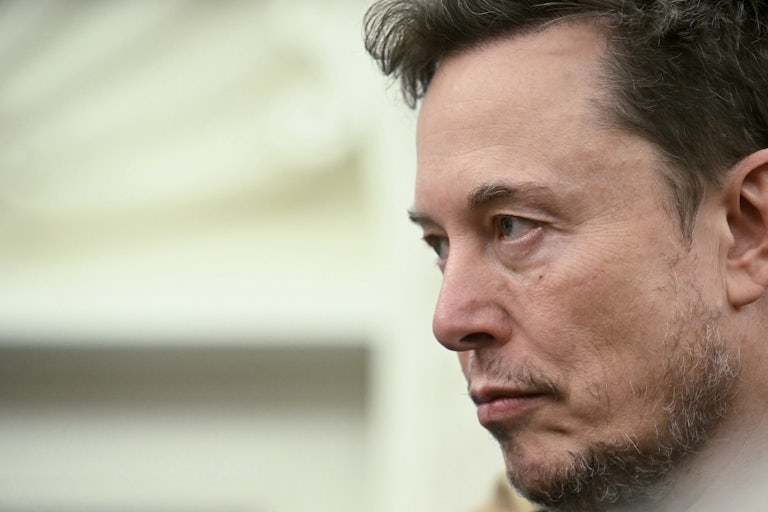
Elon Musk stands in the Oval Office
Jim Watson/AFP/Getty Images

Republicans may be glad that Elon Musk is gone from the White House, but they’re not happy he’s taking his money with him.

The world’s richest man said at the Qatar Economic Forum on Tuesday that he believes he’s “done enough” when it comes to political spending.

“I think in terms of political spending, I’m going to do a lot less in the future,” Musk said.

But that news was not welcomed by Republicans, who feared that they could be losing their “whale” before the midterm elections, per Politico.

Musk was Donald Trump’s top financial backer in the 2024 election, spending at least $250 million in the final months of the president’s campaign after Trump was shot in July.

But Trump wasn’t the only beneficiary of Musk’s immense wealth: America’s top political donor also dropped north of $3 million on a key Wisconsin Supreme Court race in April, which much to the party’s chagrin saw the Republican-backed candidate Brad Schimel lose by double digits. (Musk-backed groups, including America PAC and Rebuilding America’s Future, spent another $19 million to sponsor Schimel.)

The unpopular Tesla CEO became a central figure in the Wisconsin race, and it’s unclear if his desperate and sometimes illegal attempts to help Schimel win—including bribing voters to ideologically side with the conservative candidate—did more harm than good at the voting booth. Regardless, Schimel’s poor performance has led political observer to wonder if the entire experience left a bad taste in the billionaire’s mouth.

If it did, it would come at an especially inopportune time for Republicans, who are quietly hoping that there’s still enough favor in the tank to influence Musk to support Winsome Earle-Sears for Virginia governor, who “faces a major cash disadvantage against Democrat Abigail Spanberger,” according to Politico.

Republicans had come to rely on Musk’s seemingly endless cashflow. In the wake of the November election, Musk declared that his super PACs would “play a significant role in primaries.” In the following months, Musk threatened to use his money to fund primary challengers to Trump’s agenda and go after Democrats, and that he would be preparing “for the midterms and any intermediate elections, as well as looking at elections at the district attorney level.”

If Musk sticks to his word this time, Republicans can wave that cash goodbye. Still, some conservatives are crossing their fingers that the unlikable billionaire will return to party politics—along with his open faucet of cash.

“I believe he means it right now,” GOP consultant Josh Novotney told Politico. “But every election is unique. So he may be motivated to be active again in the future.”

Democrats, meanwhile, don’t expect Musk’s influence to dissipate all at once. Instead, strategists on the other side of the aisle predict that Musk’s money will begin to flow through dark channels that will make it harder to track his influence.

“I believe he will start moving his money in the background, through nonprofits,” Pat Dennis, president of major Democratic super PAC American Bridge, told Politico. “It’ll be a lot more of that now.”