Breaking News
Breaking News
from Washington and beyond

Elon Musk Whines That Trump Is Hanging Him Out to Dry

The tech billionaire dumped cold water on Donald Trump’s prized tax bill.

Elon Musk sits in Donald Trump’s Cabinet meeting
Andrew Harnik/Getty Images

Donald Trump’s biggest 2024 donor isn’t too stoked about the administration’s spending habits.

Weeks after exiting his temporary role in the White House, Elon Musk is still speaking his mind on critical Republican affairs. In an interview with CBS Sunday Morning, the former government-diminishing task rabbit lamented that the “big, beautiful” bill being deliberated in the Senate would practically undo the Department of Government Efficiency’s work.

“I was disappointed to see the massive spending bill, frankly, which increases the budget deficit—not decrease[s] it—and undermines the work the DOGE team is doing,” Musk said. “I think a bill could be big, or it could be beautiful—I don’t know if it can be both. My personal opinion.”

Musk’s DOGE was tasked with sizing down the federal government to cut spending. But in a separate interview Tuesday, the world’s richest man said he increasingly felt that his department was being used as a scapegoat for other administration failures.

“DOGE is just becoming the whipping boy for everything,” Musk told The Washington Post. “So, like, something bad would happen anywhere, and we would get blamed for it even if we had nothing to do with it.”

But Musk isn’t the only powerful conservative to brush off Trump’s “big, beautiful” bill. Immediately after the House passed the reconciliation package last week, South Carolina Senator Lindsey Graham shot down some of the cuts included in the bill as “not real,” arguing that the House had done next to nothing to actually bring down federal spending.

Even a $880 billion cut in Medicaid couldn’t offset the gargantuan price tag on extending Trump’s 2017 tax cuts, which are estimated to add somewhere between $3.8 trillion and $5.3 trillion to the national debt. Those numbers have ruffled feathers among congressional budget hawks, who were under the impression that the Trump administration would be sizing down spending rather than beefing it up.

Several conservative senators have indicated they won’t vote for the bill if it includes a debt limit increase, including Senators Rand Paul, Ron Johnson, and Rick Scott. The growing coalition of budget-conscious naysayers is threatening enough to potentially keep the bill from reaching the president’s desk, as Republicans grapple with their narrow majority in the Senate.

On Sunday, Johnson told CNN that he believes there’s enough opposition within the caucus to stall its advancement.

“We have enough to stop the process until the president gets serious about spending reduction and reducing the deficit,” Johnson told the network.

America’s national debt is currently more than $36.9 trillion, as of the time of publishing.
Trump Asks Supreme Court to Help Him Deport People Wherever He Wants

The Trump administration is asking the Supreme Court to make it easier for him to ignore due process rights as he deports people to South Sudan.

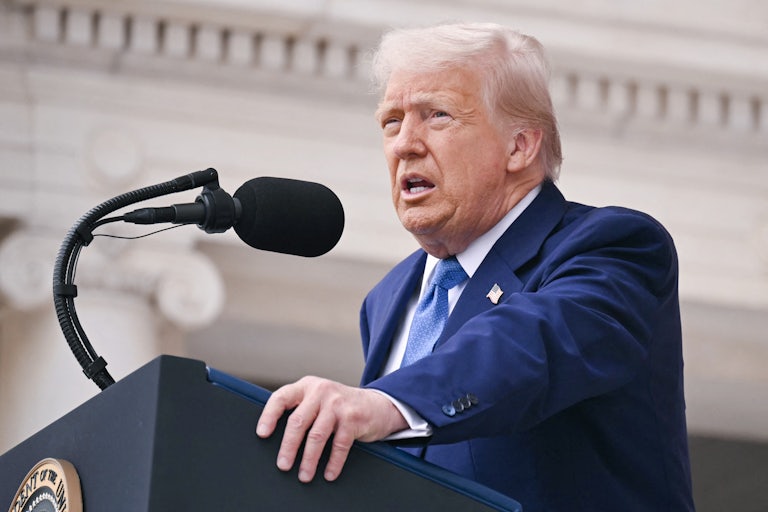
Donald Trump speaks at a podium.
SAUL LOEB/AFP/Getty Images

Donald Trump is pleading with the Supreme Court to make it easier to deport immigrants to countries they aren’t from, like South Sudan.

The president on Tuesday filed an emergency application to the Supreme Court, asking them to stay a lower court’s injunction last week that prevented the government from deporting a group of immigrants not from South Sudan to the country. U.S. District Court Judge Brian Murphy said that the White House provided “plainly insufficient” notice to the immigrants.

“It was impossible for these people to have a meaningful opportunity to object to their transfer to South Sudan,” Murphy ruled last Wednesday.

The Trump administration was not happy with the ruling,

“Many class members are aliens who have never been admitted into the United States,” Solicitor General D. John Sauer wrote in the Justice Department’s filing to the Supreme Court. “Thus, they do not have due-process rights to any additional removal procedures beyond the ones the political branches have provided.”

“Those judicially created procedures are currently wreaking havoc on the third country removal process,” Sauer added. “In addition to usurping the Executive’s authority over immigration policy, the injunction disrupts sensitive diplomatic, foreign-policy, and national-security efforts.”

Murphy castigated the administration Monday evening for “manufacturing the very chaos they decry” by deporting the immigrants from Vietnam and Myanmar to South Sudan, which Murphy said violated his injunction.

“The court recognizes that the class members at issue here have criminal histories,” Murphy said. “But that does not change due process.… The court treats its obligation to these principles with the seriousness that anyone committed to the rule of law should understand.”

This point seems particularly difficult for Trump and the rest of his administration to understand: Immigrants they wish to deport still have the right of due process, and the judiciary has the ability to rule on the president’s decisions. Trump can claim “foreign policy” all he wants, but the immigrants residing on U.S. soil, who in many cases aren’t the criminals the president claims they are, are still subject to protections under U.S. law. Now he’s trying to convince the Supreme Court to give him what he wants.

Pete Hegseth’s Pentagon Is Locked in a “Cold War”

One person called the atmosphere “unsettling.”

Pete Hegseth sits at a table and speaks
Oliver Contreras/AFP/Getty Images

Tension is bubbling in Pete Hegseth’s Pentagon.

The defense secretary’s senior advisers are falling further apart, causing rifts and scandals that are attracting the ire of the White House despite attempts to reset Hegseth’s team, The Washington Post reported Tuesday.

“There’s a cold war that exists in between flash points,” one anonymous source told the Post while recounting flaring tempers on Hegseth’s team. “It’s unsettling at times.”

One of the more prominent rifts is between Eric Geressy, Hegseth’s former mentor, and Ricky Buria, a junior military assistant whom Hegseth tried and failed to morph into his chief of staff.

Shortly after The Atlantic revealed that its editor in chief had been included in a Signal chat where top Trump officials—Hegseth included—discussed sensitive war plans regarding the imminent bombing of Yemen, Geressy expressed frustration at the administration’s decision to rely on the unsecured and unclassified communication app.

Geressy has also voiced “disgust” at White House reports describing Buria as “self important” and willing to ostracize other officials in order to snag more time with Hegseth or the White House, according to the Post.

“Friction between the two senior advisers remains palpable, those familiar with the situation say, and is emblematic of the instability that reigns at the Pentagon as Hegseth attempts to regain his footing after several scandals that irked the White House, alarmed Congress and left the former Fox News personality on the defensive,” the Post reported, noting that several current and former defense officials weren’t sure how long Hegseth could survive in the role amid the searing divisions.

The story followed more bad news for Hegseth Tuesday, after The Guardian reported that the White House had “lost confidence” in his investigation into leaked details regarding U.S. military options to claim the Panama Canal.

Hegseth had used the press leak to justify expelling three top aides last month, but Trump’s advisers raised flags after claims emerged that information of the leak had been obtained via a blatantly unconstitutional National Security Agency wiretap—a scandal considerably worse than the initial leak.

That claim fueled a “breakdown in trust” between the Pentagon and the White House, The Guardian reported, with Trump advisers suggesting that they “no longer have any idea about who or what to believe,” with at least one adviser interpreting the botched investigation as a way to nix defense aides that had reportedly been involved in infighting with Hegseth’s first chief of staff, Joe Kasper.

GOP’s Dumbest Senator Tommy Tuberville Launches Run for Governor

Tommy Tuberville will finally leave the Senate after only one embarrassing term.

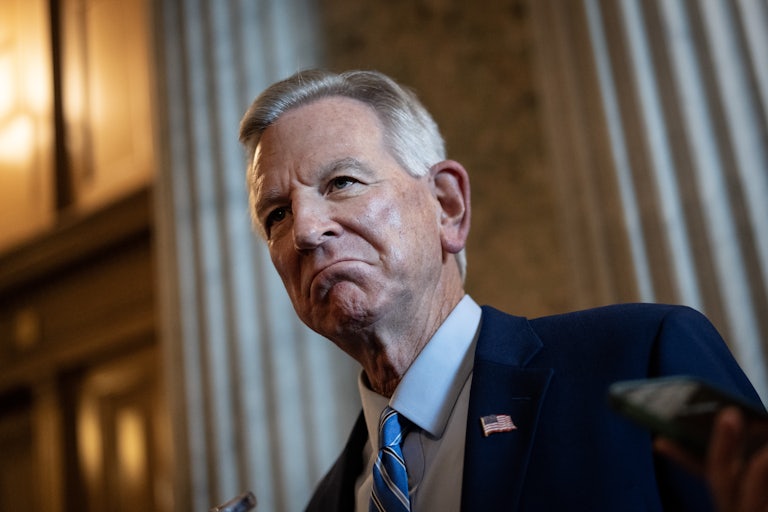
Alabama Senator Tommy Tuberville frowns
Drew Angerer/Getty Images

Tommy Tuberville, one of the GOP’s most dim-witted senators, is leaving Capitol Hill to run for governor in his alleged residence of Alabama next year.

“Coach Tommy Tuberville is running for governor!” his newly minted campaign website reads. His platform consists of “standing up for Alabama values,” fighting “woke ideology,” keeping Alabama pro-life, among other cookie-cutter MAGA Republican positions. Tuberville is looking to succeed term-limited Governor Kay Ivey, and is the clear favorite in the deep red Heart of Dixie.

Tuberville confirmed on Fox News that he’s ending his Senate career after just one term to run for governor.

Tuberville’s time in the Senate has been defined by shameless, gaffe-ridden loyalty to Trump and the MAGA agenda. He spent nine months of 2023 personally blocking over 450 military promotions to protest the Defense Department’s policy of reimbursing soldiers forced to travel out of state for an abortion. In the end, he caved, and nothing changed at the Defense Department.

He has also made national headlines for refusing to acknowledge that white nationalism is racist, fumbling the question so badly that it led to questions about his general competency. He lied about his dad getting five bronze stars in World War I. He tried to goad President Trump into taking over the Panama Canal, and spread vaccine misinformation in defense of Health and Human Services Secretary Robert F. Kennedy Jr. And that was all in just one term. The upcoming gubernatorial campaign is sure to provide more classic, alarmingly ignorant moments from Coach Tuberville.

How Trump Plans to Avoid a Potential Third Impeachment

Donald Trump is scrambling to keep Republicans in power.

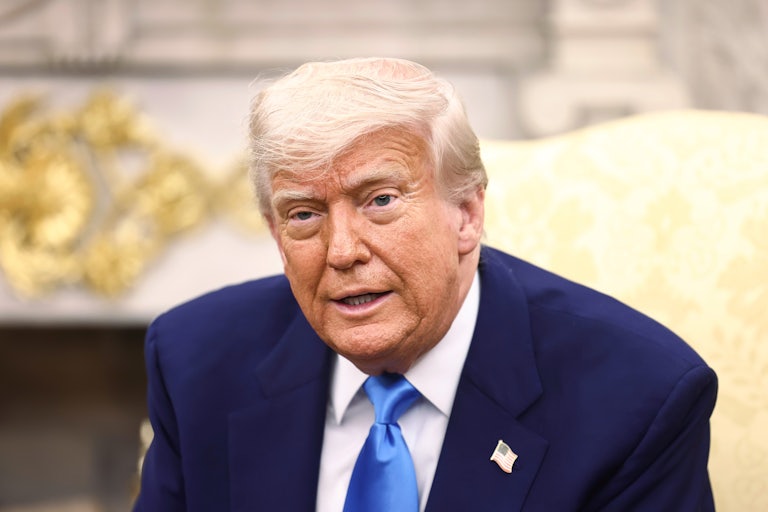
Donald Trump sits in the Oval Office
Jim Lo Scalzo/EPA/Bloomberg/Getty Images

Donald Trump has a five-step plan to keep Republican control of the House of Representatives in 2026, as part of a desperate bid to stave off yet another impeachment inquiry, Axios reported Tuesday.

There is no shortage of potential subjects for an impeachment inquiry. Trump has openly profited from his seat, and helped his allies get rich too—whether by manipulating the market or by turning administration officials into salespeople. Not to mention, he claims to have accepted a massive gift from a foreign government, likely violating the U.S. Constitution. Suffice it to say, Trump needs to keep the Democrats out of power.

Trump “knows the stakes firsthand. He saw what can happen. It’s clear he doesn’t want that again,” Matt Gorman, a top official for House Republicans’ campaign arm in the 2018 midterms, told Axios.

“Investigations, impeachment—he knows it’s all on the table with a Speaker [Hakeem] Jeffries.”

In an effort to maintain a GOP-led House, the president will try to prevent lawmakers from leaving their seats, either to retire or to run for another office. Any defections could hurt the party’s chances of retaining the seats and cost millions of dollars—which could hurt them come the next general election.

Earlier this month, Trump endorsed New York Representative Mike Lawler to keep his seat, despite the congressman’s ambitions to run for governor. Last week, during a contentious meeting with Republicans to secure the passage of the president’s “big beautiful bill,” Lawler had fought to restore state and local tax, or SALT, deductions—in part, to boost his viability as a candidate statewide—but failed. Trump told him to forget the SALT, warning, “I know your district better than you do. If you lose because of SALT, you were going to lose anyway.”

The Trump team is already concerned over the defections of Michigan Representative John James, who has opted to run for governor, and Kentucky Representative Andy Barr, who is leaving his seat to run for Senate.

In that same vein, an essential part of Trump’s plan involves shutting down primary challenges. If the president endorses vulnerable Republicans in the early stages of their races, it could potentially ward off challengers. Over the weekend, Trump made posts endorsing New York Representative Andrew Garbarino and Montana Representative Troy Downing. Although Downing handily defeated his Democratic challenger, he’d also had to defeat eight Republican challengers in the primary.

The next two steps of Trump’s plan are to raise big and spend big. The president has proven to be the GOP’s most effective fundraiser, raising more than $35 million for the cowardly National Republican Congressional Committee at a dinner in April. More events like these are sure to fill the party’s coffers ahead of the midterm elections.

Additionally, Trump’s political operation already has about half a million dollars ready to spend on future elections, and has launched a massive ad campaign backing the president’s tax plan, which will cost an estimated $5.3 trillion over the next decade.

Finally, the president will get hands-on with his recruitment. Gorman explained that the president would act as a “closer,” bringing in candidates to run in swing districts.