Breaking News
Breaking News
from Washington and beyond

Pete Hegseth Hit With Stunning Illegal Wiretap Allegations

The White House was left scrambling after reports that Hegseth had fired three top aides following an illegal wiretap.

Pete Hegseth gestures while speaking at a podium during an event at Arlington National Cemetery
Saul Loeb/AFP/Getty Images

Pete Hegseth’s lawyer suggested that the Pentagon may have fired three of the defense secretary’s top aides last month as the result of an illegal wiretap, according to an exclusive from The Guardian.

White House advisers were reportedly shocked when Tim Parlatore, Hegseth’s personal lawyer who was tasked with overseeing an investigation into a series of leaks at the Pentagon, told them that a warrantless wiretap was used to find classified documents on the phone of the secretary’s then–senior adviser Dan Caldwell.

Caldwell was dismissed last month, alongside the chief of staff to the deputy defense secretary, Colin Carroll, and deputy chief of staff Darin Selnick. Hegseth was reportedly counseled to dismiss those three by Joe Kasper, his former chief of staff, as part of a detonating power struggle within their office.

Kasper was reportedly close with Parlatore, who was charged with investigating his enemies at work, according to The Guardian.

In mid-April, White House advisers reportedly caught wind that there was evidence Caldwell had taken a photograph of U.S. military plans for Panama on his phone. After Caldwell was removed, they were disturbed that he maintained his innocence, claiming that individuals with “personal vendettas” against Hegseth’s three ousted advisers had “weaponized” the investigation against them.

Advisers also heard another rumor that the Air Force Office of Special Investigations, which had been looking into the leaked document, had focused its search on mid-level aides. They hadn’t turned their attention to the three top aides until the weekend after they were fired.

When the White House questioned Parlatore about how he’d determined that Caldwell had the leaked document on his phone, he suggested that a wiretap had taken place. He later denied this, and said all information he’d received had been passed to him from officials at the Pentagon. The Guardian noted that a warrantless wiretap, as this allegedly was, would “almost certainly be unconstitutional.”

While White House advisers found this claim to be untrue, The Guardian reported that the incident significantly undermined Parlatore’s credibility. The investigation was transferred to deputy Defense Secretary Stephen Feinberg, while Parlatore went to work on another case.

Concerns over leaks within the Trump administration have been escalating since before Hegseth’s humiliating Signalgate scandal. As the administration has begun to wheel out the lie detectors, morale has plummeted. Carroll, one of Hegseth’s ousted aides, said on a podcast last month that his former boss and his team had become “consumed” by leaks. “If you look at a pie chart of the secretary’s day, at this point, 50 percent of it is probably a leak investigation,” he said.
Cognitive Decline? Trump Repeatedly Fumbles in Multiple Weird Rants

Donald Trump made several gaffes throughout his speeches during the Memorial Day weekend.

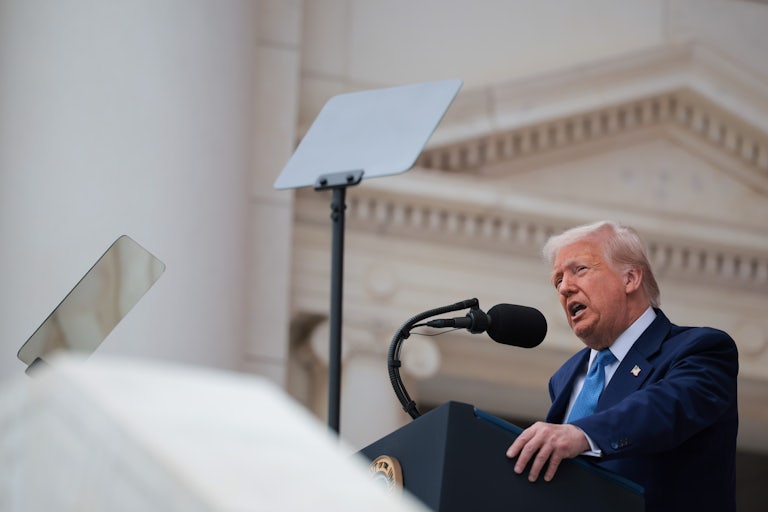
Donald Trump speaks at a podium during an event at Arlington National Cemetery
Kayla Bartkowski/Getty Images

The president and his speechwriters just had a terrible, horrible, no good, very bad weekend.

Over the course of 72 hours, Donald Trump droned and dragged his way through stump speeches and interviews with the press, making some critics question whether the 78-year-old was still totally with it.

Trump urged the officer class of West Point Military Academy to “not lose momentum” on Saturday—but while doing so, he went on a long, rambling side note about Cold War–era real estate businessman Bill Levitt and his “trophy wife,” his yacht, and how he lost it all.

At an Arlington Memorial Day ceremony intended to commemorate fallen soldiers, Trump basically alleged that his second term was a gift from God because the nation would experience both the World Cup and the Olympics during the next four years.

“In some ways I’m glad I missed that second term where it was,” Trump said, apparently refusing once again to acknowledge that he lost the 2020 presidential election. “Because I wouldn’t be your president for that—most important of all, in addition we have the World Cup and we have the Olympics.

“Can you imagine, I miss that four years and now I have everything,” Trump continued. “Amazing the way things work out. God did that; I believe that.”

(The World Cup and the Olympics are not scheduled by God, as you can imagine. Instead, they are both held every four years, with host countries selected through non-national organizations.)

During the same speech, Trump offered another verbal “covfefe” moment, lazily stumbling over the word “cryptologist” and instead blurting out “cryptolologic” while referring to a technician.

On Sunday, Trump spoke with reporters on the tarmac in Morristown, New Jersey, only to reveal (while boasting) that he actually did not understand the specifics of a deal between U.S. Steel and Japanese company Nippon Steel. Trump had announced the partnership on social media Friday, claiming that it would create “at least 70,000 jobs” and add “$14 billion dollars [sic]” to the economy. But instead of sharing the specifics of the deal on Sunday, the president mistakenly pitched that Japanese carmaker Nissan was involved in the steel arrangement.

“Everybody seems to want it, and we’ll see. We’ll see what the final is, but they’re going to invest billions of dollars in steel, and it’s a good company—Nissan—a very good company,” Trump said. “It’s an investment and a partial ownership but it will be controlled by the U.S.A.”

NPR Hits Trump With Major Lawsuit That Goes Beyond First Amendment

This lawsuit isn’t just about free speech.

NPR headquarters building
SAUL LOEB/AFP/Getty Images

NPR is suing President Trump. 

National Public Radio and three local Colorado affiliates filed a suit Tuesday morning against the president on the grounds that his executive order to cut the organization off from federal funding is a violation of free speech rights—and an attempt to usurp Congress’s power of appropriating federal funding. 

Trump’s  May order barred the Corporation for Public Broadcasting, a congressionally authorized private corporation, from sending funds to NPR and PBS. 

“The Executive Order is a clear violation of the Constitution and the First Amendment’s protections for freedom of speech and association, and freedom of the press,” said NPR President and CEO Katherine Maher.

Colorado Public Radio, Aspen Public Radio, and KSUT are the other represented stations on the suit. 

Trump has been attacking NPR and other liberal media institutions for some time now, pushing the tried and true conservative narrative that the network is a propaganda arm of the U.S. left. 

“NPR and PBS, two horrible and completely biased platforms (Networks!), should be DEFUNDED by Congress, IMMEDIATELY,” he wrote in March. “Republicans, don’t miss this opportunity to rid our Country of this giant SCAM, both being arms of the Radical Left Democrat Party. JUST SAY NO AND, MAKE AMERICA GREAT AGAIN!!!”

This story has been updated.

Trump’s Crypto Dinner Guests Admit They’re Trying to Buy Him Off

“He’ll always be good to his sponsors,” one wealthy guest said.

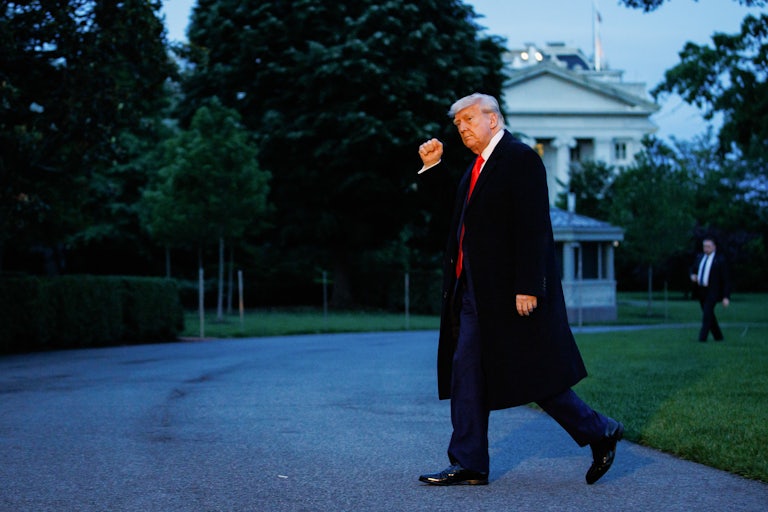
Donald Trump walks outside the White House and raises a fist in the air as if in victory.
Samuel Corum/Politico/Bloomberg/Getty Images

Incredibly unsurprising news: The people who paid millions of dollars to get into Trump’s lavish cryptocurrency dinner did so to directly influence the president’s financial policy in their favor.

“I will definitely not hesitate to share my perspective,” Vincent Liu, CIO of Taiwanese-based crypto firm Kronos Research, who bought enough of Trump’s crypto to attend the dinner Thursday night, told The New York Times. “It’s great to see the current direction that everything’s going.”

“It’s kind of a fund-raiser” for Mr. Trump, Korean crypto executive Sangrok Oh and another dinner attendee, told the Times. “And he’ll always be good to his sponsors.”

The dinner was held at Trump’s private golf club in northern Virginia on Thursday evening for the top 220 holders of the president’s meme coin cryptocurrency—after an auction that brought in $147,586,796.41. Protesters lined the entrance to the building, chanting “Shame, shame, shame!” and holding up signs while attendees arrived.

The event was promoted as the “most EXCLUSIVE INVITATION in the world,” according to an email. While the top 220 buyers got into the gala, the top 25 buyers received a much more personal, “ultra-exclusive private VIP reception” and “Special VIP Tour” with Trump, allowing them unfettered access to the president.

There were also some other high-profile attendees there (with much smaller pockets than the likes of Liu and Oh). Embattled former NBA player and reality TV star Lamar Odom posted a video on X of himself walking into the event while boos and jeers rained down on him from the crowd.

“I’m just about to pass through security and officially walk into the Trump Gala.

Honestly … I’m fired up. Think about it—what meme coin has ever done this?” Odom wrote on X, plugging his own meme coin, as well. “$ODOM isn’t just a token, it’s taking the stage at a presidential gala tonight!”

Trump’s cryptocurrency has been widely condemned as a blatant conflict of interest that completely blurs the lines between executive power and private business.

“Donald Trump’s dinner is an orgy of corruption. That’s what this is all about,” Senator Elizabeth Warren said that evening. “Donald Trump is using the presidency of the United States to make himself richer through crypto, and he’s doing it right out there in plain sight. He is signaling to anyone who wants to ask for a special favor—and is willing to pay for it—exactly how to do that.

Here’s What Happened at Trump’s Shady Cryptocurrency Dinner

A conservative influencer who attended Donald Trump’s crypto dinner says it was a total bust.

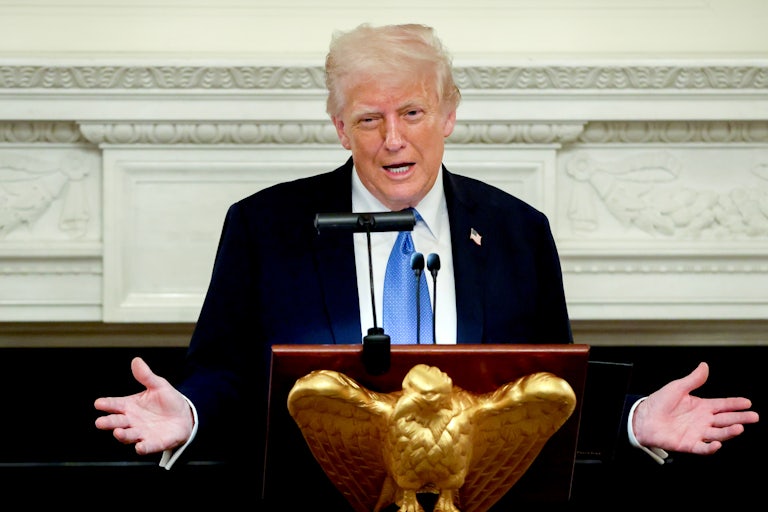
Donald Trump gestures while speaking at a podium
Samuel Corum/Bloomberg/Getty Images

Crypto-investors anonymously shelled out a total $148 million to purchase access to Donald Trump, but all they got was a low-quality steak.

Guests at Trump’s supposedly “intimate” gala for the 220 top buyers of the $TRUMP memecoin gathered at the Trump National Golf Club in Virginia Thursday night, hoping for a little facetime with the president. But they were left entirely unsatisfied.

Nicholas Pinto, a 25-year-old social media influencer who spent a whopping $360,000 on the president’s memecoin, told Fortune that he was distinctly underwhelmed by the affair.

Trump, rather than cozy up to his guests, gave an address to the room that was “pretty much like bullshit,” Pinto said. Most guests struggled to get any face time with the president, according to Pinto. The event’s host Caitlin Sinclair, an anchor at OANN, said that she didn’t even get a picture with the commander-in-chief, Pinto recalled.

Christoph Heuermann, who shared a series of photographs from the event on his Instagram page, wrote that Trump gave a brief 20-minute speech “and didn’t interact with the crowd other than enjoying being celebrated.”

Only the 25 biggest investors were given access to a small VIP reception with Trump. The rest were left with only their halibut or filet mignon.

During the banquet, Pinto texted Fortune to say that the food was “trash.”

“Walmart steak, man,” he wrote.

Guests reportedly included the coin’s top buyer Justin Sun, a Chinese billionaire who founded the crypto platform Tron, and former Los Angeles Laker Lamar Odom. Press Secretary Karoline Leavitt said Thursday that a list of attendees would not be made public because the president was attending the event off-the-clock—which doesn’t even begin to resolve the conflicts of interest issues at play for the president of the United States.

On average, each person had spent roughly $1.8 million on the president’s meme coin, in what many critics have called a blatant pay-for-access scheme.