Breaking News
Breaking News
from Washington and beyond

White House Gives Chilling Update on Hegseth’s “Kill Them All” Order

White House press secretary Karoline Leavitt clarified the Pentagon order that led to a second strike to kill survivors after a boat bombing in the Caribbean Sea.

Defense Secretary Pete Hegseth looks to his right.
Anna Moneymaker/Getty Images

The U.S. government’s September 2 attack on a boat off the coast of Trinidad, the first of dozens of strikes on what the Trump administration has claimed are drug-trafficking vessels, is drawing increased scrutiny after reports that an immediate, second missile strike was ordered to kill survivors.

ABC News reporter Rachel Scott asked White House press secretary Karoline Leavitt at a Monday briefing whether the Pentagon’s policy had changed, noting that in a subsequent October Caribbean Sea airstrike, survivors were rescued instead of targeted.

“Was there a decision to handle survivors differently after these airstrikes?” Scott asked.

“Not to my knowledge,” Leavitt replied.

The answer is chilling, as it doesn’t clear up anything about what policy or legal method governs the airstrikes, which have continued for nearly three months. According to a Washington Post article, which Scott referenced in her question, Secretary of Defense Pete Hegseth made the order to kill everybody in the September airstrike, which the White House denies.

The Trump administration’s legal justifications for striking boats in the waters around Central America have repeatedly been questioned by Democratic and Republican members of Congress, foreign governments, and the United Nations. The Defense Department’s own Law of War Manual prohibits declaring “no quarter” or conducting operations “on the basis that there shall be no survivors.”

As officials admit that they have no idea who is even being killed, the Trump administration continues launching airstrikes with impunity. At the same time, the airstrikes seem to be a precursor for war, with 14 percent of the U.S. Navy fleet already dispatched to the region. Alleged war crimes are becoming the norm in this yet-to-be-declared war.
Karoline Leavitt Flails Trying to Defend Pete Hegseth’s Second Strike

She also tried to shift blame away from Hegseth.

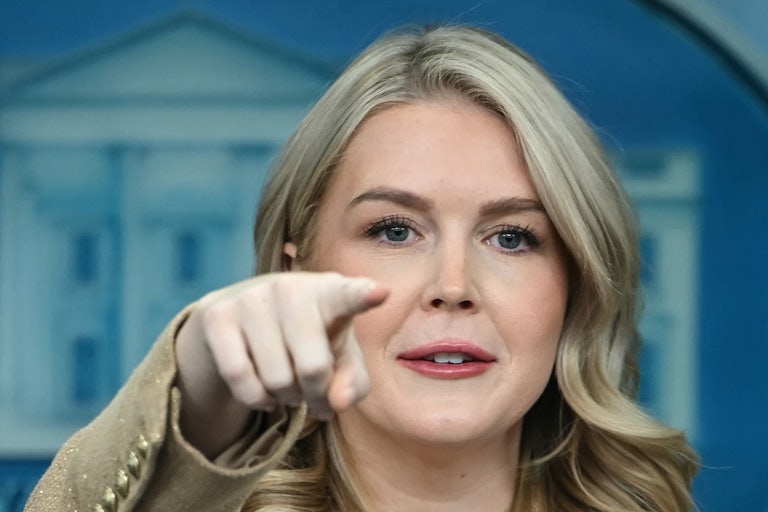
Karoline Leavitt points during a White House press briefing
ANDREW CABALLERO-REYNOLDS/AFP/Getty Images

The White House is still trying to defend Defense Secretary Pete Hegseth’s “no survivors” approach to bombing small boats in the Caribbean.

A live drone feed revealed that the Pentagon mercilessly attacked two people who clung to the wreckage of an airstrike on September 2 in order to comply with the Pentagon chief’s orders to “kill everybody” at the scene, The Washington Post reported over the weekend.

News of the administration’s ruthlessness ruffled feathers across Washington. GOP-led panels in the House and Senate announced that they would dial up their scrutiny of the Pentagon, while Donald Trump told reporters aboard Air Force One that he was choosing to believe Hegseth, who claimed he did not “order the death of those two men.”

But the cover-up was still alive and well back at the White House on Monday, where press secretary Karoline Leavitt claimed that one of Hegseth’s subordinates was the one truly responsible for the second airstrike.

“Does the administration deny that that second strike happened, or did it happen and the administration denies that Secretary Hegseth gave the order?” asked a reporter, quoting one of Hegseth’s reports in which he claimed that the entire story about the attack had been fabricated.

“The latter is true,” Leavitt said. “President Trump and Secretary Hegseth have made it clear that presidentially designated narcoterrorist groups are subject to lethal targeting in accordance with the laws of war.”

“With respect to the strikes in question on September 2, Secretary Hegseth authorized Admiral Bradley to conduct these kinetic strikes. Admiral Bradley worked well within his authority and the law, directing the engagement to ensure the boat was destroyed and the threat to the United States of America was eliminated,” she added.

The attacks have been condemned by U.S. lawmakers on both sides of the aisle and foreign human advocates alike, including the United Nations’ human rights chief, who said in October that the strikes “violate international human rights law.”

The White House has insisted the violence is justified, broadly accusing the boats of trafficking narcotics to the U.S. from Venezuela and Colombia, though U.S. lawmakers have been more than skeptical—particularly since several of the boats were thousands of miles away in international waters and since the attacks were conducted without prior investigations or interdiction. Pentagon officials reportedly haven’t been concerned with identifying the people on the boats before attacking.

Trump’s careless killing spree has so far killed at least 83 people aboard the tiny watercraft. It has also rallied tens of thousands of Venezuelans in favor of war against the United States.

Trump has attempted to use the attacks to shove Venezuelan President Nicolás Maduro out of power, something that he tried and failed to do in 2019.

But despite the justifications, Leavitt had no additional details to offer when she was asked to clarify Monday whether the administration was aware that the ship hit on September 2 had survivors aboard.

“Why won’t the administration either confirm or deny or reveal whether or not there were survivors after that initial first strike? And what imminent threat would survivors pose who were clinging presumably to the wreckage of that boat?” a reporter pressed.

“Again, as I’ve said, I think you guys are not listening fully to the statement I provided,” Leavitt responded. “Admiral Bradley worked well within his authority and the law directing the engagement to ensure the boat was totally destroyed and the threat to the narcoterrorists—to the United States—was eliminated.”

The White House mouthpiece then told the room of journalists to redirect their questions to the Department of Defense, adding that she “obviously wasn’t in the room” when the decision was made.

Trump Sure Seems Stressed Republicans Are at Risk of Losing House Seat

A special election in Tennessee is closer than it should be for Republicans.

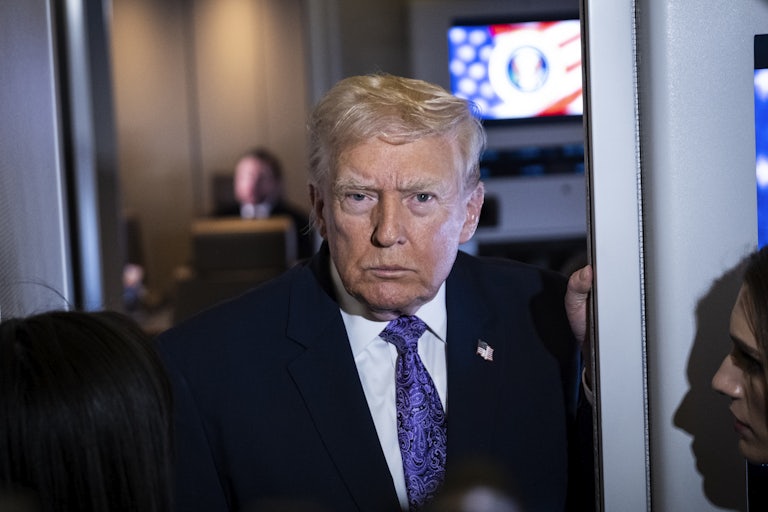
Donald Trump speaks with reporters aboard Air Force One.
Pete Marovich/Getty Images

President Trump dedicated part of his day Monday to attacking Tennessee Democratic House candidate Aftyn Behn, only further confirming that the GOP is desperate for wins as it limps into 2026.

Last week, an Emerson College Polling/The Hill survey of the special election had Behn just behind Republican candidate Matt Van Epps, 46 percent to 48 percent—with 2 percent voting elsewhere and 5 percent undecided. A victory for Behn would be a massive upset to a Republican House majority already on its last legs in the wake of Representative Marjorie Taylor Greene’s resignation announcement—and the impending resignations of various others.

“We have to win this seat. We’ve gotten you the largest tax cuts in history, and the new bill—the Great Big Beautiful Bill—kicks in, as you know, on January 1. It hasn’t even kicked in yet,” Trump told a Van Epps rally while on House Leader Mike Johnson’s speaker phone. “Number one, [Behn] hates Christianity, number two, she hates country music. How the hell can you elect a person like that? … It’s a big vote, and it’s gonna show something. It’s gonna show that the Republican Party is stronger than it’s ever been.”

The president also noted that he’d be doing a telerally for Van Epps on Monday night.

The narrative that Behn “hates Christianity” is one of many falsities that the GOP has pushed in a race where more than $3.3 million has been spent against her. Behn has mentioned that she disapproves of religions being “at the core of everything we do in the legislature” but has never said anything close to what Trump claimed.

Many also noted the urgency that Trump spoke with.

“‘The whole world is watching,’ President Trump says of tomorrow’s special election for Tennessee’s 7th congressional district—which Trump carried by 22 points in 2024,” USA Today’s Joey Garrison wrote.

The special election is on Tuesday. .

Only One President Was Less Popular Than Trump Is Right Now: Poll

A brutal new poll shows Donald Trump’s popularity is tanking across the board.

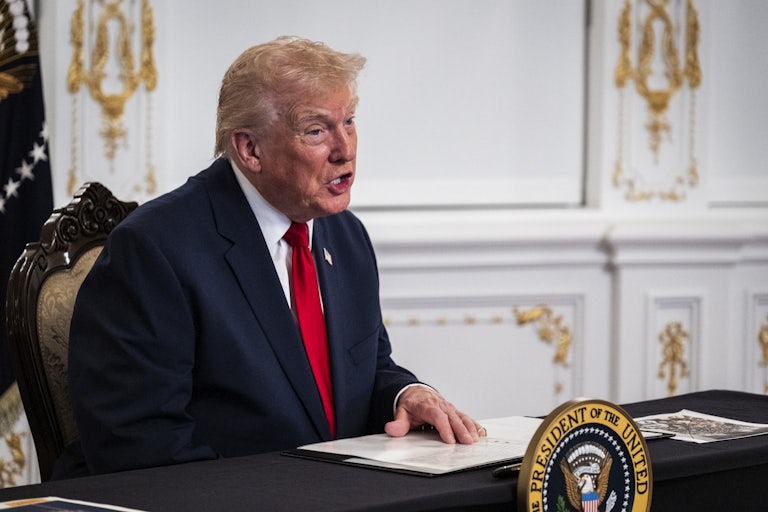
Donald Trump speaks while sitting at a desk in Mar-a-Lago
Pete Marovich/Getty Images

A recent series of polls are signaling disaster for President Donald Trump’s hopes of carrying the Republican Party through the 2026 midterm elections.

CNN’s chief data analyst Harry Enten on Monday discussed several different polls that found that Trump had hit an approval low for his second term.

Enten cited a recent Gallup poll that saw Trump’s net approval rating sink to -24 percent from -1 percent in January. “We’re talking about a drop of over 20 points in the wrong direction for the president of the United States,” the analyst said.

The only president who was less popular than Trump at this point in his second term? Richard Nixon, who had an approval rating of -36 points just a few months before he resigned from office. “Anywhere you look this is the second-worst for a president of either party in their second term dating all the way back since the 1940s,” Enten said.

Since the 1940s, Enten said, no president has successfully increased their approval rating by more than five points between this point in their second term and the midterm elections. Unless Trump can “break history,” he can say, “‘See you later!’ to that Republican majority,” Enten cried.

To be sure, Trump’s approval rating is expected to have an outsize impact on Republicans’ performance in next year’s midterm elections. In November’s off-cycle elections, as in 2018 and 2020, voters who disapproved of Trump’s performance in the White House supported the other party’s candidates at a higher rate than for any other recent president, according to CNN.

As Enten pointed out, Trump has garnered a negative net approval rating across several recent polls. The Gallup poll, conducted from November 3 to 25, found that the president’s approval rating had fallen to 36 percent, approaching his all-time low approval rating of just 34 percent after the deadly riot at the U.S. Capitol in 2021.

Another poll by the American Research Group found that Trump’s net approval rating was -27 percent, and another sponsored by Fox News placed him at just -17 percent. A recent Reuters/Ipsos poll found that he had a net approval rating of -22 percent, thanks to the Trump administration’s handling of the Epstein files and high consumer prices.

Alleged D.C. Shooter Begged CIA for Help as He Tried to Find Work

The National Guard shooting suspect felt abandoned by the CIA after working together for so long, his fellow unit member said.

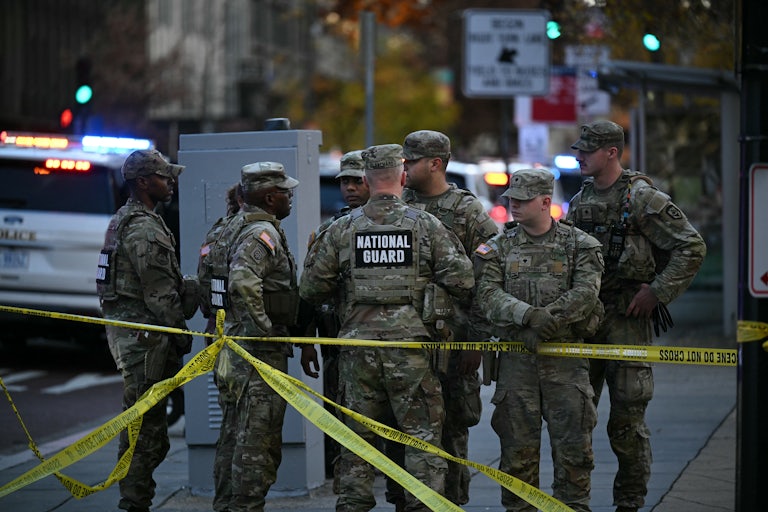
Six National Guard soldiers gather near the crime scene after a shooting in downtown Washington, D.C.
Drew ANGERER/AFP/Getty Images
National Guard soldiers gather near the crime scene after a shooting in downtown Washington, D.C., on November 26.

The Afghan refugee accused of shooting two National Guard members Wednesday used to serve in a CIA-backed military unit, and felt abandoned by the agency, Rolling Stone reports.

Rahmanullah Lakanwal served in the “Zero Units,” a paramilitary unit in Afghanistan led by the CIA and trained by U.S. special operations soldiers. After the Taliban returned to power in the country in 2021, Lakanwal came to the United States with his wife and five sons, settling in Bellingham, Washington.

Lakanwal’s move to the U.S. was helped by Operation Allies Welcome, a Biden administration initiative to help resettle Afghans fleeing the new regime, especially those who had worked with U.S. personnel and could be in danger from the Taliban. Lakanwal struggled in his new life, though.

Despite receiving asylum and work authorization from the Trump administration, he was fired from a laundromat job because he didn’t have a work authorization card, a fellow member of his unit told the magazine. Lakanwal’s nephew also wrote a letter to the Bellingham housing authority asking to move the family closer to an Afghan community, citing a physical attack on his uncle that required hospital treatment.

The letter noted that Lakanwal was isolated, lacked English skills, and would benefit from being in a larger area like Seattle where he could easily find work. More than one month ago, Lakanwal reportedly told his unit mate that his missing paperwork meant that he couldn’t get a job, leaving his family unable to afford food or a place to rent.

As a result, Lakanwal had to borrow money from friends and other unit members, breaking down in tears when speaking to his unit mate. In June, Lakanwal reached out to a CIA program meant to aid Zero Unit veterans with their immigration issues. Rolling Stone saw a screenshot of a group chat where unit members shared their issues with an agency representative, including Lakanwal, who repeatedly asked for help.

Lakanwal’s last post was unanswered and deleted by the group’s administrator. When the magazine contacted the CIA representative, they claimed it was a wrong number. The agency did not respond to the magazine’s request for a comment.

All of this must not have helped Lakanwal’s mental health. Other reports say that he spent weeks at a time isolated in a dark room and would suffer “manic episodes,” according to a case worker who helped with his family’s relocation. During these episodes, which could last weeks, Lakanwal would make cross-country drives by himself.

After last week’s shooting, which killed one National Guard member and hospitalized another, the Trump administration has used the incident to attack immigration and refugee asylum policies, claiming that Lakanwal was not properly vetted, despite the administration’s approving his asylum claim in April.

Its claim belies the fact that Lakanwal worked directly with U.S. personnel in Afghanistan in a select unit that required extreme vetting and a probationary period. Zero Unit veterans were also vetted upon arrival in the U.S. before getting Special Immigrant Visas, meant for Iraqis and Afghans who aided the U.S. government.

Lakanwal may have been suffering from PTSD and feeling frozen out by the U.S. government, an unfortunately common problem affecting military veterans. He also couldn’t work thanks to missing immigration paperwork, a problem exacerbated by the Trump administration’s wholescale gutting of the federal government. If he had gotten the help he was seeking, who knows if last week’s tragedy could have been averted.