Breaking News
Breaking News
from Washington and beyond

Trump Is Begging for a New Trial in E. Jean Carroll Case

The former president, found guilty of sexual abuse, is getting desperate.

James Devaney/GC Images

Donald Trump cannot accept that he was found liable for sexually abusing E. Jean Carroll, and on Thursday asked for a new trial in the decided case.

Trump was unanimously found liable in May for sexual abuse and battery against Carroll in the mid-1990s, and for defaming her in 2022 while denying the assault. He was ordered to pay her about $5 million in damages. Carroll has two more defamation lawsuits against Trump pending: one from 2019 and one from last month, after he bashed her during the CNN town hall.

Trump’s lawyers argued in court documents that he had been charged too much for damages. They said that the $2 million award for sexual abuse was “excessive” because the jury determined Carroll had not been raped and that his assault had not caused her any mental injury.

The lawyers also said the $2.7 million for defamation was “based on pure speculation.” They asked that the total damages either be reduced to $900,000 or that the judge grant an entirely new trial.

Carroll accused Trump in her 2019 memoir of raping her in the Manhattan Bergdorf Goodman department store in the mid-1990s. She initially sued him twice for defamation: first in 2019, when he said she made up the rape allegation to promote her book, and again in November for posts he made about her on social media.

Carroll is not the only woman to accuse Trump of sexual assault, but her case was the first to make it to a courtroom. Trump continues to vehemently deny all of the allegations and launched fresh vitriol at Carroll during the disastrous CNN town hall last month. So Carroll sued him for defamation again.

Trump and his allies have repeatedly tried to thwart Carroll’s various lawsuits. Last week, a judge denied an attempt to throw out the 2019 defamation suit by Trump ally James H. Brady, who argued that the former president was being unfairly treated because he is a “white Christian.”

And on Monday, Trump and his legal team also requested that the 2019 suit be dismissed, arguing that he couldn’t have defamed Carroll then because he was technically telling the truth when he denied raping her.

Supreme Court Makes It Easier for Dems to Retake the House With Voting Rights Ruling

The court’s decision affects congressional district maps across the country, and a few Republicans are in big trouble.

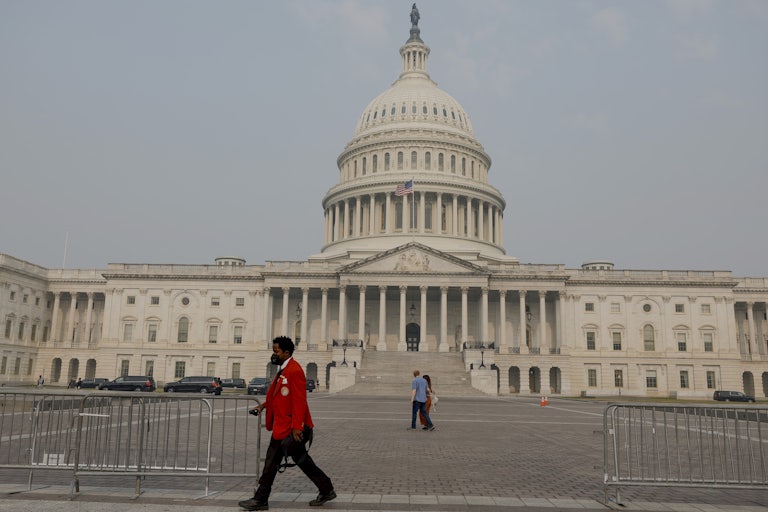
Capitol building
Anna Moneymaker/Getty Images

The Supreme Court’s ruling Thursday that Alabama’s congressional district map discriminated against Black voters could have bigger implications for several Southern states—and could help Democrats retake the House in 2024.

The biggest change and most immediate impact, obviously, will be in Alabama. But a handful of other states where racially gerrymandered districts are facing legal challenges could also see a very different map in the coming election. That includes Louisiana, South Carolina, and Georgia—and may affect races beyond that.

Democrats currently have 212 seats in the House of Representatives, and they would only need to reclaim six to retake the majority in the chamber.

Alabama

Alabama will have to redraw its map to create two majority-Black districts, which could set a precedent for rulings in the other states. There are seven congressional districts in the state, and six of them are held by Republicans.

Here are the Republican representatives who could be most in trouble from the redistricting:

  • Jerry Carl
  • Barry Moore
  • Mike Rogers

Georgia

Georgia Democrats lost a seat to Republicans during the 2022 midterms after the state GOP redrew the 6th district to include more conservative, majority-white areas. A judge could rule later this year that the new map illegally dilutes the Black vote and needs to be redrawn. The Republicans who could be at stake are:

  • Barry Loudermilk
  • A. Drew Ferguson

Louisiana

The Supreme Court previously blocked a lower court’s ruling to redistrict Louisiana to include a second majority-Black district, until it could issue its Alabama ruling. And now that we have a decision on Alabama, Louisiana will likely also have to redraw its maps to stop diluting the Black vote. That means Republicans who might lose their seats are:

  • Garret Graves
  • Julia Letlow

South Carolina

The Supreme Court agreed to hear the challenge to a South Carolina court ordering the state to redraw its 1st district.

Good luck to Nancy Mace.

Saudi Arabia Just Took Over Golf. Is Soccer Next?

The brutal kingdom had a very good, if not perfect, week.

Photo by FAYEZ NURELDINE/AFP/Getty Images
The Lion in Winter (Cristiano Ronaldo playing in Saudi Arabia in March)

This was supposed to be a perfect week for Saudi Arabia, but it only ended up being a very good one. Taking over pro golf, which Saudi Arabia literally did on Tuesday, is a pretty good achievement—even though the deal will likely face antitrust scrutiny. (They did, after all, literally take over golf.) But the controversial kingdom also took its biggest steps yet to taking over soccer.

Wooing Cristiano Ronaldo with a $200 million annual salary in January was only one small part of the Saudis’ larger plan. Newcastle United, the English Premier League team the country’s sovereign wealth fund owns, will play in the Champions League next season. And since the conclusion of the European leagues, Saudi Arabia has splashed money around, wooing players to its domestic league. Karim Benzema, Ronaldo’s former teammate at Real Madrid, will play for Al-Ittihad; the brilliant, diminutive, oft-injured N’Golo Kante will join him there as well. On Monday, Saudi Arabia’s ruthless dictator Mohammed bin Salman announced that the state’s Public Investment Fund—which he definitely does not control—will take over the state’s four biggest teams. Saudi Arabia, in other words, is trying to become a huge player in global soccer. They only just missed out on their crown jewel.

Lionel Messi, soccer’s greatest ever player, who rebuffed the kingdom at the last minute on Wednesday, announcing that he would be spurning what likely amounted to more than a billion dollars to spend his twilight years in Saudi Arabia to instead take (probably) far less money in a far more convoluted deal to play in Miami. Messi is serving as a “cultural ambassador” for Saudi Arabia and is seen as a key cog in its effort to win the 2030 World Cup; his decision to spurn its offer was seen as a slap in the face. It was also a reminder that for all the money Saudi Arabia is kicking around, it is still a long way from becoming a major player in soccer.

Saudi Arabia has vast account surpluses and is investing heavily in sports as part of its efforts to launder its dismal human rights record—and as a way of transitioning its economy. It desperately wants the 2030 World Cup and is doing everything that it can to win it—and will spend billions to bring European stars to its domestic league.

It has already made huge strides in the world of golf and boxing, in particular. But it’s clear that the globe’s most popular sport is next. Bringing in soccer’s biggest stars—though many are well past their prime—may simply be part of the larger push to secure the 2030 World Cup. And yet Saudi Arabia’s ambitions seem to surpass hosting one global tournament. The larger effort is toward something like LIV Golf but for soccer. As with LIV, the Saudis are using their competitive advantage—they can pay many players exponentially more than many European clubs can—to build an empire. The next step will be taking on the global soccer elite directly.

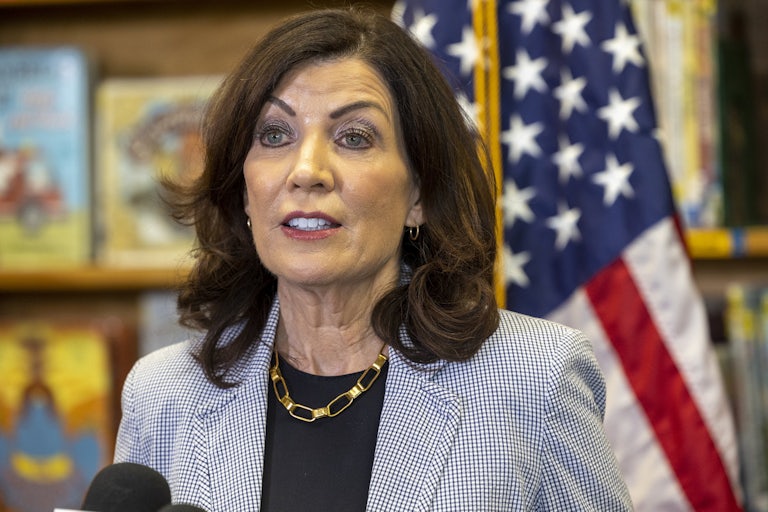
Kathy Hochul Wants a Republican to Lead New York’s Energy Sector

There’s reason to be concerned about Justin Driscoll’s nomination as head of the New York Power Authority.

Kathy Hochul
Howard Schnapp/Newsday RM/Getty Images
New York Governor Kathy Hochul

New York is enveloped in a dense, ominous haze of smoke, a looming reminder of what may come without a green transition. Meanwhile, Kathy Hochul is trying to push through a Republican and climate-denialist donor to lead the state’s energy and power operations.

Justin Driscoll is the current interim CEO of the New York Power Authority, earning the recommendation of the NYPA board last year (a board that is appointed by the governor). Now, the state Senate will hold a confirmation vote this week on whether he should become a permanent fixture in the role.

Driscoll has a long résumé working in energy, but a closer look reveals a mixed record of concern to anyone who might specifically care about clean energy.

For starters, Driscoll is a registered Republican with a history of donations to Republican candidates and organizations.

That includes the New York Assembly Republican Campaign Committee, then–New Jersey gubernatorial candidate Chris Christie, and Texas’s John Cornyn, during his first bid for the Senate in 2002. At the time, Cornyn had been criticized for accepting nearly $200,000 in political contributions from Enron, the energy company infamously wrapped up in corporate fraud. Driscoll nevertheless apparently found the Texas Republican—now a member of Congress who doesn’t believe climate change is real—to be compelling.

Driscoll’s record on actual policy also brings cause for scrutiny. Last year, he opposed the Build Public Renewables Act, legislation that sought to expand NYPA’s green energy production.

State lawmakers have passed the bill anyway, and many have hailed it as the “biggest Green New Deal win in U.S. history,” providing a model for how states can set course for strong transitions toward greener energy while creating jobs.

That is the kind of success Driscoll went out of his way to oppose.

“The NY State Senate voted to pass the BPRA this session because we know how crucial it is for climate action in New York,” state Senator Julia Salazar tweeted last year. “We cannot then turn around and vote to confirm a NYPA CEO who isn’t up to the task, which is why I wouldn’t be able to support Justin Driscoll’s nomination.”

And even on his actual leadership, there is reason to be concerned.

On Tuesday, Buffalo News reported that Driscoll oversaw an alleged racially discriminatory NYPA environment while serving as its general counsel from 2014 to 2021.

One senior power plant operator, Christopher Carey, was accused of berating, belittling, and discrediting the late Shirley Hamilton, the former president of the Niagara Falls NAACP and NYPA employee of 44 years.

Carey allegedly said no one could have Hamilton fired because she was “Black and untouchable,” but threatened that he would “get her fired and be the first.” Carey reportedly held Hamilton to standards he would not hold white employees to and said he had “management so bamboozled that I could run around the control room nude with Shirley and no one would believe her.”

The complainant, NYPA employee Nick Gilewski, claimed he was denied a raise and disciplined by Carey in retaliation for making the accusations. Gilewski resigned, citing how Carey’s pay just kept increasing despite the allegations, which grew to include another Black employee, Rudolph June.

In 2015, Buffalo News reports, June wrote a letter directly to Driscoll, who was general counsel for NYPA at the time. In it, June cited the hostile work environment, including threats of violence and even an incident where drawings that depicted African Americans as Black minstrels were found on site.

“While I can appreciate your frustration, I want to assure you that the Authority conducted a thorough investigation into your claims,” Driscoll wrote back.

June was fired from the agency in 2019, which he maintains was due to his complaints related to discrimination.

Perhaps Driscoll’s nomination makes sense when you look at Hochul’s own dodgy record on energy. In April, she granted an economic development award to Amazon, one of the wealthiest corporations in the world, giving it special access to low-cost power. She put the Build Public Renewables Act on the negotiating table while finalizing next year’s budget, allowing it to be slightly watered down.

Hochul also pushed a pro–fossil fuel bill that would have the state measure methane emissions impacts over 100 years, rather than 20, absurdly decreasing accountability. And she even appointed Caitlin Halligan to the state’s Court of Appeals; Halligan was part of Chevron’s legal team that aimed to take down environmental lawyer Steven Donziger, who stood up to the company for profiting off polluting the Amazon rainforest.

Just months after Hochul’s unsuccessful bid to push through a court nominee widely unpopular with much of the Democratic base—liberals, progressives, workers, pro-choice voters, and more—she is now trying to push through a Republican who has donated to climate denialists and who allegedly oversaw a racially discriminatory workplace to lead New York’s public power operations.

Supreme Court Surprises Us All and Delivers Major Win for Voting Rights

The 5–4 decision ruled in favor of Black voters.

Alex Wong/Getty Images

The U.S. Supreme Court ruled Thursday in favor of voting rights for Black residents of Alabama, in a total shock to everyone.

Chief Justice John Roberts and Justice Brett Kavanaugh joined the three liberal justices, ruling 5–4 that Republican-drawn congressional districts in Alabama discriminated against Black voters under the Voting Rights Act.

This means that the seven congressional districts will now be redrawn. More than a quarter of Alabama residents are Black, but only one of Alabama’s seven congressional districts is majority-Black. Black voters are scattered throughout the other districts, dramatically reducing their ability to elect their preferred candidates. As a result of the racial gerrymandering, the state only has one Black representative.

A three-judge district court ruled unanimously in January 2022 that the map violated the Voting Rights Act by diluting Black votes, and ordered a new map be drawn. The judges ruled that Alabama’s Black population was large enough, and concentrated enough in one area, that there could be two majority-Black districts.

The state appealed the case to the Supreme Court, which heard arguments in October. While the case was ongoing, the map was used during the 2022 midterm elections.

Roberts wrote the majority opinion, and repeatedly rejected Alabama’s arguments in favor of keeping the current map as “unpersuasive” or of “little merit.”

“The Court’s opinion does not diminish or disregard the concern that [the Voting Rights Act] may impermissibly elevate race in the allocation of political power within the States,” he wrote. “Instead, the Court simply holds that a faithful application of precedent and a fair reading of the record do not bear those concerns out here.”

Alabama’s new districting map could prove crucial to Democrats’ ability to retake the House of Representatives in 2024.

This post has been updated.