Breaking News
Breaking News
from Washington and beyond

Ohio Prepares for Abortion Election by Kicking Thousands off Voting Rolls

Ohio Republicans seem hell-bent on making sure the pro-abortion advocates don’t win this election.

Megan Jelinger/SOPA Images/LightRocket/Getty Images

Ohio Republican officials purged the voter registrations of almost 27,000 residents, just weeks before the state was set to vote on whether to enshrine the right to abortion in the Constitution.

Secretary of State Frank LaRose ordered that 26,666 voter registrations be purged in late September. He did not publicly announce his decision at the time and only acknowledged it when local outlets began reporting it last week. Those who were purged cannot re-register to vote in time for the abortion ballot measure on November 7. The deadline to register for the upcoming election was October 10.

LaRose had told county boards over the summer to pause any purges ahead of an August special election, in which Republicans sought to raise the threshold for ballot initiatives to 60 percent of votes. After that attempt ended in resounding failure, LaRose charged ahead with purging voter registrations.

Democratic state Representative Bride Rose Sweeney slammed LaRose’s move as “a purge of choice.”

“Since you insist on purging voters, the very least you can do is wait until after the election to do it,” she said in an October 26 letter to the secretary of state. “You even stopped the purge before the August 2023 election, but now that our reproductive rights, our very lives, are on the November ballot, you have rushed to purge voters.”

LaRose pushed back, insisting on October 26 that they had only removed inactive registrations “after we’ve learned a voter has moved & not been active at that address for more than FOUR YEARS.”

But LaRose’s refusal to be transparent around his decision should come as no surprise. He and his fellow state Republicans have been actively working to undermine local democracy over the abortion referendum.

Abortion is currently legal in Ohio until about 22 weeks, although not for lack of GOP efforts after Roe v. Wade was overturned. Next week’s amendment would allow people to decide for themselves about all reproductive health.

Republicans initially tried to raise the threshold for constitutional amendments to a 60 percent vote, instead of a simple majority. This would have paved the way for minority rule in the state. The state GOP argued the amendment was needed to protect the state Constitution from the influence of special interest groups, but LaRose later admitted the move was “100 percent” about blocking the abortion amendment.

LaRose is running to win the Republican nomination for Senate against Democrat Sherrod Brown. His campaign has also begun to indicate it might be open to extremist stances on election integrity. LaRose endorsed Donald Trump earlier this year—a departure from his strategy in 2020.

His campaign recently appeared to issue a veiled threat to Trump, urging him to endorse LaRose back. A source close to LaRose’s campaign, speaking anonymously, hinted to HuffPost that it would behoove Trump to back LaRose.

“If you are the president and you are fighting four legal battles, most of them centered around the validity of the election—and you’re most likely going to be on the general election ballot in a state you cannot win the White House without—are you going to do anything to antagonize the guy counting the votes?” the person said.

This article has been updated.
Could Trump Be Banned From the Ballot? In One State, We’re About to Find Out

A challenge seeks to remove Donald Trump from the 2024 ballot on grounds of insurrection.

Ethan Miller/Getty Images

A lawsuit to remove Donald Trump from Colorado’s 2024 presidential ballot kicked off Monday, the first of two cases arguing the former president rendered himself ineligible by engaging in insurrection.

A group of Colorado voters, all either Republican or unaffiliated, filed a petition in September to remove Trump from the Colorado ballot. They argue that his efforts to overturn the 2020 election should disqualify him under Section 3 of the Fourteenth Amendment. That section of the Constitution states that anyone who has taken an oath of office to the United States and then “engages in insurrection or rebellion” against the country is banned from holding public office again.

Opening arguments began Monday in a Denver courtroom. Judge Sarah B. Wallace gave each side 18 hours to lay out their entire arguments.

A lawyer for the petitioners, who are represented by the liberal organization Citizens for Responsible Ethics in Washington, or CREW, pointed to Trump’s violent and militaristic language just moments before an angry mob of his supporters stormed the U.S. Capitol on January 6, 2021.

Trump “summoned and organized the mob,” said Eric Olson. “We are here because Trump claims, after all that, that he has the right to be president again.”

“But our Constitution, the shared charter of our nation, says he cannot do so.”

Lawyers for Trump pushed back, calling the petition “anti-democratic” and even claiming it amounted to “election interference.”

Trump’s lawyers also said that the petition was inappropriately asking the Colorado secretary of state to analyze a candidate’s conduct, instead of a more clear-cut eligibility requirement, such as age or citizenship.

Trump has been indicted twice for trying to overturn the election, once federally in Washington and again at the state level in Georgia. He has yet to be tried in either case, meaning there is no verdict that can definitively say whether or not he is guilty of engaging in insurrection or election interference.

The Colorado lawsuit is one of two that could reach the Supreme Court. A group of voters in Minnesota filed a lawsuit in September, just a week after the Colorado petition, to remove Trump from their state’s presidential ballot.

This Promise Is Exactly Why Russia’s Putin Loves Trump So Much

Donald Trump is making his position on this foreign policy issue crystal clear.

Donald Trump
Scott Olson/Getty Images

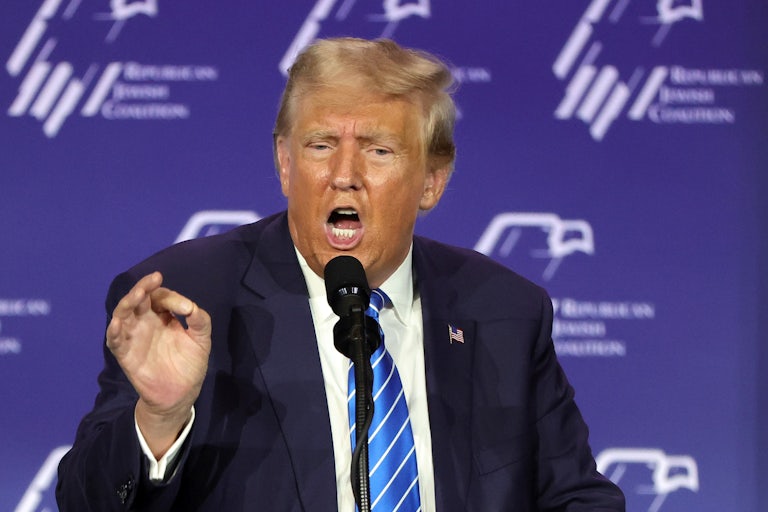
Donald Trump bragged during a campaign speech about threatening to abandon U.S. allies, even if Russia attacked one of them.

Trump appeared in Sioux City, Iowa, on Sunday. During his speech, he made a series of bizarre comments, including mistaking the city for Sioux Falls, South Dakota, and pronouncing Canada as “Canya.”

But he notably also said he had threatened to withhold U.S. military aid from NATO members unless they paid the bloc more. He said, at one point, he told member state leaders, “We’re not going to protect you any longer.”

“The head of a country stood up, said, ‘Does that mean if Russia attacks my country, you will not be there?’ That’s right, that’s what it means,” Trump said to applause. “I will not protect you.”

“And the money came!”

Trump’s refusal to step in even in the case of a Russian attack is notable considering how much he loves Russia’s leader, Vladimir Putin. Trump and Putin enjoy a particularly cozy relationship, and Trump has repeatedly praised the Russian president.

Given the fact that Republican support for the war in Ukraine is on the wane, Putin must be overjoyed that the party’s presidential front-runner is actively advocating letting Russia attack whichever countries it wants.

Trump falsely claimed throughout his presidency that the other NATO members had failed to make sufficient contributions to the alliance. In 2018, he accused other countries of owing the U.S. “a tremendous amount of money from many years back, where they’re delinquent as far as I’m concerned.”

He also threatened to withdraw the U.S. from NATO over the other countries’ supposed unpaid dues. But in reality, the U.S. has never been shortchanged by NATO allies.

“There is no ledger that maintains accounts of what countries pay and owe,” Aaron O’Connell, a former Obama administration National Security Council staffer, told NPR in 2018. “NATO is not like a club with annual membership fees.”

That fact hasn’t stopped Trump from resurrecting his NATO falsehoods during his current campaign. Trump also bragged about his threat to abandon NATO allies to Russian attacks during an early October campaign stop in Waterloo, Iowa.

With this UAW Win, the PATCO-Reagan Anti-Union Era Is Over

The UAW has secured a massive victory in deals with the three big auto companies. And in the process, it has ushered in a brand new era for unions.

UAW Strike
Jim Vondruska/Getty Images

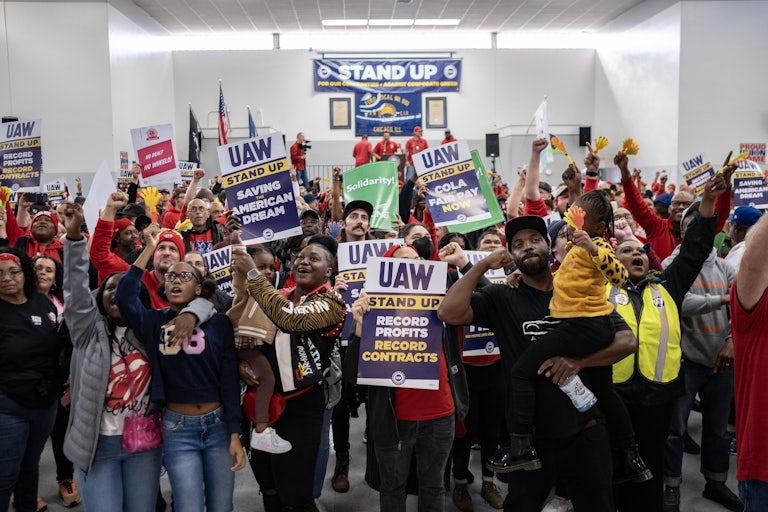
The United Auto Workers have officially landed big wins at the Big Three.

The union reached a tentative deal with General Motors on Monday, less than 48 hours after the autoworkers union ramped up its strike at the Spring Hill Assembly plant, the company’s largest manufacturing plant in North America.

As a result, General Motors employees will receive some of their biggest gains in decades, with a 25 percent pay bump in base wages over four and a half years, reported The Washington Post. The other terms of the deal are not yet known.

“I think it’s great,” President Joe Biden told reporters as he boarded Air Force One on Monday. The Biden administration had become increasingly involved in the negotiations as the six-week strike wore on, even grabbing a bullhorn at one GM strike in September to tell workers to “stick with it,” reported the Associated Press.

The fruits of the collective agreement are a sign that the anti-union era sparked more than 40 years ago is over. In 1981, the Reagan administration crushed a Professional Air Traffic Controllers Organization, or PATCO, strike, firing federal employees who refused to return to work and turning the tide against American labor relations for decades to come.

The deal is the third big win for the union in the last week. On Wednesday, UAW negotiated a historic arrangement with Ford that would increase salaries by 25 percent over five years and bring back major benefits lost during the Great Recession. Then, on Saturday, Jeep manufacturer Stellantis also gave in and offered a similar deal.

Altogether, nearly 50,000 employees out of 150,000 union members picketed the Big Three in a series of walkouts that started September 15.

UAW President Shawn Fain used an escalating bargaining strategy to achieve the contracts, keeping a reserve of employees at work while peeling some out as the weeks grew. For the first time, the union negotiated with all three auto companies simultaneously, leveraging the threat of walkouts at major auto plants to create a bidding war between the manufacturers. Then, when talks stalled, Fain expanded the strike.

As a part of the agreement, workers will return to their jobs while the union organizes ratification votes, according to Reuters. That process is expected to take a week or more, though if workers reject the arrangement the strike will go on.

Days After Maine Shooting, NRA Gleefully Shares Ad With New House Speaker

The gun rights lobbying group is bragging about its close relationship with Mike Johnson in a newly resurfaced video.

Mike Johnson
Drew Angerer/Getty Images

The National Rifle Association posted an old video of Mike Johnson opposing gun safety measures, essentially bragging about how it has the new House speaker in its pocket.

The NRA’s Sunday night tweet was also just a few days after a gunman killed 18 people in Maine, the biggest mass shooting in the state’s history and the country’s deadliest mass shooting of the year thus far.

In the 2019 video, Johnson—who is an NRA member—says that gun ownership is one of Americans’ “fundamental freedoms” and accuses Democrats of infringing on basic rights by trying to pass gun safety regulations.

“As NRA members, we understand the Second Amendment is grounded in fundamental freedoms,” Johnson says. “We make the point on the Hill all the time when these gun bills come up and when Democrats are trying to push their agenda on the people. We remind them that the Second Amendment is grounded in those fundamental freedoms―those inalienable rights that we have to personal liberty and personal security and private property.”

The NRA’s boastful tweet came at the tail end of a weekend that saw 12 different mass shootings, according to the Gun Violence Archive. The nonprofit defines a mass shooting as an attack when at least four people are injured or killed, excluding the shooter.

Between Friday and Sunday, shooters opened fire in Indianapolis, Chicago, Atlanta, and Tampa, as well as cities in Texas, Kansas, Maryland, New Mexico, Ohio, and Johnson’s home state of Louisiana.

Last week, the state of Maine waited in terror during a two-day hunt for a man who killed 18 people and wounded 13 more in the town of Lewiston. Authorities found the shooter’s body in a trailer on Friday. He appeared to have shot himself.

There have been 580 mass shootings in 2023 so far, which averages to about two mass shootings per day. These attacks have resulted in 616 people killed, 2,426 people injured, and countless people traumatized.

But according to Johnson, “at the end of the day, the problem is the human heart.”

“It’s not the guns, it’s not the weapons,” he insisted on Fox News a day after the Maine shooting.