Breaking News
Breaking News
from Washington and beyond

Ford Hikes Car Prices Thanks to Trump’s Reckless Tariffs

Consumers are already seeing the costs of Trump’s trade war.

Ford cars in a parking lot
FREDERIC J. BROWN/AFP/Getty Images

Ford is jacking up the cost of its foreign-made cars, including what’s known as America’s most affordable pickup, amid Donald Trump’s disastrous auto tariffs.

Just days after the company said it didn’t expect auto prices to increase this year, a memo sent to Ford’s dealerships revealed it would hike prices on three of its Mexican-made models, Reuters first reported. The suggested retail price is expected to increase anywhere between $600 to $2,000 per car beginning May 2 and would hit the Maverick, known as the most affordable pickup truck in the country.

“This is our usual mid-year pricing actions combined with some tariffs we are facing,” Ford spokesman Said Deep told CNN. “We have not passed on the full cost of tariffs to our customers. Our approach throughout this evolving situation continues to be doing what’s right for our customers—and our business.”

Last month, the Trump administration imposed a 25 percent tariff on imported vehicles and auto parts, a devastating blow to car manufacturers who have long freely imported cars and parts without fee.

Economists estimate this will lead to imported vehicles facing tariffs ranging from $2,000 to $15,000 per vehicle, which will ultimately raise car prices for consumers. Auto dealers are already seeing a dwindling supply of available cars to sell.

On Monday, Ford said Trump’s tariffs were likely to drop the company’s profits for the year by about $1.5 billion, but that it is “well positioned to adapt to the changes tariffs are driving” in the industry. The majority of Ford’s cars are manufactured in the U.S., so it likely won’t be hit as hard by Trump’s tariffs as other manufacturers. Still, the three models it makes in Mexico—the Ford Mustang Mach-E, the Maverick, and the Bronco Sport—are already going up in price.

The auto industry has been relatively supportive of Trump’s tariff scheme, and manufacturers have been slow to peg price increases to the president’s economic policies. But now not even Ford, the pride and joy of the American auto industry, can keep up the facade.
Trump’s Birthday Parade to Cost Eyewatering Amount—and Could Get Worse

The price tag for Donald Trump’s birthday parade keeps going up.

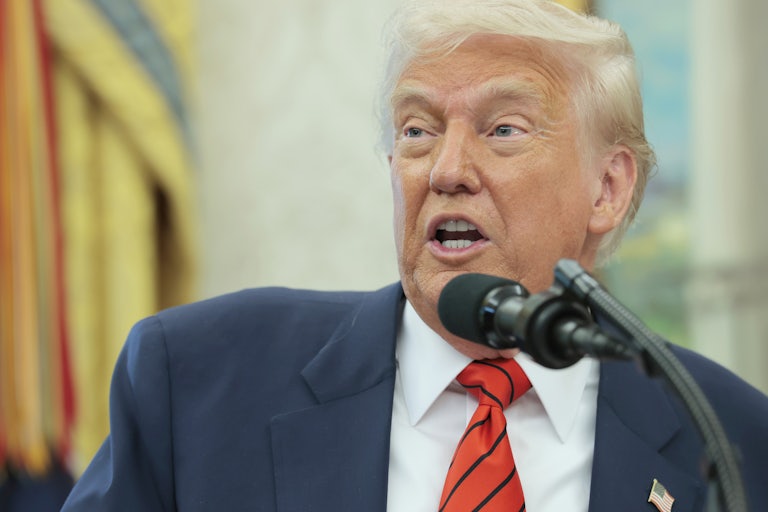
Donald Trump speaks into a microphone in the Oval Office
Samuel Corum/Sipa/Bloomberg/Getty Images

Donald Trump is planning to pay $45 million to roll tanks down the streets of Washington, D.C., on his birthday.

It was only a few months ago that the president signed an executive order creating a program to “beautify Washington D.C.” Now he’s plotting to transform his expensive birthday parade into a demolition derby that will cause serious damage to the roads that line the nation’s capital.

Jennifer Griffin, Fox News’s chief national security correspondent, wrote on X Wednesday that the newest batch of plans for a military parade to mark the Army’s 250th anniversary—which also happens to fall on Flag Day, Trump’s birthday—will feature 90 heavy vehicles.

This would include tanks, infantry fighting vehicles, and heavy artillery weaponry. Griffin reported there would be 10 tanks and 10 Howitzers.

The first time Trump pitched the idea of throwing a massive military parade in his honor was in 2018. At the time, plans to include tanks were ultimately scrapped over concerns they would damage the roads. A Pentagon planning memo said that the procession would “include wheeled vehicles only, no tanks” because “consideration must be given to minimize damage to local infrastructure.”

This time around, it seems similar considerations to preserve local infrastructure have been skipped.

During an interview on NBC News’s Meet the Press Sunday, Trump said the hefty $45 million price tag was “peanuts compared to the value of doing it.” U.S. defense planners said that the price would fall somewhere between $25 million and $45 million, according to Griffin.

Those numbers should be questionable, however. In 2018, the estimated price tag of Trump’s parade was roughly $92 million. Imagining that these plans include many of the same features as the ones from seven years ago, inflation would put the price tag closer to $117 million.

Whatever the price may be, it will fall squarely on the Army, with the cost being divided between units. Meanwhile, the Trump administration has ordered major cost-cutting measures in the military. Defense Secretary Pete Hegseth called Monday for a 20 percent reduction in the number of four-star generals and general officers in the National Guard and a 10 percent reduction in general and flag officers.

“Through these measures, we will uphold our position as the most lethal fighting force in the world, achieving peace through strength and ensuring greater efficiency, innovation, and preparedness for any challenge that lies ahead,” Hegseth stated in a memo.

It’s no secret that Trump has hated Washington for years—but that doesn’t mean he should be allowed to destroy it for a vanity project. A “No Kings Day” protest is already being planned to combat the parade.

Devastating New Poll Shows Trump Has Lost Key Support Groups

Donald Trump is losing the very people who helped him get elected.

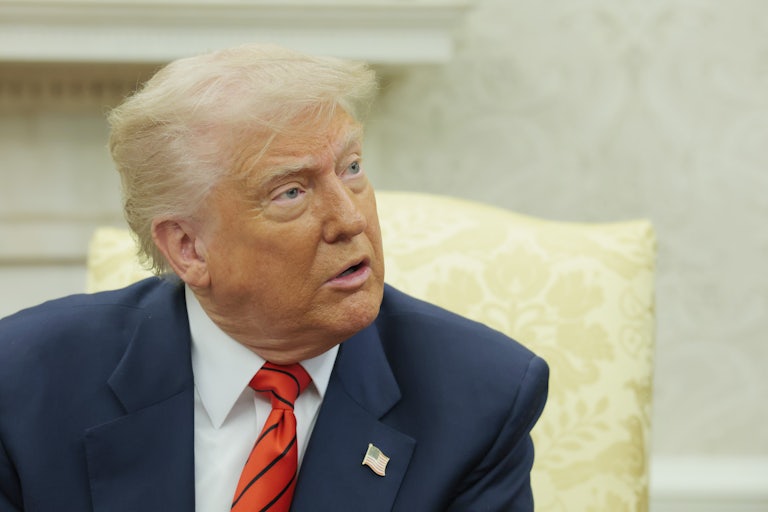
Donald Trump looks up while sitting in the Oval Office
Anna Moneymaker/Getty Images

The numbers are in, and they don’t look good for the president.

The Cook Political Report observed Wednesday that Donald Trump’s  poll numbers are in a slump with key groups that helped him win in November, including young voters, Latinos, and independents.

Cook’s newly launched poll tracker found that Trump’s net job-approval rating had plummeted just since April 15, dropping by seven points from -3.9 percent to -10.7 percent. The most dramatic shifts were witnessed in the aforementioned groups: For 18- to 29-year-old voters, Trump’s approval dropped by -11.8 points. The president lost Latinos by 10.4 points, and independents soured on Trump by 7.9 points.

“It’s worth noting that even significant slumps in the president’s popularity don’t directly translate into shifts in downballot vote choice, particularly in a deeply polarized climate,” the report read. “It’s no guarantee that most—or even many—Americans who ultimately sour on the current occupant of the White House will be driven into the arms of the Democratic Party come next November.”

Instead, those voters may be more likely to stay home—though that wouldn’t bode well for Republicans jockeying for other political positions downballot.

It’s just the latest in a string of sinking reactions to the president’s performance. An ABC News/Washington Post/Ipsos poll published last month found that Trump’s approval rating had plummeted to 39 percent—a 6 percent drop from February—marking the lowest first-100-day rating of a president since modern polling began roughly 80 years ago.

And an April report by the Conference Board found that its consumer confidence index had fallen by 7.9 points, bringing overall U.S. consumer confidence to 86 points. Consumer futures were brought to a 13-year low, with outlooks on the economy dropping by 12.5 points to 54.5 points—well below the threshold of 80 that “usually signals a recession ahead,” according to the Conference Board.

The root cause of the instability was “high financial market volatility in April,” which hit American consumers’ stock portfolios and retirement savings hard and fast, per the Conference Board’s report. That was almost singularly due to Trump’s machinations in the White House, which included releasing (and stalling) a sweeping and vindictive tariff proposal plan that economists observed (and the White House eventually confirmed) was founded on bad math.

Trump Dealt Massive Blow as Judge Blocks Executive Order on Libraries

Donald Trump’s executive order dismantled the federal agencies supporting libraries, museums, minority businesses, and mediation services.

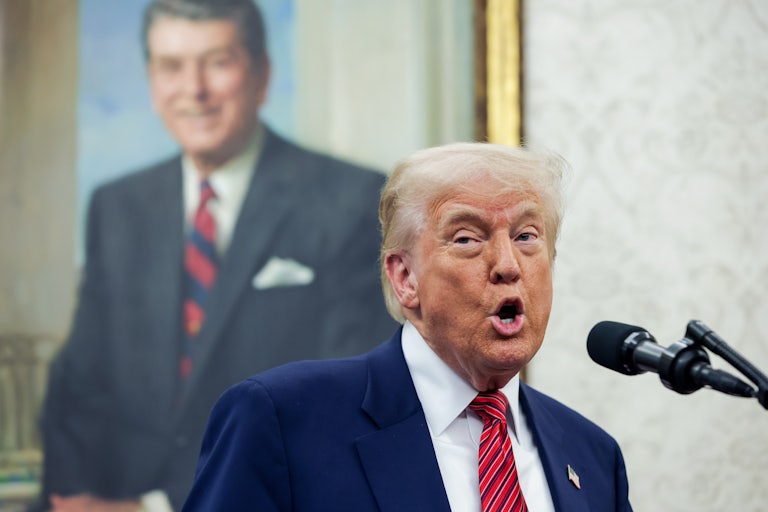
Donald Trump speaks into a microphone in the Oval Office
Anna Moneymaker/Getty Images

Three federal agencies on Donald Trump’s chopping block have been saved by a federal judge.

U.S. District Judge John McConnell Jr. sided with a 21-state coalition Tuesday, issuing a preliminary injunction to halt one of Trump’s executive orders dismantling federal agencies that support libraries, museums, minority businesses, and mediation services. They included the Institute of Museum and Library Services, or IMLS; the Minority Business Development Agency, MBDA; and the Federal Mediation and Conciliation Service, FMCS.

The March order also marked the end of four other agencies, including the United States Agency for Global Media, the Woodrow Wilson International Center for Scholars in the Smithsonian Institution, the United States Interagency Council on Homelessness, and the Community Development Financial Institutions Fund.

In a 49-page memorandum, McConnell wrote that Trump’s order blatantly ignored the separation of powers and violated the Administrative Procedure Act “in the arbitrary and capricious way it was carried out.”

“It also disregards the fundamental constitutional role of each of the branches of our federal government; specifically, it ignores the unshakable principles that Congress makes the law and appropriates funds, and the Executive implements the law Congress enacted and spends the funds Congress appropriated,” McConnell wrote.

The sweeping order translated to mass layoffs, grant freezes, and whopping reductions. Last week, another federal judge paused planned layoffs at the IMLS, responding to a related lawsuit brought by the American Library Association.

“The States have presented compelling evidence illustrating that the harms stemming from the dismantling of IMLS, MBDA, and FMCS are already unfolding or are certain to occur, in of light the significant reduction in personnel available and competent to administer these agencies’ funds and services and the elimination of certain programs that served the States,” McConnell noted.

DOGE Staffer Fired the Lawyers Trying to Help Him Avoid Corruption

Lawyers warned one of Elon Musk’s DOGE cronies that his investments were a conflict of interest. He fired them.

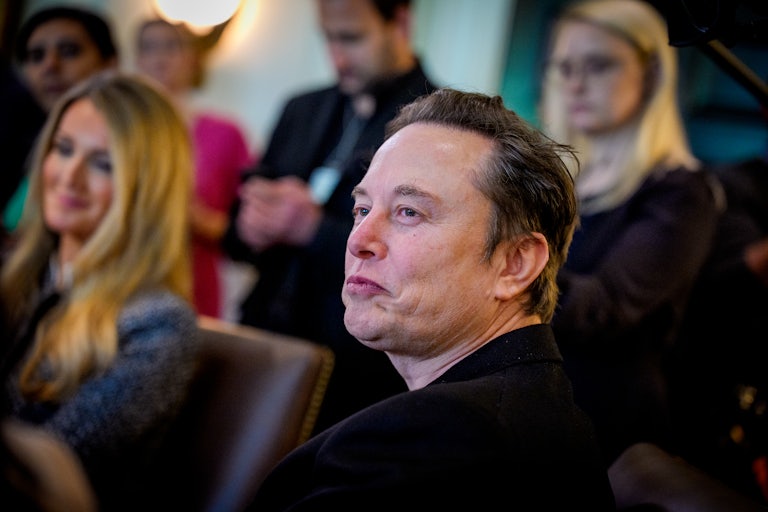
Elon Musk purses his lips while sitting in Donald Trump's Cabinet meeting
Andrew Harnik/Getty Images

A 25-year old DOGE bro oversaw the termination of lawyers at the Consumer Financial Protection Bureau last month, just days after they warned him certain stocks he owned were prohibited by employees, according to a Wednesday report by ProPublica.  

Gavin Kliger had been detailed to the CFPB in early March as part of DOGE’s efforts to take over and ultimately dismantle the ethics watchdog that oversees banks and manages vast troves of consumer data. 

But Kliger had committed a big no-no at the CFPB. His financial records indicated that he owned up to $365,000 in stock in companies that the CFPB was charged with regulating, including Tesla, which has been the subject of hundreds of consumer complaints. Kliger also owned stock in Apple and two cryptocurrencies, as well as additional companies on a “Prohibited Holdings” list, including Alphabet, Alibaba, and Berkshire Hathaway. In total, Kliger had made up to $715,000 in investments in seven barred companies. 

Kliger received an ethics notice on April 10, ProPublica reported. Shortly afterward, OMB Director Russell Vought moved forward with sweeping layoffs of federal employees, and sent Kliger and other DOGE officials an email with the subject line “CFPB RIF Work.” Another note sent to Kliger told him he’d been given access to the agency’s computer systems that “should allow you to do what you need to do.”

Kliger spent the next few days “screaming at people he did not believe were working fast enough” to disseminate termination notices, said one federal employee who used the pseudonym Alex Doe, in a sworn statement about the layoffs. On April 17, the termination notices went out, including to the ethics team, which had alerted Kliger to his prohibited investments. 

A White House spokesperson told ProPublica that Kliger “did not even manage” the layoffs, “making this entire narrative an outright lie.”

In April, the CFPB fired nearly 1,500 employees at DOGE’s direction, leaving only about 200 people employed there. The remaining workers have been forced to work around the clock to manage the transition, and they’ve begun including themselves in the layoffs.